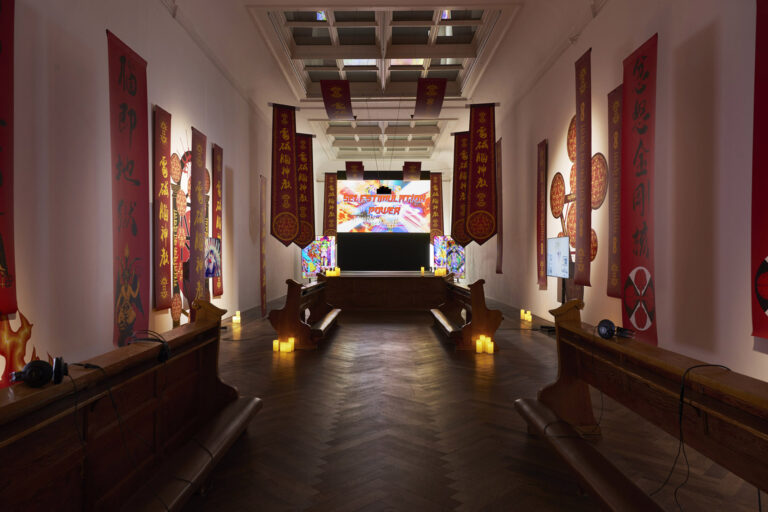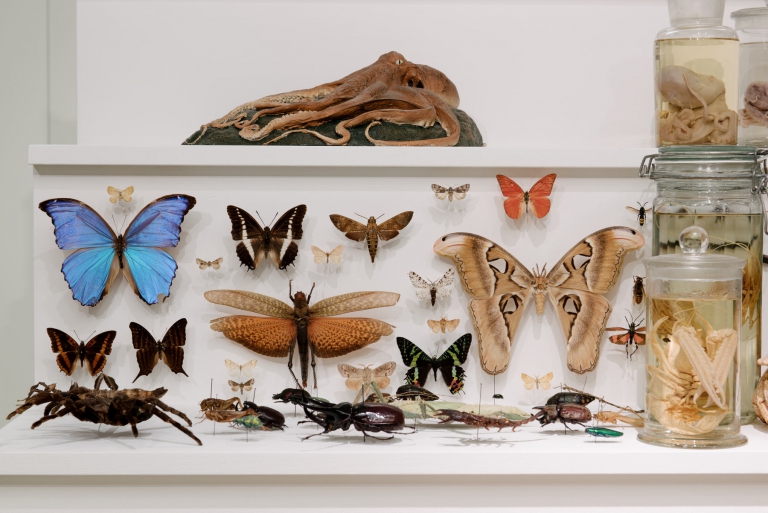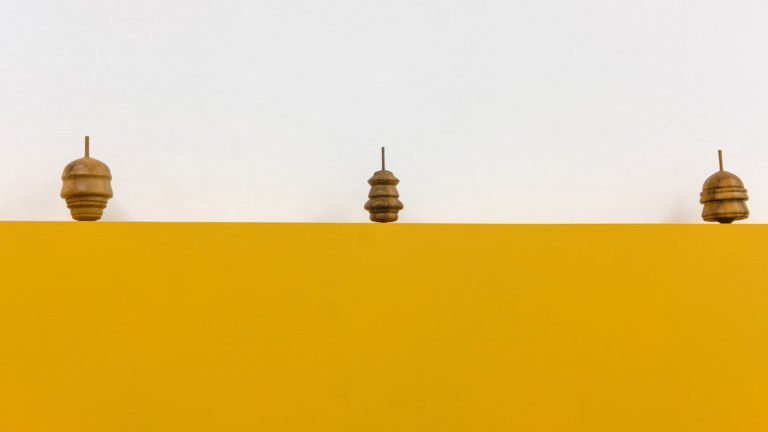
The project Towards an Affinity of Hammers is grounded in a concept formulated by Sara Ahmed: the idea that affinity—alliances, the act of holding together—is never given, but must be cultivated through the patient erosion of the systems that constrain lives.
Towards an Affinity of Hammers brings together an exhibition and a public programme composed of screening evenings and discussions, a roundtable, and a workshop in Lausanne and in Geneva. The exhibition at CALM – Centre d’Art La Meute gathers five artists—Lucas Erin, Jojo Gronostay, Belinda Kazeem-Kamiński, Monika Emmanuelle Kazi and Unyimeabasi Udoh—whose works explore forms of struggle, attention, and repair, not as heroic gestures but as persistent, subtle, sometimes quiet acts, always deeply situated. Echoing the curatorial text developed in the exhibition leaflet, the project considers “hammering” not as a spectacular breaking gesture but as a repeated, everyday action that shapes narratives, solidarities, and relationships.
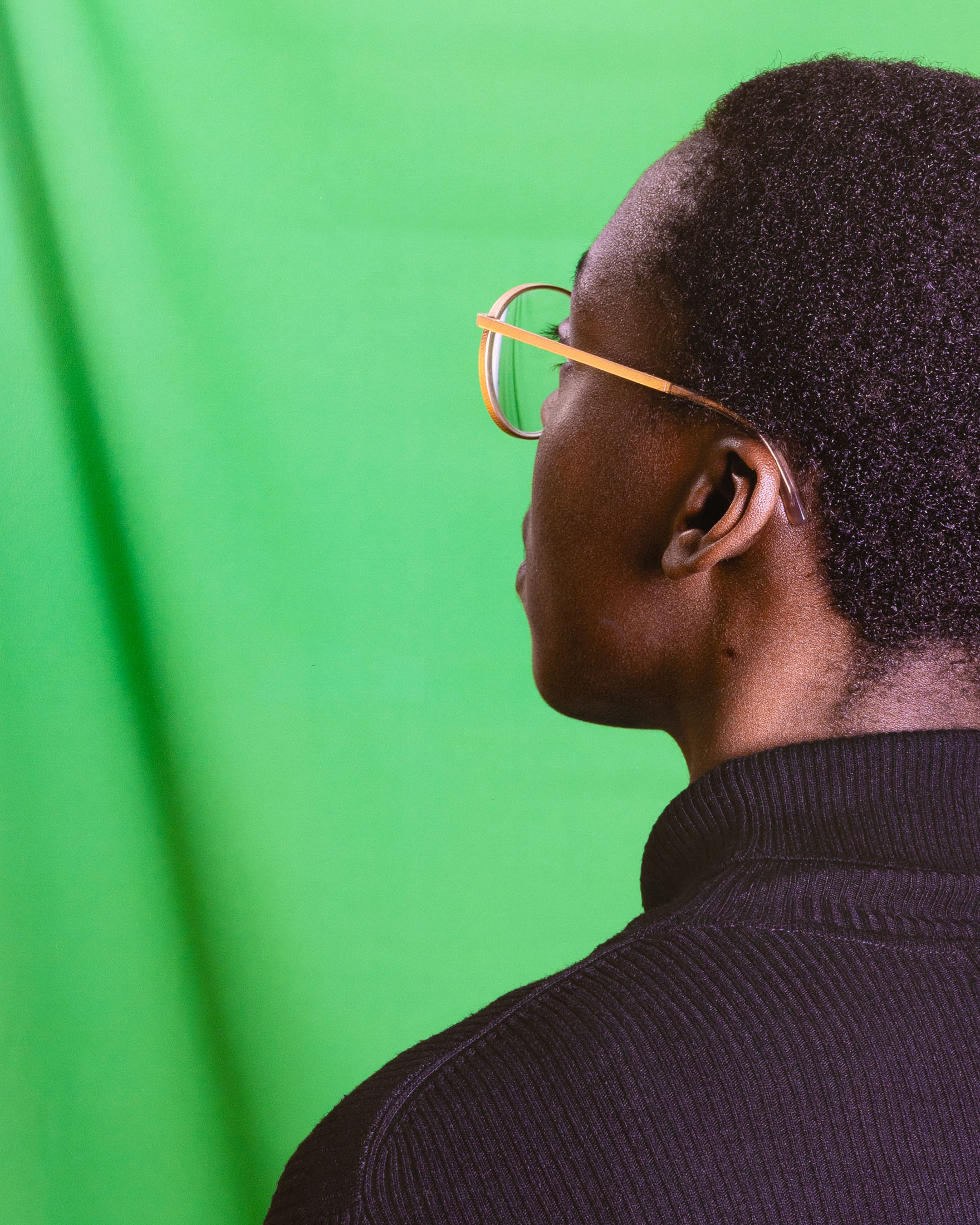
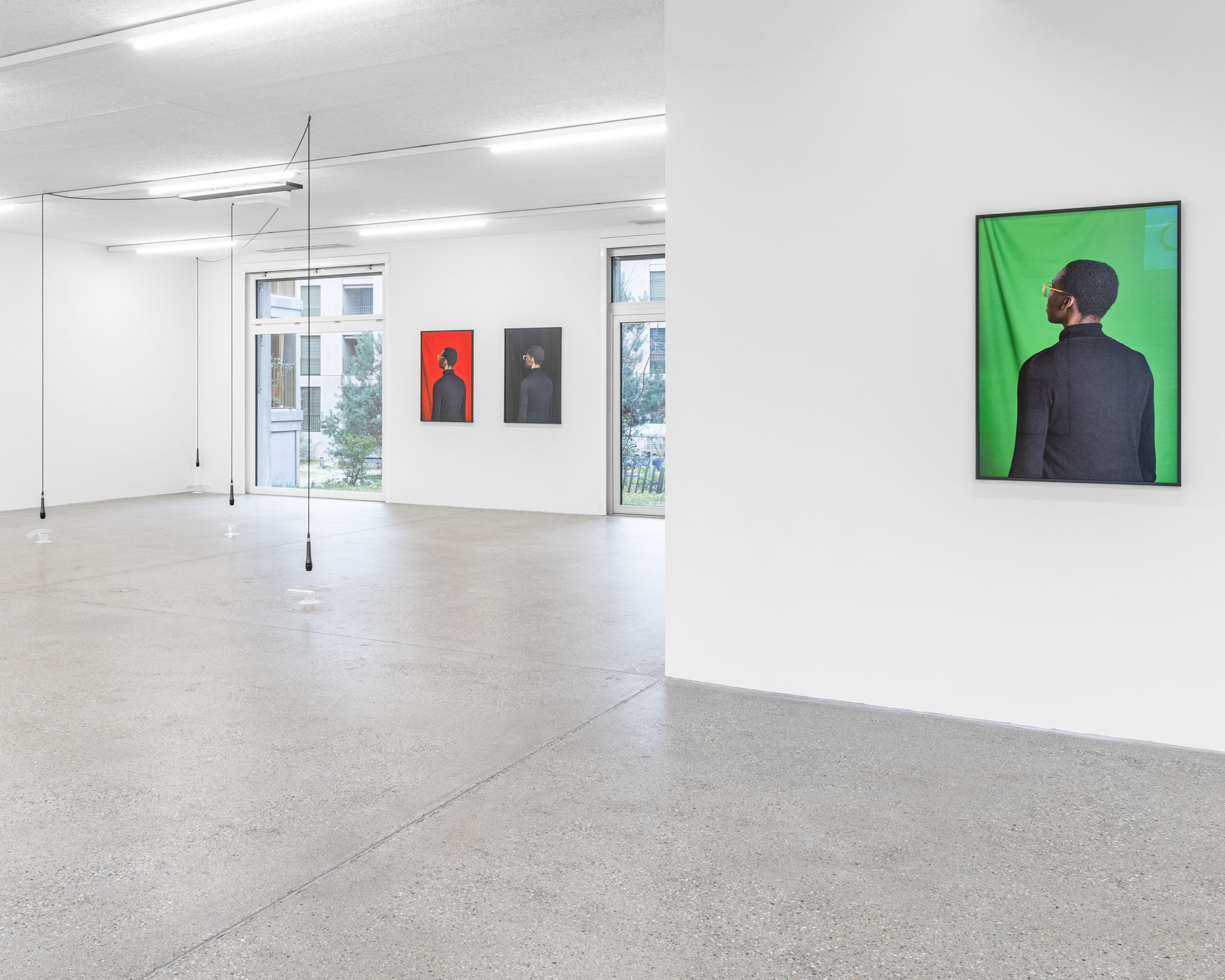
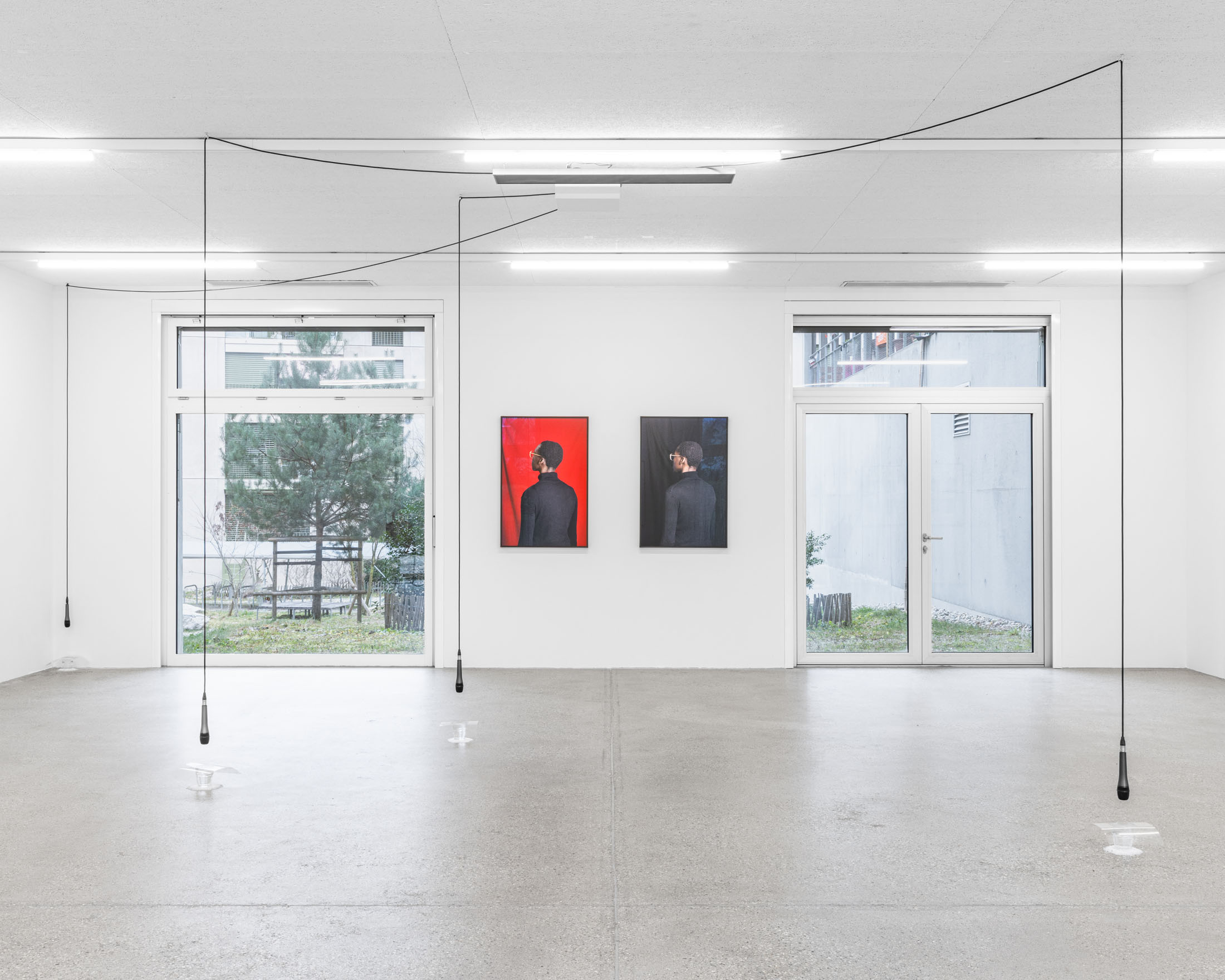
The works presented in the exhibition space include loans of existing pieces as well as new productions and works adapted specifically for the project. Entering from the Café du Loup, a first strong visual signal stands out against the white walls: the green background of the first photograph (from a series of three) by the Vienna-based artist Belinda Kazeem-Kamiński. The image shows a figure turned toward something invisible to the audience. Moving in the direction of this gaze reveals the other two photographs in the series—set against black and red backgrounds—on a wall further away. The three images, almost identical, activate the legacy of the Pan-African flag and the histories of Black emancipation struggles. Their combination may also evoke the Palestinian flag, reminding us that the struggles for freedom and self-determination for peoples remain unfinished. The upward orientation of the gaze, directed toward the horizon, expresses the hope generated through collective struggle.
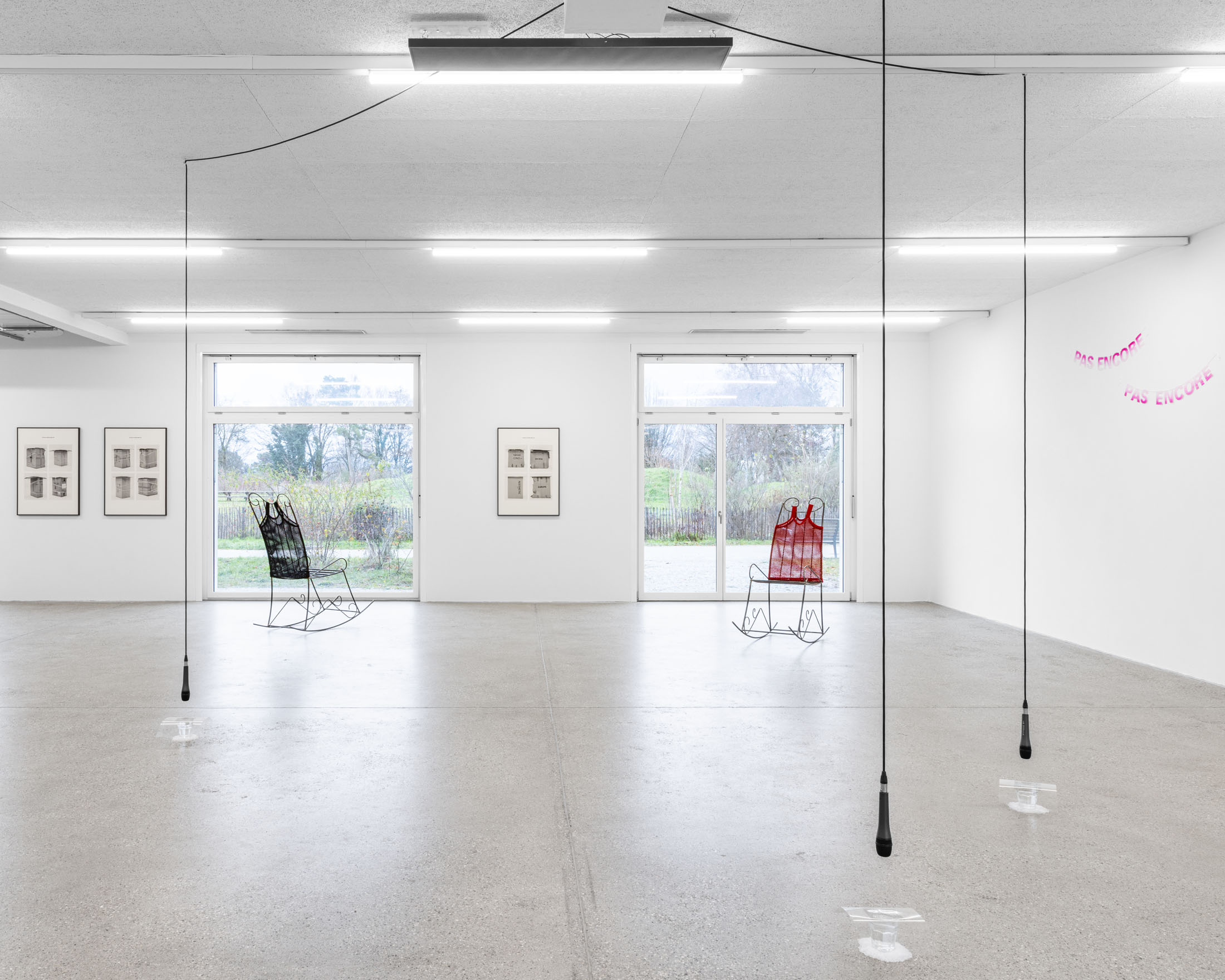
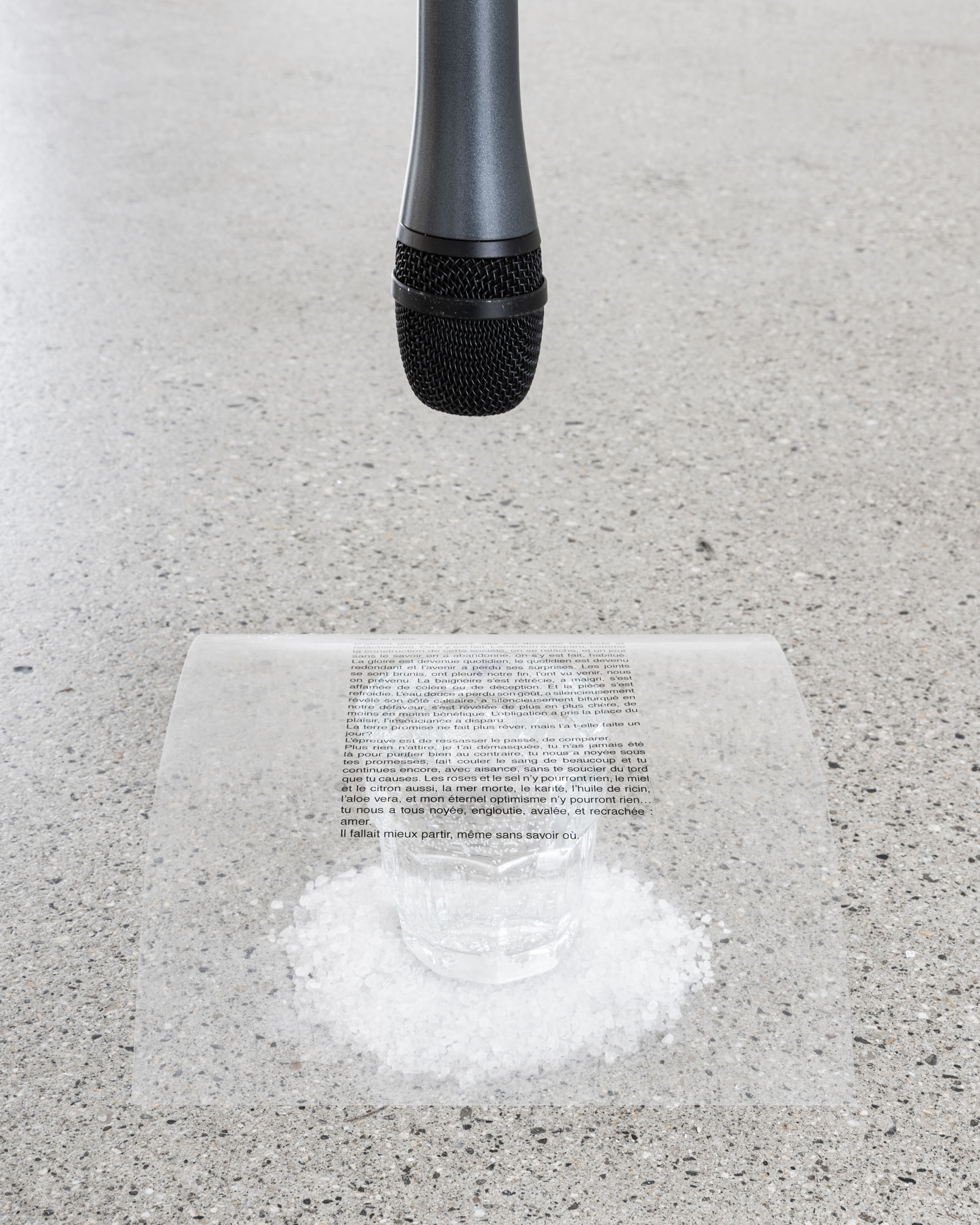
The repetition of a motif, a gesture, or a posture is central to the exhibition. Hammering, a key theme in Sara Ahmed’s essay, finds a direct echo in several works. Suspended from the ceiling, four wired microphones drop toward the floor like raindrops. In front of each microphone stands a glass filled to the brim with water, placed on a mound of coarse salt. Printed texts on acetate sheets are laid atop these glasses. In them, the Geneva-based artist Monika Emmanuelle Kazi recounts her story: her movements from the place of her childhood, Tchimbamba in Pointe-Noire, to Paris, Brussels, and finally to Champel in Geneva. The whole installation is enveloped by a sound piece titled Salé, a reworking by the artist of a song by Mbilia Bel, played by shower speaker. Symbolically and metaphorically, water irrigates Kazi’s thoughts and displacements between Africa and Europe, as well as her reflections on the forms of pouring-over and displacement generated by contemporary societies.
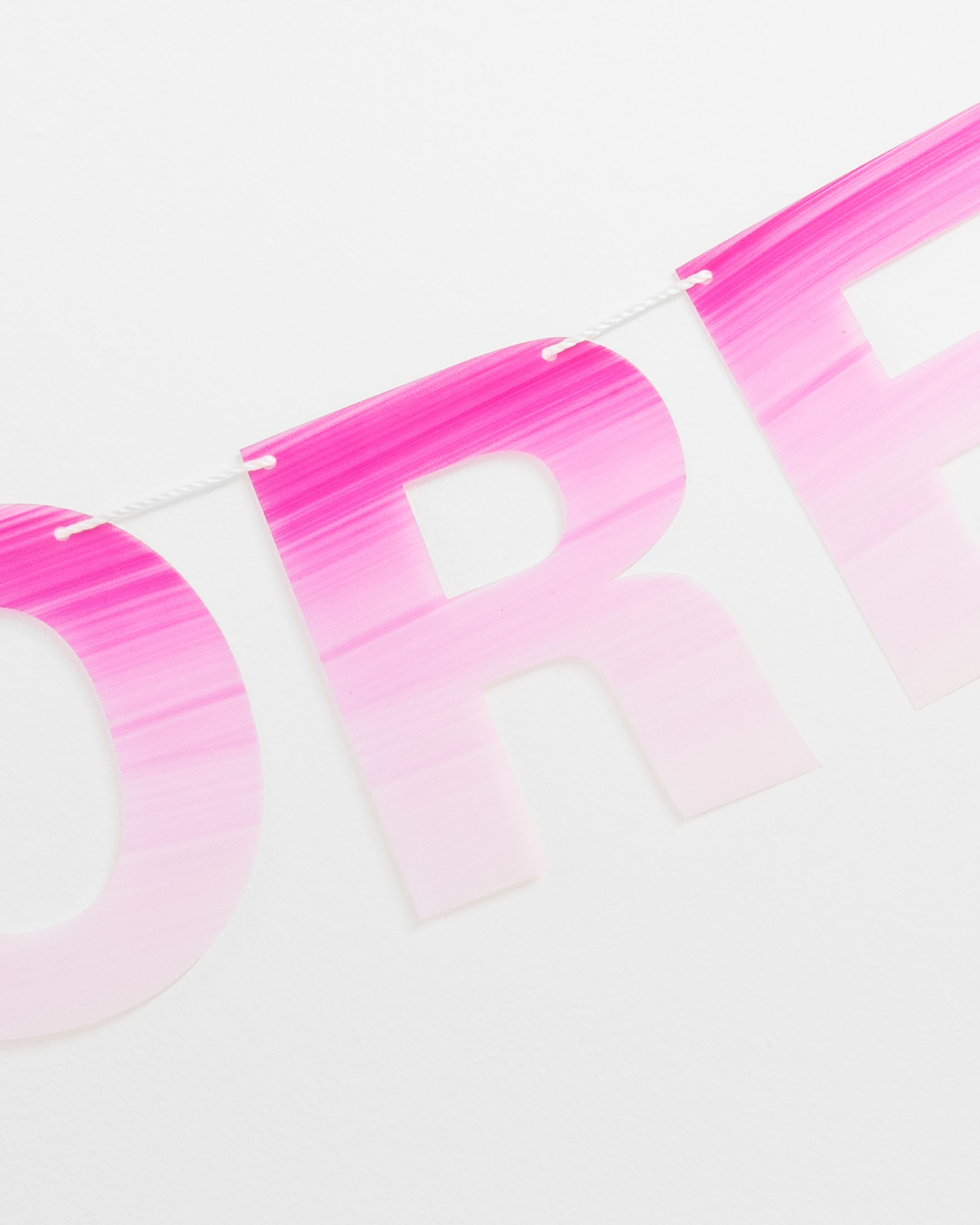
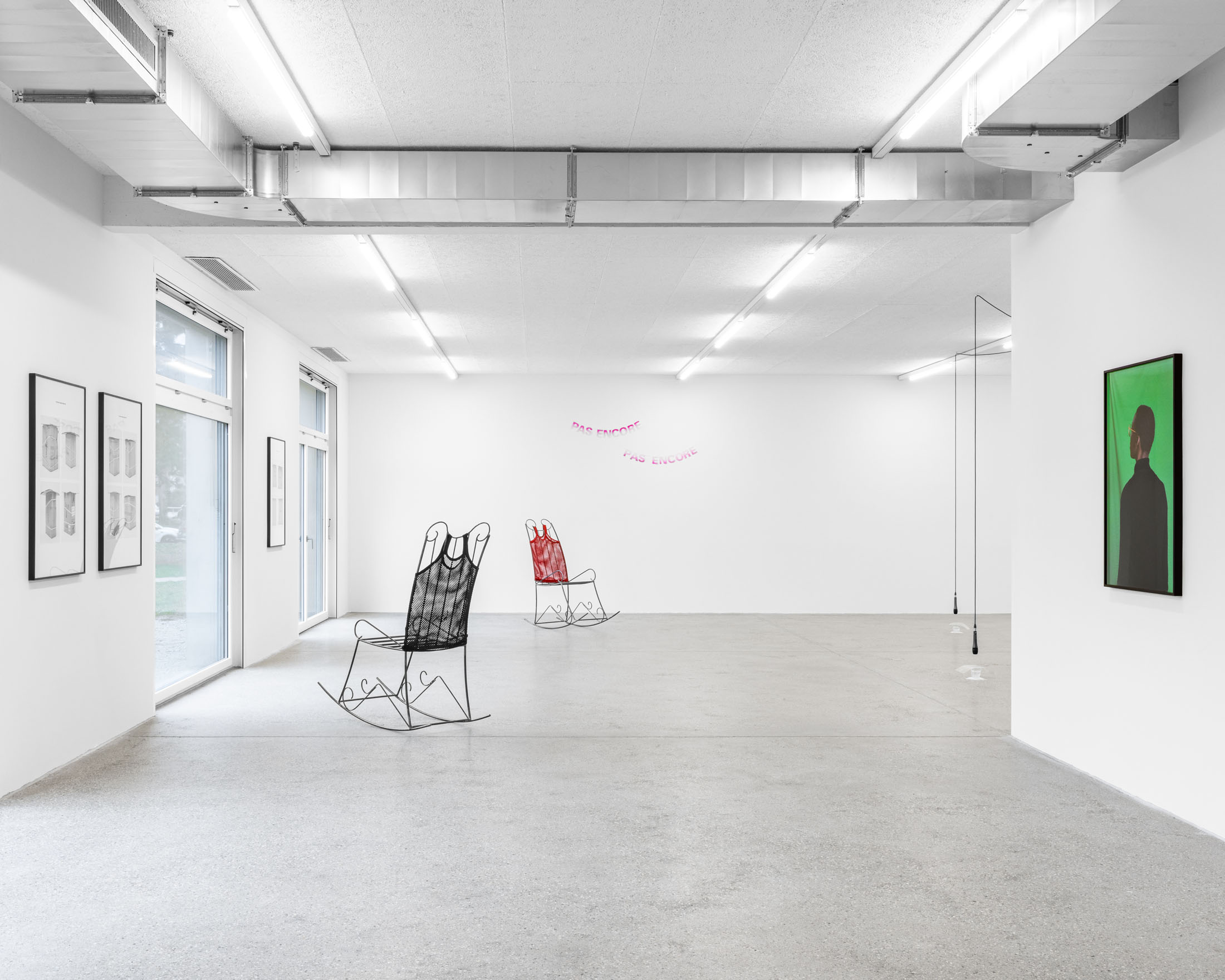
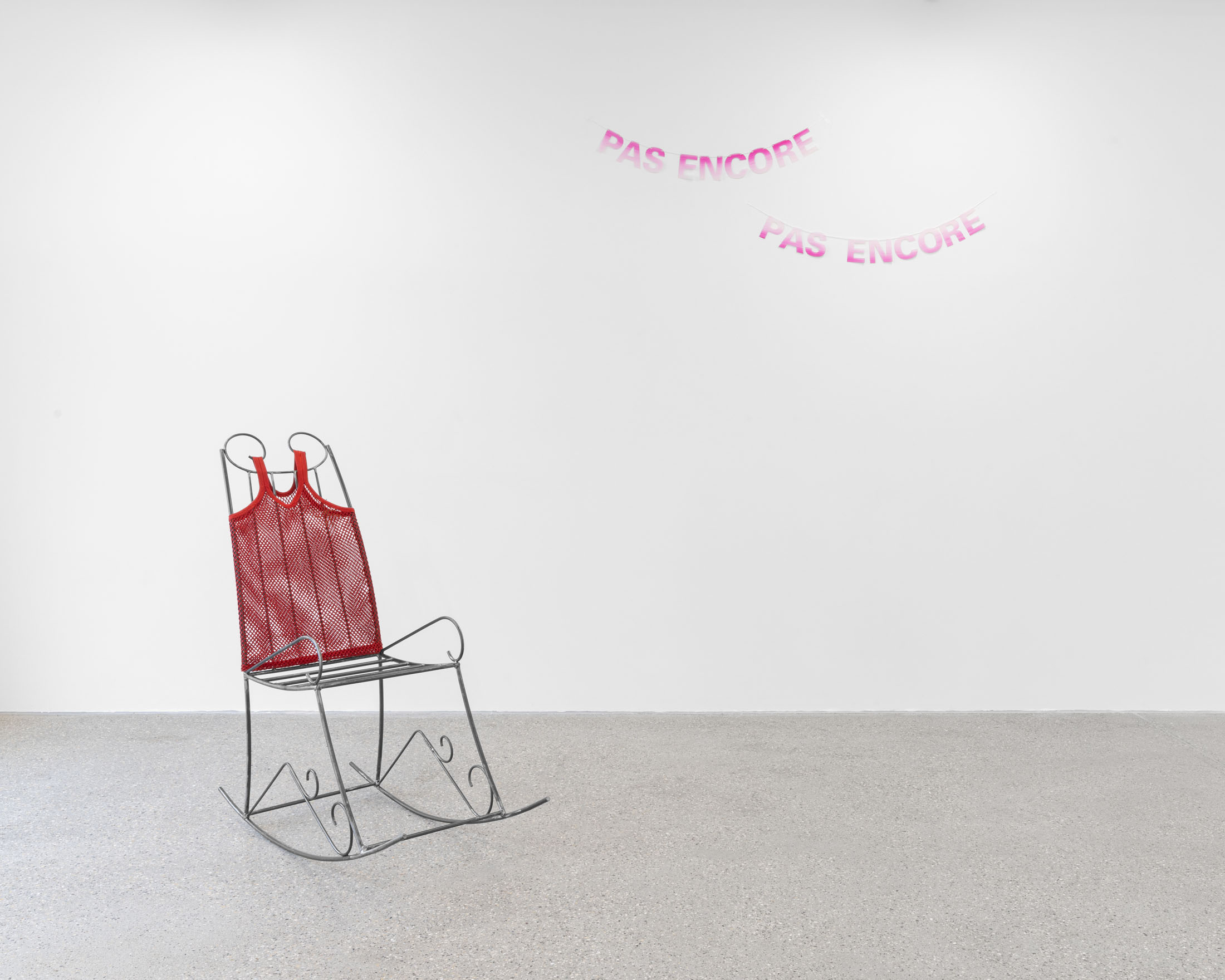
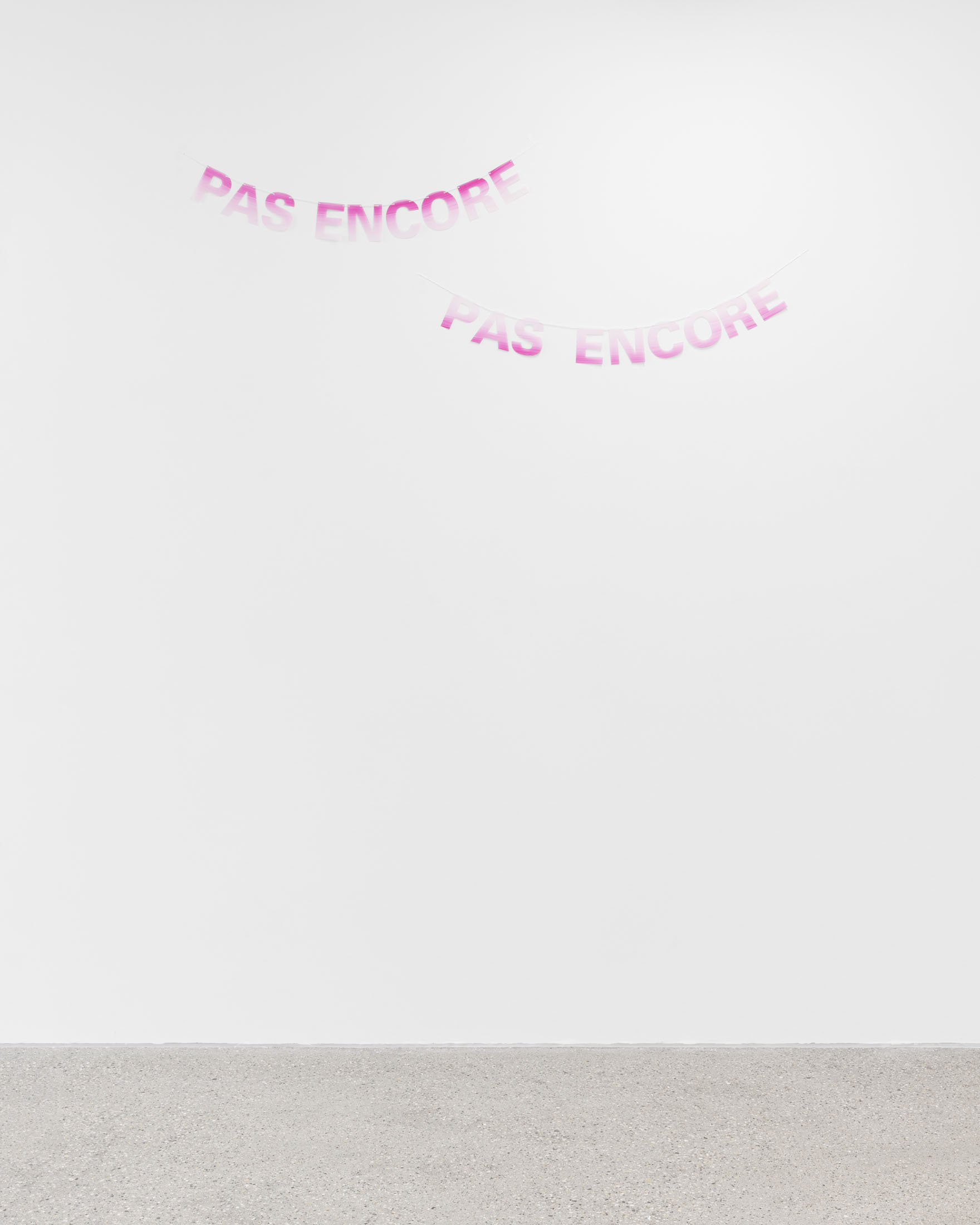
Stepping out of this immersion, the viewer’s gaze falls upon words: two expressions in french articulating the same negation, ‘pas encore’ [not yet] Unyimeabasi Udoh, a Nigerian-American artist based in London, maintains through their father an emotional and research-oriented connection to the French language. The artist is interested in linguistic effects and double-entendre expressions that maintain an ambiguous relationship to hope and expectation. Produced specifically for Towards an Affinity of Hammers, this work adopts the aesthetic of festive garlands used for family celebrations such as birthdays, births, or New Year’s gatherings. Yet here, the message is ambiguous. It signals a problem of temporality, refusing to situate itself in the present. The repetition may herald a joyful conclusion— or, conversely, an exhausted hope. Subtitled Futur antérieur [future perfect simple], the piece insists on the cynical dimension of our relationships with one another, particularly regarding class, gender, or cultural domination. The celebratory aesthetic amplifies both disappointment and the fragility of hope.
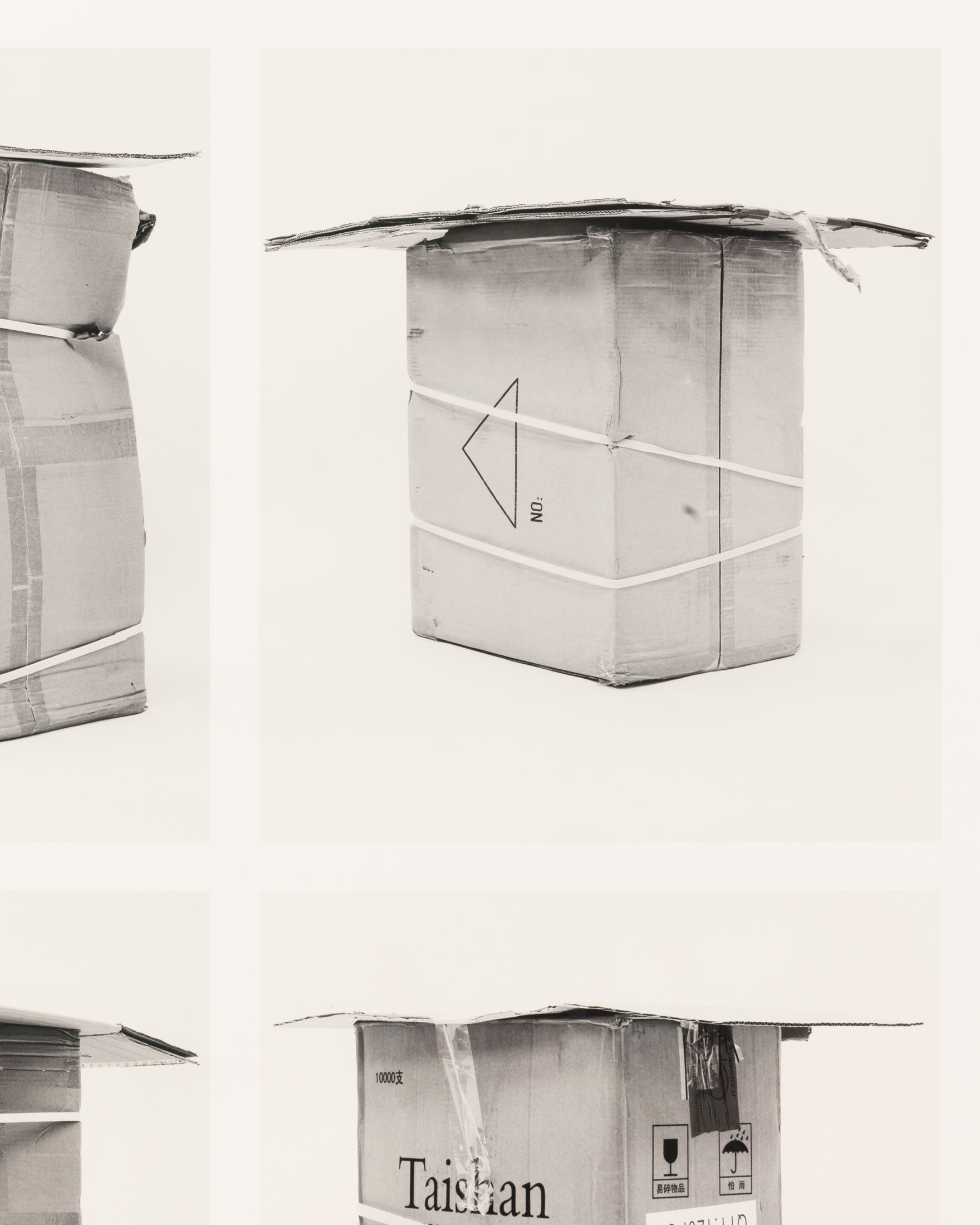
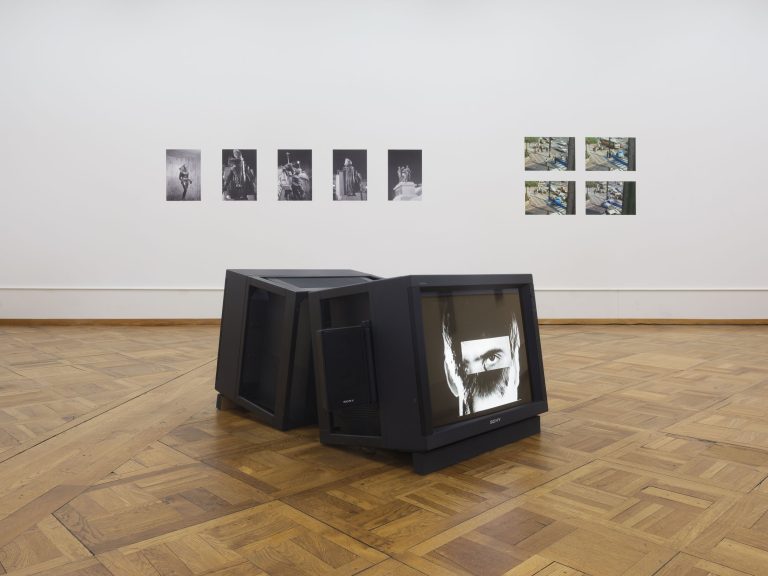
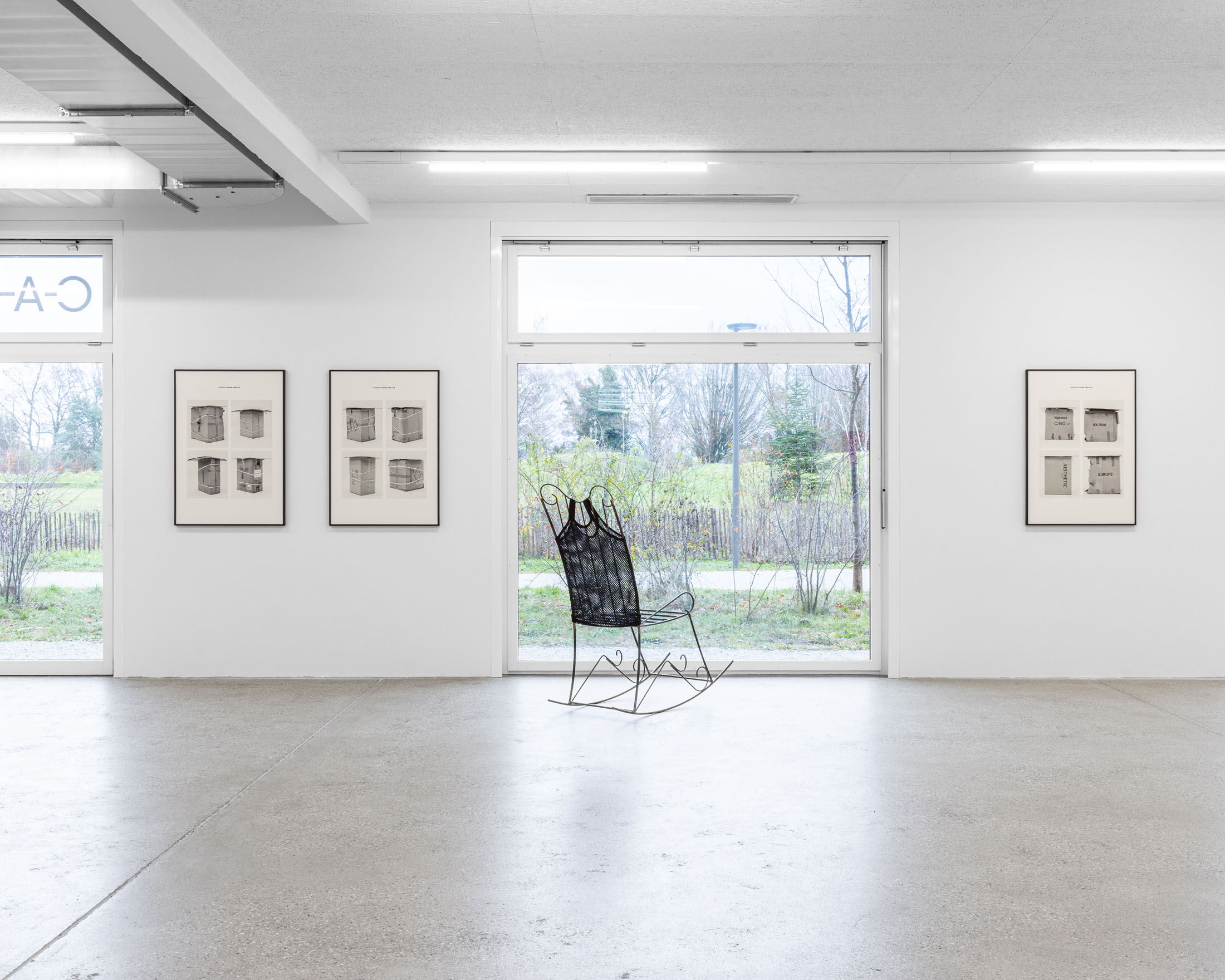
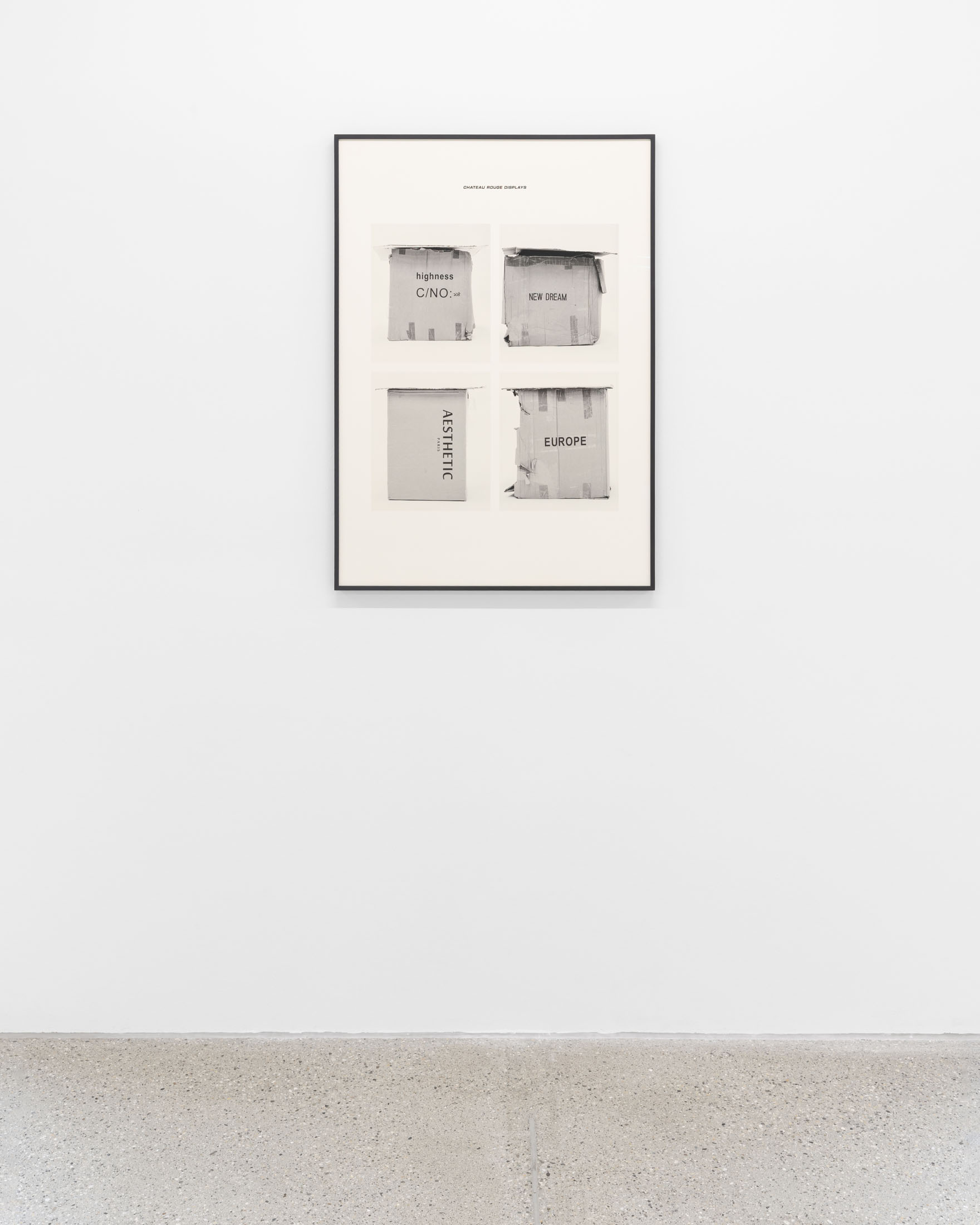
Continuing this thread, Jojo Gronostay, a German-Ghanaian artist based in Vienna, engages through photography with urban aesthetics and with the street vendors commonly referred to as ‘informal sellers’, due to lacking official authorisation. The persistence of systemic racism in Western countries with colonial histories has led to the multiplication and concentration of this survival economy in certain peripheral neighbourhoods. Chateau Rouge Displays draws its iconography from the Barbès–Château Rouge district in Paris’s 18th arrondissement. The photographed cardboard displays, sometimes held in place by strapping bands, are each fitted with an additional plate on top, functioning as a portable counter in these streets, increasingly nicknamed ‘Little Africa’ since the 1980s due to the significant presence of West African immigrant communities.
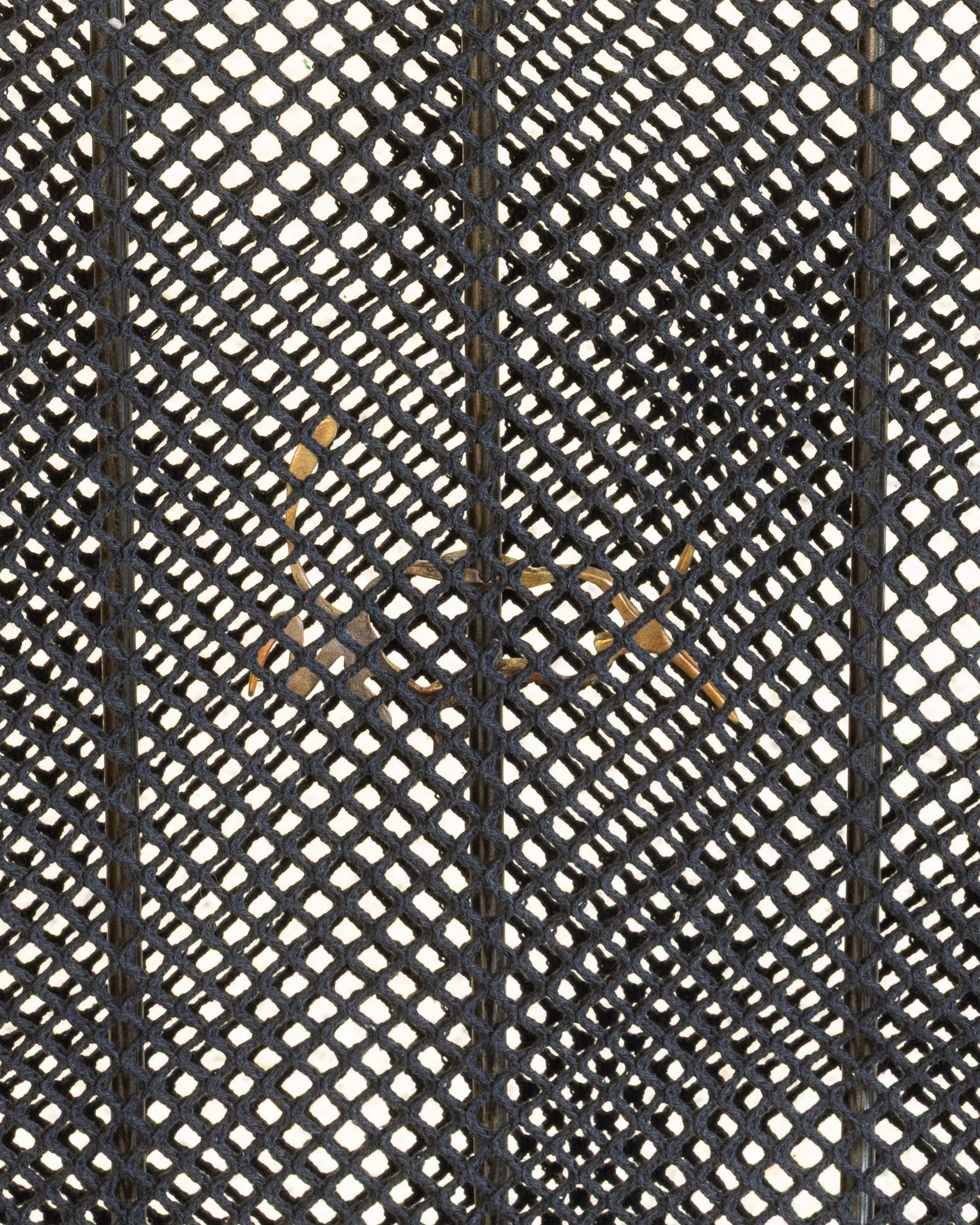
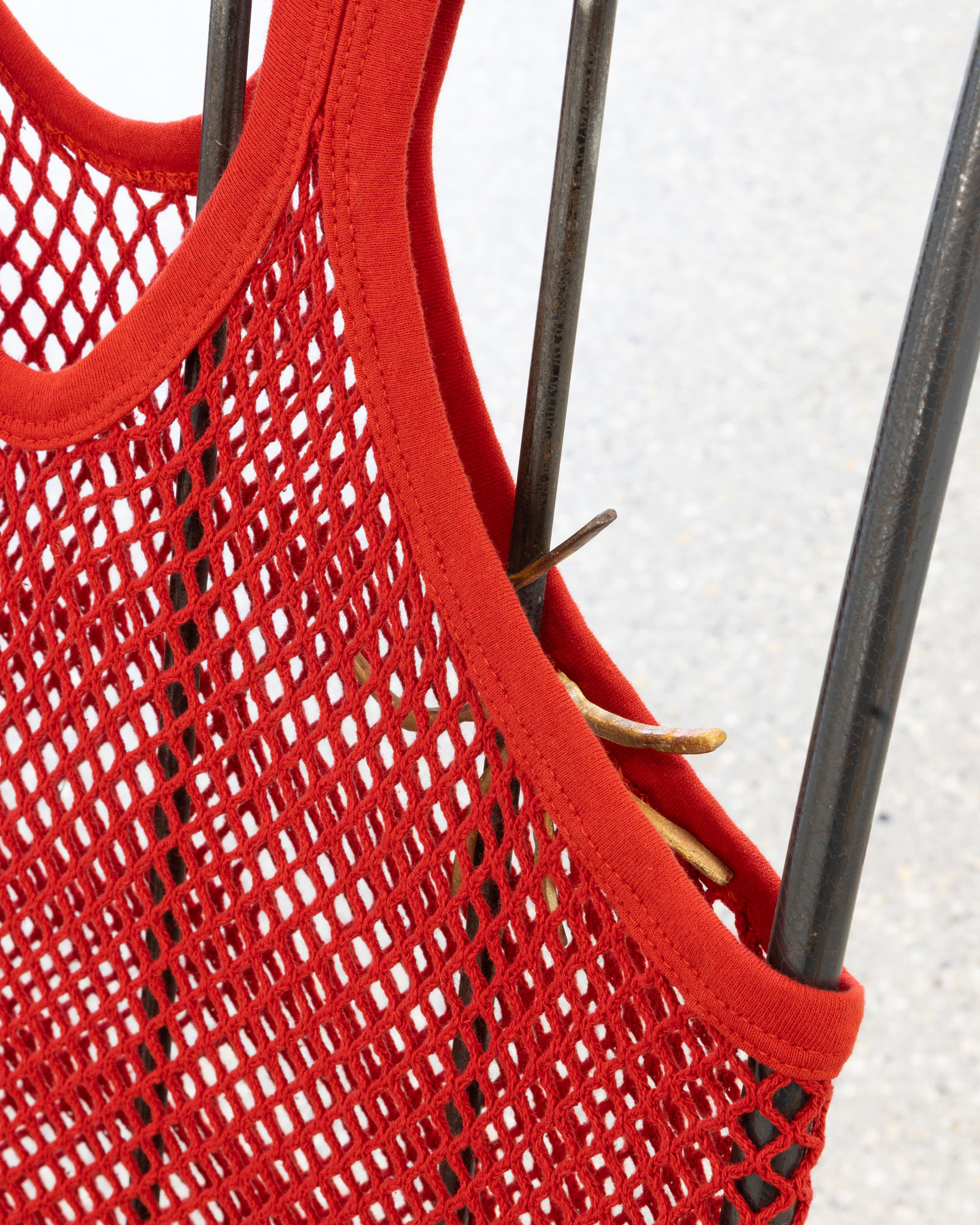
Finally, the gaze rests on the two rocking chairs created for the exhibition by Lausanne-based artist Lucas Erin. His work engages with colonial architectures—their forms and functions. The veranda in particular, as it embodies an ambivalent use and discourse from the seventeenth century to today. In Martinique, where the artist’s family originates, the veranda was used by French colonisers to oversee labour performed in the fields, since colonial homes were located on higher ground. Today, and since the development of modern Caribbean architecture, the veranda has evolved into a social space, a place of gathering and rest. It extends the domestic sphere, becoming an area for vigilance and observation. The architecture of CALM, recognisable by its large south-to-north windows spanning the eco-district, provided an ideal context for reconsidering these interior/exterior dynamics through the medium of exhibition-making. The red and black garments underline the semantic duality of the chairs; they follow the curves of the metallic structures, whose backrests are topped with bronze elements—two-metal alloy—whose sculpted forms recall flowers. Evoking the passage of time and perhaps frozen in a memorial action of rumination.
Towards an Affinity of Hammers raises aesthetic, social and political issues that fall outside the realm of the spectacular or the obvious. The project, and more specifically the exhibition, brings together practices that strongly question the way we look at an object, a subject, a situation, and the hierarchies, power struggles and frictions that narratives combine. Amidst the noise and energy of hammering, that is to say, an irrepressible need for insistence and persistence, we think ahead to all those who are yet to come and the lineages they will need to experience in order to endure the unbearable or to enlighten their lives.
–Théo-Mario Coppola and Oriane Emery & Jean-Rodolphe Petter
⁂
The performance R.u.in.es – XS version (2025) by Lausanne-based artist Léna Sophia Bagutti-Khennouf will be presented at the opening on 5 December 2025.
On 17 January 2026, an evening of screenings will take place at Cinéma Bellevaux (Lausanne), extending the exhibition into the medium of moving images, with videos and short films by Barbara Hammer, Taleb Lachheb, Isadora Neves Marques, Walid Raad, and Carole Roussopoulos (with Fatxiya Ali Aden and Sarah Osman).
On 30 January 2026, in the exceptional presence of Academy Award–winning New York filmmaker Elisabeth Subrin, Cinéma Spoutnik (Geneva) will host an evening of screenings and encounter around three of her short films made between 1997 and 2024.
⁂
Our work began in September 2024, when we first met Théo-Mario Coppola in Barcelona, Spain. Our individual and shared concerns shaped the beginning of a long-term dialogue and, through these exchanges, revealed a mutual desire to collaborate on a project deeply rooted in the most significant aspects of the present. Our collective approach incorporates the practices of recent decades, which have seen the emergence of strong artistic forms, methodologies, and viewpoints—often involving the mobilization of other disciplines, other forms of knowledge, as well as an awareness of others that is frequently shaped by activist movements or spontaneous engagement. Since Théo-Mario Coppola has worked extensively on the connections between aesthetics, social realities, and political theory, we chose to build our project around a text by Sara Ahmed, which became the conceptual grounding of our curatorial reflection. By resisting mere illustration or thematic framing, we sought more subtle, personal, and complex modes of expression. By affirming openness and dialogue as core priorities of our mandate at CALM, together with our colleagues, we aim to shape this space into a working tool that welcomes other ways of thinking and acting. Working alongside Théo-Mario Coppola allows us to extend this intention through a project that resonates with both our shared and individual practices that we wish grounded, committed, and rigorous.
2025 / Photo : Théo Dufloo / Courtesy of the artist / Curated by Théo-Mario Coppola and Oriane Emery & Jean-Rodolphe Petter