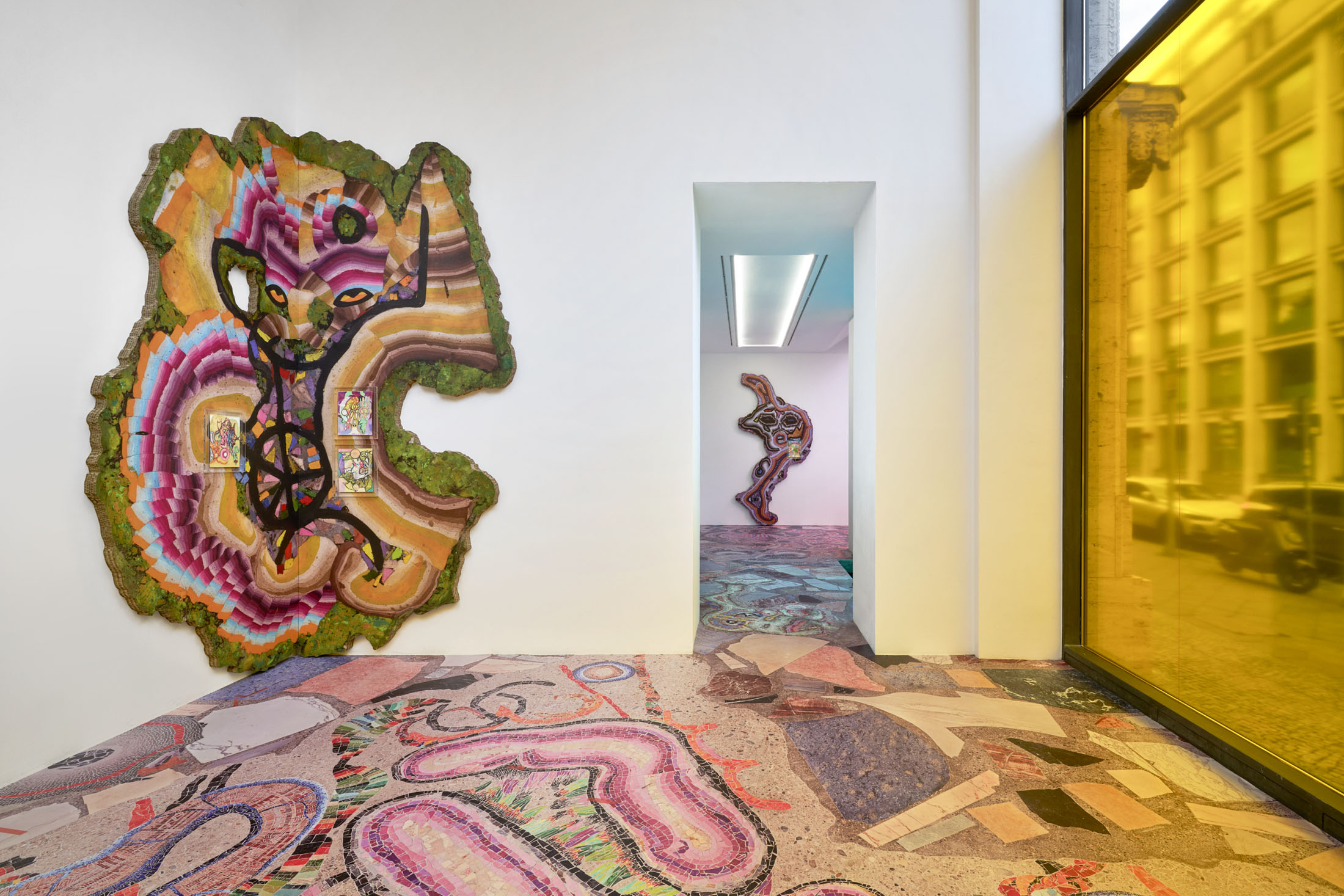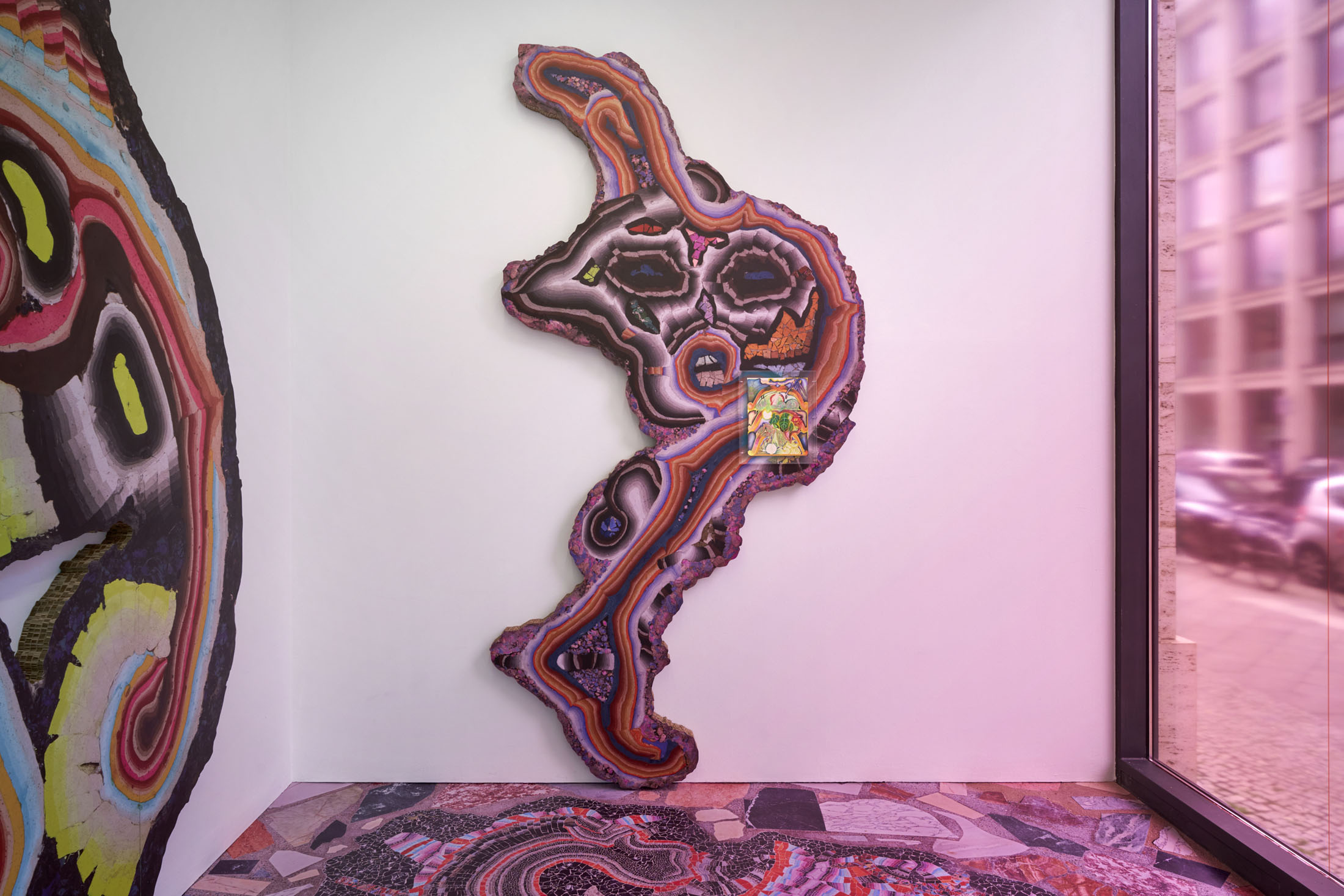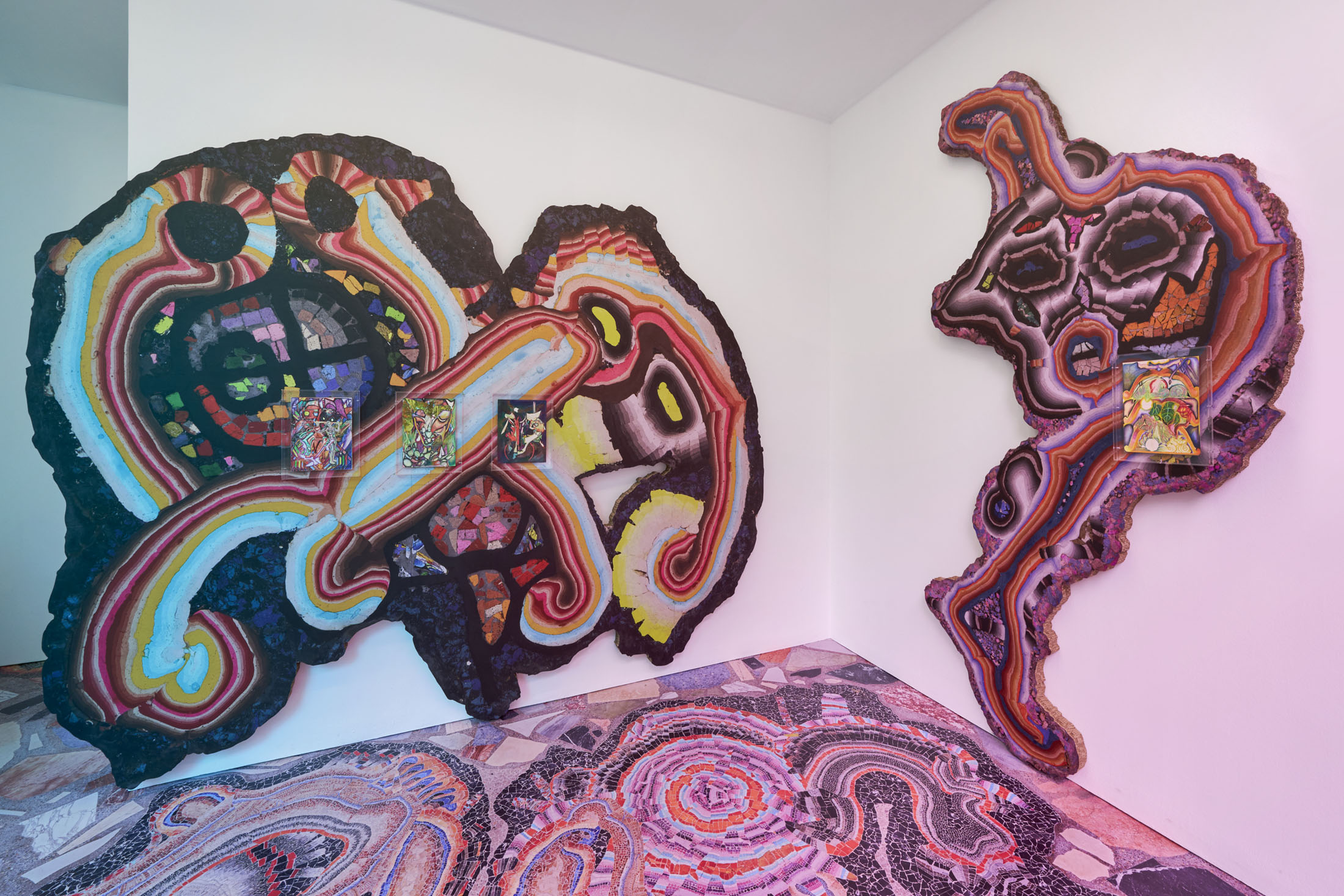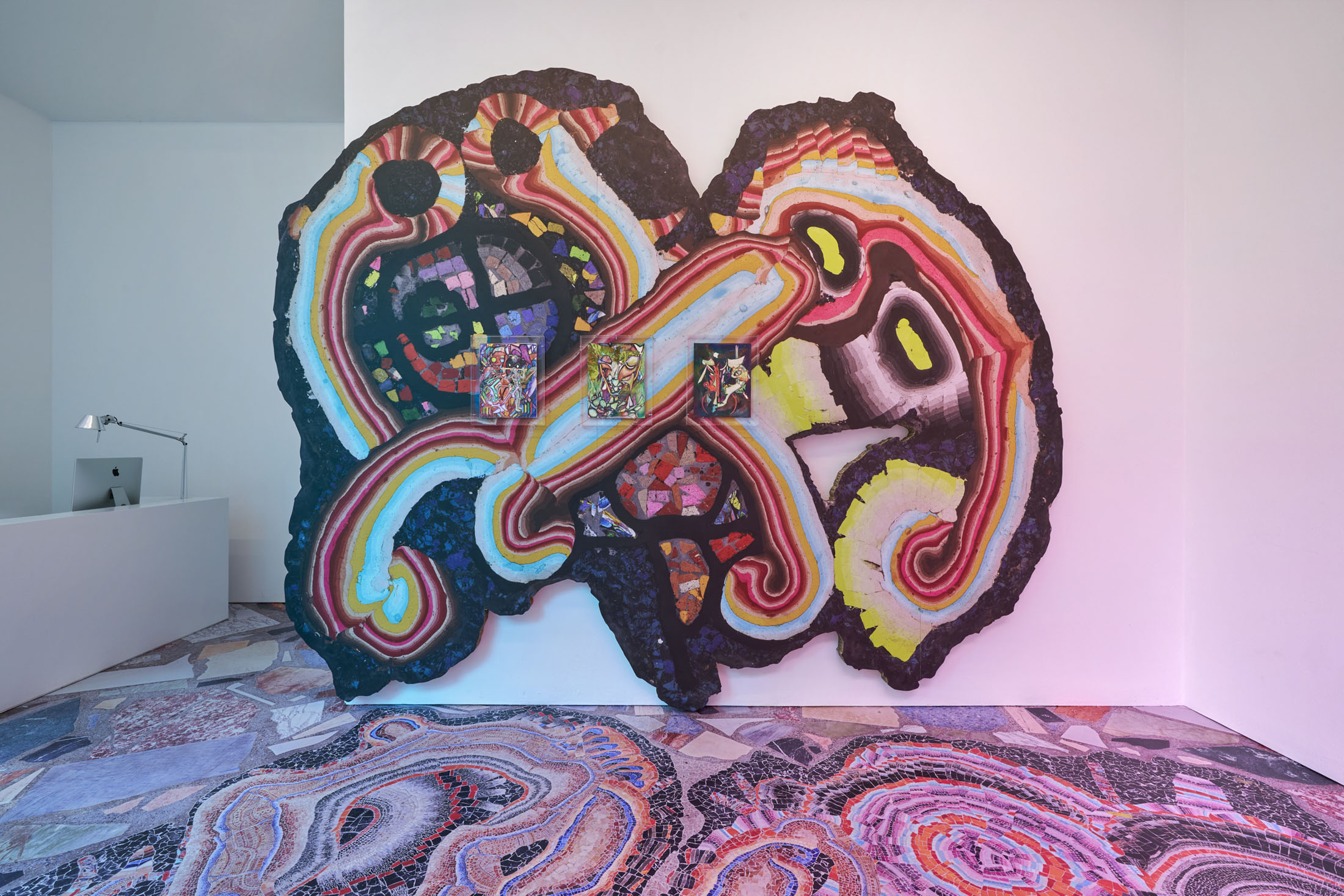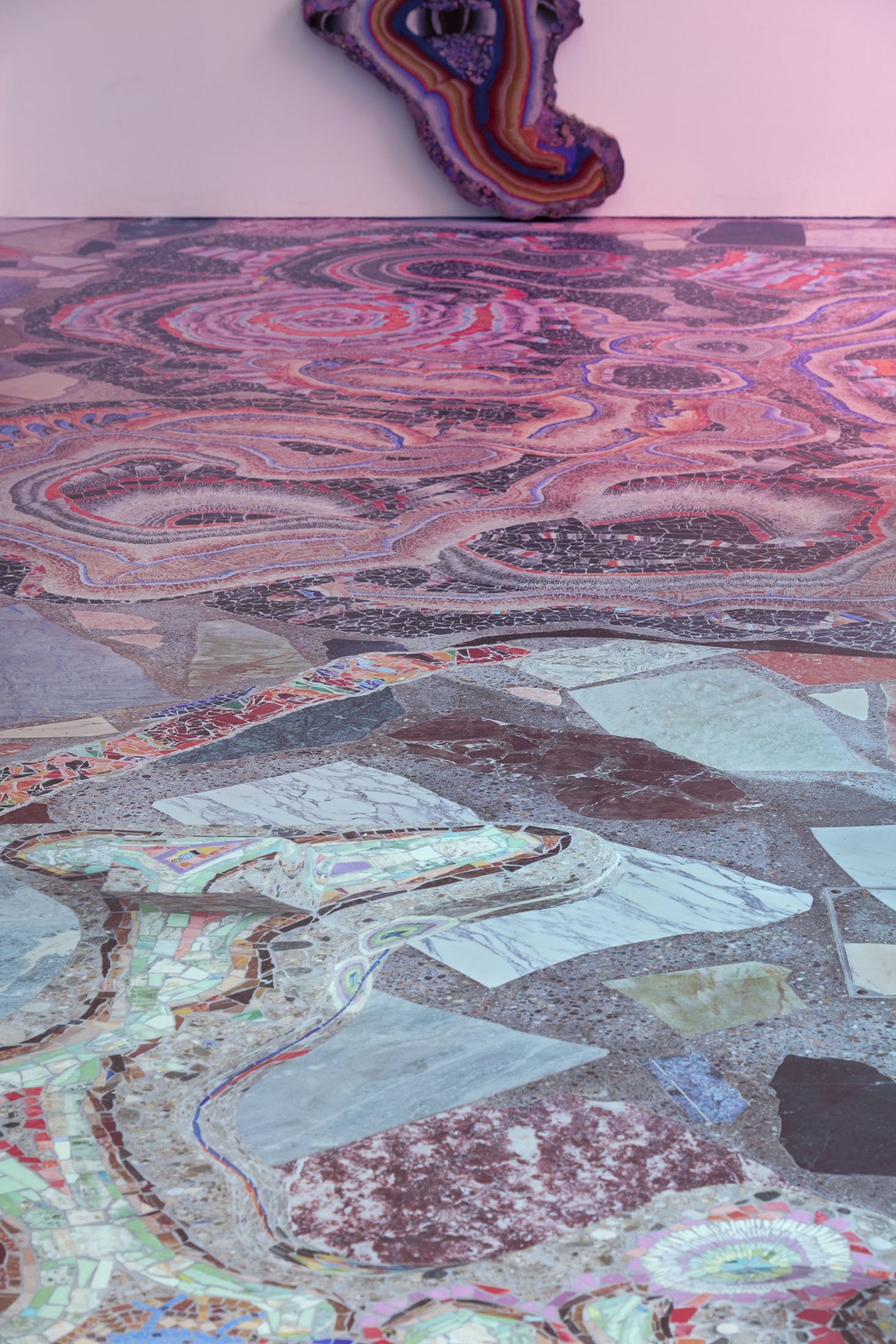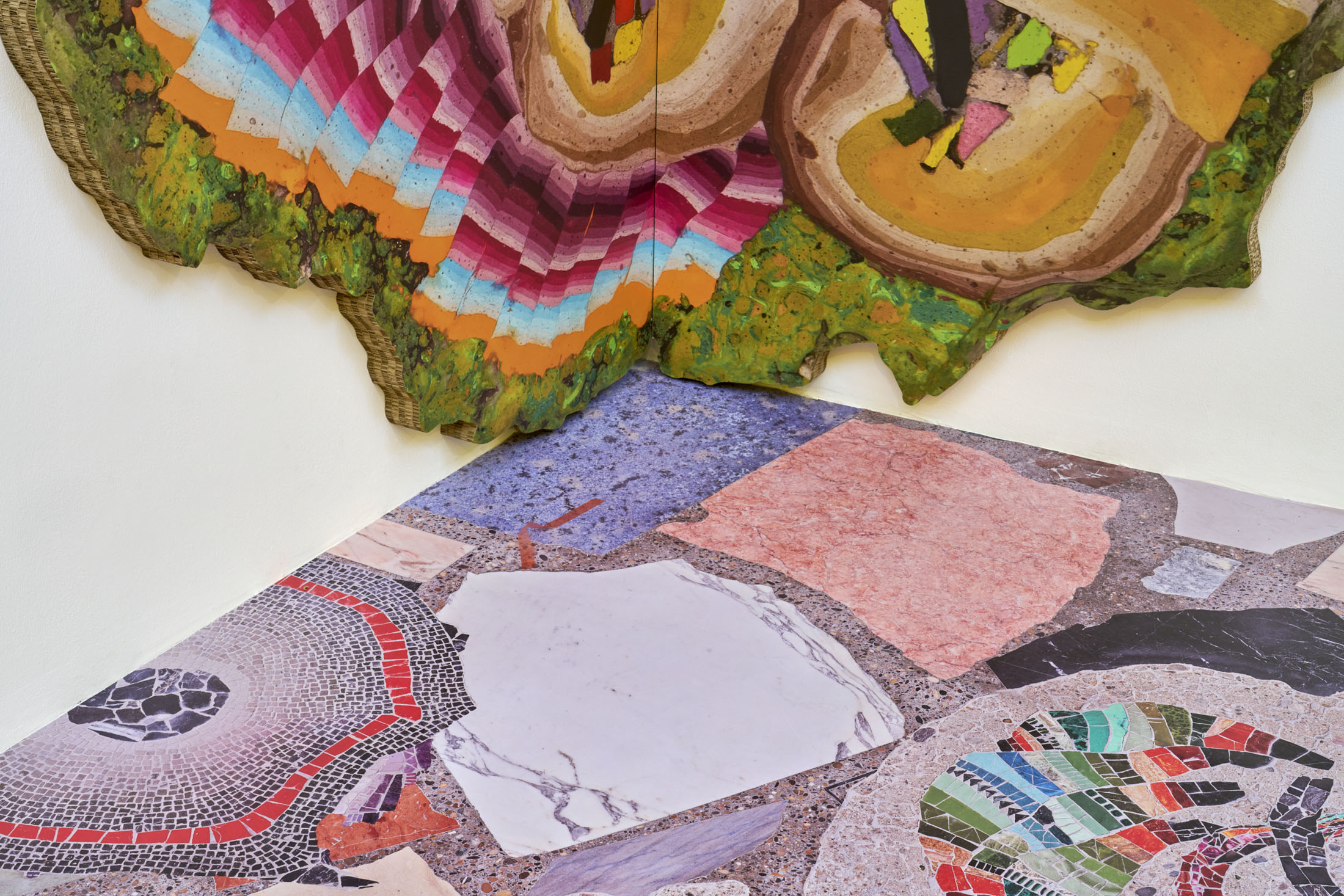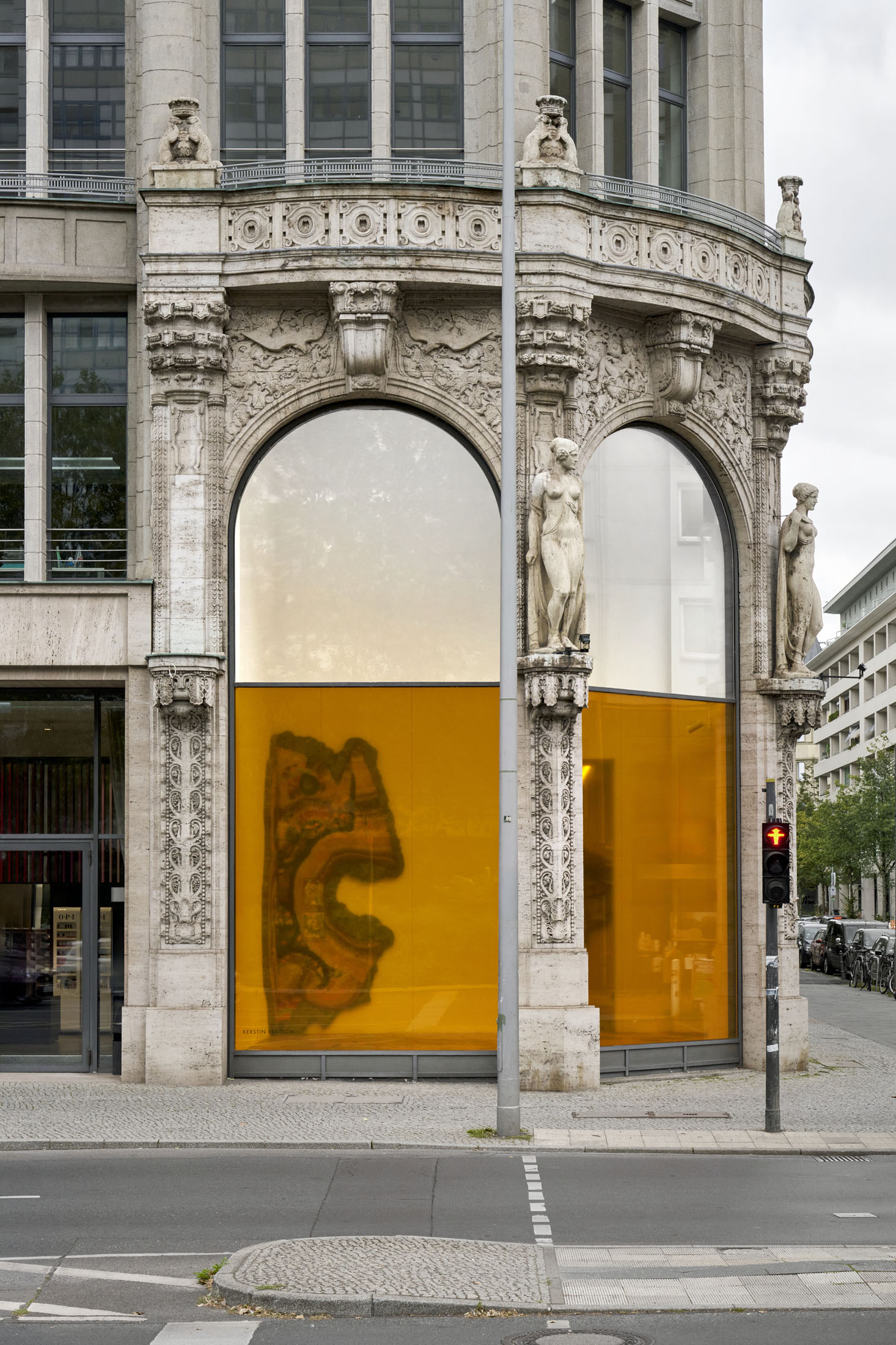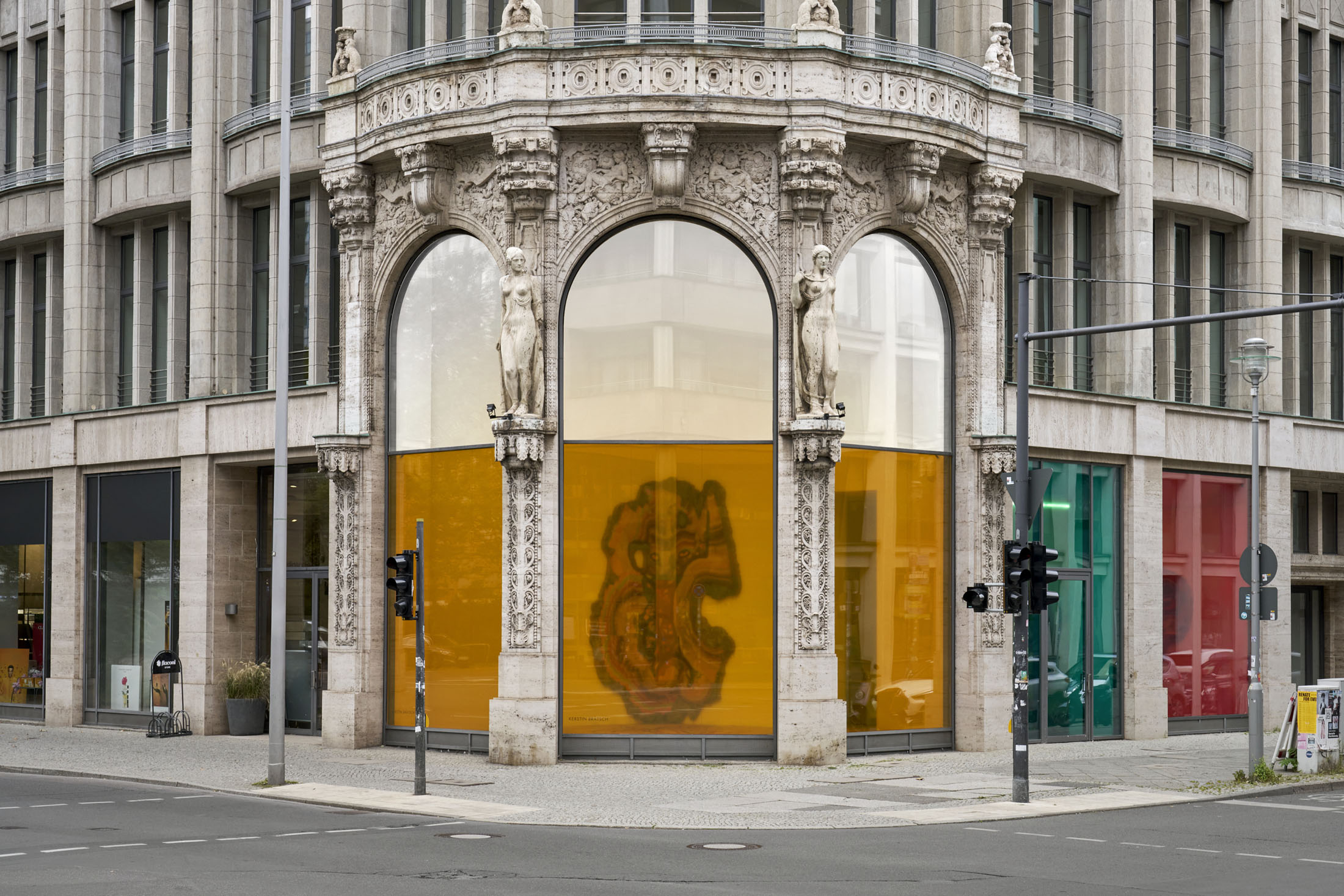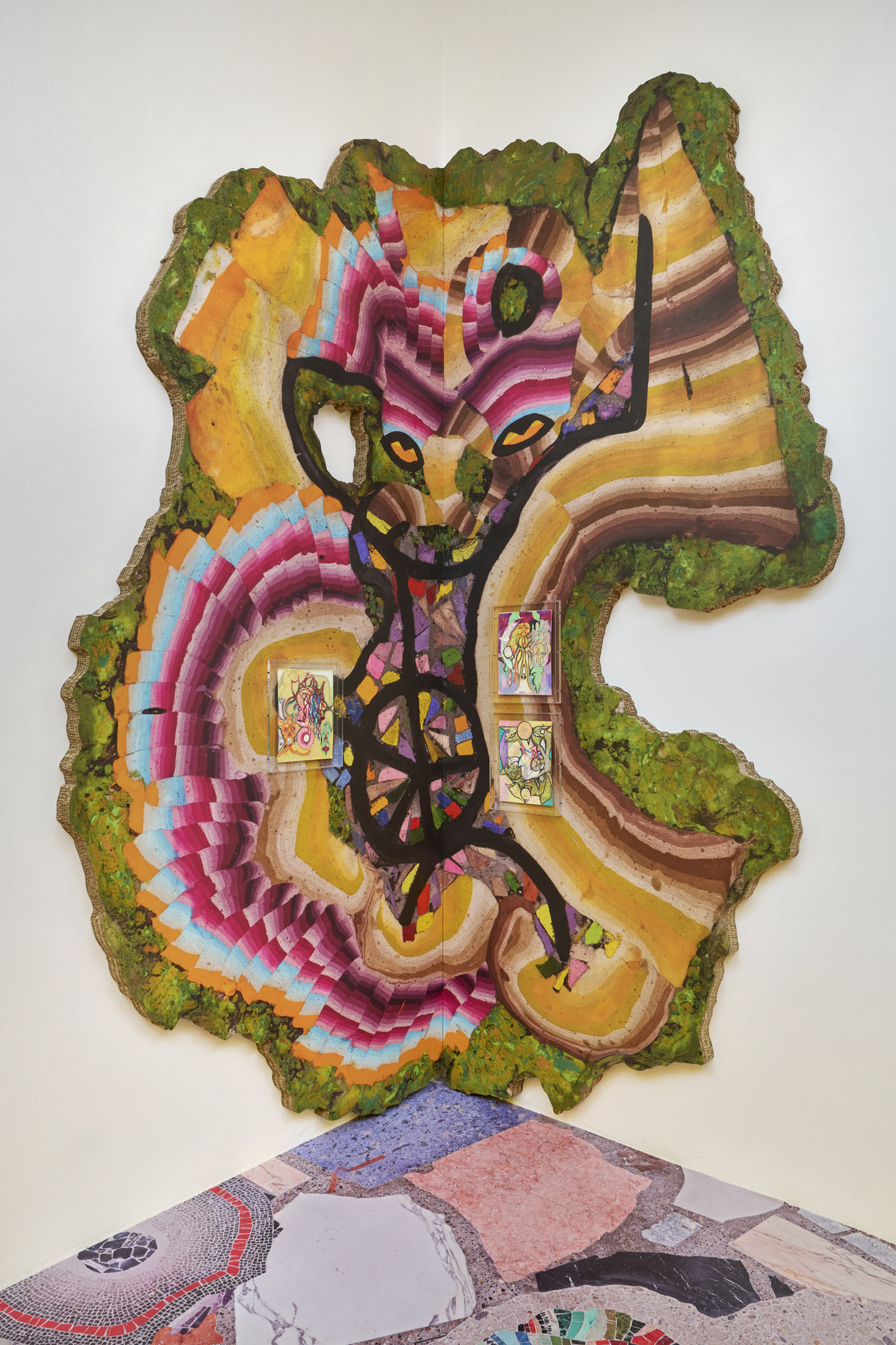
For this year’s edition of Berlin Art Week, Galerie Thomas Schulte presents Die Sein: Para Psychics Expanded (Excerpt), Kerstin Brätsch’s first solo exhibition with the gallery. The Corner Space and adjacent window front are transformed through an expansion from painting, as though from living matter, into a cosmos, or organism, of its own. The site-specific installation gives shape to an immersive environment; a shared yet fluctuating encounter, both rooted in the body and moving beyond material conditions.
Brätsch’s works not only appear as though they are shaped by recursion and a state of transformation, but frequently are. Installations previously set in other exhibition and spatial contexts are adapted or reiterated in different scales and materials, reemerging elsewhere and in changing relationships. Through additional forms of translation and imitation of one medium by another, the works here also refer back to or build from another source—originating in painting—the traces of which remain. This is reflected in the properties and materiality not just of the medium itself, which Brätsch breaks down and repeatedly reassembles, but also of its essential components: namely, light and color. With their ever-changing nature, different energies, and inherent element of chance, they are engaged as almost primal forces or living entities in themselves.
As though by alchemical processes, this often unfolds in the transmutations and translations between painting and stone in Brätsch’s various bodies of work, for which she draws on ancient and artisanal practices. Whereas her works in stucco marmo, for instance, mimic stone through the sheer build up of sculptural brushstrokes, her mosaics translate painting, essentially freezing brushstrokes, as minute painterly gestures, in stone. There is a transfer of energy, as though between liquid and solid states of matter, via a medium that is itself between states, like the seemingly fluid patterns of a stable marble surface. In both mosaic and stucco marmo works there is a similar character of individuated brushstrokes of separate particles that appear to coalesce and crystallize, like geological layers of time. Here, within the exhibition, such works are only referred to; their motifs and stony textures appear, almost as traces, in surfaces of other kinds, becoming temporary spatial structures and modes of display.
The intricate pattern of the vinyl floor featured here, for example, is derived from one that Brätsch originally produced in stone mosaic. It is composed of enlarged forms that have undergone various material transfers: taking her stucco marmo works as a base, which, in turn, follow the logic of her oil paintings on transparent Mylar. A kind of metamorphosis occurs: from painting to stone imitation to stone itself and back to two-dimensional image. Seen from above, its forms recall living cells, generating, flowing, or mutating under a microscope; or else strange, oversized creatures. Described by Brätsch as a painting that faces the sky, here, its fluid forms act as a connective element between the works and us as we traverse it, between the gallery’s two adjacent window spaces and, by extension, between interior and exterior. In the Corner Space’s tall windows, colored films further transform the appearance of sunlight. The floor interacts with light in its changing conditions, not just according to time of day and weather changes, but as it passes from outside to inside and from space to space. What gives the appearance of being set in stone still remains susceptible to shifts.
Set in interplay with the dynamic floor, three large-format cardboard panels hover along the walls—tucked into corners or extending past their edges. These consist of enlarged motifs extracted from Brätsch’s stucco marmo works, which are typically produced on a smaller scale from plaster, pigment and glue—materializing like bodies of paint. Through layers of time and material that harden to altered effect, the centuries-old technique is used to imitate marble and stone as decorative surfaces in indoor and outdoor spaces. The cardboard reproductions of Brätsch’s stucco marmo can be reconfigured and integrated into different spaces, acting as display surfaces for other works—as exhibition architectures of sorts. Their organic forms, bold colorations and expressive patterns resemble formations in agate geodes—smooth yet irregular, with their multi-colored striations and unpredictable fault lines. These also begin to morph into faces with distinctive, open eyes, seemingly emerging out of and dissolving back into abstract patterns like psychedelic pareidolias – both giving structure to and inhabiting the space as eerie, otherworldly beings.
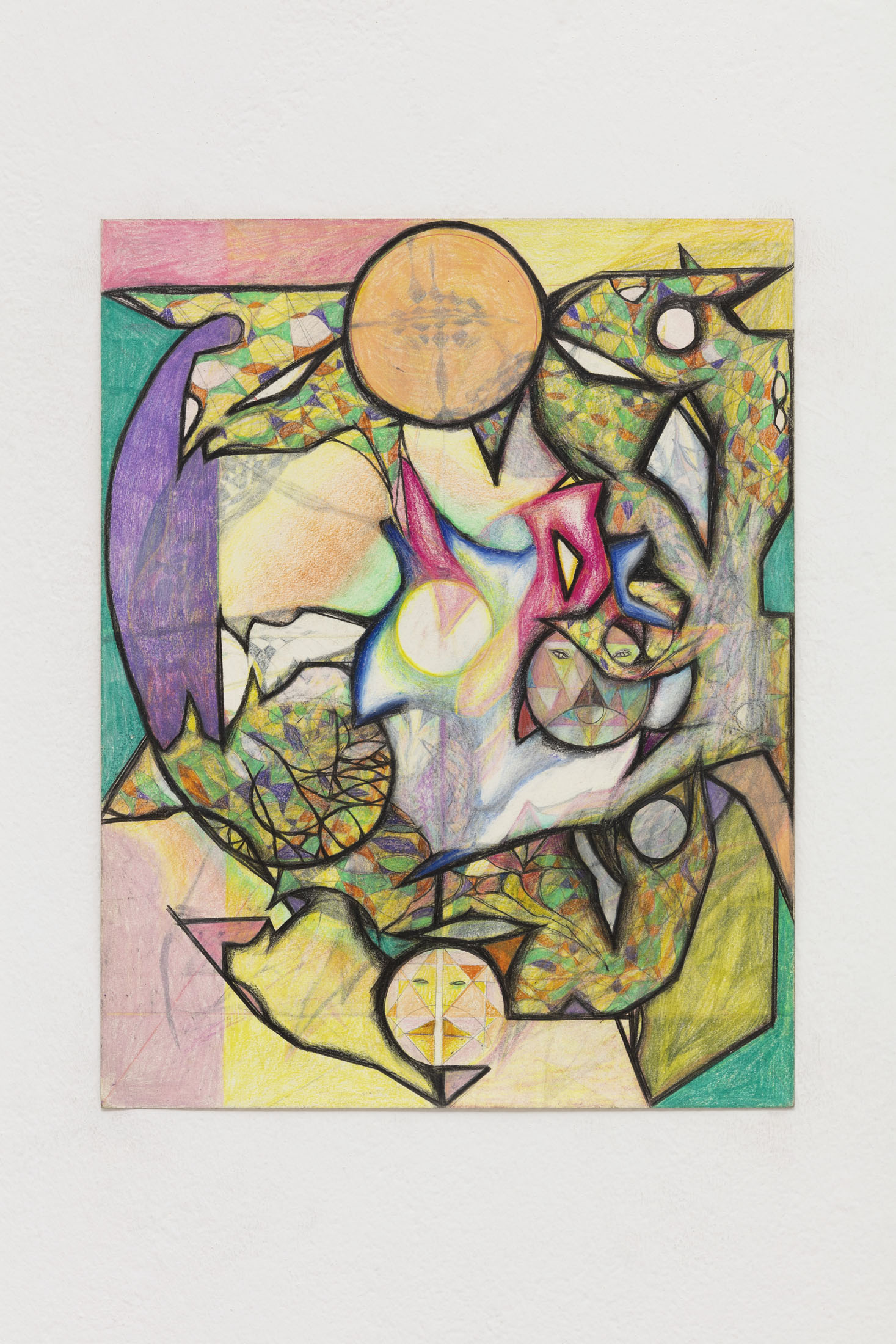
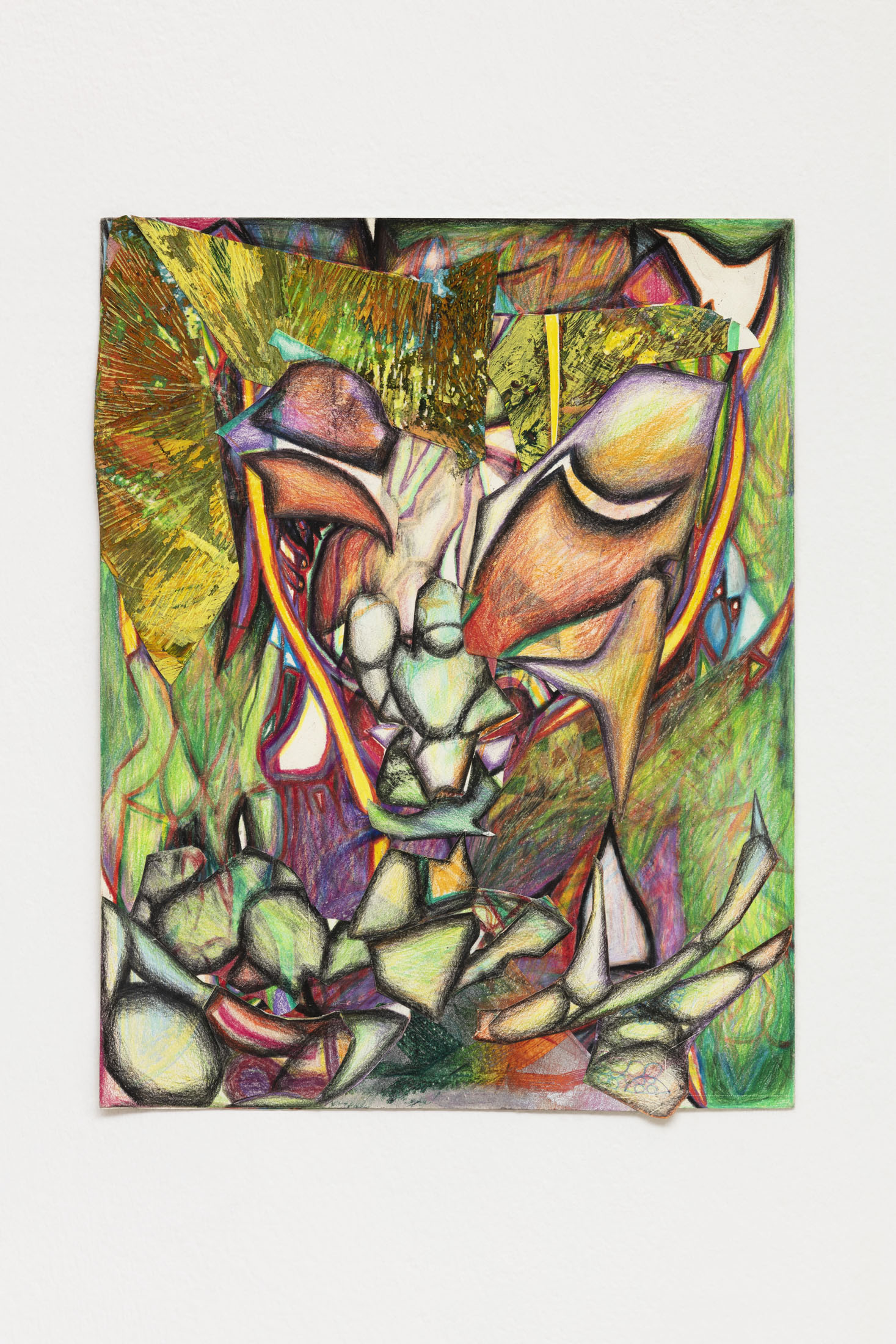
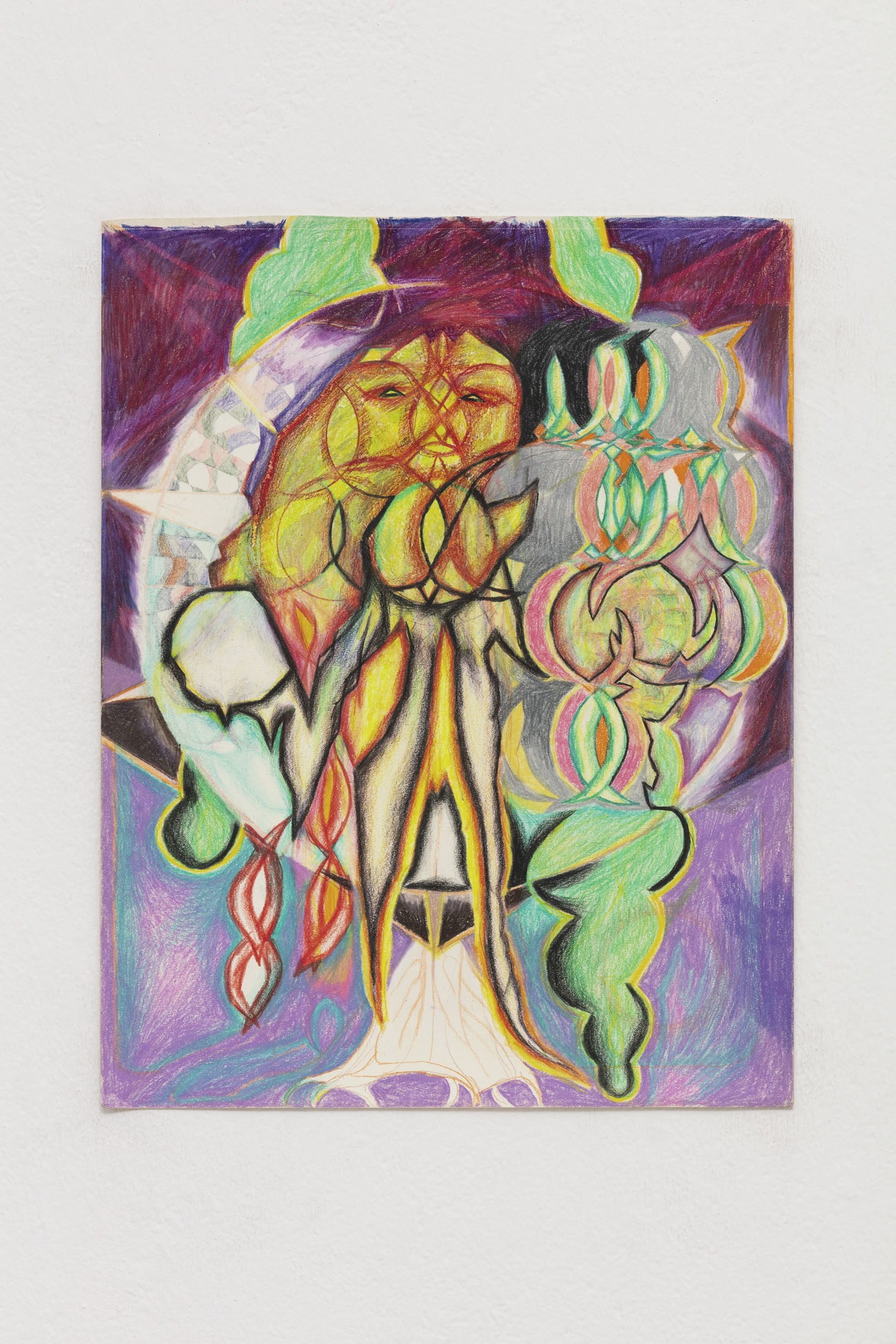
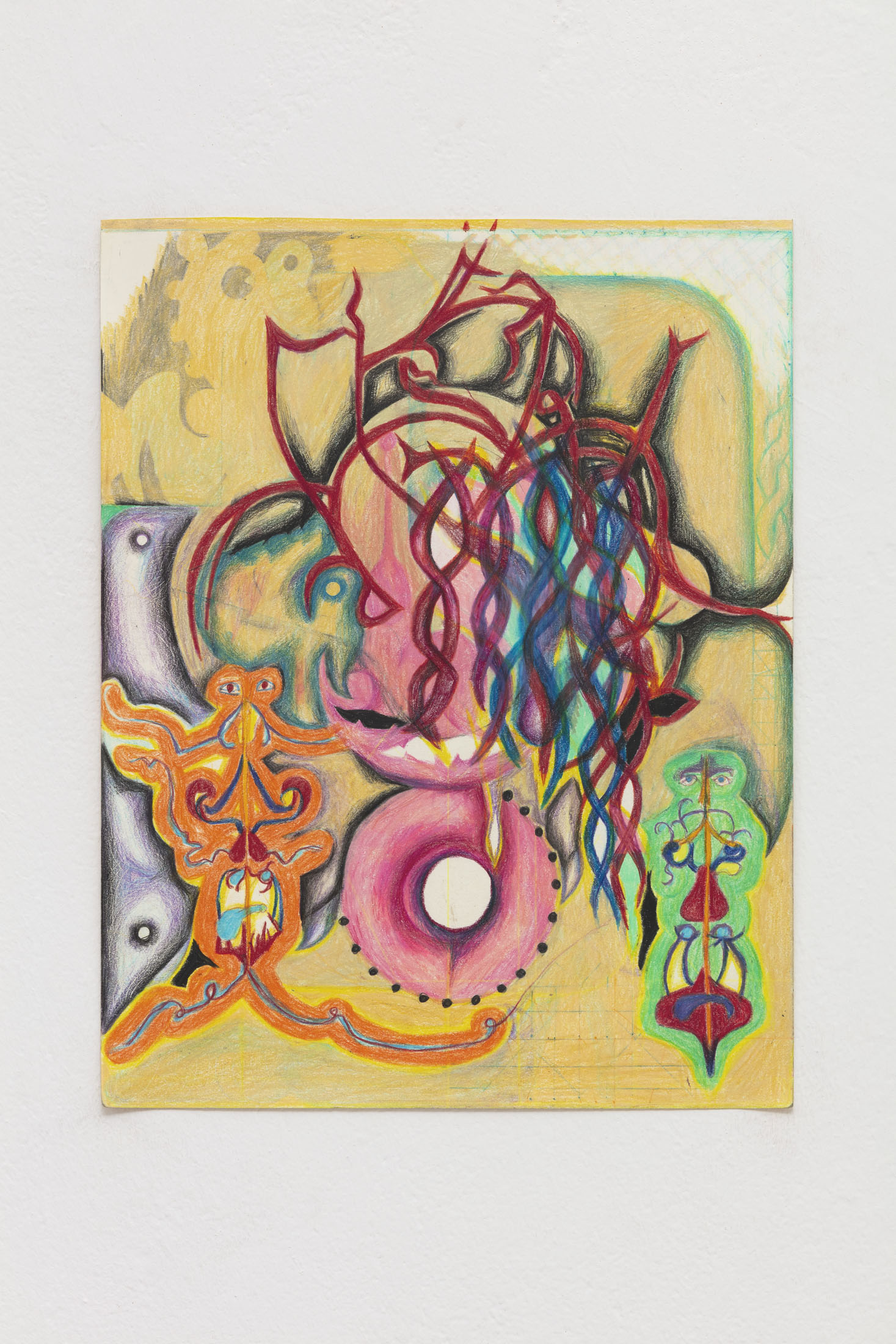
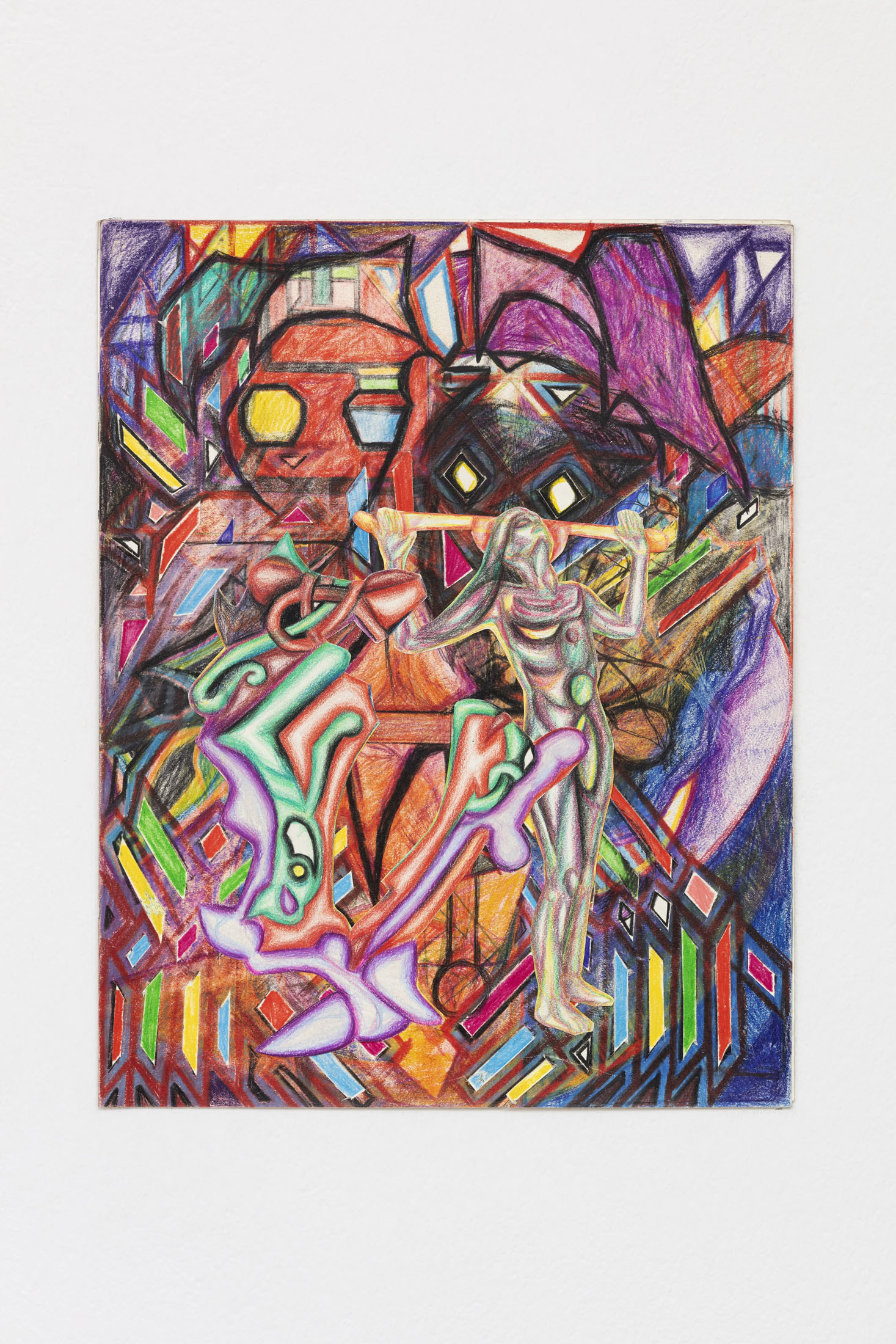
Against this mutating backdrop hangs a small selection of works from Brätsch’s titular Para Psychics series: small-scale drawings in colored pencil whose almost mandala-like though asymmetrical patterns appear as living, ever-transforming systems. The complete series is expansive: an accumulation of one hundred drawings, each marked by a slow unfolding through processes of layering and erasure, defined by an intimate space and time. In them, color fields often bordered by darker, thicker lines, like stained glass, suggest a susceptibility to changes in light and opacity. Their kaleidoscopic intersections, not fully geometric, at times recall mirrored Rorschach inkblots, many-faced entities or entangled vegetation—offering themselves up to experiential and interpretative multiplicity.
An invitation to engage in manifold possible readings is extended by a loose formal association with tarot cards and other systems of divination—as one of many sources for Brätsch in her approach to this series. Entering into the depths of the mental body, tracing its hidden networks and interconnections, the transformations that occur through these works are characterized by movement ever inward. In some, prism-like reflections give the sense of peering inside crystal; entwining strands like DNA open up into portals, translucent orbs glow from some inner light source. Even as the drawings’ internal structures and temporal rhythms always simultaneously unfold in reverse or in multiple directions and orientations. There is a continual turning over, slipping away, recombining and resettling, like sediment onto a surface—in a kind of extrasensory mapping of what lies beyond.
Die Sein: Para Psychics Expanded (Excerpt), as the title’s final parenthetical note may suggest, presents a kind of microcosm, a mirror onto something larger—or other—than itself. And yet, it is also a buildup: of internal references and external influences; of non-linear processes of exchange; of recurrences and the subtle shifts that they bring; of one fluid body flowing into many. Here, stratifications of time, like parallel existences, seem to both stretch open infinitely and condense into spectral traces, as though fossilized in stone.
—Text by Julianne Cordray
Kerstin Brätsch, born in 1979, in Hamburg, Germany, received an MFA from Columbia University in New York in 2007 and completed her studies at the Universität der Künste Berlin in 2008. Her work has been presented in numerous individual exhibitions, including Casa São Roque, Porto (2025), Kunstmuseum Bonn (2025), MUNCH, Oslo (2025), Fondazione Memmo, Rome (2018), including KAYA, and Museum Brandhorst, Munich (2017). She has also participated in numerous group exhibitions, including the Venice Biennale (2022), The Museum of Modern Art, New York (2023, 2014), Camden Art Centre, London (2020), and, as KAYA, the Whitney Biennial at the Whitney Museum of American Art, New York (2017).
Brätsch has received commissions from several institutions, including the Aspen Art Museum (2026), Fridericianum, Kassel (2023), LUMA Foundation, Café du Parc, Arles (2021), and The Museum of Modern Art, New York (2019). Her play space for children, BAUBAU, opened at the Gropius Bau, Berlin, in 2024. Her public commissions include works for the High Line in New York and the new Terminal 6 at John F. Kennedy International Airport in New York.
She is the recipient of numerous awards, including the Zurich Art Prize 2027, the Marta Prize of the Wemhöner Foundation and the Tiemann Prize for Contemporary Painting (2025), the Rosenthal Family Foundation Award from the American Academy of Arts and Letters, New York (2022), the Guenther Peill Prize (2020), the Helen Frankenthaler Award for Painting (2020), the Edvard Munch Art Award (2017), and the August Macke Prize (2014).
Since 2010, Brätsch has worked collaboratively with artist Debo Eilers under the name KAYA. Since 2024, she has been Professor of Painting/Drawing at the Hochschule für bildende Künste Hamburg. Kerstin Brätsch lives and works in New York and Berlin.