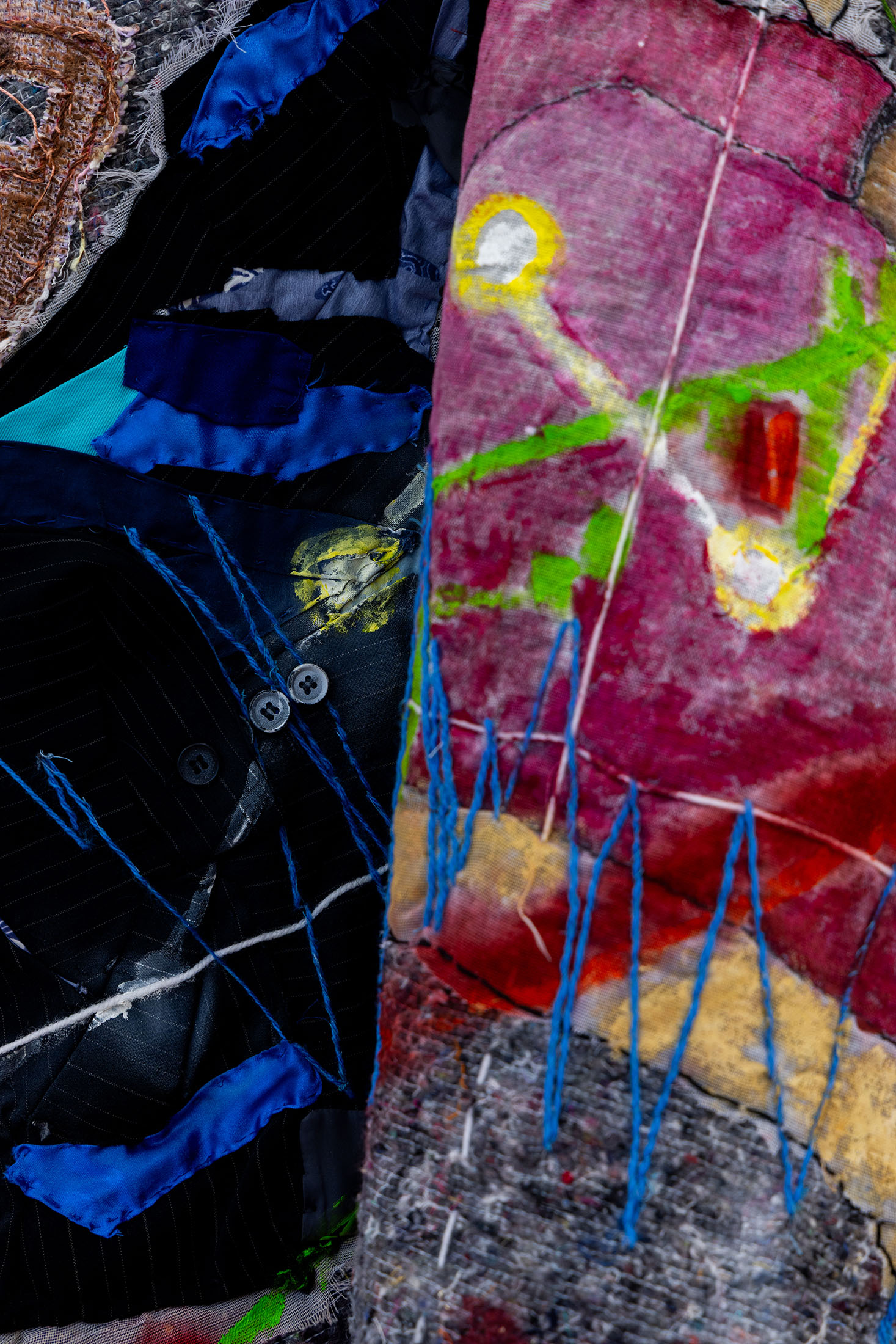
Eva de Souza’s artistic and activist practice com-bines textile works with a long-standing engage-ment with social justice, anti-racism and feminism. Through embroidery and sewing she interweaves personal stories with social events, media images with names and political slogans, creating visual worlds and objects that give voice to resistance and protest. Her new abstract textile works foreground acts of self-empowerment and the concept of healing.
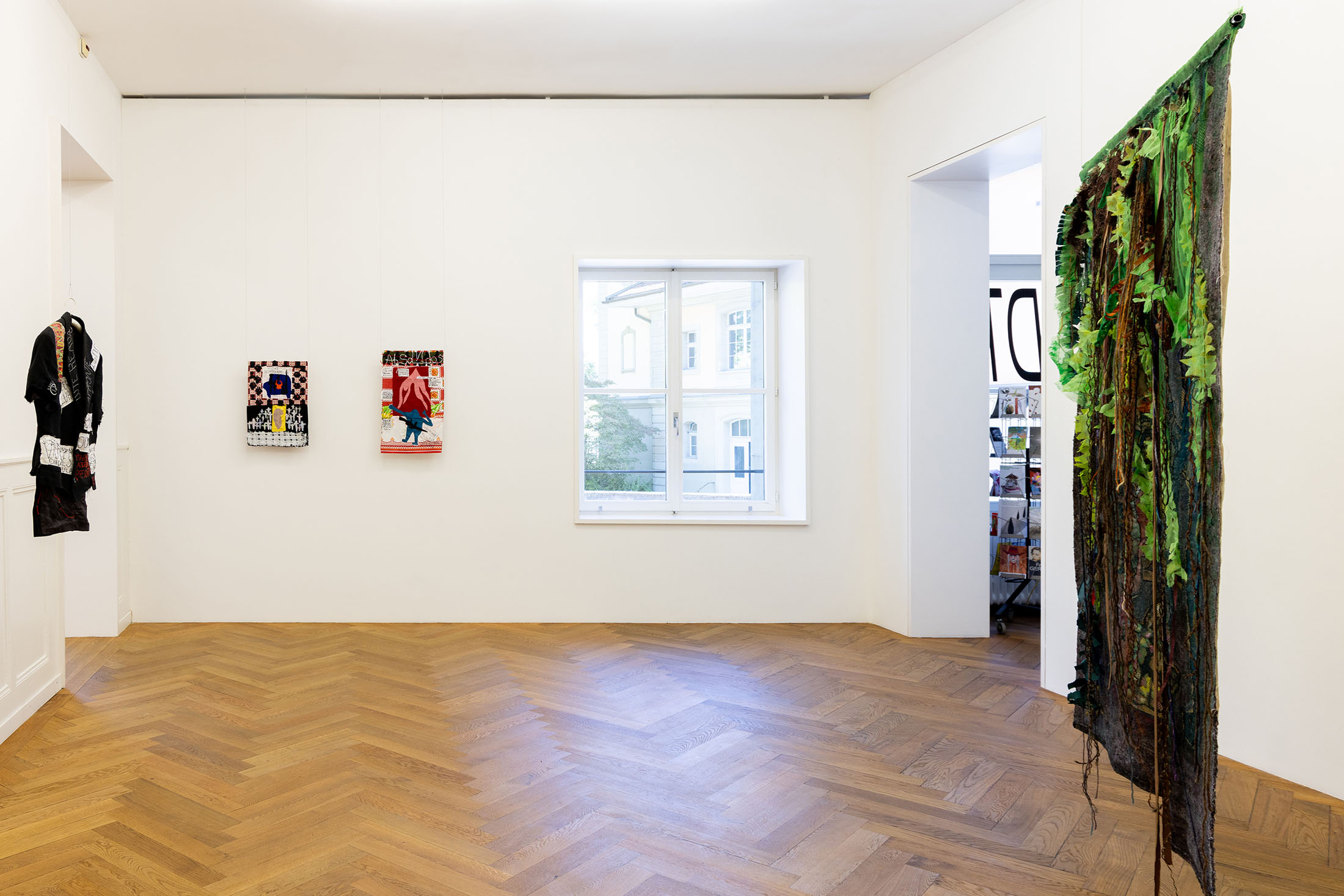
For the three exhibition spaces at Stadtgalerie, the artist has developed a narrative installation com-prising existing and new work. The exhibition title, which translates from Portuguese as ‘healing fabrics’ or ‘fabrics that heal’, is intentionally ambig-uous, referring both to social structures (the ‘social fabric’) and the materiality of textiles, whose transformative potential plays a central role in her practice. Organised around the themes of protest, self-healing and contemplation, the exhibition invites visitors to explore multiple aspects of her work and to engage with a space of remembrance, exchange and care.
With tecidos que curam, Stadtgalerie Bern presents Eva de Souza’s first institutional solo exhibition. The Brazilian Swiss artist lives and works in Salvador, Brazil, and Bern.
Room 1
Trigger warning: The text describes racist police violence.
The first exhibition space is dedicated to protest against human rights violations, in particular racist violence toward Black people.
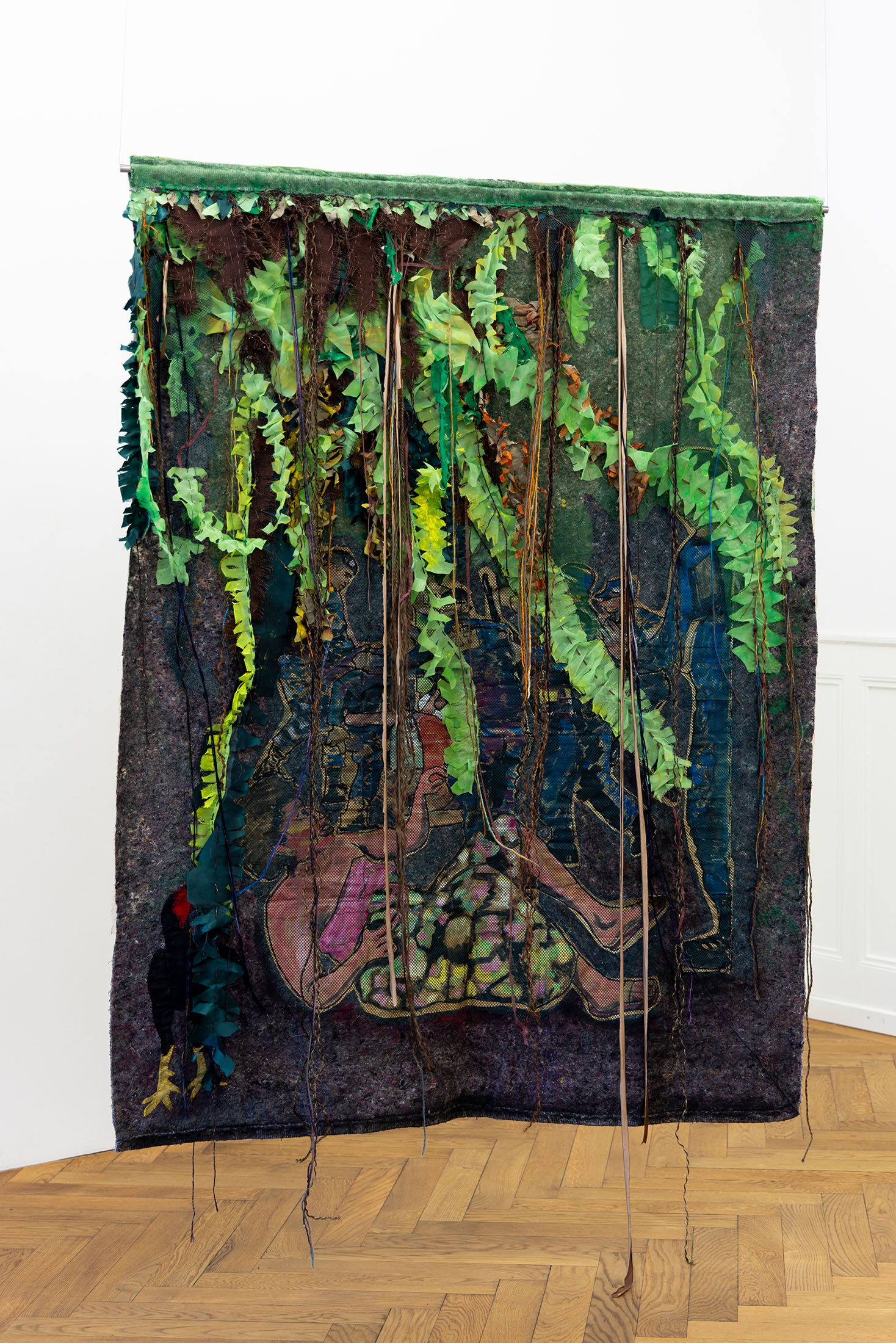
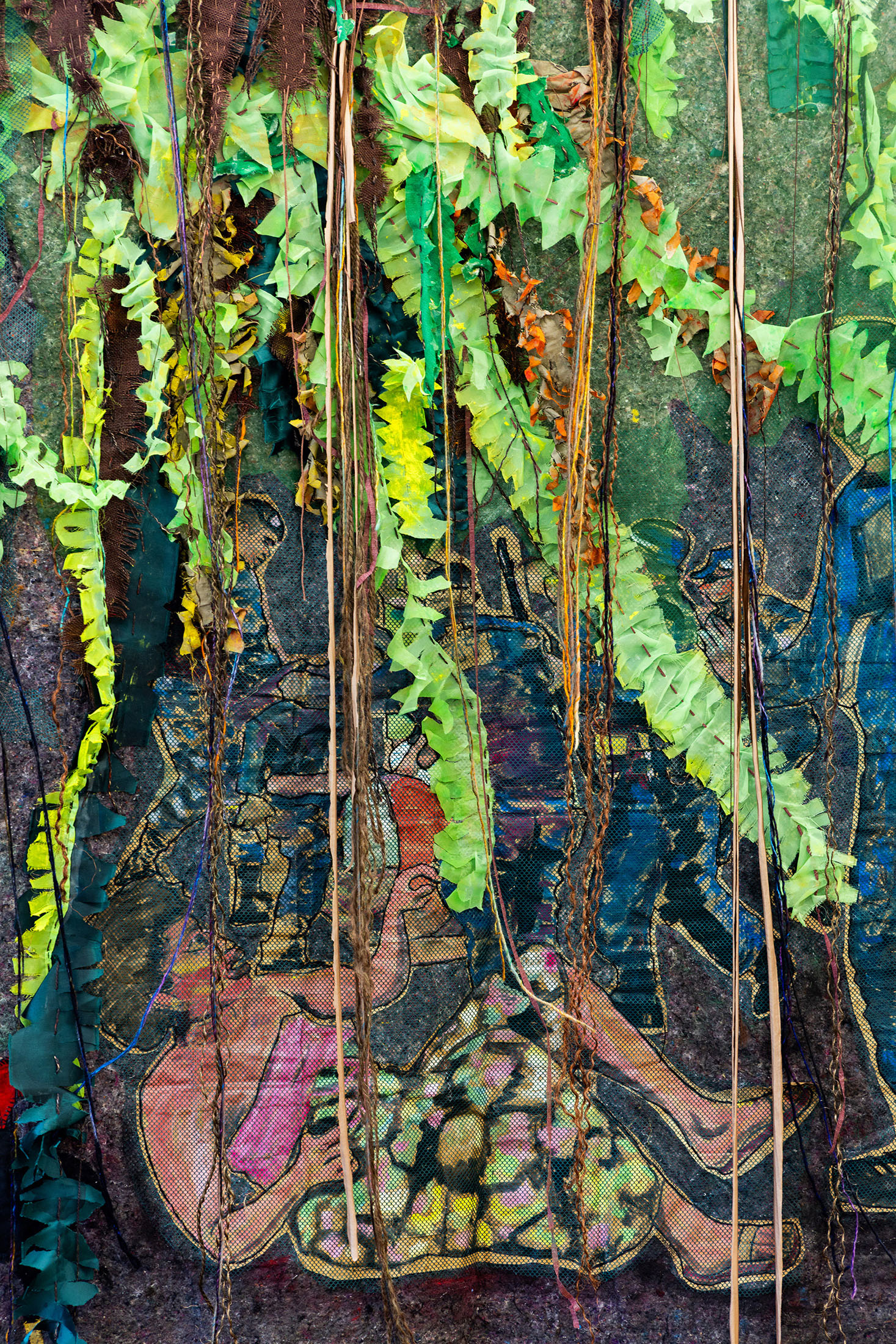
In the large-scale embroidery Zamambaia, a Black woman lies on the ground, surrounded by a group of police officers. Whether she is being helped or trying to protect herself from the police remains open to interpretation. Through this ambiguity, Eva de Souza reflects on how structural violence is experienced, observed and remembered in every-day life.
The title Zamambaia is Portuguese for ‘fern’. This primeval plant, which frames the scene, symbolises resilience and regeneration: It continues to grow, adapt and thrive even under adverse conditions.
Nature is therefore presented as a force of renewal, in contrast to experiences of violence and discrimi-nation. The rooster also depicted here alludes to the spiritual dimension of Eva de Souza’s practice. She describes it as a symbol for the connection to ancestors and their protective presence, which is deeply rooted in Afro-Brazilian culture.
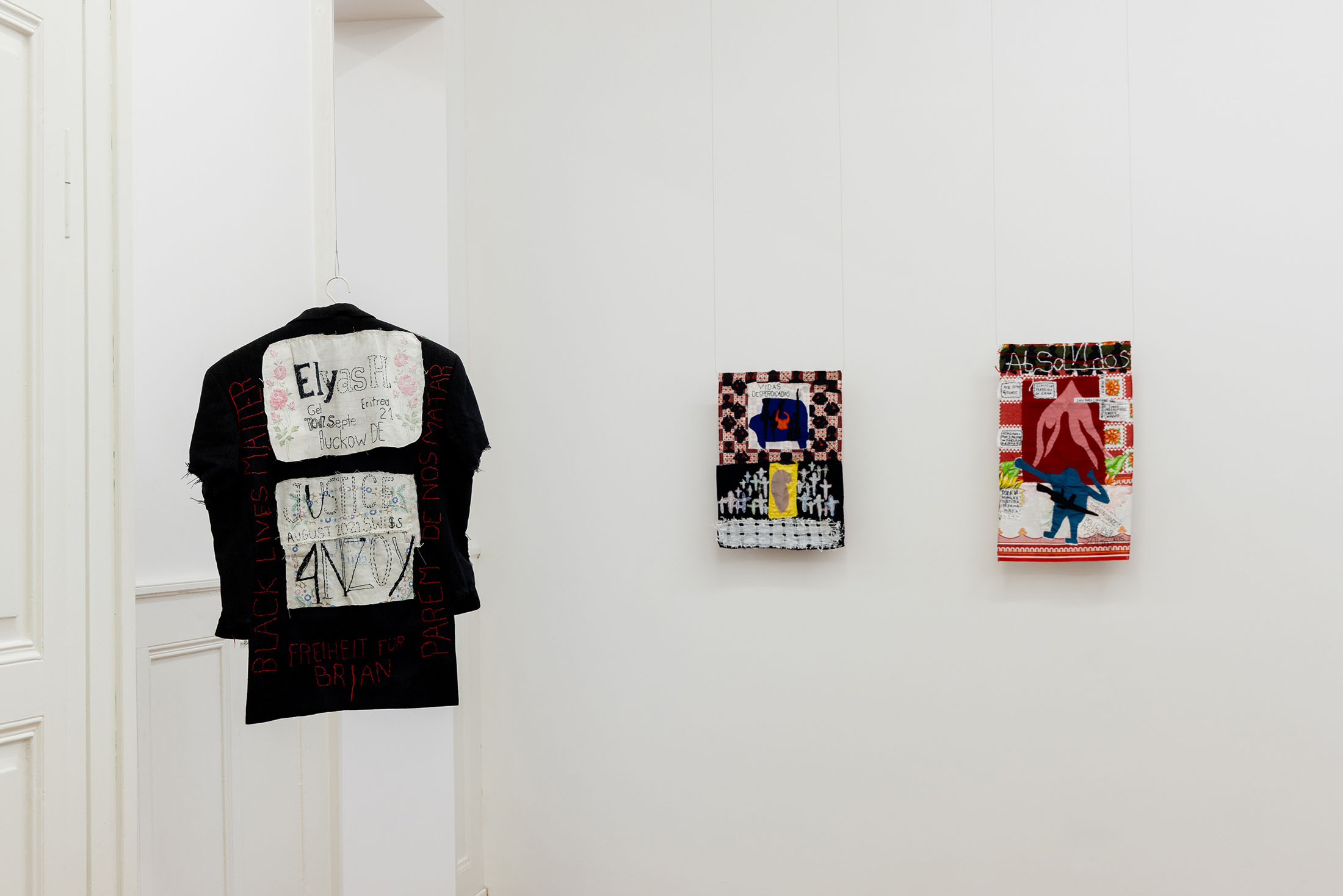
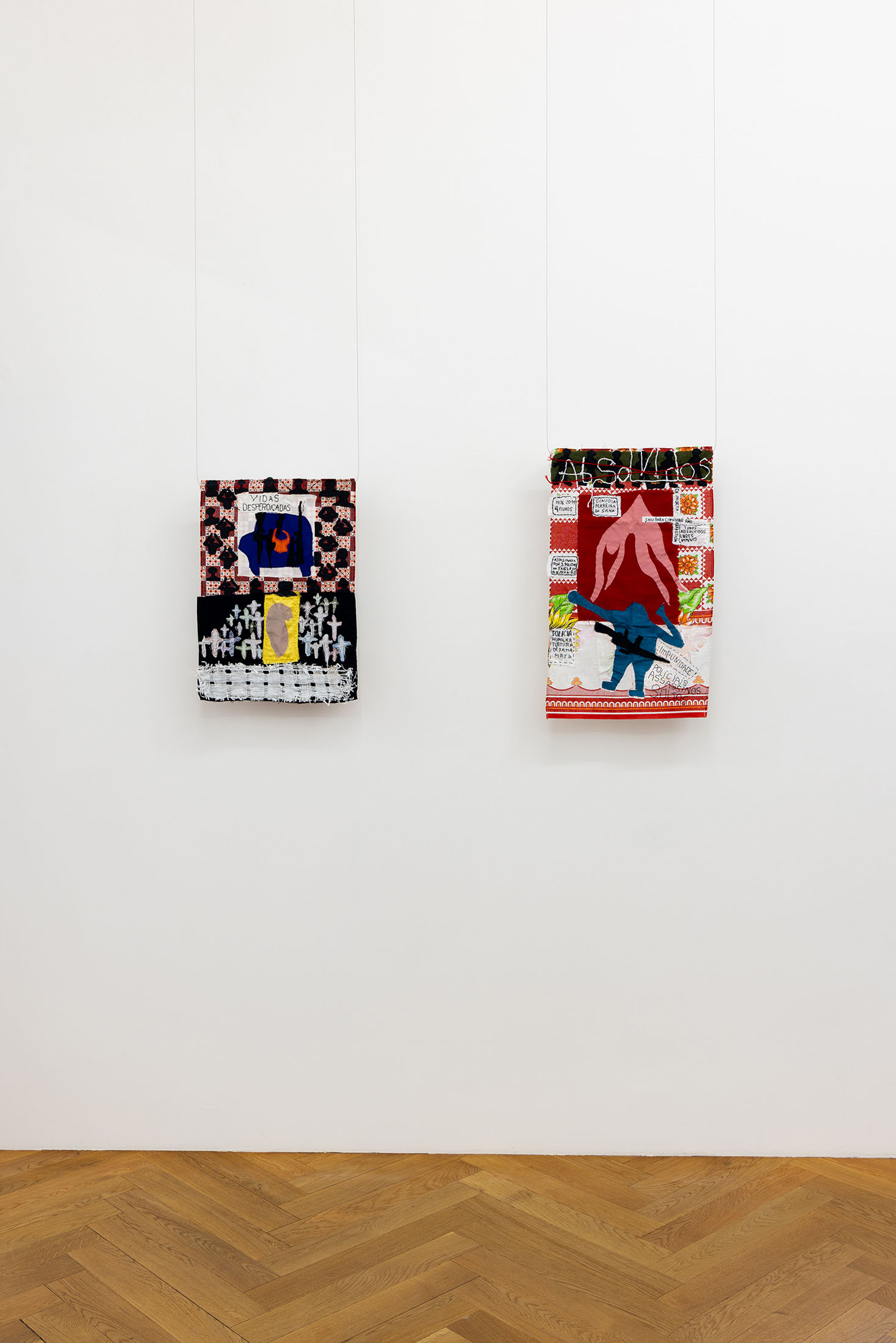
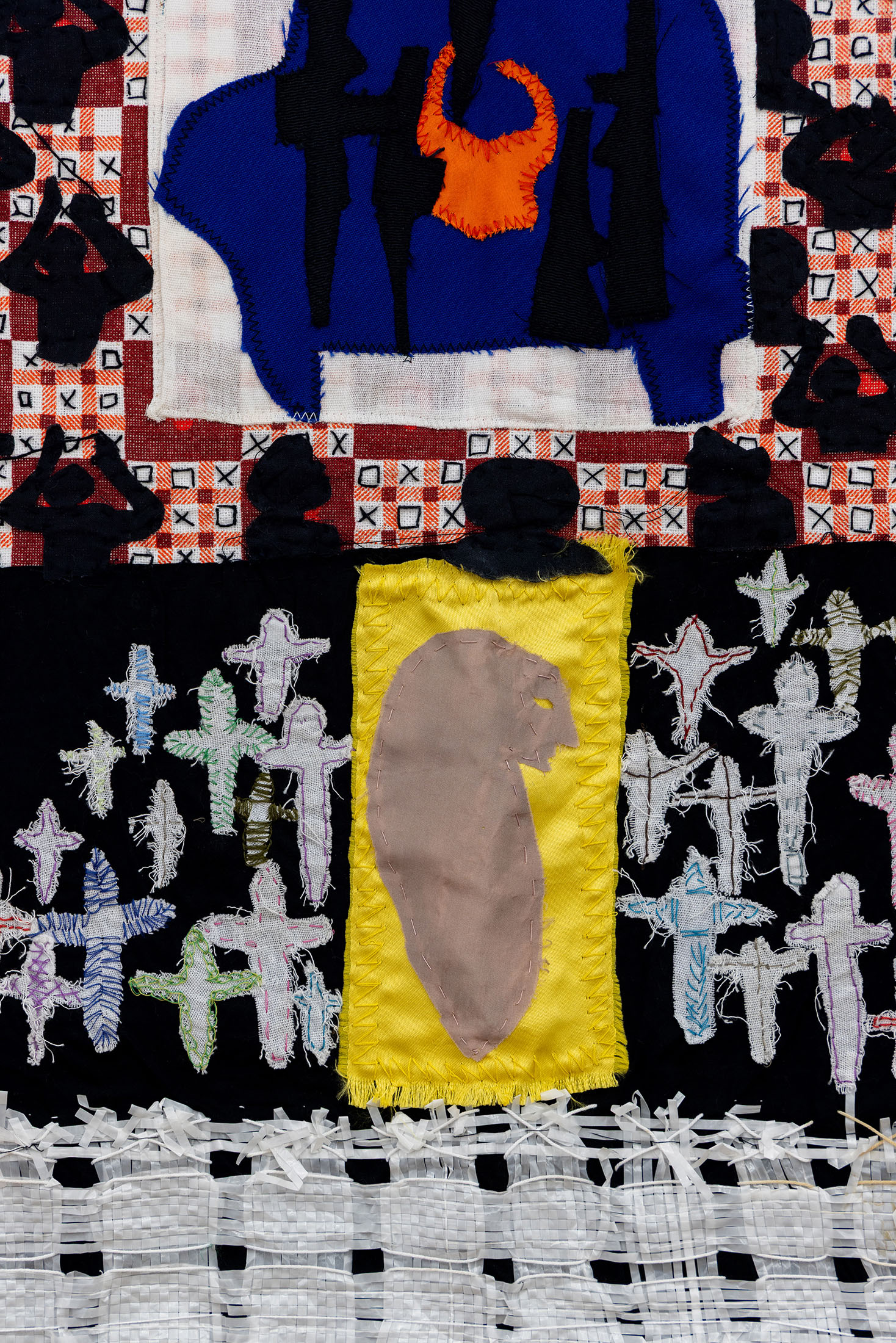
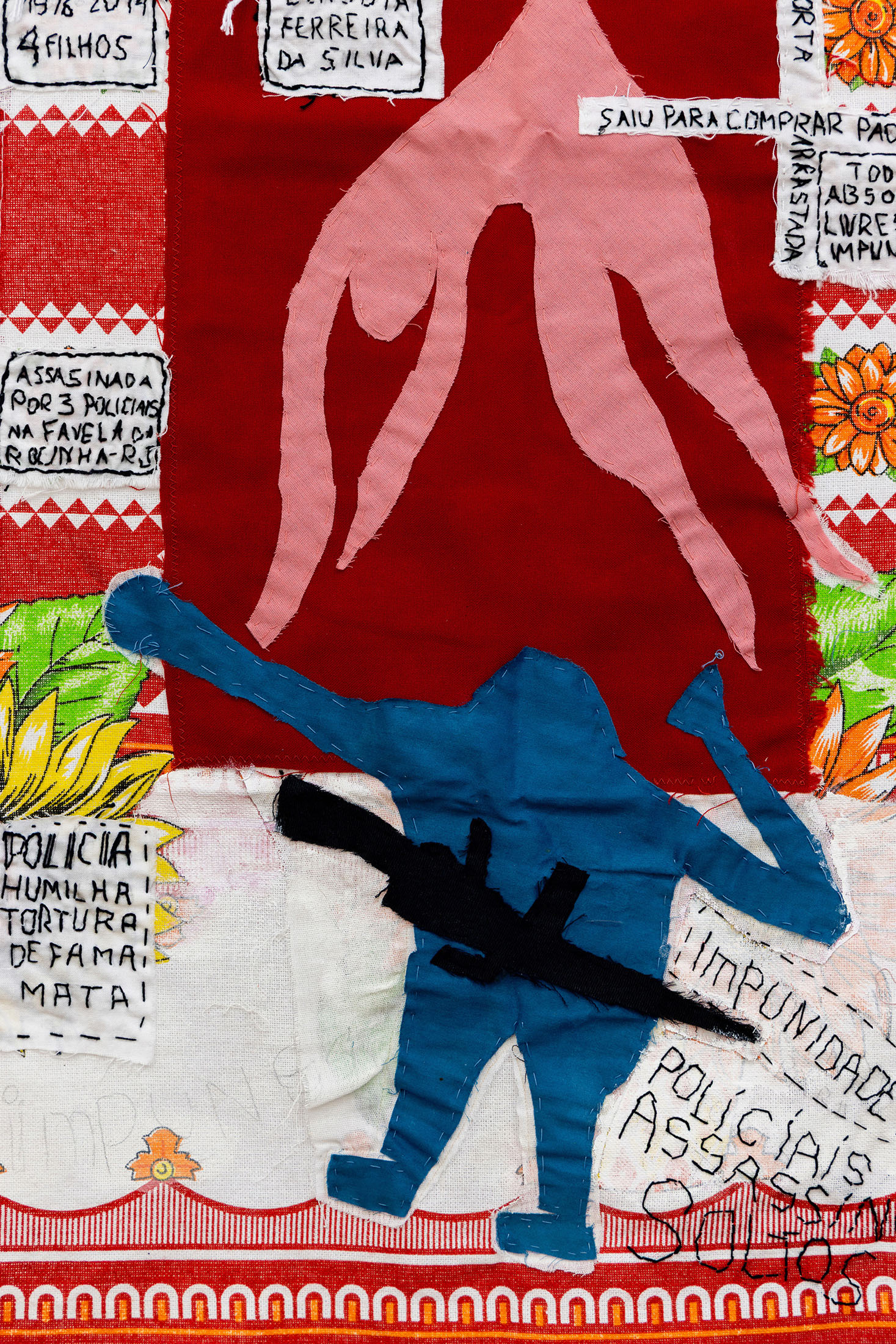
The smaller textile works Vidas Desperdiçadas 1 and Vidas Desperdiçadas 2 (‘wasted lives’) from 2021 respond to cases of racist police violence in Brazil. On kitchen towels, Eva de Souza has embroidered names, biographical details, silhouettes of bodies and crosses, as well as the crossed-out word absolvidos (‘acquitted’). Vidas Desperdiçadas 2 commemo-rates the murder of Cláudia Ferreira da Silva, a 38-year-old Brazilian mother of four who was shot by police officers in Rio de Janeiro in 2014. On the way to the hospital, she fell from the trunk of a police car and was dragged along the road for around 300 metres. Video footage of the incident circulated in the media and sparked nationwide protests. Nevertheless, the six military police officers charged in connection with her death were acquitted. Vidas Desperdiçadas 1 commemorates young Black people wrongfully imprisoned in Brazilian jails or killed by police violence.
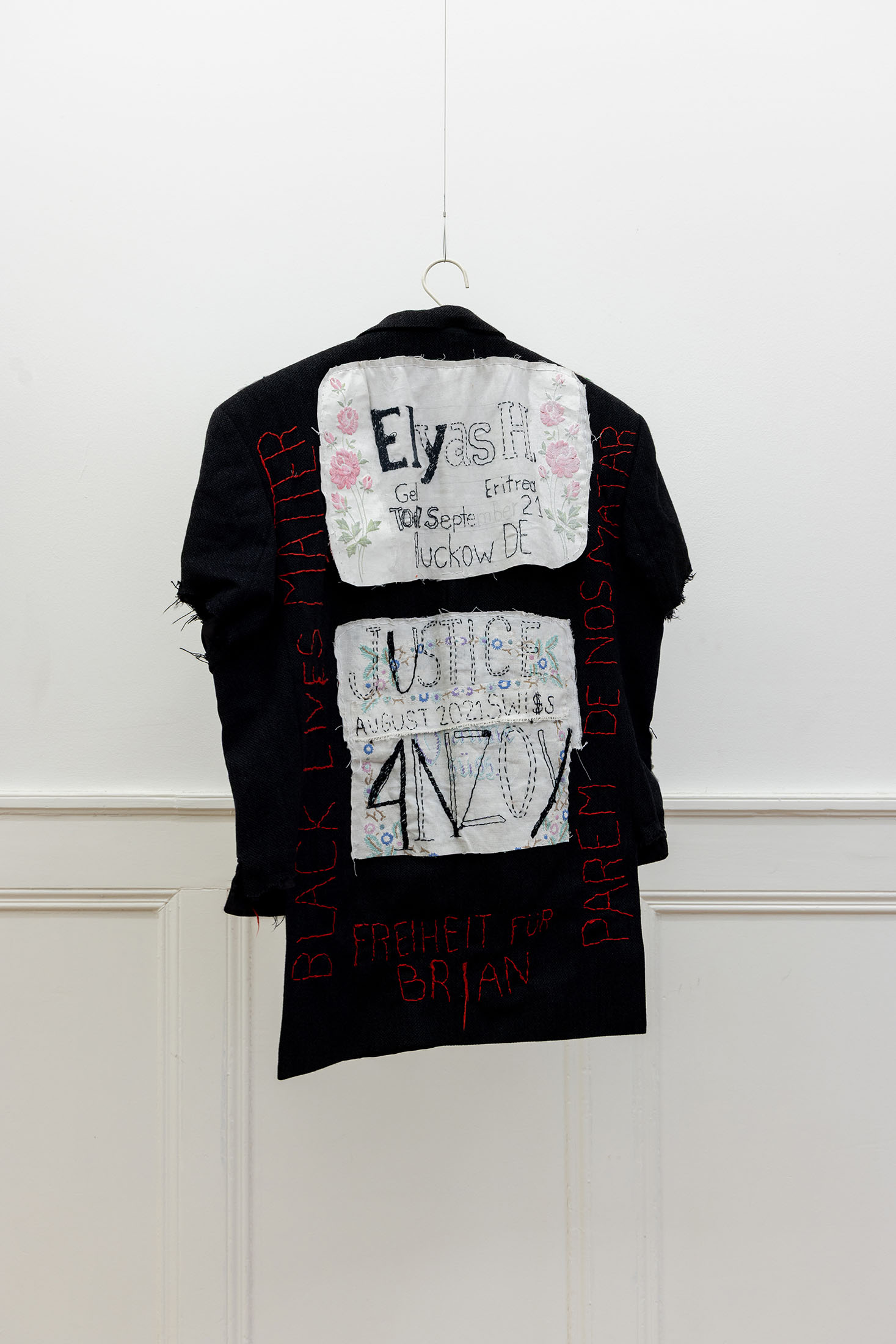
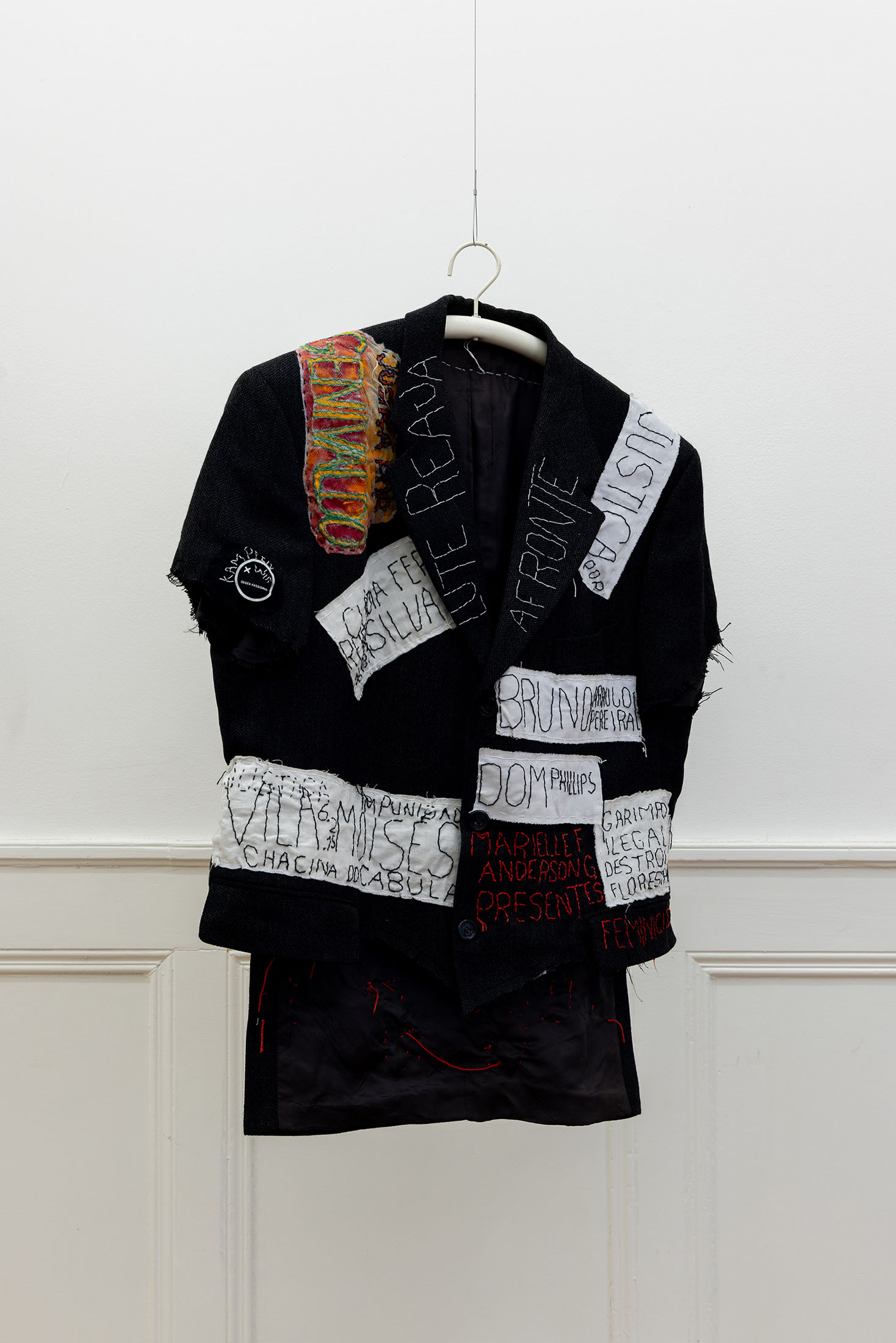
The Manifesto Jacket (2022) is embroidered with political slogans such as ‘Black Lives Matter’, along with the names of other Black people killed by police violence in various parts of the world.
Among them is Roger Nzoy Wilhelm, who was shot by a police officer in Morges, Switzerland, in 2021. By relating deaths in Brazil, Germany and Switzerland to one another, Eva de Souza demon-strates that racist and state-perpetrated violence are not isolated incidents but rather a form of struc-tural violence that is continues to be shaped by colonial power relations.
The jacket is not only a textile manifesto for social justice but also a garment through which remem-brance and resistance are manifested in the public sphere. Eva de Souza thus articulates an artistic approach inspired by protest movements, to keep the memory of people killed or injured by state vio-lence. She tells their stories to counter oblivion and invisibility and through them connects with people to initiate conversations around shared experi-ences, fears and emotional distress.
Room 2
The second exhibition space focuses on aspects of participation, ritual and healing.
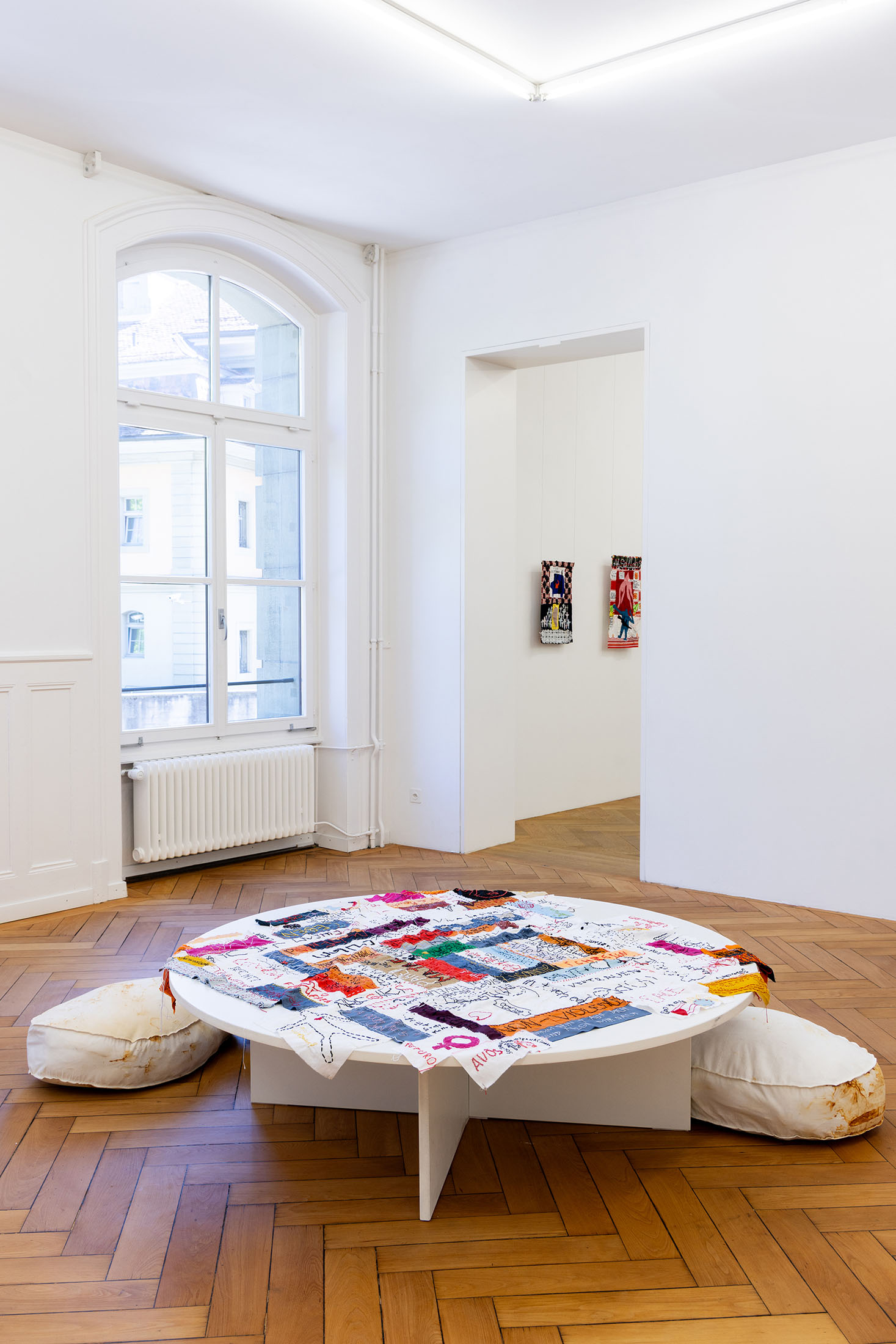
Starting from the premise that structural racism cannot be addressed on an individual level, for several years Eva de Souza has been developing participatory workshops for people with various experiences of discrimination. These collective encounters and the shared act of embroidery facili-tate the exchange of experiences and perspectives, as well as the opportunity to raise personal con-cerns and ideas. Here, textile practices and oral tradition come together as a way of exchanging knowledge in solidarity and mutual empowerment.
One example is the ongoing participative piece Cartografia Afetiva (2023/26–) (‘affective cartog-raphy’). The embroidered words and symbols bear witness to a multiplicity of voices, expressing wishes, hopes and thoughts. Visitors to the exhibi-tion are invited to embroider their own messages and add them to this ongoing textile work of art, which will continue to grow for the duration of the exhibition at Stadtgalerie. Fabric, thread and sewing needles are provided – the Stadtgalerie team is happy to assist you!
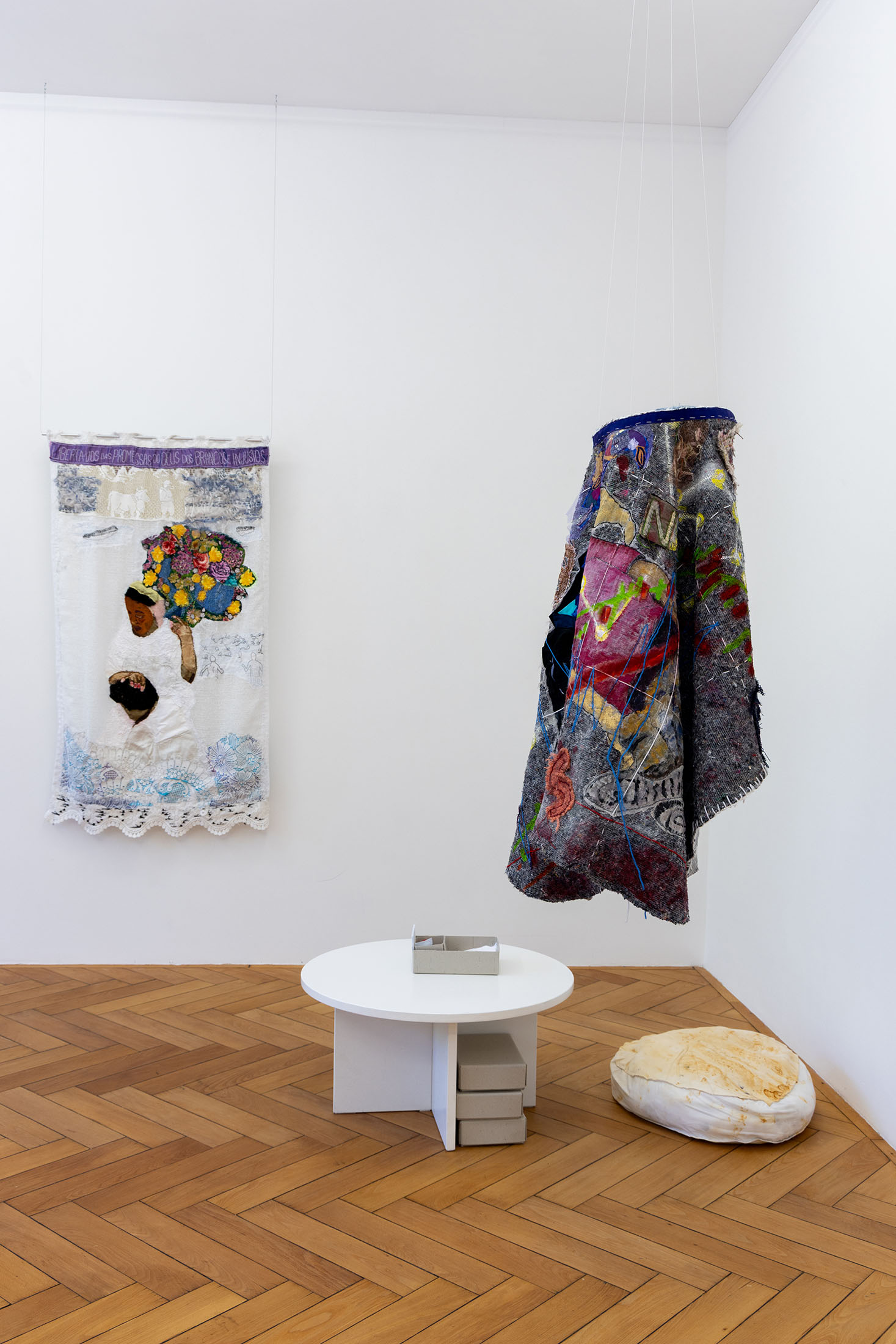
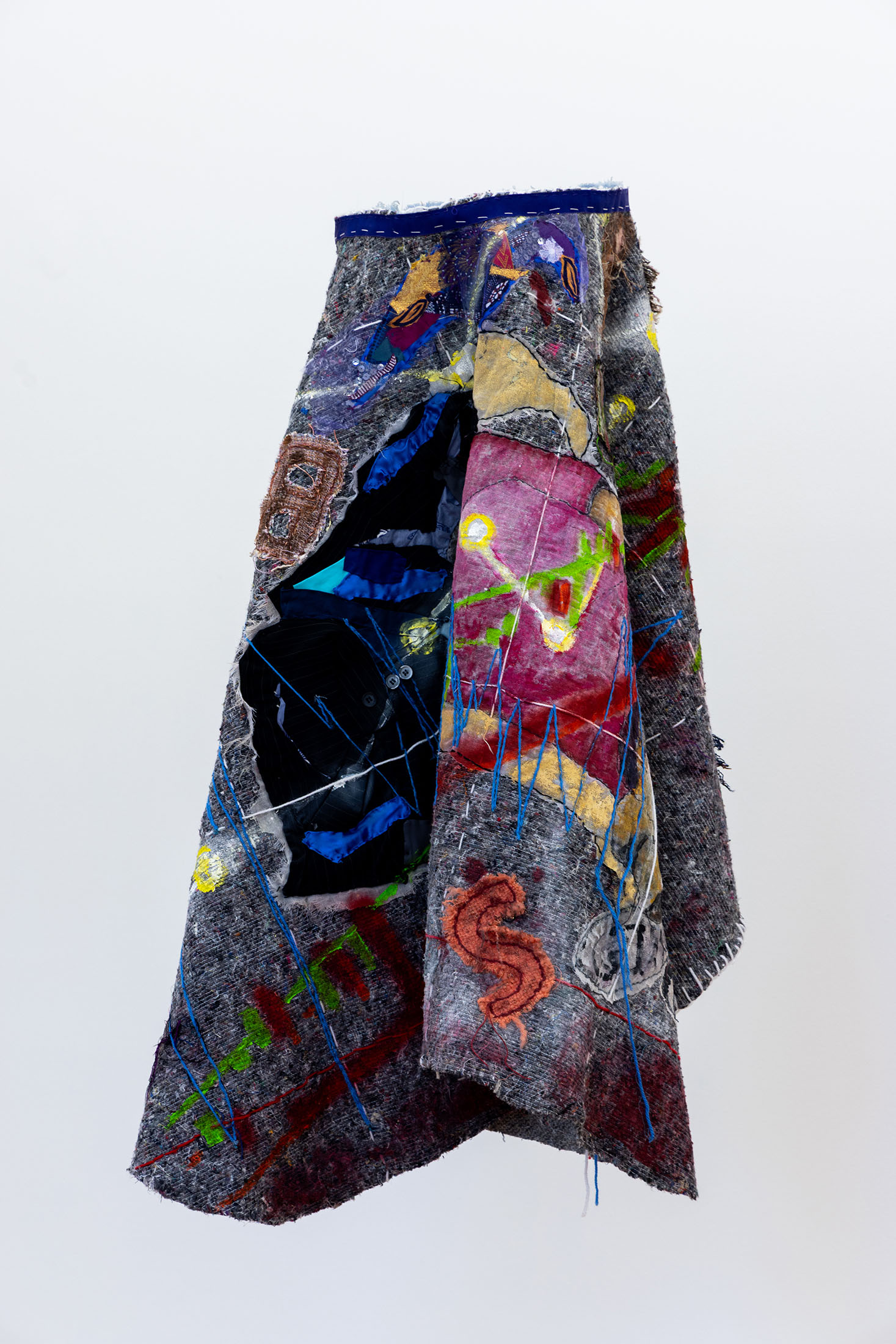
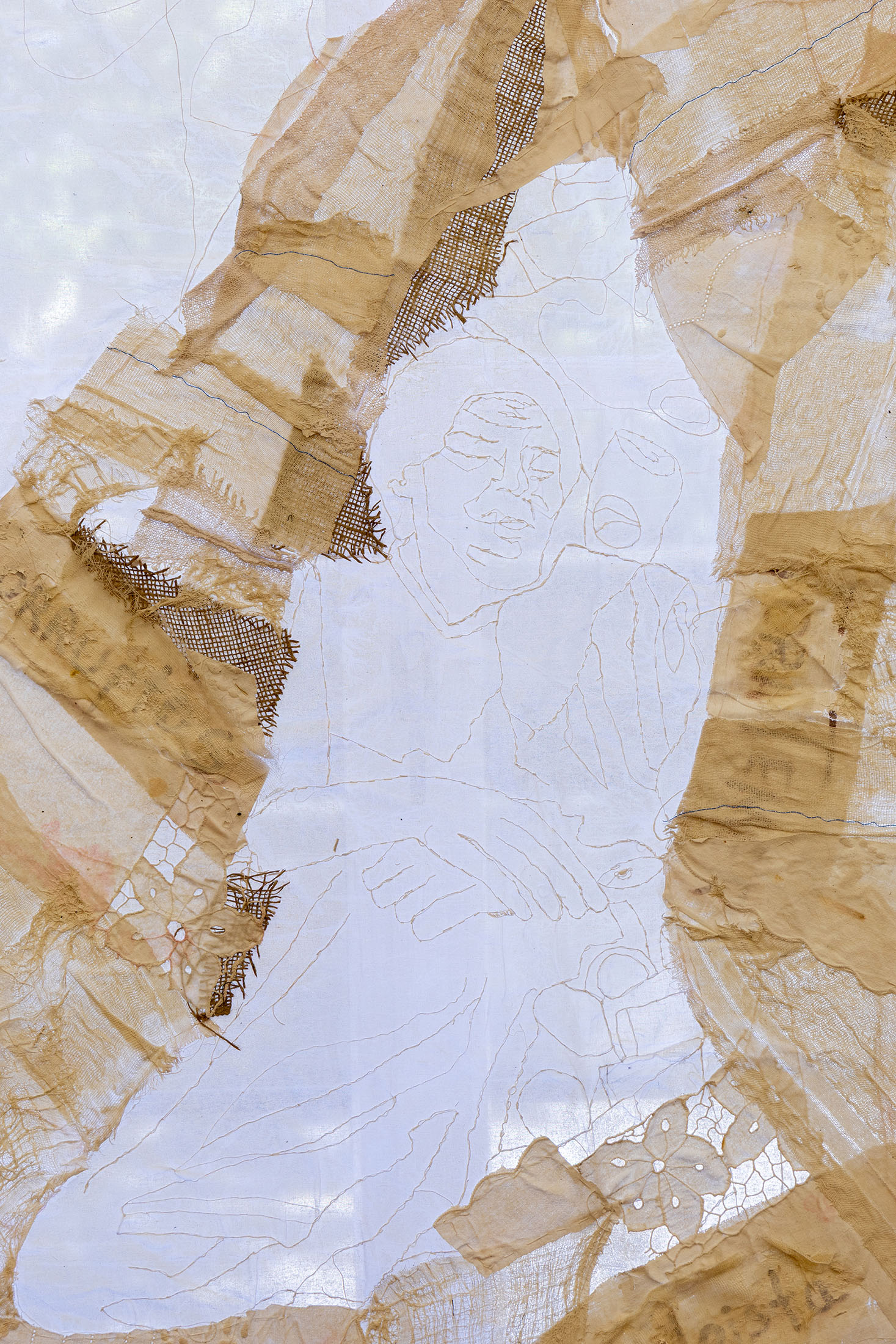
The two works facing each other, A Mulher no Saco (2023) and O Manto (2020), are part of a series depicting sleeping figures. Eva de Souza considers sleep as a strategy of resistance, a means of evading the pressure to conform to capitalist expectations of productivity and exploitability. She portrays two people resting in public space. In O Manto an oscillating line suggests a heartbeat, or perhaps the stock market price. The letters can be interpreted as a reference to a precarious residency status.
Material itself also plays an important role in Eva de Souza’s textile practice. She frequently works with textiles found in second-hand shops, often originating in domestic contexts such as the kitchen or needlework. The grey cloth on which the scenes of O Manto and Zamambaia in the first space are embroidered is a recycled fabric, of a type often used by homeless people in Brazil as a sturdy blanket for protection against the cold. The fabric itself is thus already imbued with its own social history, with associations to the depicted scene on the street and the unyielding materiality of the asphalt. Much like Manifesto Jacket, the artist con-ceived O Manto as a cloak. Worn on the body, it provides protection and strengthens the wearer’s agency in relation to the world. The translucent sheet of A Mulher no Saco, by contrast, points to the vulnerability and social invisibility of unhoused people.
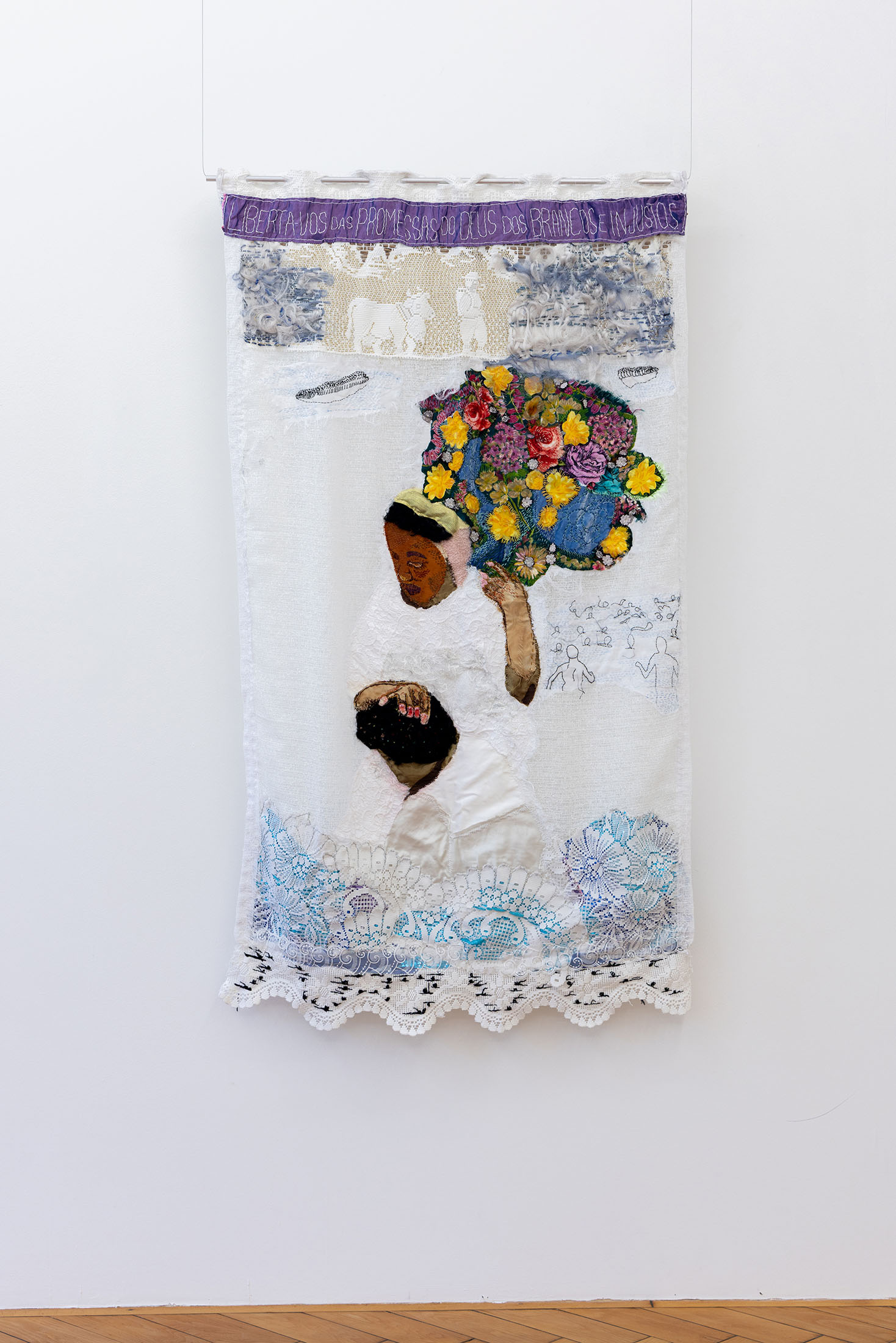
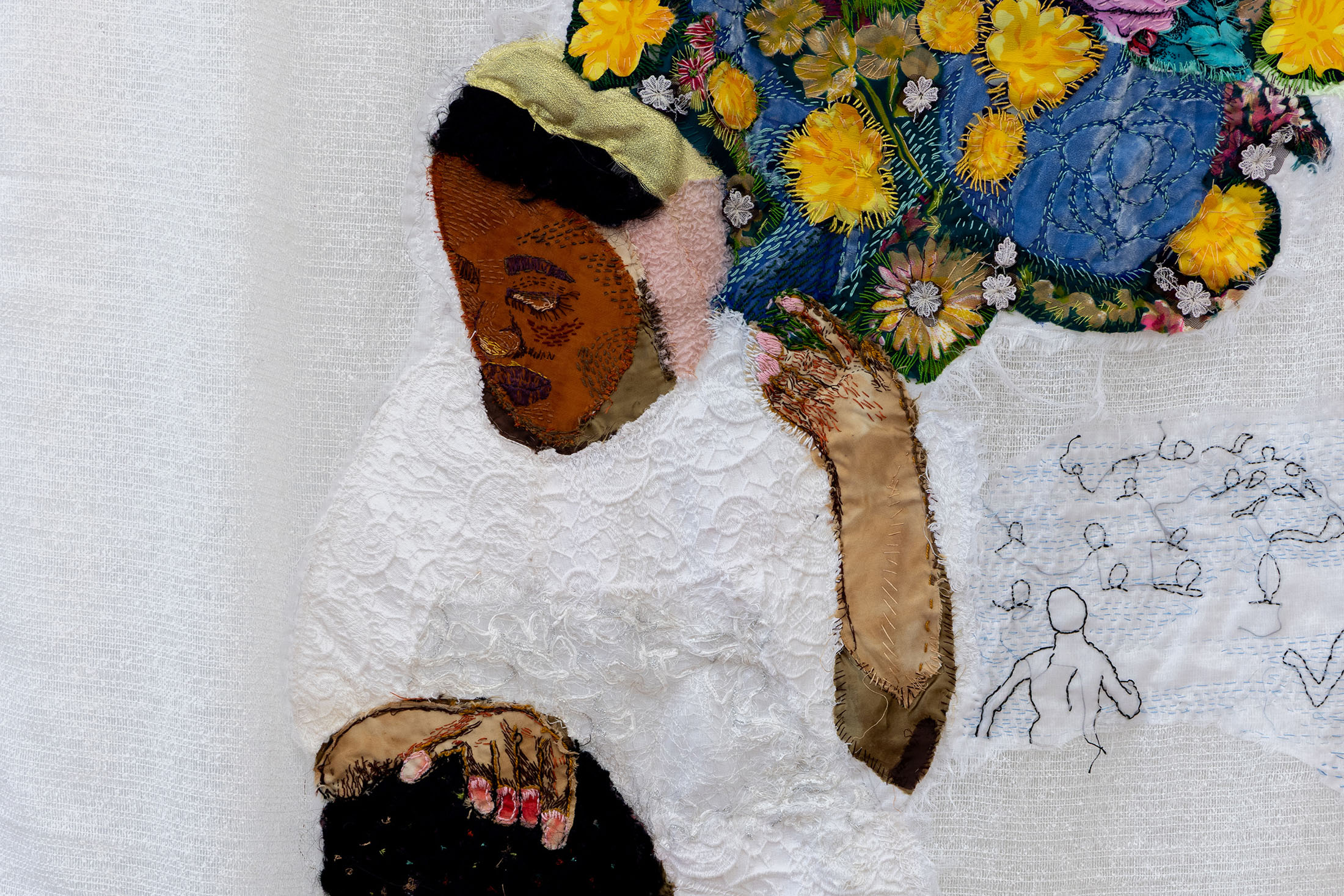
O Batismo (2025) (‘the baptism’) is a textile self-portrait of Eva de Souza. As a priestess in a white gown and adorned with flowers, she performs a baptismal ritual. In the water, bodies and boats float towards a golden horizon. Behind them are cows, snow-capped mountains and the figure of an alpine herdsman. The work explores the histo-ries of colonialism and migration, as well as reli-gious promises of salvation. Eva de Souza draws parallels with the hopes held by many migrants of finding prosperity and security in another place.
The spiritual ritual could be understood as an attempt to break free of ideas shaped by colonial-ism. The priestess represented here draws her strength from within herself and from her connec-tion with nature, water and plants.
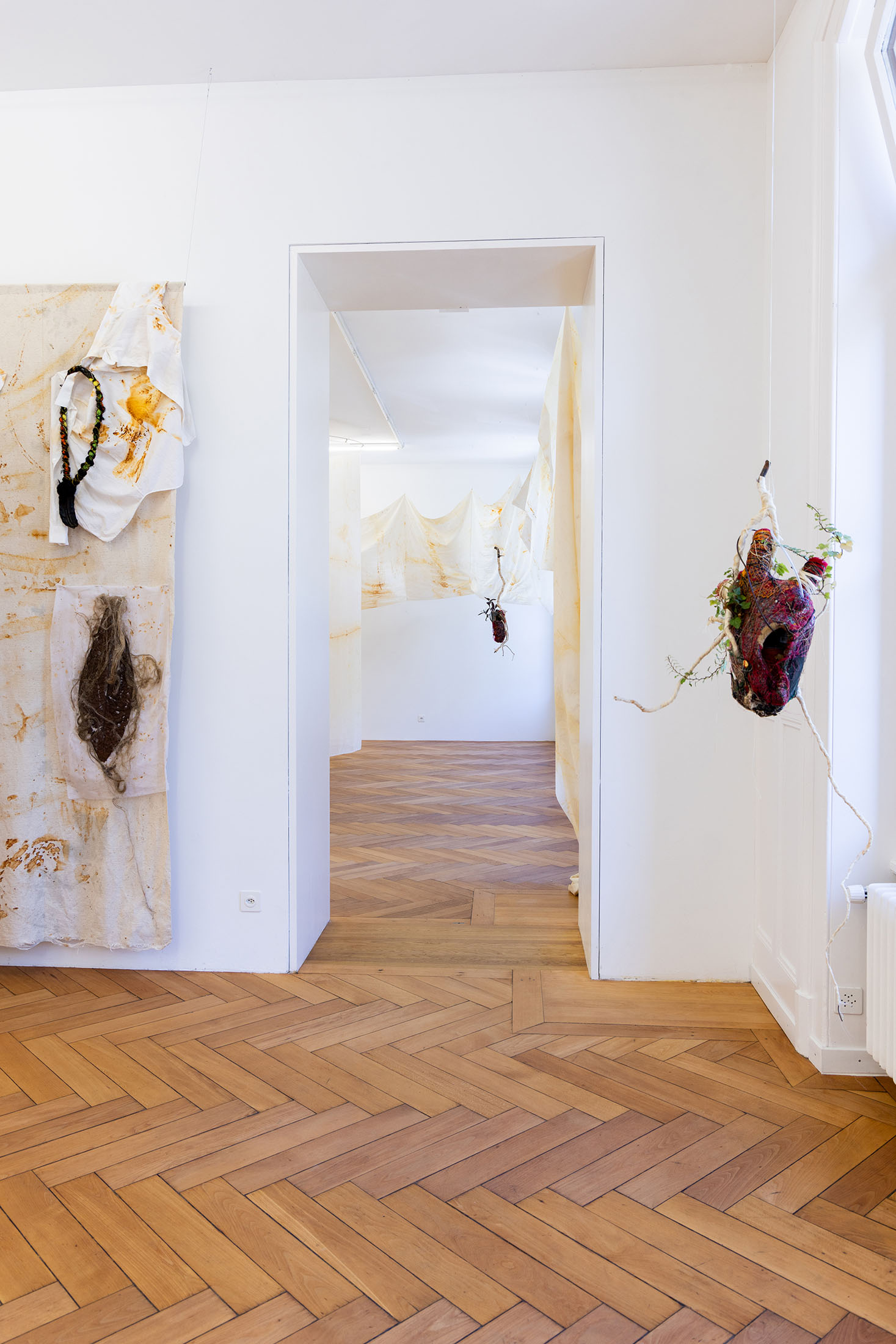
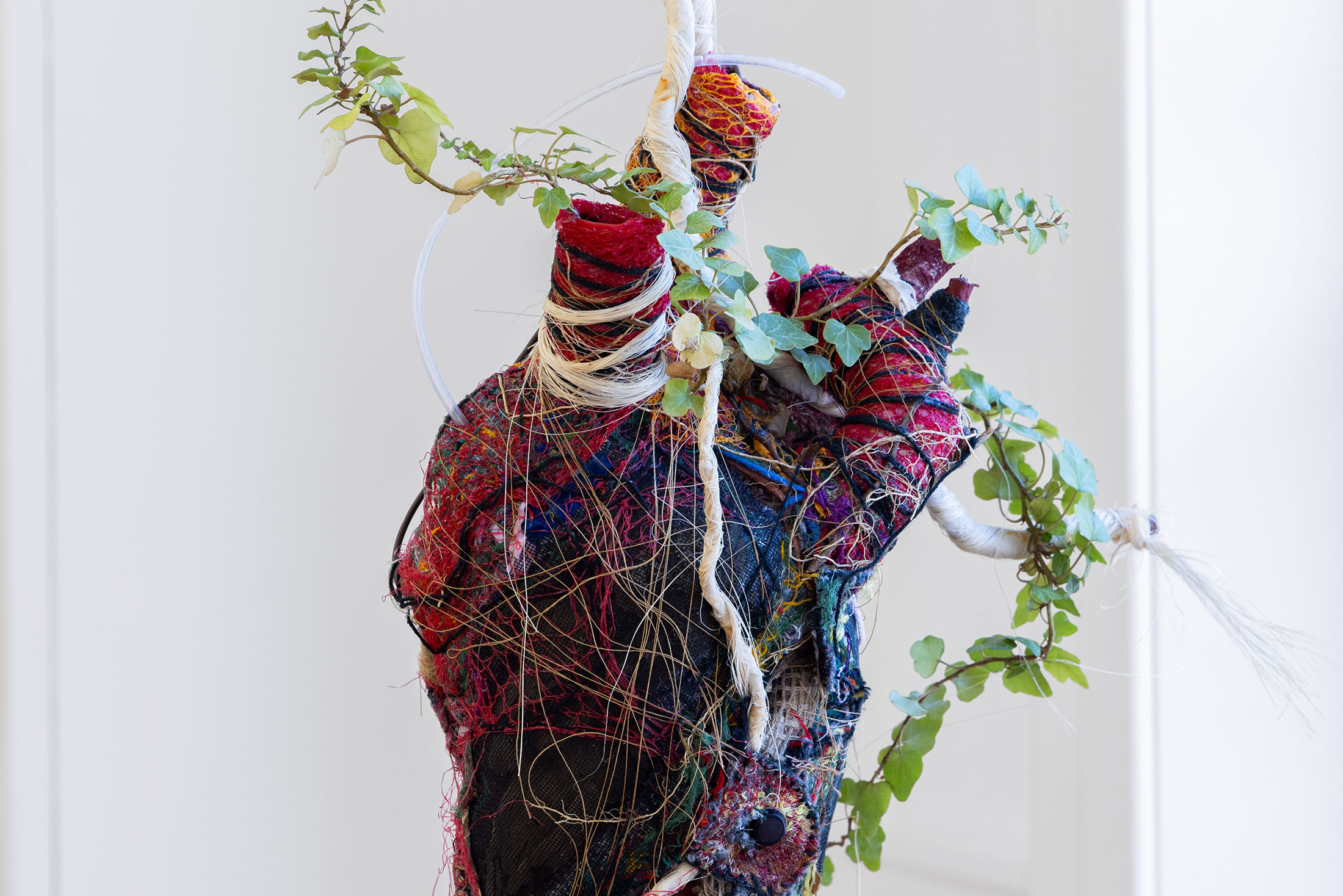
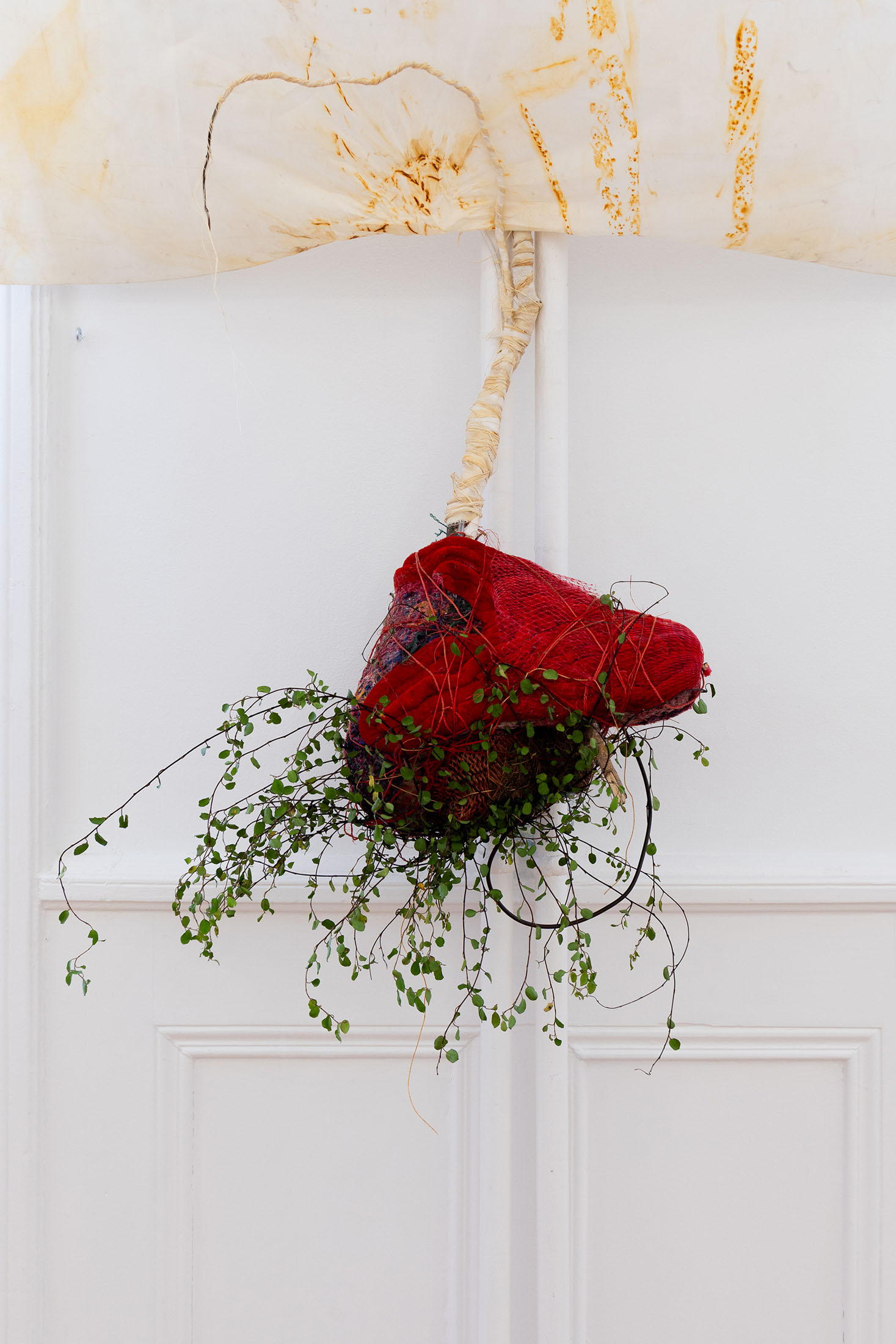
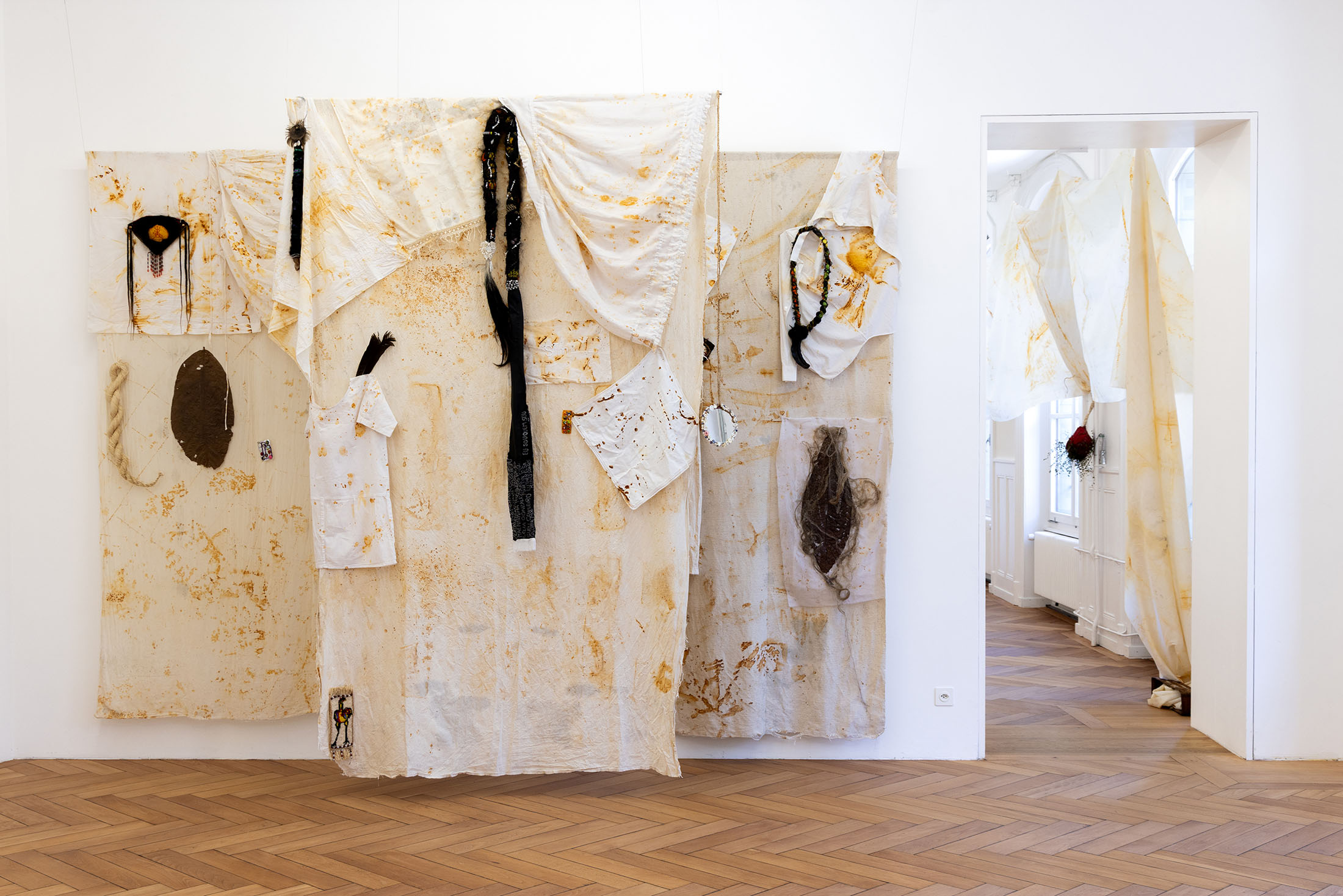
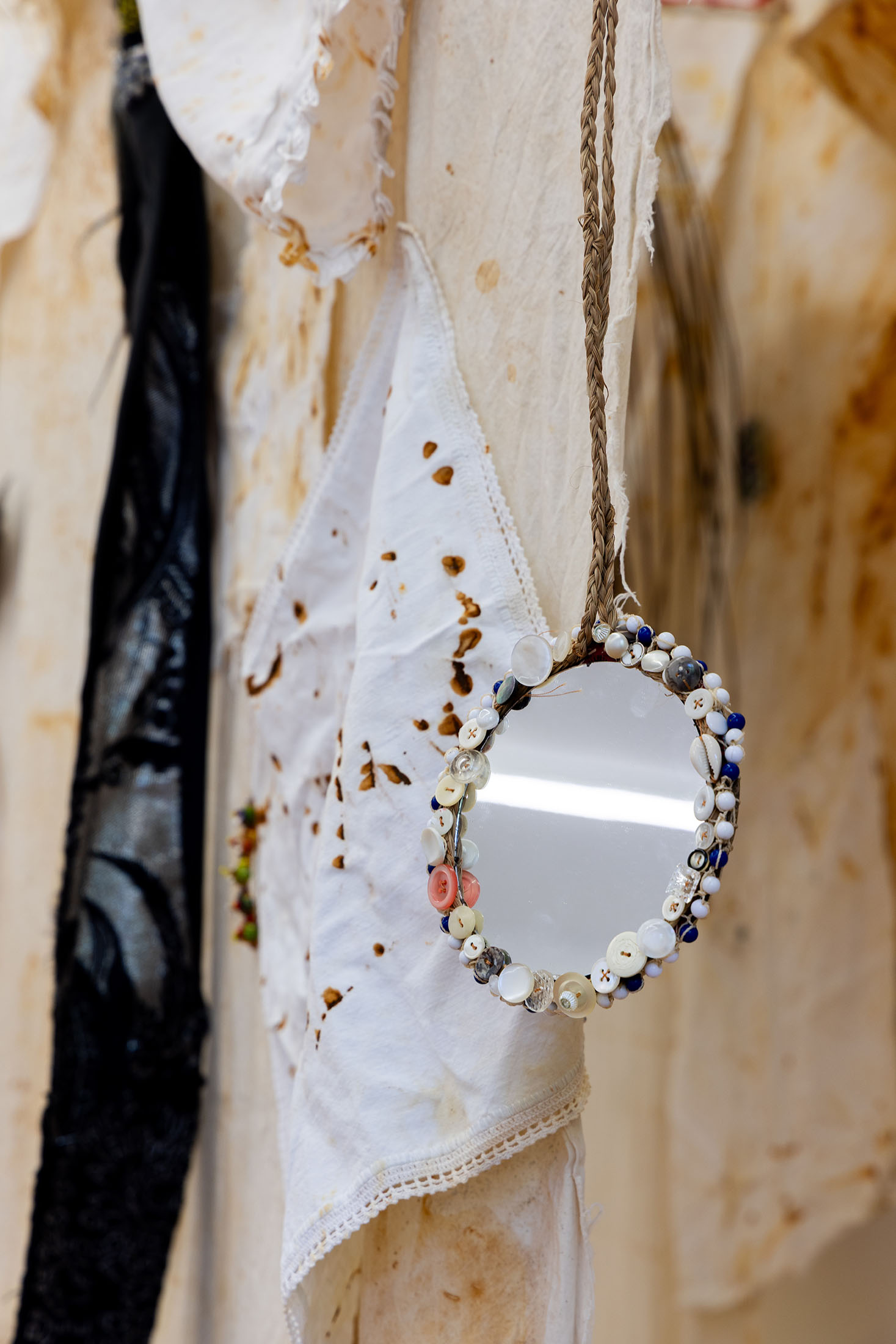
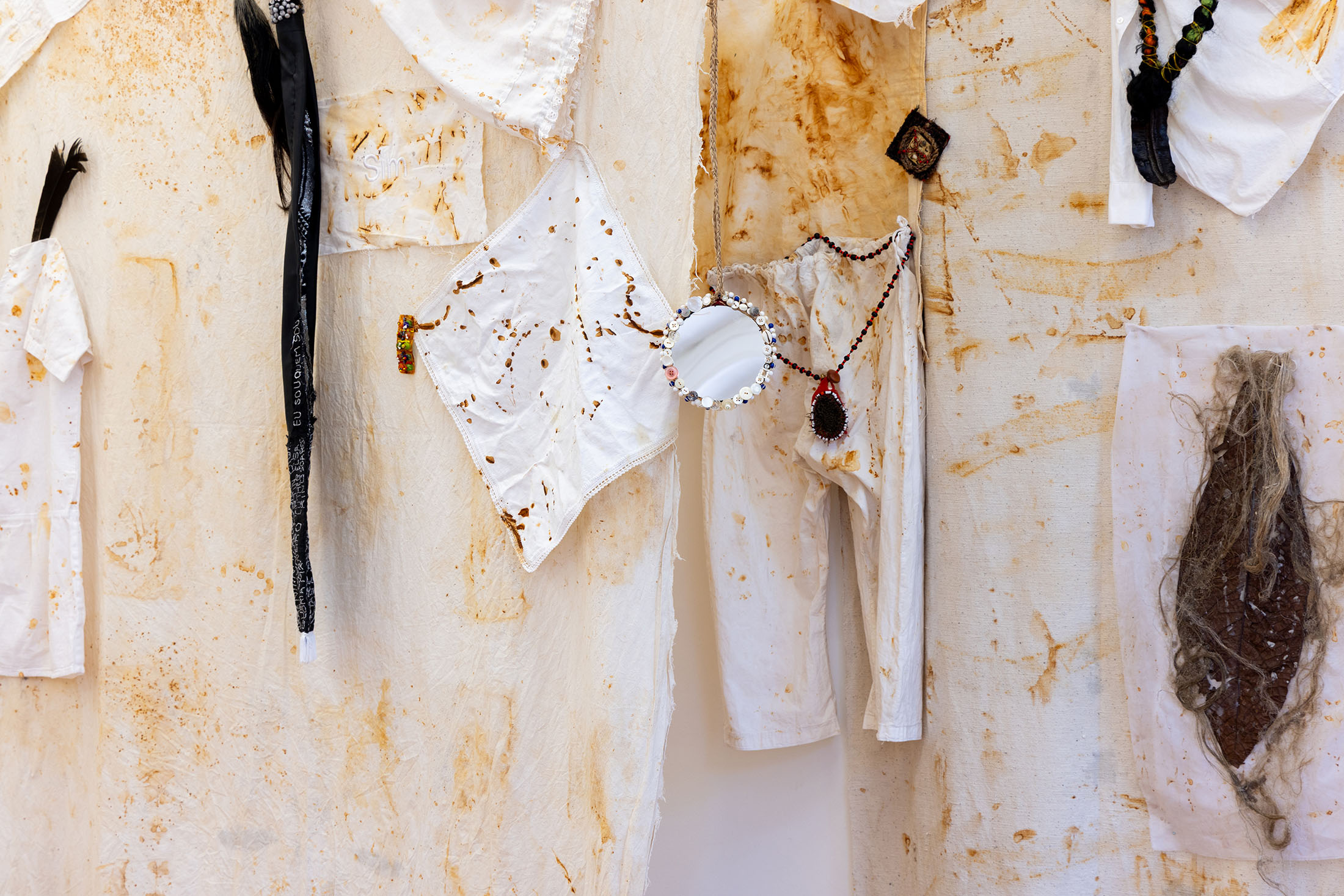
On the opposite wall, amulets, plant fibres, items of clothing and panels suspended from the ceiling combine to form a vibrant tapestry. Eva de Souza made the amulets from seed pods, used textiles and medicine packages. Through this act of repurpos-ing, these everyday materials acquire a symbolic meaning: the objects evoke sexual organs, body extensions or pieces of jewellery. Originally created as protective companions for people in her community, they develop their own physical pres-ence in conjunction with the other elements of the installation. The palm leaves from Bahia hanging between the fabrics mark a transition. Tradition-ally, they are hung in doorways, to cleanse those entering of negative thoughts and inspire new beginnings. Visitors to the exhibition are also invited to walk through the installation, to engage with the objects and their own perceptions. Body awareness, purification, traditional knowledge and artistic creation intertwine to form another source of self-healing.
Room 3
Eva de Souza devotes the final space in the exhibi-tion to themes of time and contemplation.
By turning to abstraction, she claims an artistic freedom that in the Western art canon was long regarded as a supposedly universal and autonomous expression of modernism, while Black artists were often confined to questions of origin, identity and political representation. Eva de Souza resists this expectation and reframes abstraction as artistic self-determination.
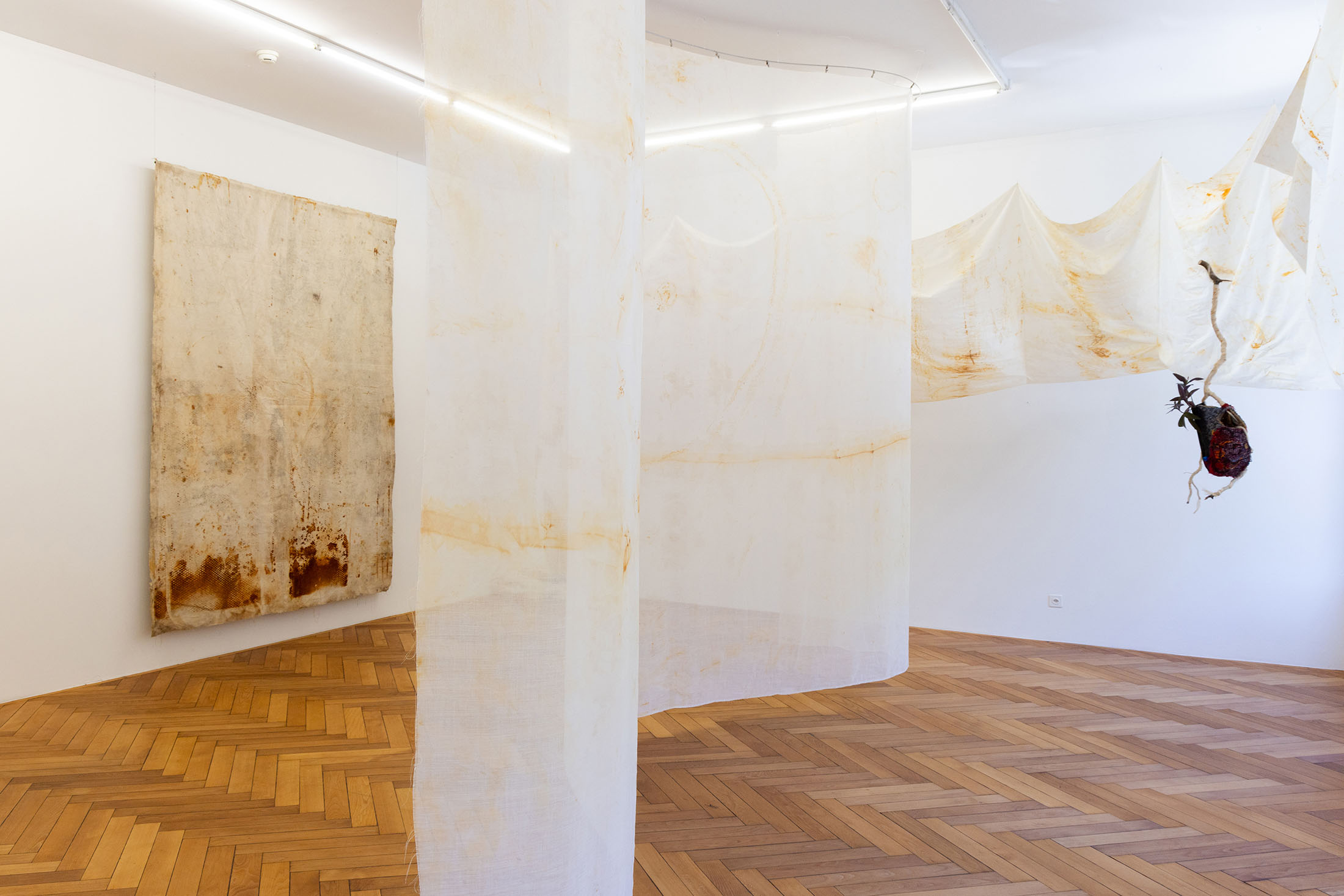
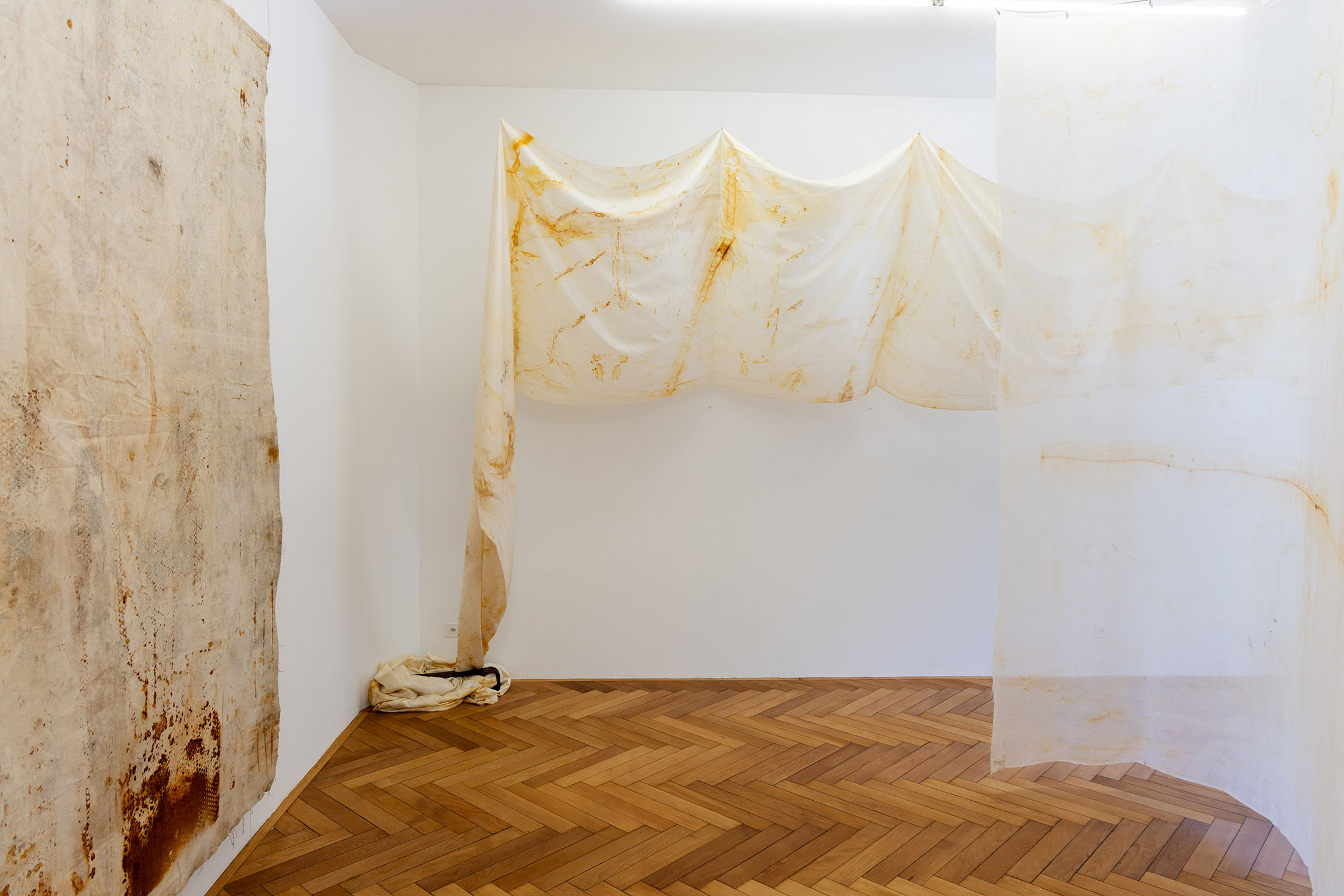
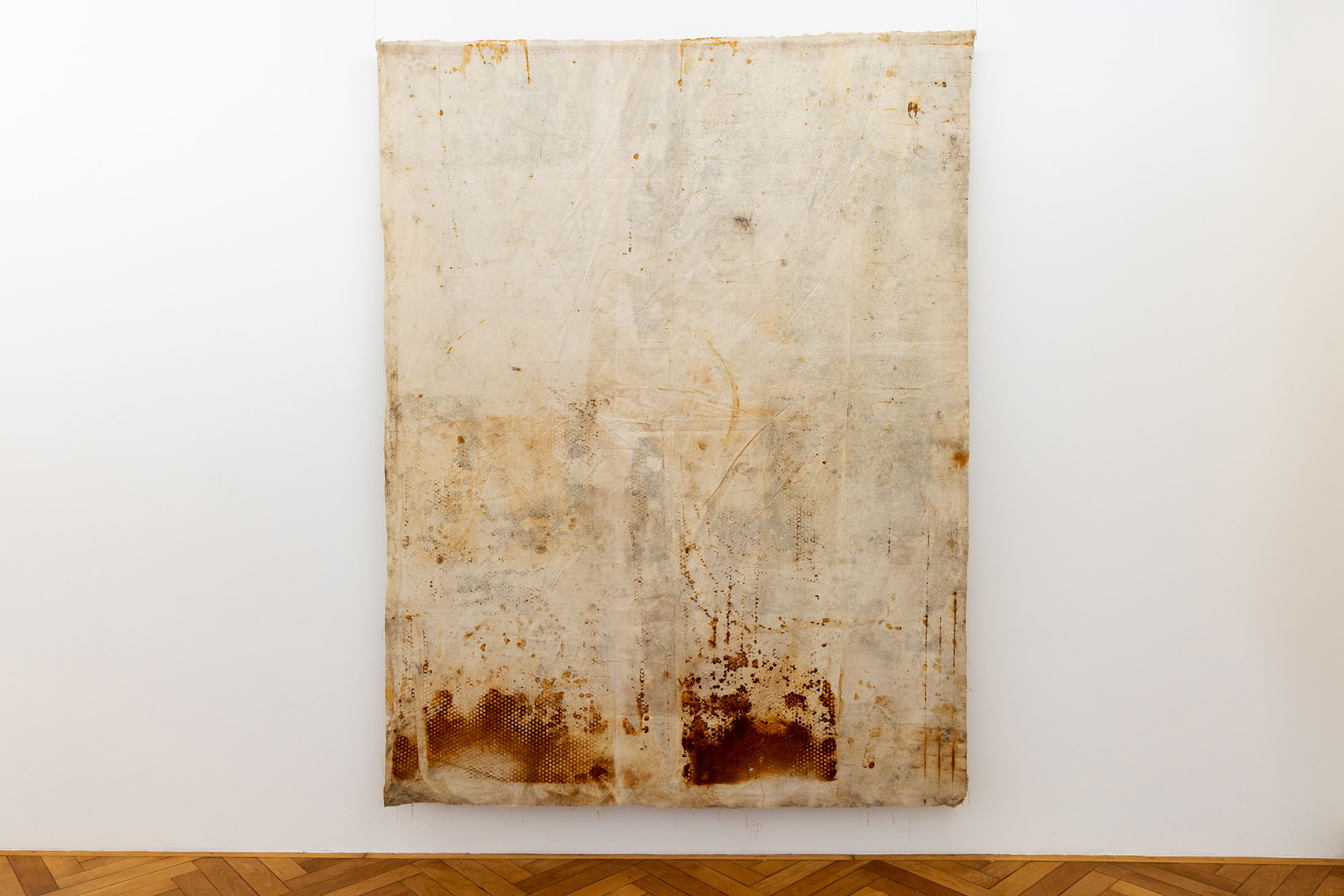
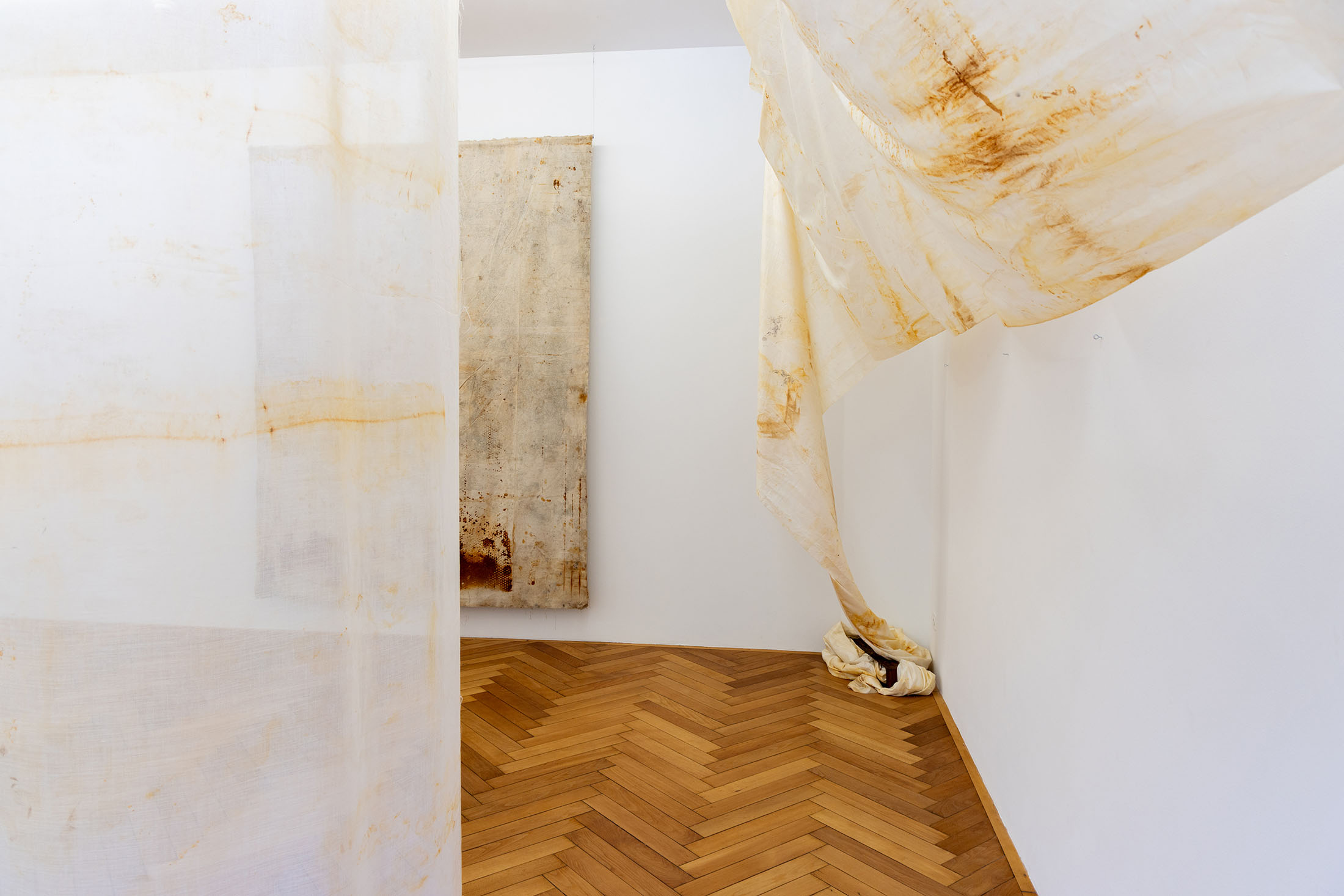
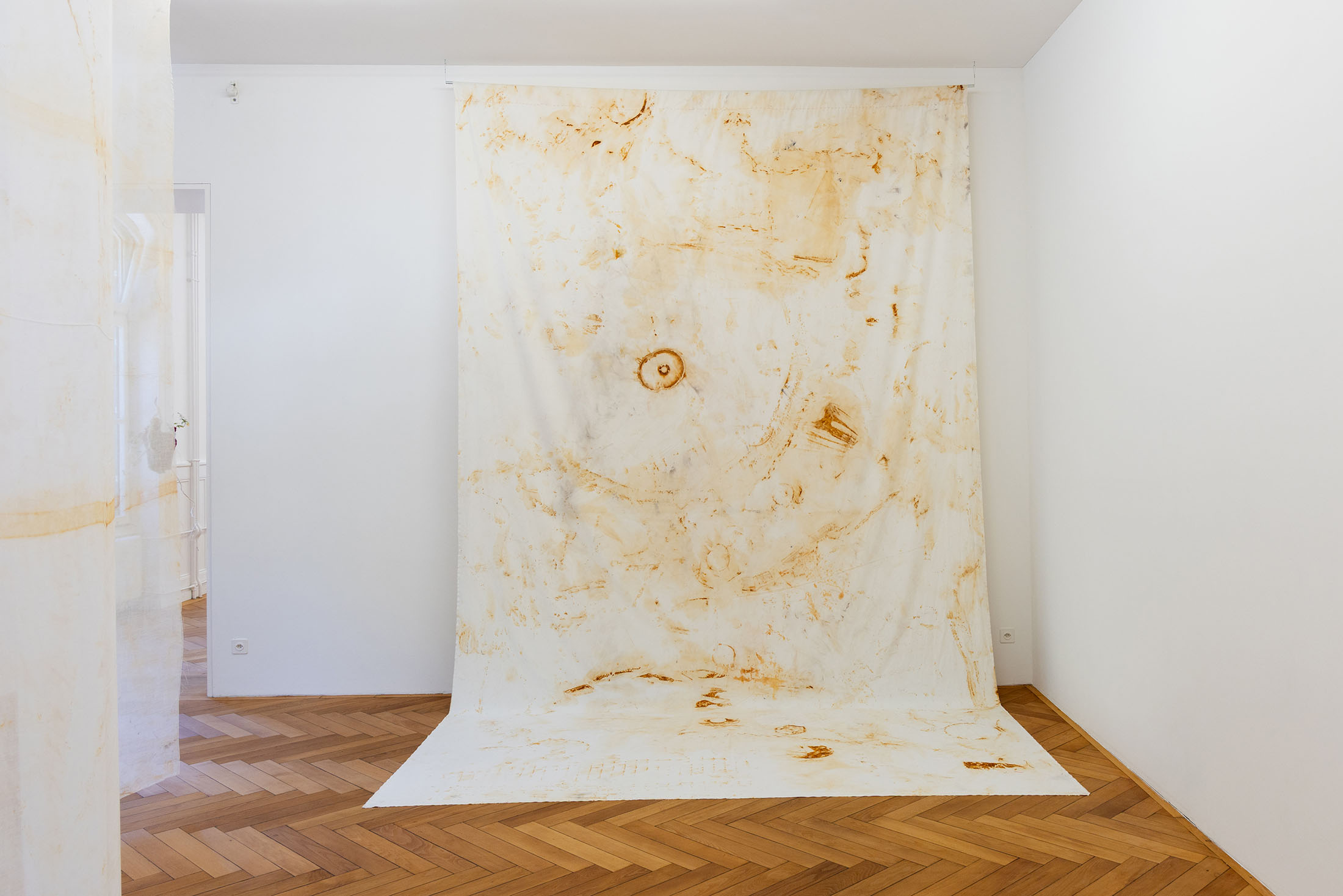
For this large-scale installation, Eva de Souza attached sheets of fabric to rusty surfaces over an extended period, watering them and allowing them to oxidise. Traces of rust are inscribed in the textiles like a map of time. Some of the light, pale fabrics are freely suspended in space and react to drafts of air and movement. Following the figura-tive and narrative work in the preceding parts of the exhibition, this space foregrounds the immedi-ate experience of material, light, movement and time. The focus shifts from protest against external violence to a form of reflective agency.
—Text: Eva-Maria Knüsel