
↳ Conversations
September 30, 2025
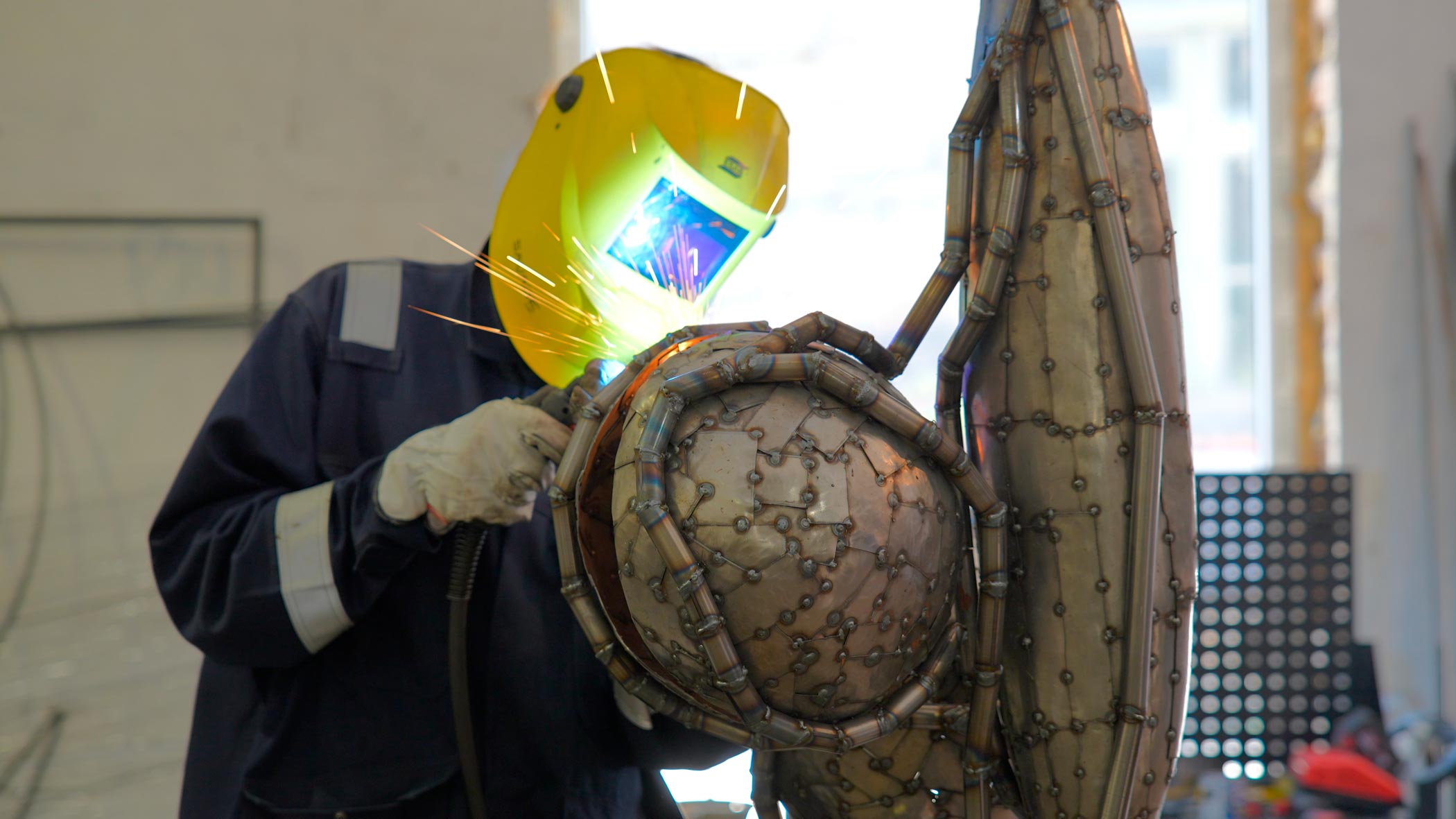
Indrikis Gelzis’ work operates at the intersection of sculpture, visual language, and conceptual inquiry. Over the course of his practice, Ģelzis has transitioned from early explorations in video and installation art to abstract sculpture, spatial objects, and “wall sculptures.” These works integrate industrial and organic materials such as stainless steel, MDF, natural veneer, textiles, and paint, manipulated through processes including cutting, bending, welding, burning, and collage. His work is distinguished by its processual nature: each work unfolds from the logic of the preceding one, foregrounding continuity and investigation over closure or definitive statement. Rather than imposing a singular message, Gelzis deliberately cultivates interpretative openness, allowing viewers to construct meaning through their encounter with the work.
Indrikis Gelzis practice interrogates the shifting relationships between the human, the natural, and the technological, as well as the tension between organic and mechanical systems. Recent exhibitions, such as Bingo Gaze (2024), exemplify this concern through the integration of sculptural form with light and sound environments. In these settings, perception is examined as a mediated experience structured by temporal, optical, and acoustic phenomena. Furthermore, his works frequently evoke an “algorithmic reality”: formal arrangements that recall data visualizations, networks, or cartographies. These do not represent empirical data per se but rather the affective and epistemological resonances of such systems—identity, memory, fragmentation, and relational tension.
Central to Gelzis’ practice is the negotiation of formal and conceptual dualities: linearity and spatiality, system and fragment, information and experience. His aesthetic language also incorporates an affective dimension, one that might be described as a form of romantic claustrophobia bound to fragility, entropy, and temporality. In this respect, his cyborg-like aesthetic—merging biological associations with industrial form—positions the viewer in a liminal space that is simultaneously unsettling and seductive. Here, rigid materials assume corporeal qualities, while mechanical structures acquire metaphorical and emotional resonance, underscoring the instability of boundaries between organic life and technological systems.
June 25, 2025
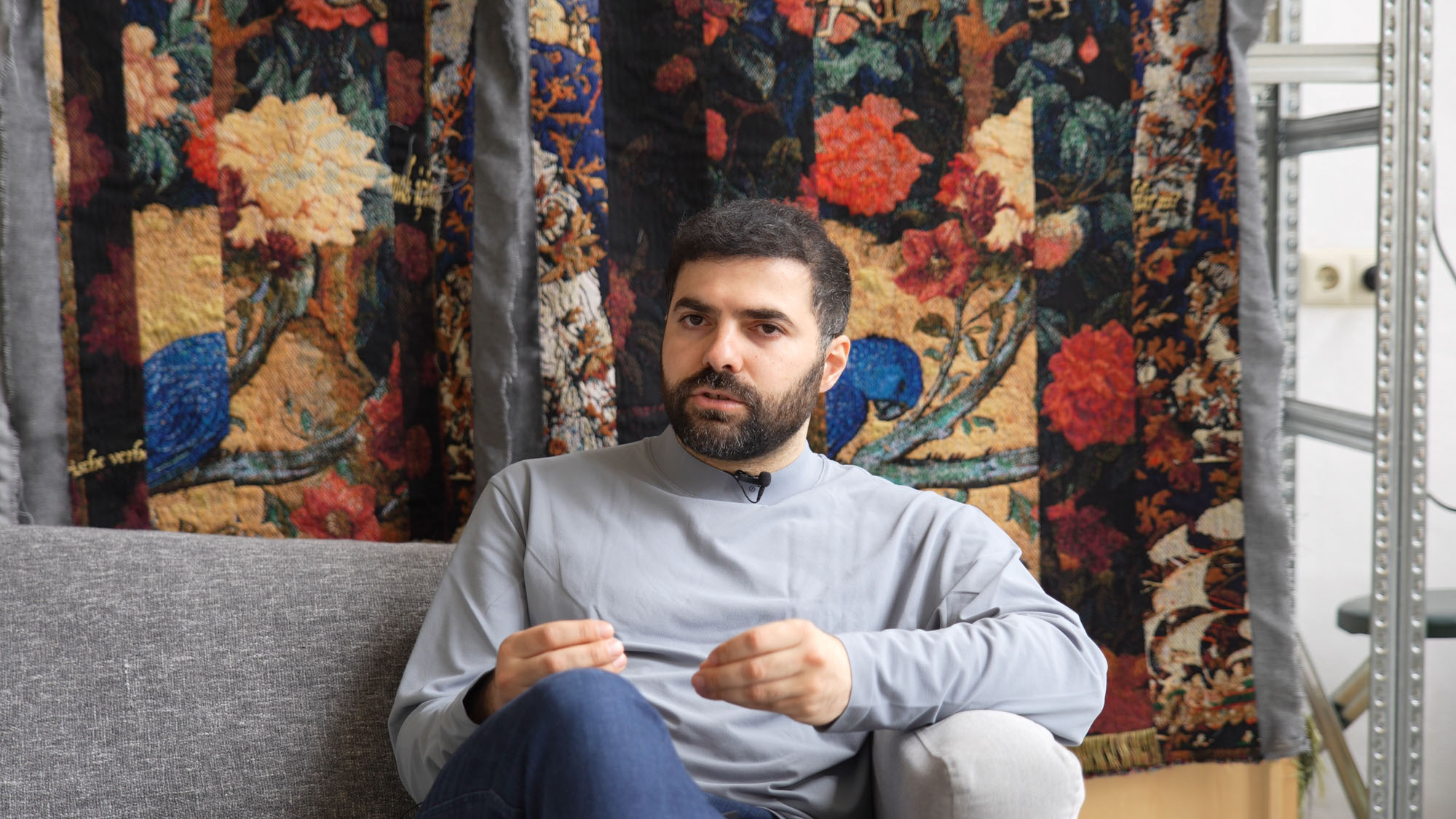
In this video, we visit Cihad Caner in his studio in the Afrikaanderwijk district of Rotterdam. The artist discusses his project “(Re)membering the riots in Afrikaanderwijk in 1972 or guest, host, ghos-ti”, exhibited at Kunstinstituut Melly. This project examines the largely forgotten 1972 riots, where guest workers were targeted, and explores the complexity and elusive nature of memory. Through the testimonies of witnesses to the riots, the artist constructs a collective memory that is not entirely accurate or true but attempts to reflect on something lost in the past that inhabits the present state of the neighborhood itself. By reconstructing the events of 1972, the artist proposes a healing of Afrikaanderwijk’s history through alternative narratives that challenge the dominant ones.
For his exhibition “Parroting The Parrot” at 1646 in The Hague, the artist delves into the history of Sultan Cem, an Ottoman prince accompanied by his parrot, who serves as the narrator of the story. A story that defies primary narratives by mixing myth and reality. The exhibition is accompanied by tapestries and lamps made especially for this exhibition.
In our conversation, Cihad Caner elaborates on his projects and experiences, focusing on how history is constructed and distributed, as well as the influence it has in shaping socio-political realities that have distant origins in time but act in entirely contemporary ways. His work employs non-linear and multi-directional narratives that offer a perspective that challenges accepted and taken-for-granted parameters.
May 30, 2024
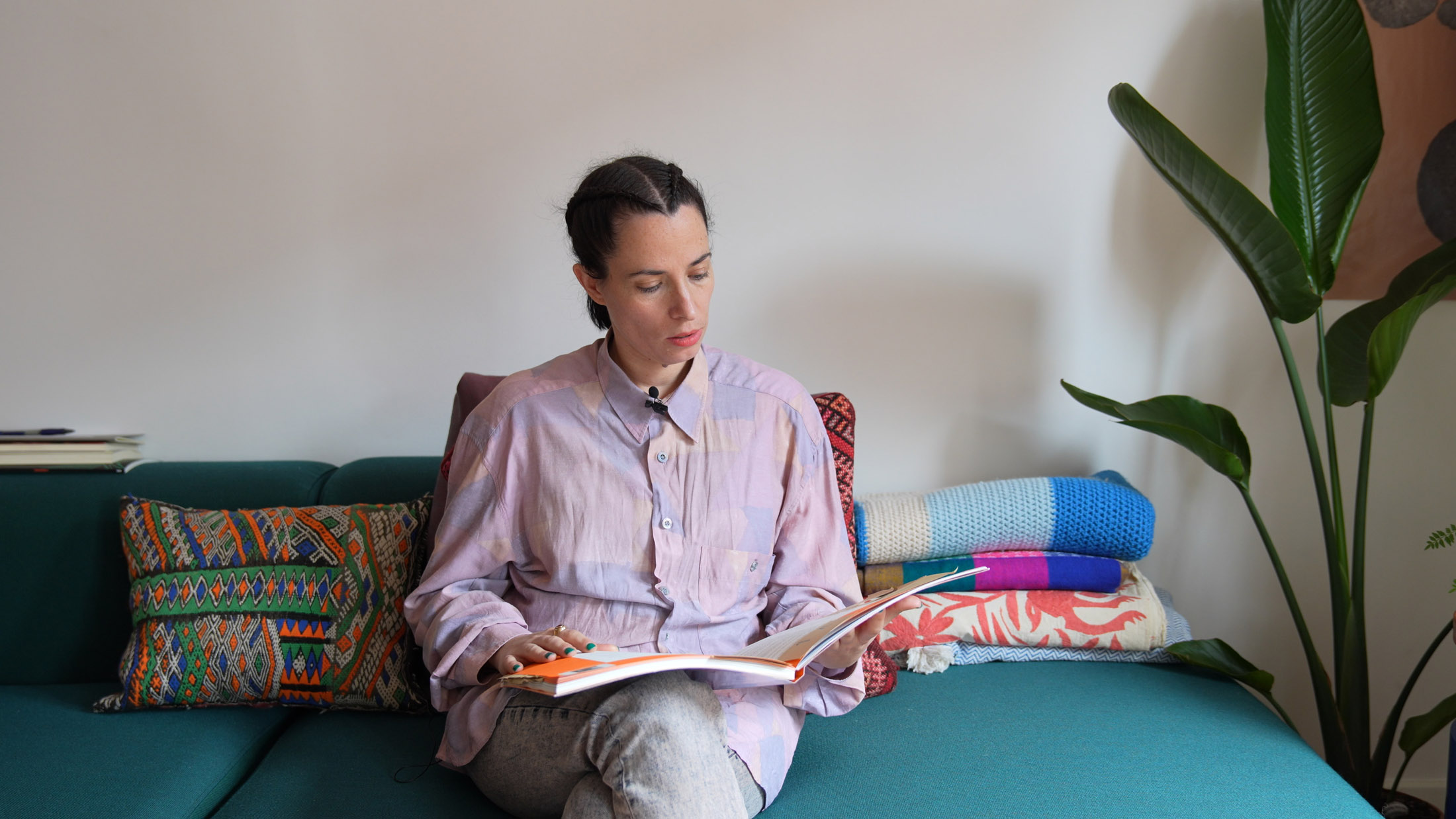
This video, produced by Art Viewer, takes a journey through June Crespo’s oeuvre, including recent exhibitions and her working process. Over a year, we accompanied the artist to her studio, home, and foundry in the Basque Country, where she lives and works, and had conversations with her.
Since her beginnings, June Crespo has approached the expressive possibilities of materials, addressing themes such as corporeality, architecture, and the transformation of everyday objects. Her sculptures, often monumental and robust in appearance, are characterized by a balance between solidity and fragility that invites the viewer to reflect on the relationship between body and space.
In her works, Crespo usually keeps the traces of the process visible, such as the remains left during the casting or the natural textures of materials, thus highlighting the importance of the process in the final result. The artist turns industrial and everyday materials into sculptural forms that transcend their origin and invites us to re-read space and the object, playing with perceptions of weight, balance, and scale.
September 12, 2023
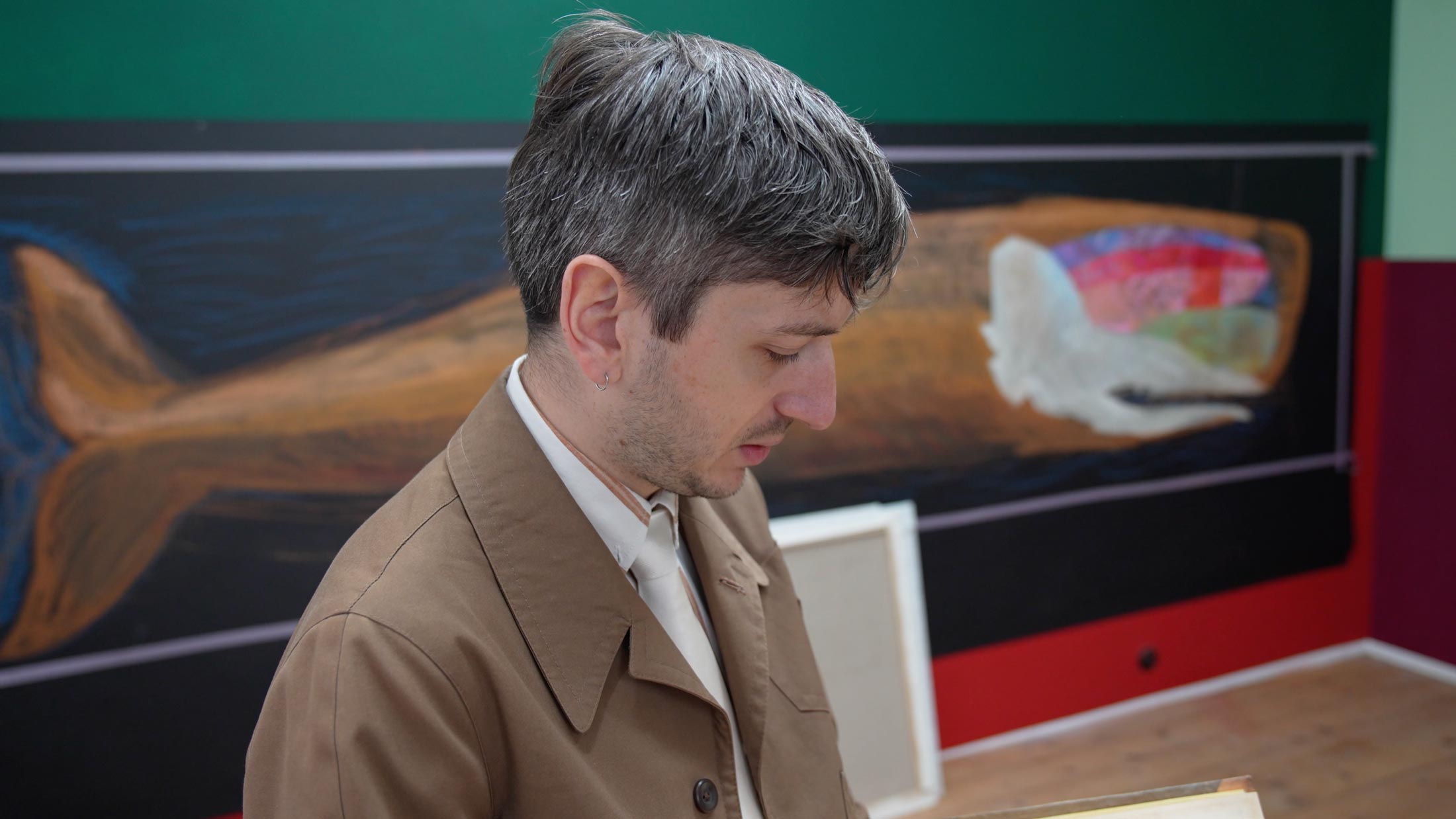
In April 2023, we visited Kasper Bosman at his home and studio in Brussels. Our conversation focused on the stories behind his work, process, latest projects, and his background as an artist, including his childhood.
Kasper Bosmans, born in Lommel (Belgium) in 1990, employs storytelling by creating narratives with multiple references from different cultural and historical sources. From an intuitive anthropological approach, he examines contemporary life’s vestiges of local traditions and mythological symbols.
Bosmans has gained recognition for his unique and thought-provoking pieces that explore themes such as cultural identity, tradition, and belief systems. His work often combines elements of the past with contemporary perspectives, creating a multi-layered visual experience.
June 20, 2023
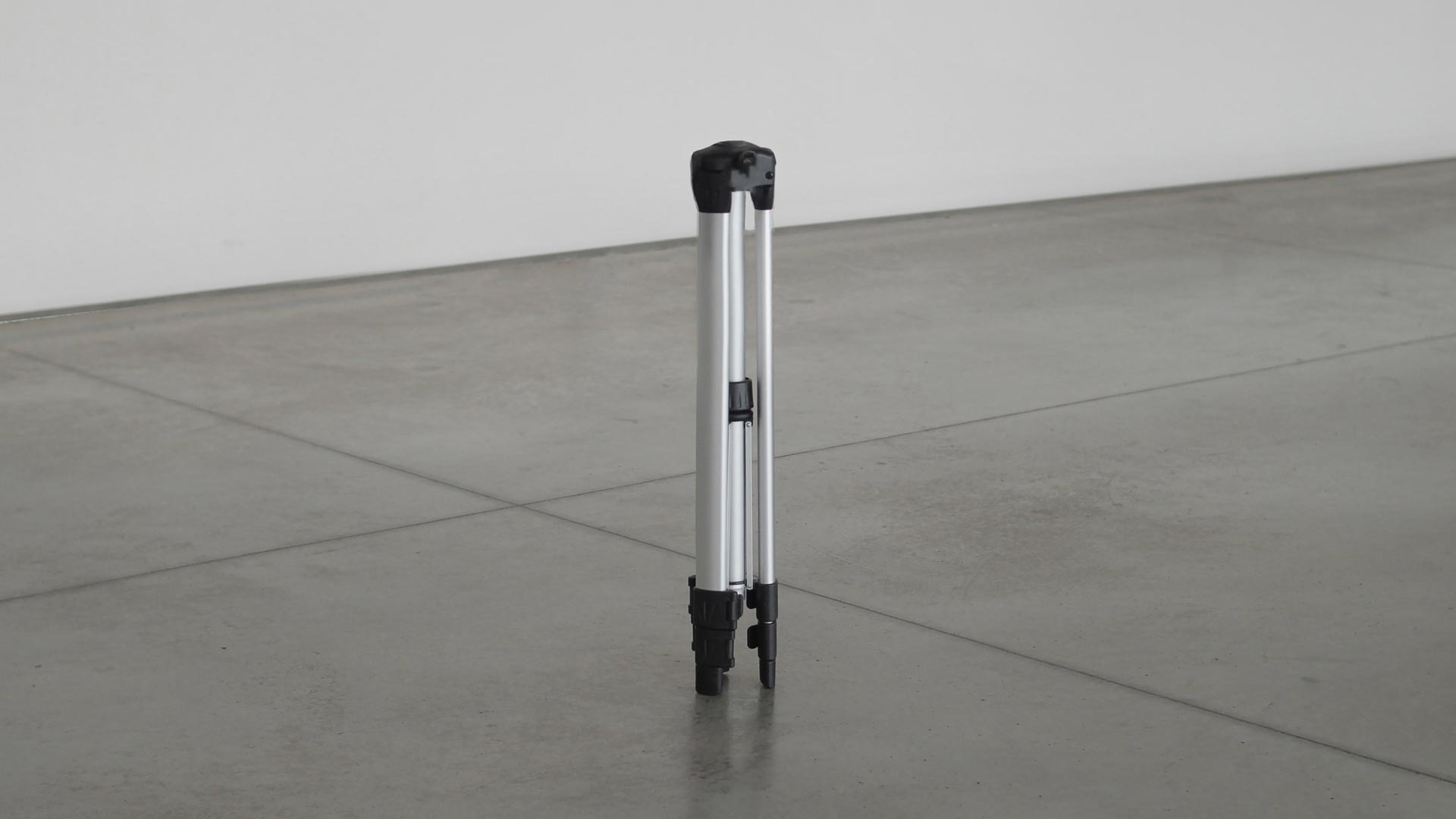
Francesco De Prezzo examines the logics and structures that configure the exhibition space and its different forms of mediation. His work is activated by the interweaving of the presence, absence, substitution, and almost erasement of the work of art as such.
De Prezzo carefully explores the layout and arrangement of the space, using it as a stage on which the viewers circulate in search of clues and fragments that will help them potentially form and construct the artwork. Through a well-constructed narrative, the artist places the object creating situations of ambivalence and questioning the concept of exhibition-making.
Following his project “Placeholder Sculptures” at FORM (Wageningen, The Netherlands), Art Viewer talks to Francesco De Prezzo about his working process.
March 17, 2023
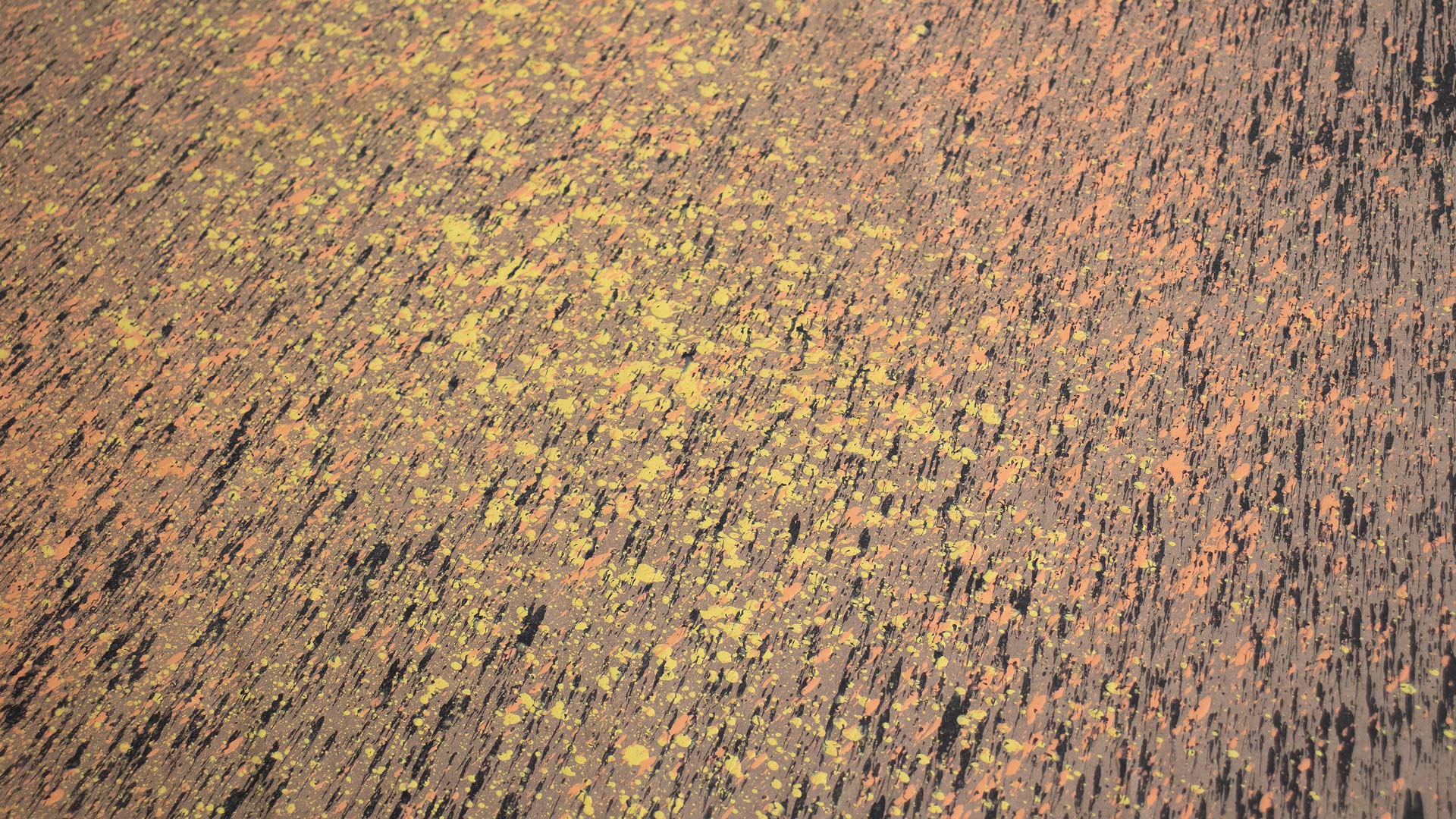
The documentaries of Félix Rodríguez de la Fuente, minimal and postminimal art, body shakers, the lyrebird song, bodybuilding photography, and butch aesthetics all find themselves matching up in the work of artist Leto Ybarra (Madrid, 1991). Her latest show, Neoned, articulates different scenarios where masculinity, theatricality, and artifice are drawn and blurred until almost completing a single body.
Crucial for Ybarra’s work is making visible theatrical strategies that operate in the construction of hegemonic masculinity. With her multiple references and formats, the artist addresses different aspects of the fabrication and manipulation of reality and meaning. We visited The Ryder gallery, where Ybarra showed her latest work, and she told us about her artistic process.
Neoned is curated by the Yaby collective (Beatriz Ortega Botas & Alberto Vallejo). Yaby is a curatorial project based in Madrid that has worked with artists such as Aria Dean, Claudia Pagès, P. Staff, Angharad Williams, and Bruno Zhu, among others.
February 14, 2023
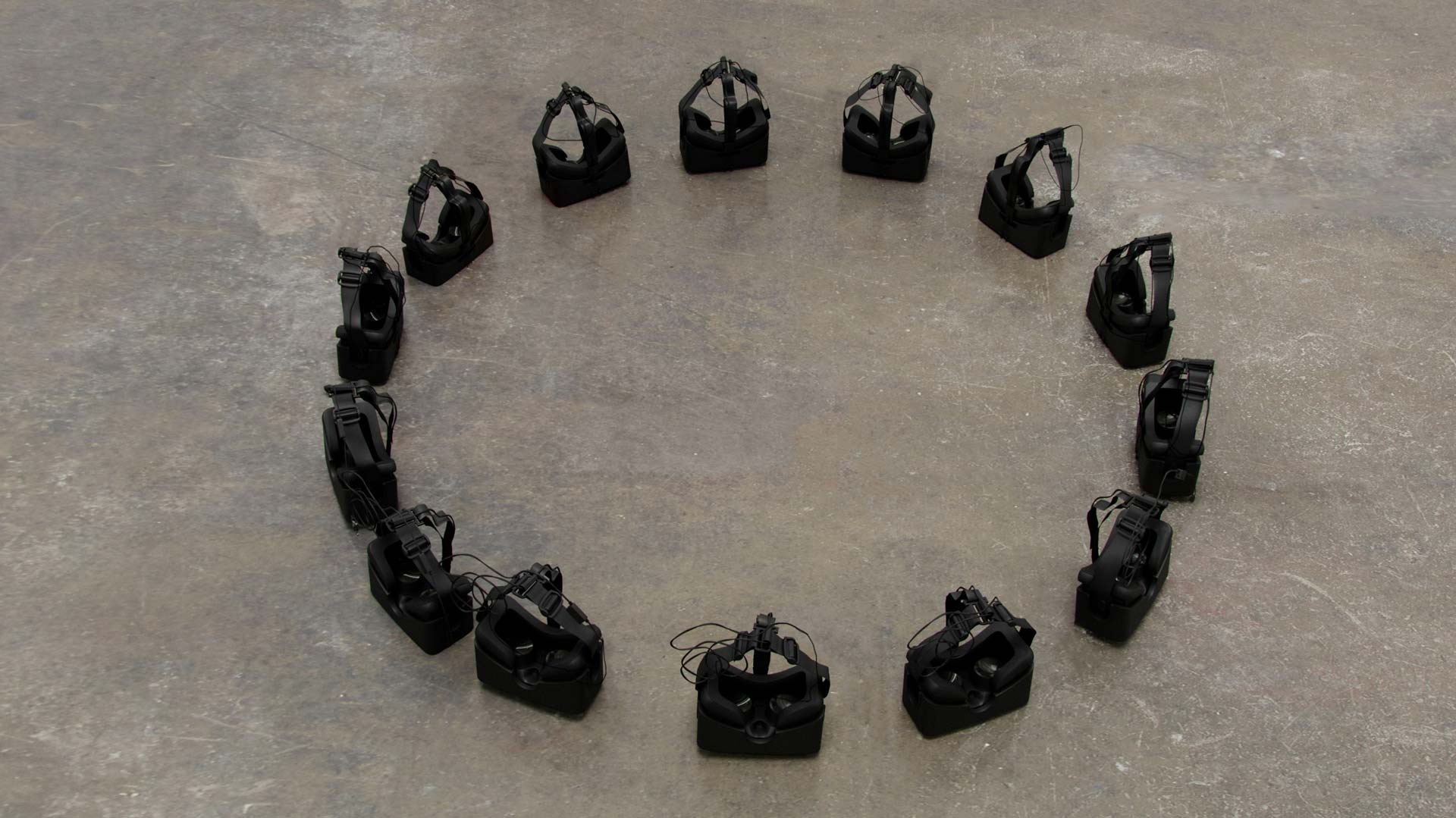
On the occasion of the exhibition PCE: Post Concrete Era, currently on display at Nighttimestory, Art Viewer talks to artist Skygolpe about his latest exhibition, the processes, and the stories behind his work.
Skygolpe is one of the most relevant artists in the digital art space working with NTFs. His work has been exhibited in many international galleries and institutions, such as Palazzo Giustinian (Venice, IT), Villa Panza (Varese, IT), Christie’s NY, Art Basel Miami, Museo della Permanente (Milan, IT), Valuart (Lugano, CH), Galerie Widmer (Zurich, CH), Nighttimestory (USA).
His iconic, faceless portraits result from a unique process converging physical layers with digital components. His work is born out of the encounter with the digital world, incorporating the virtual and the material in a continuous and inseparable solution.
Through his work, Skygolpe offers in-depth commentary on the impact of technology on society and the human experience, opening up new ways of interpreting, using, and thinking about art through blockchain technology.