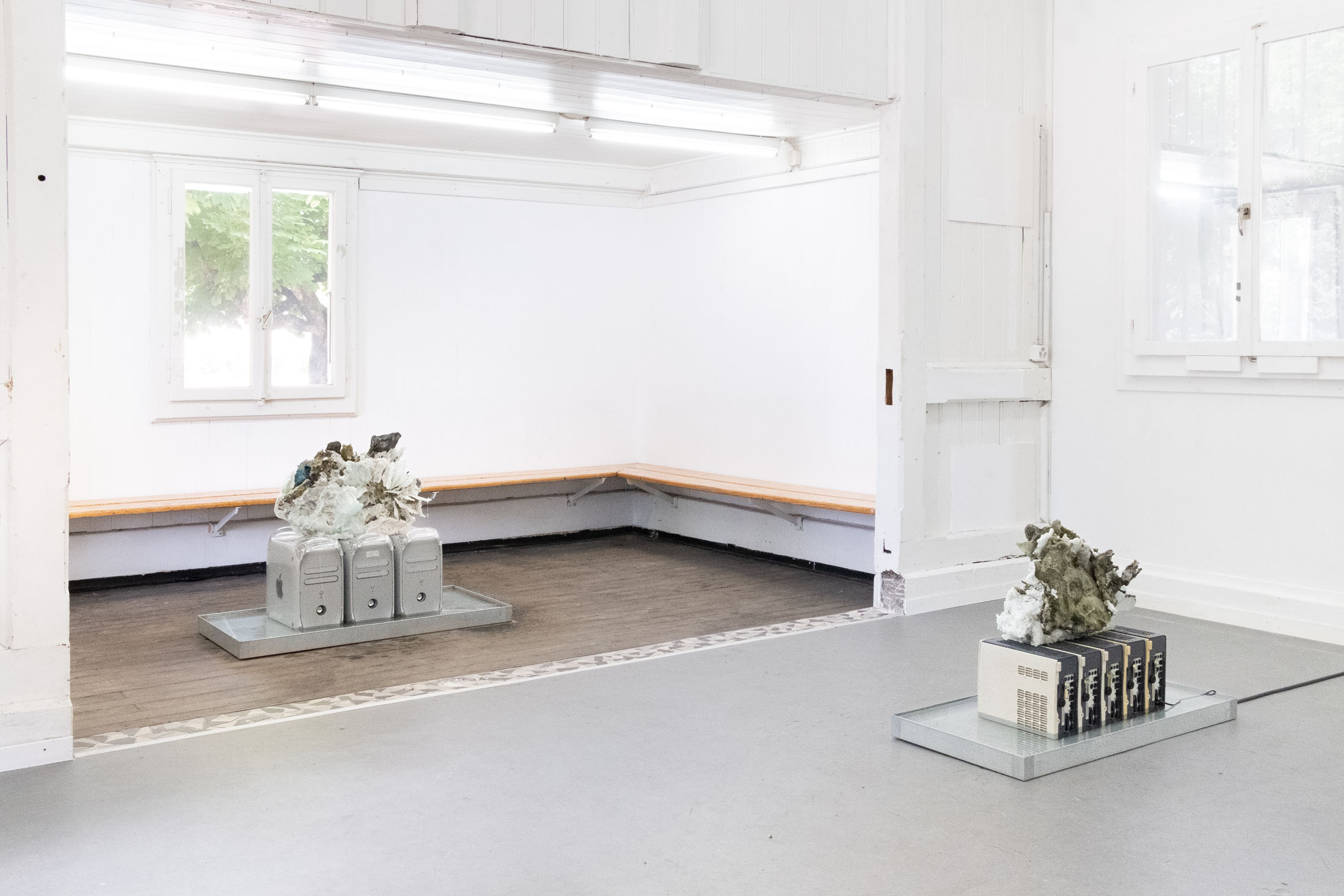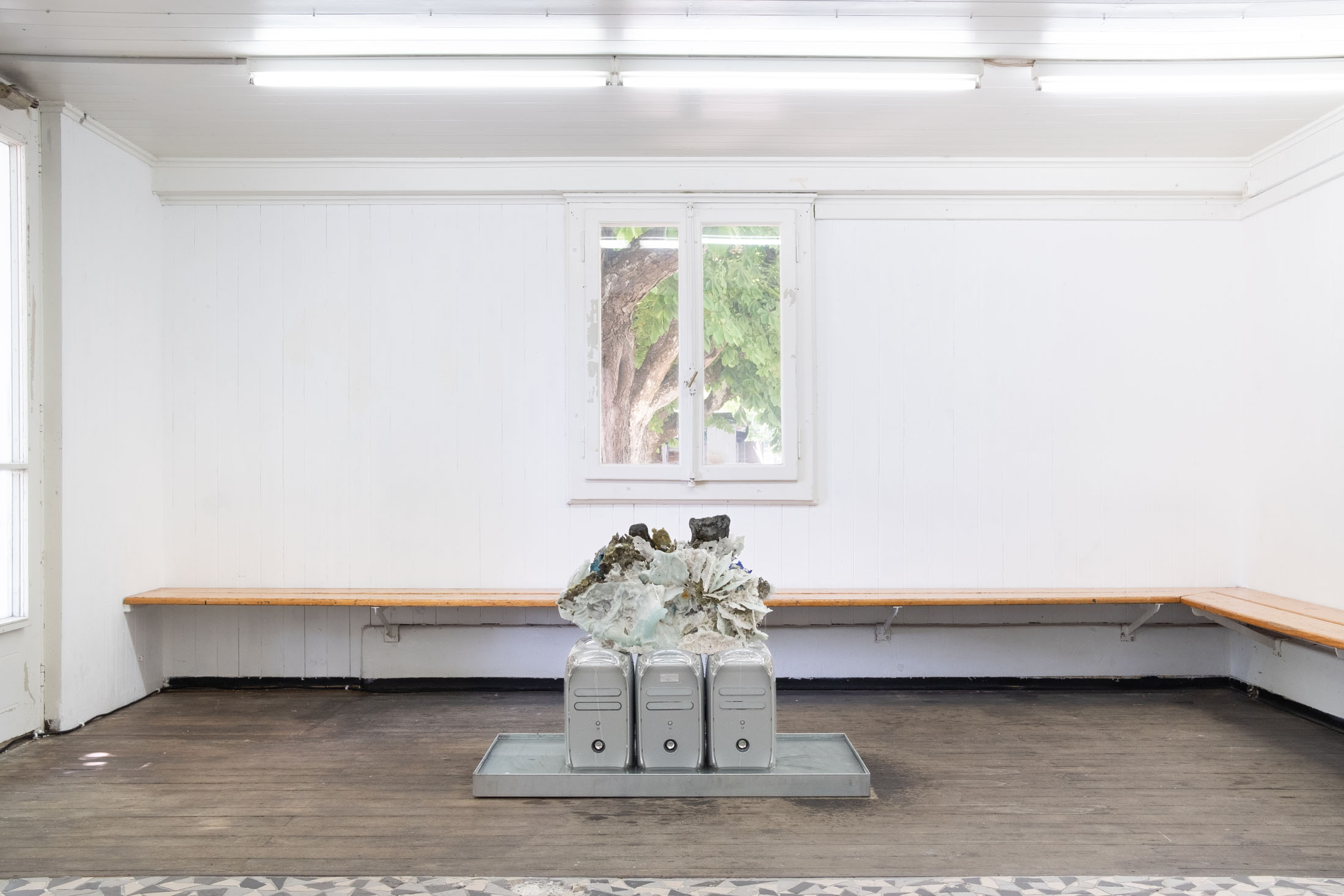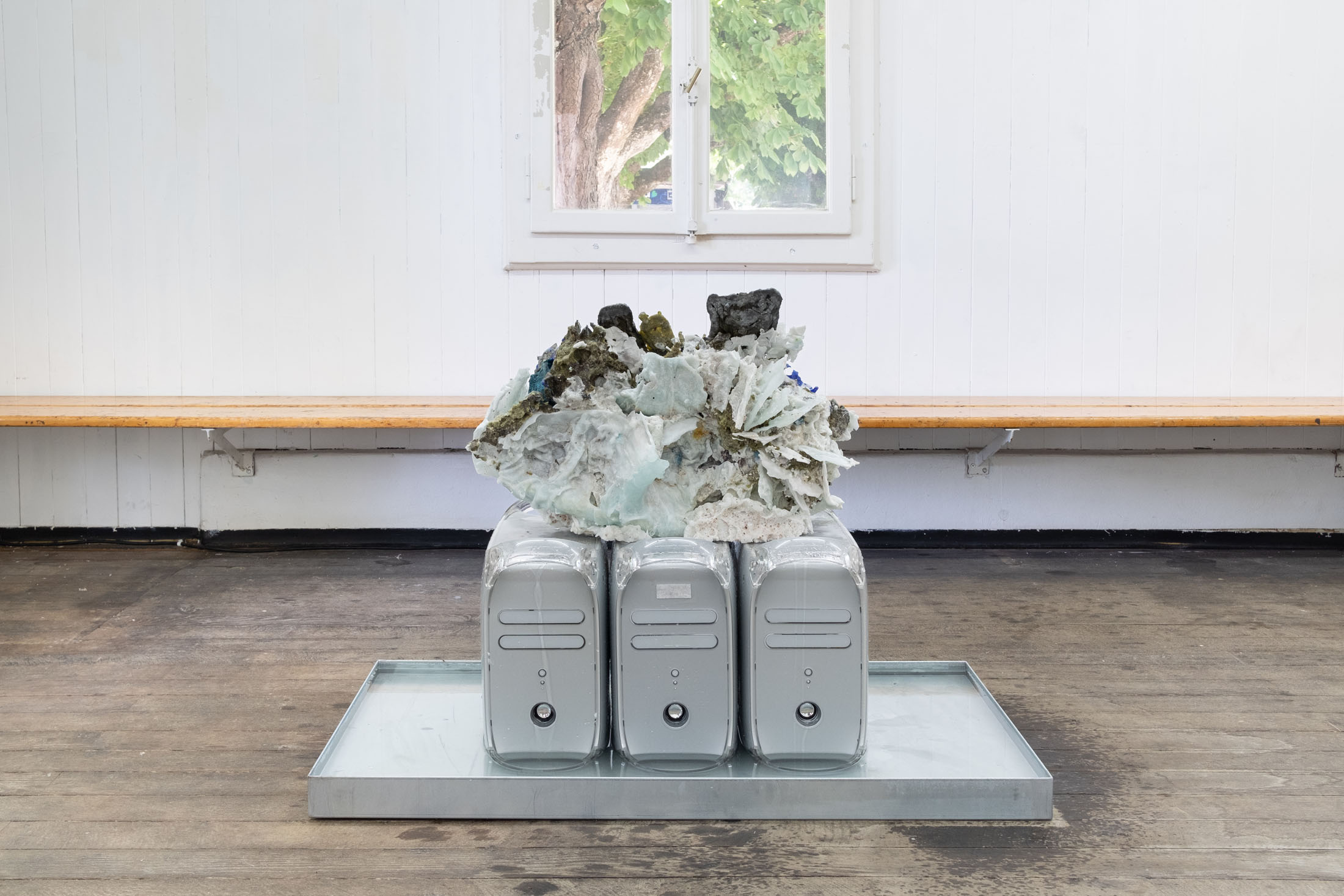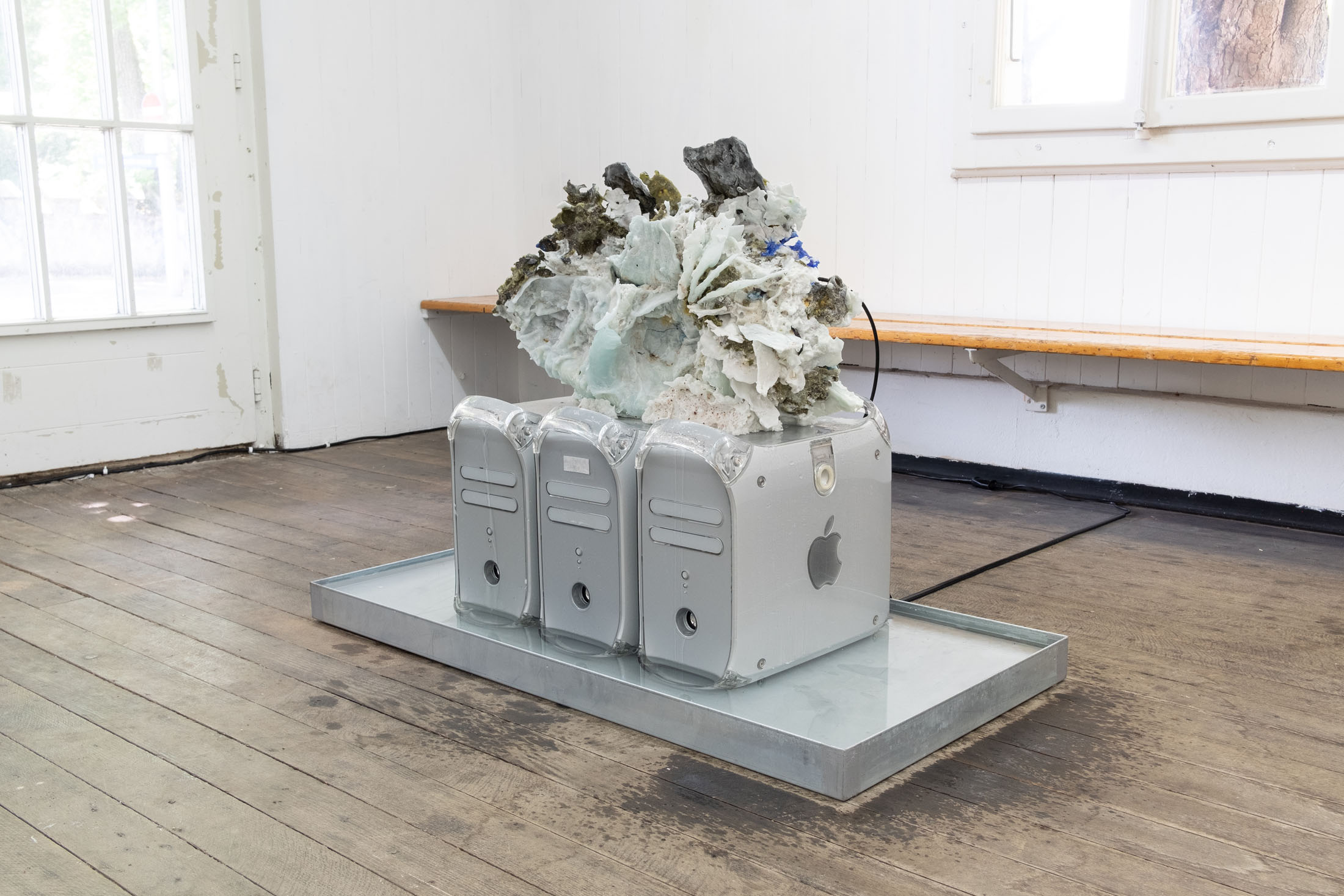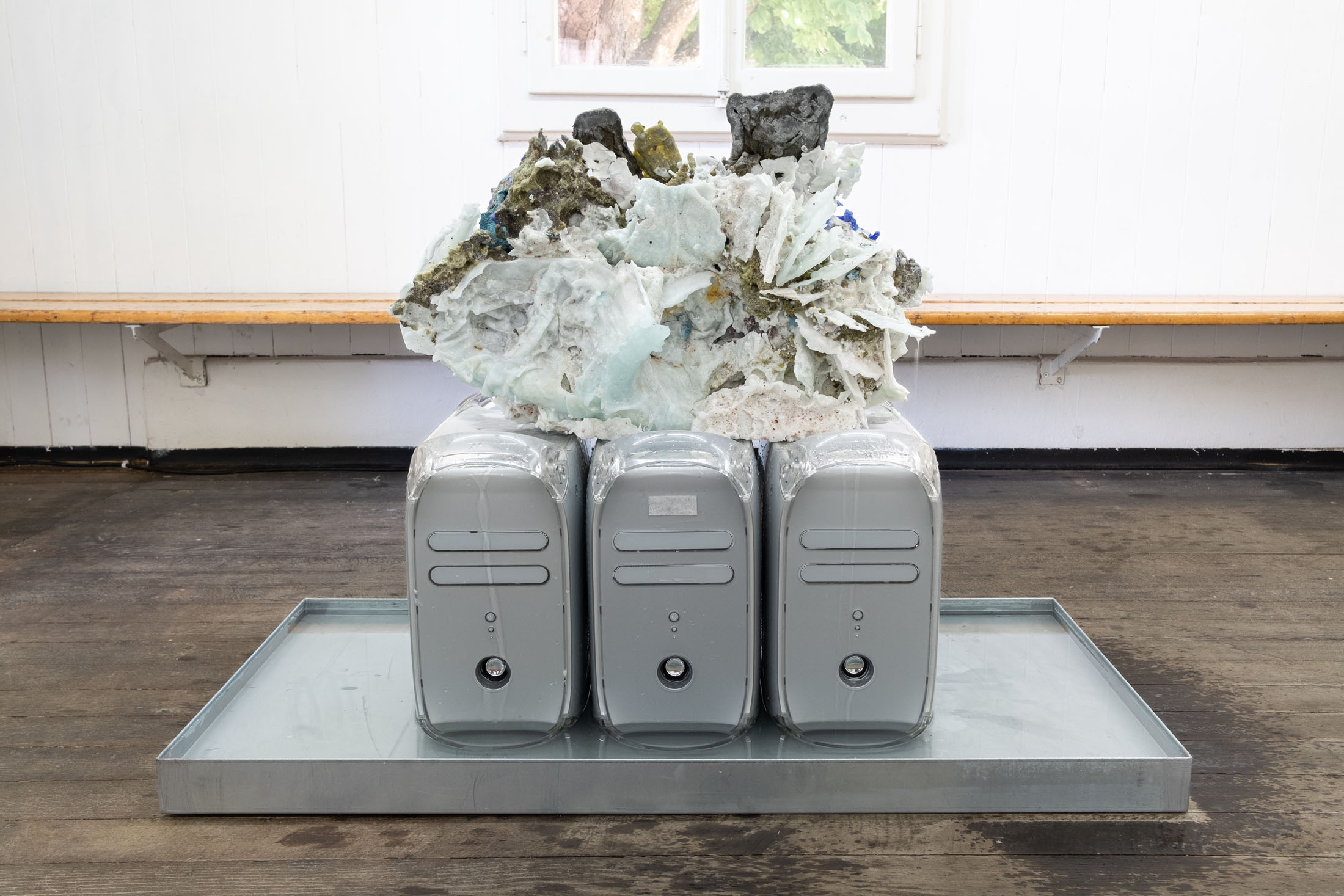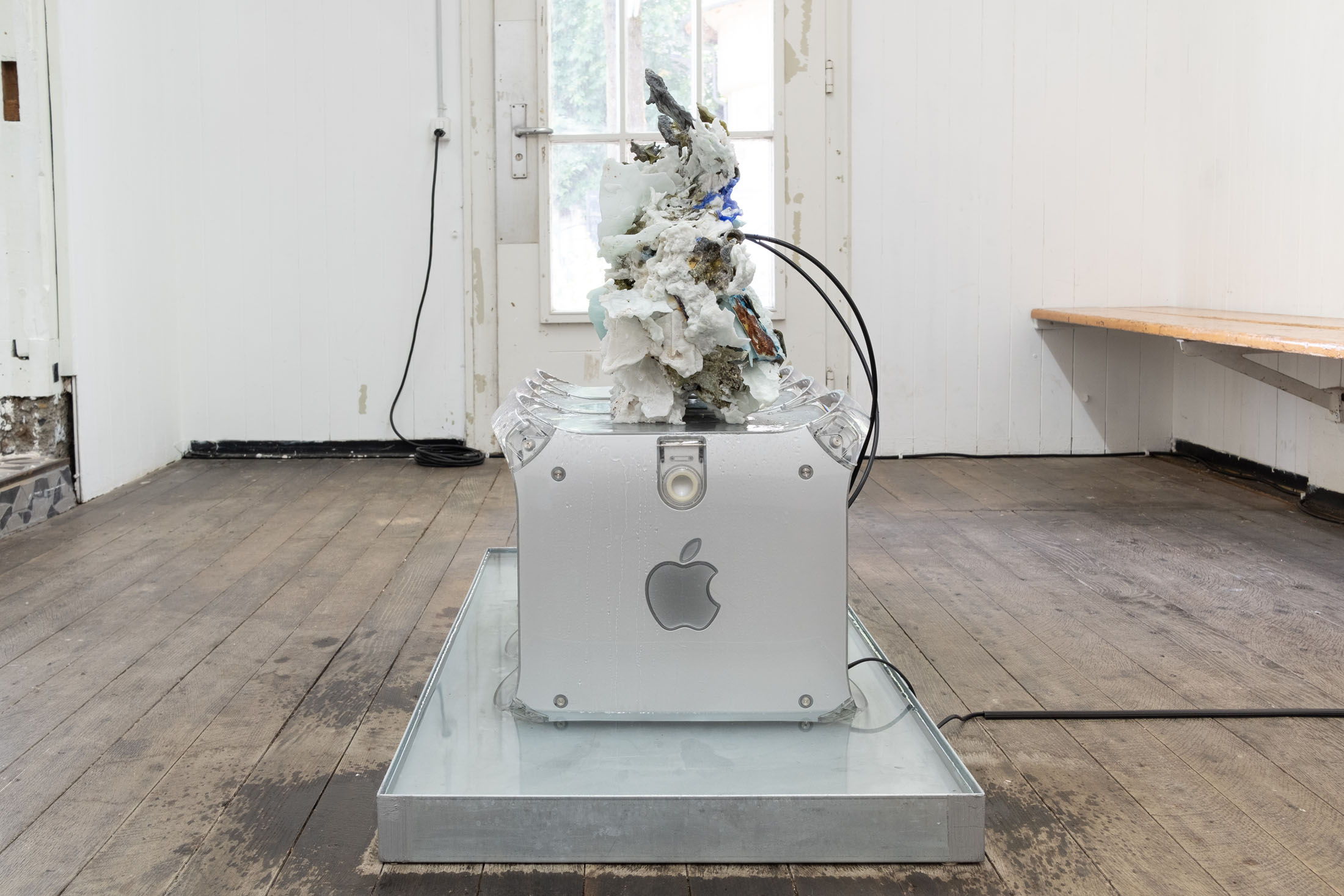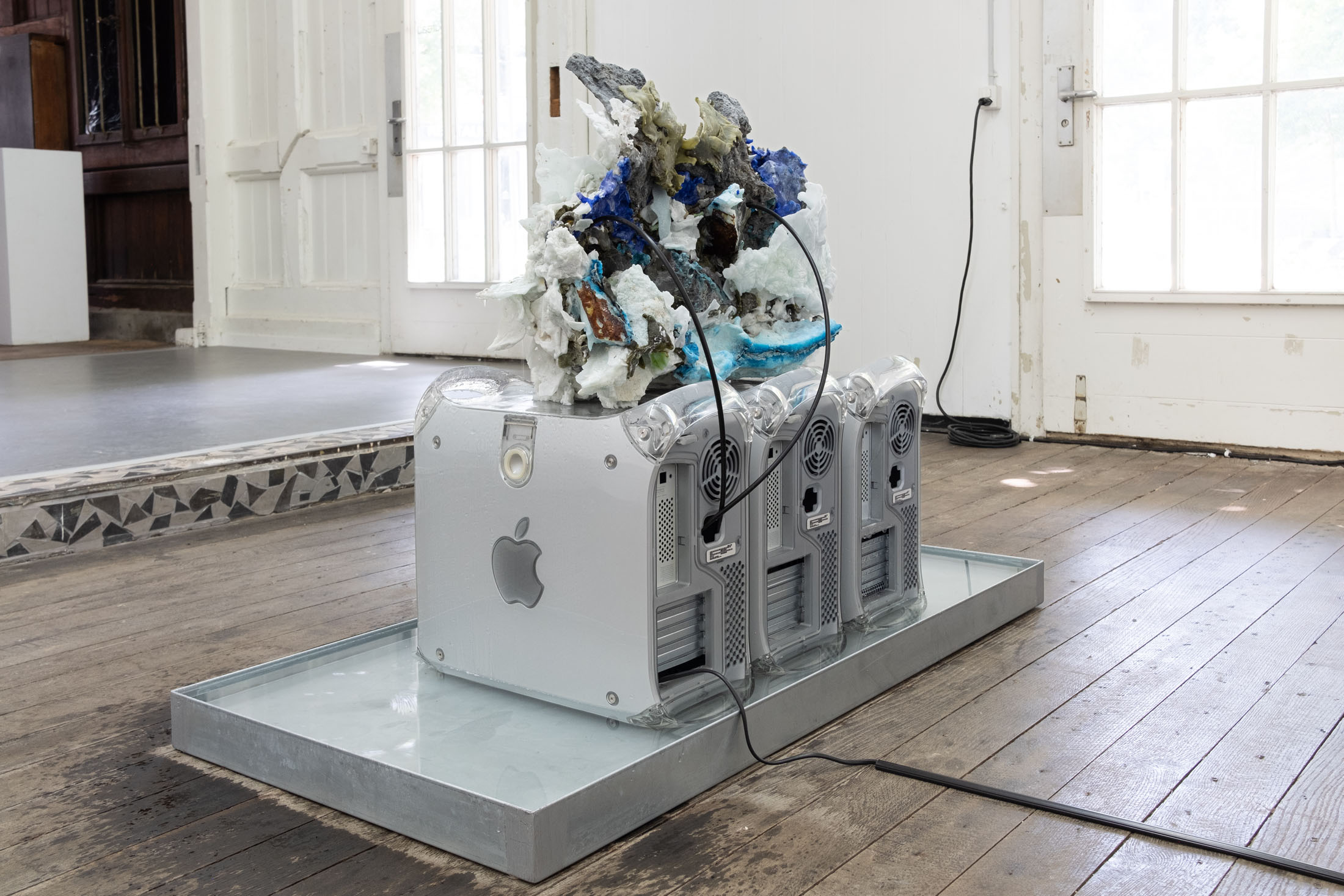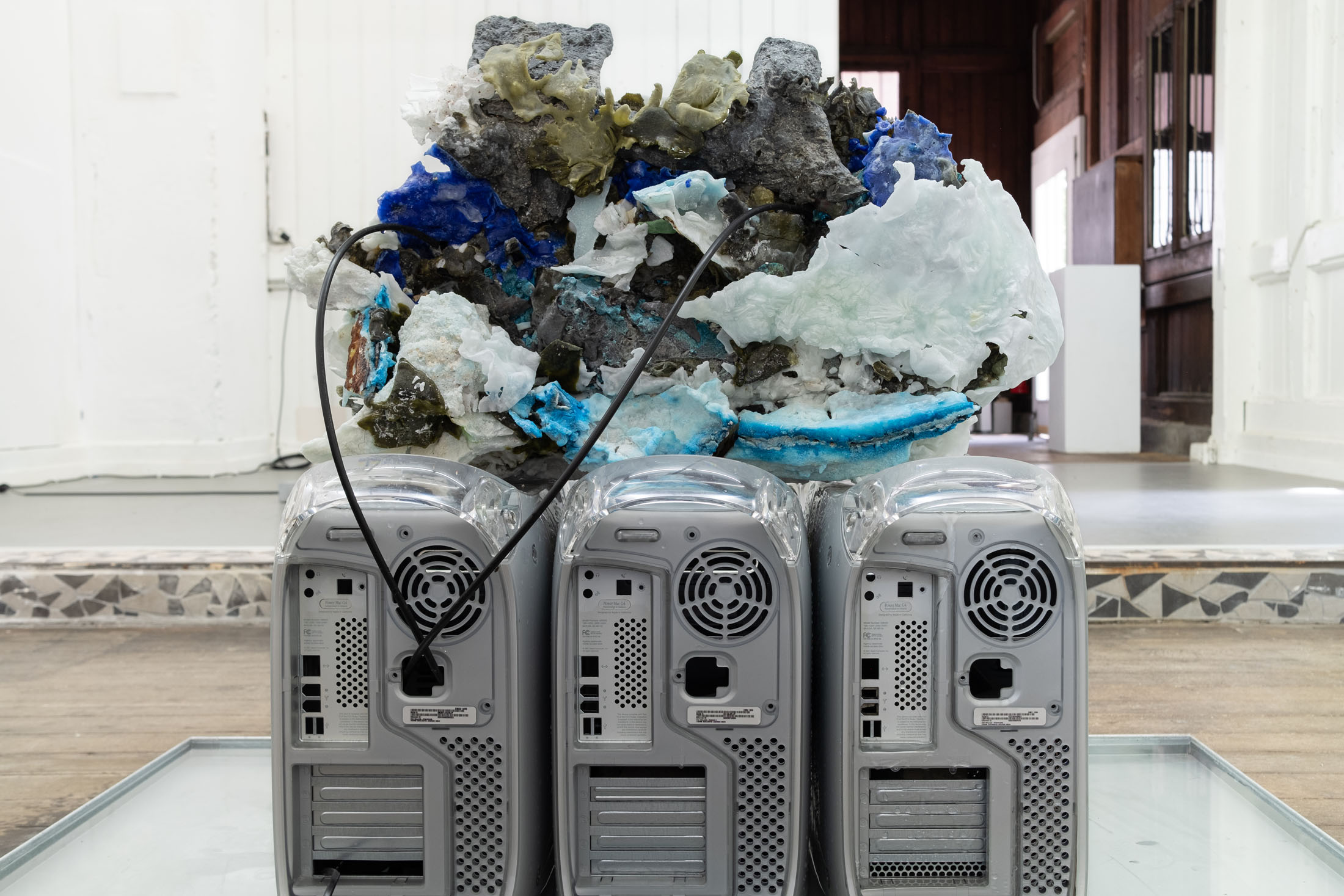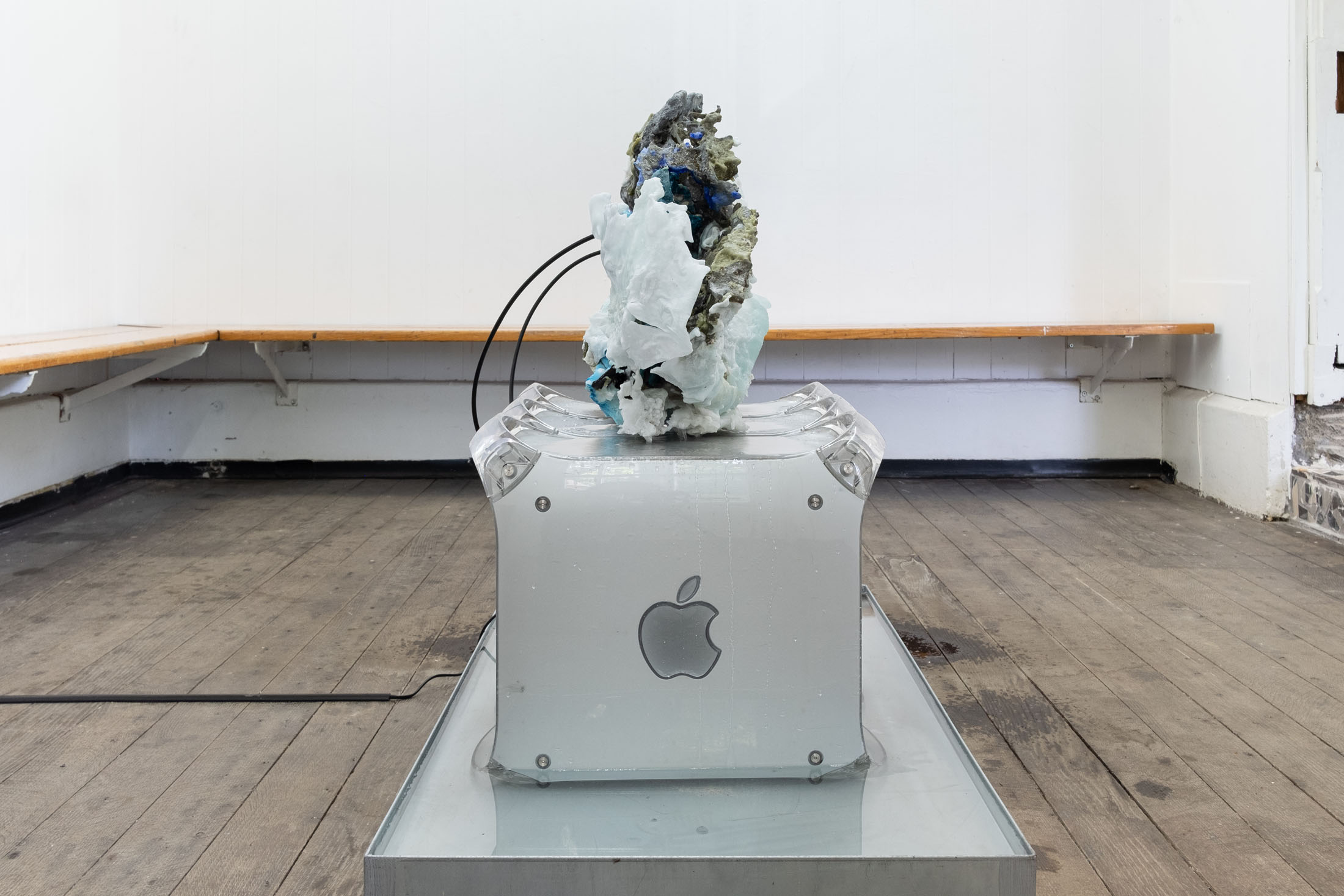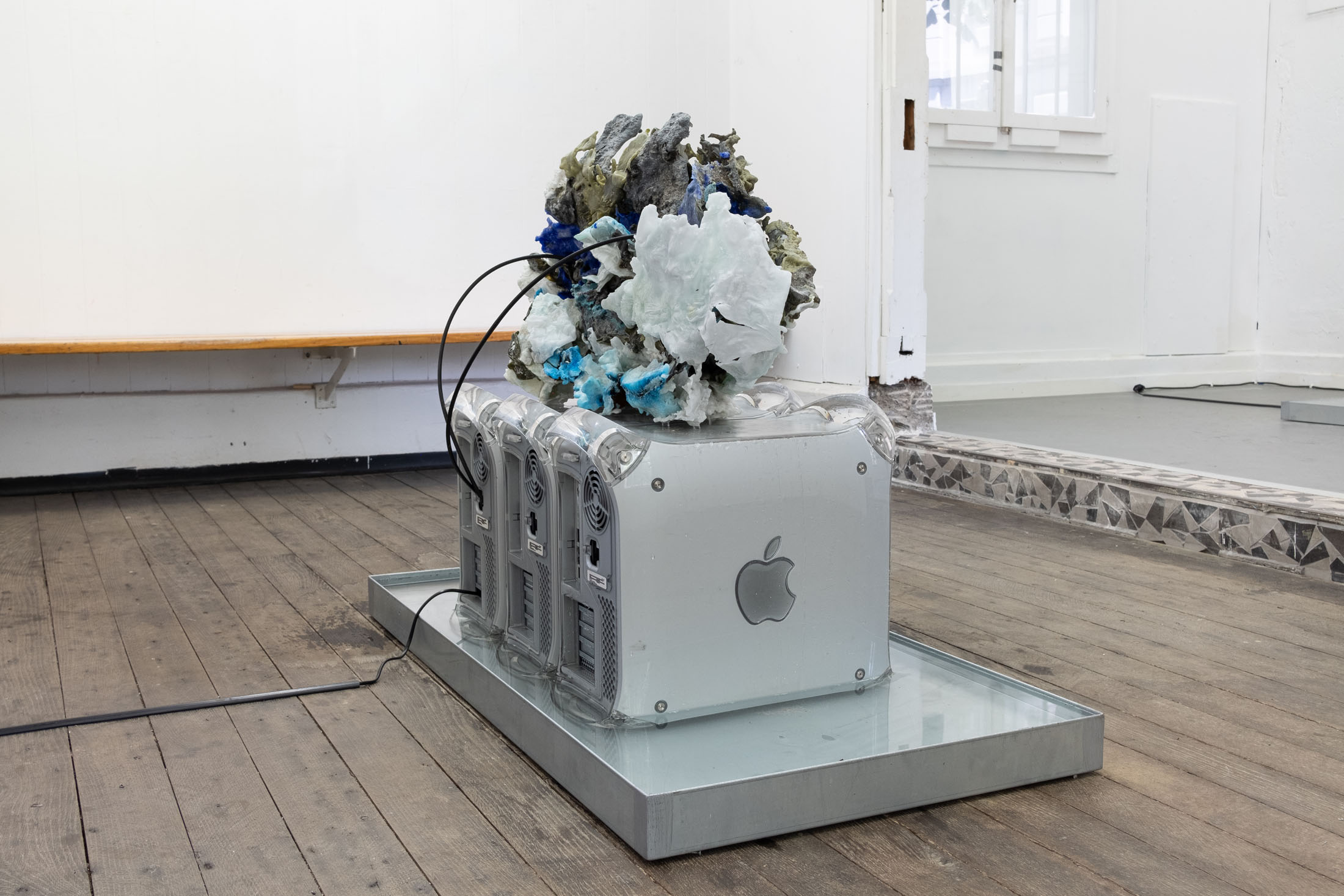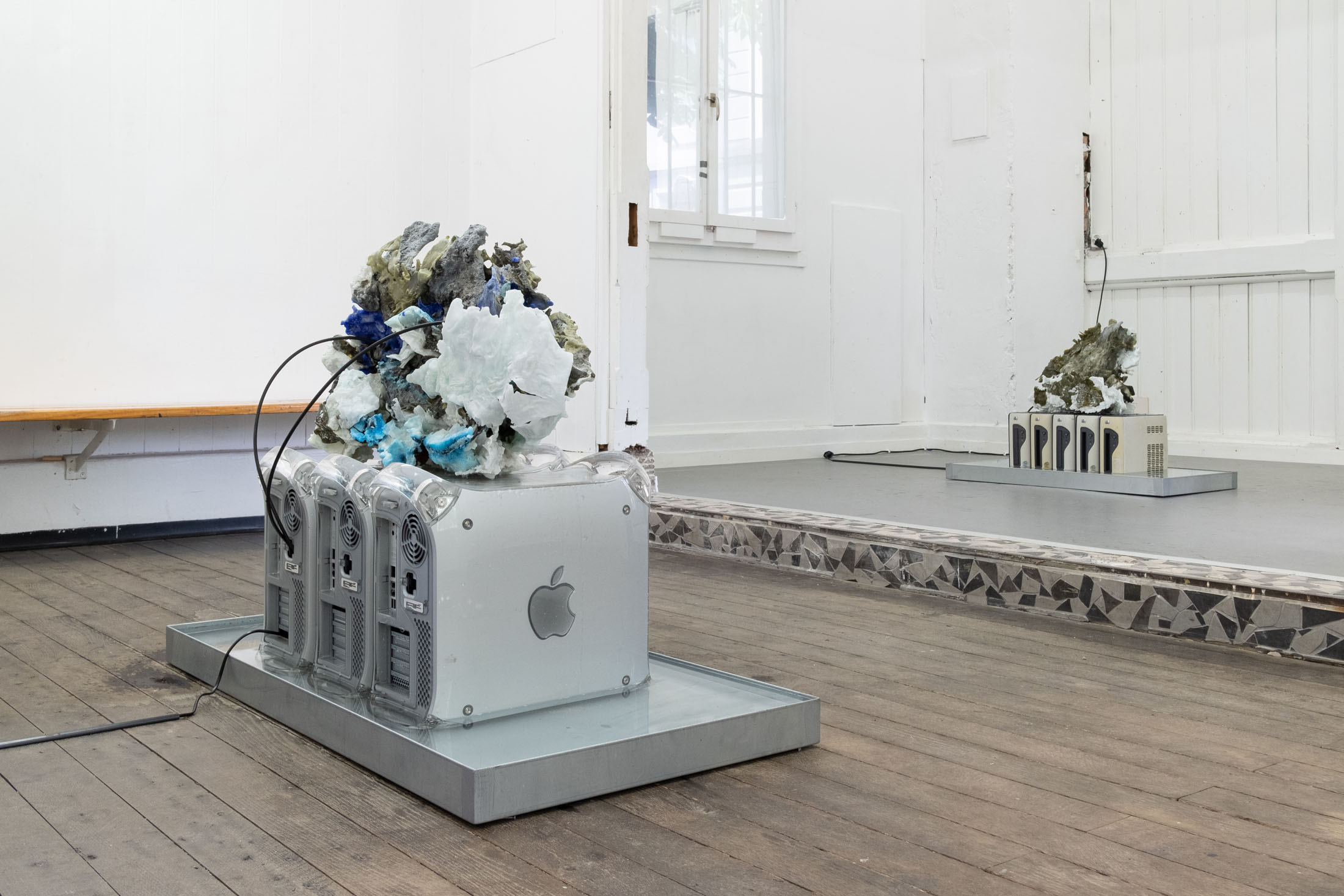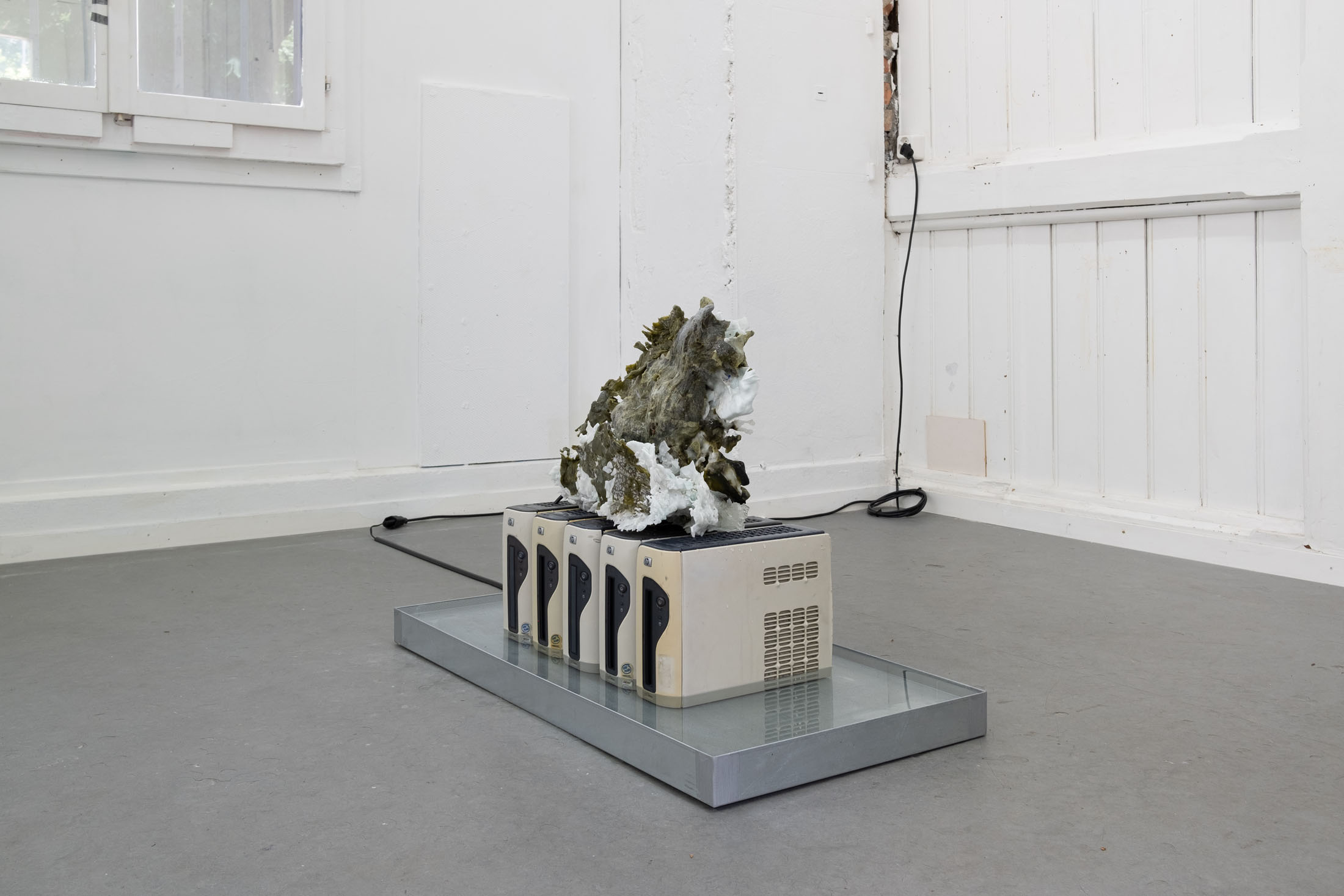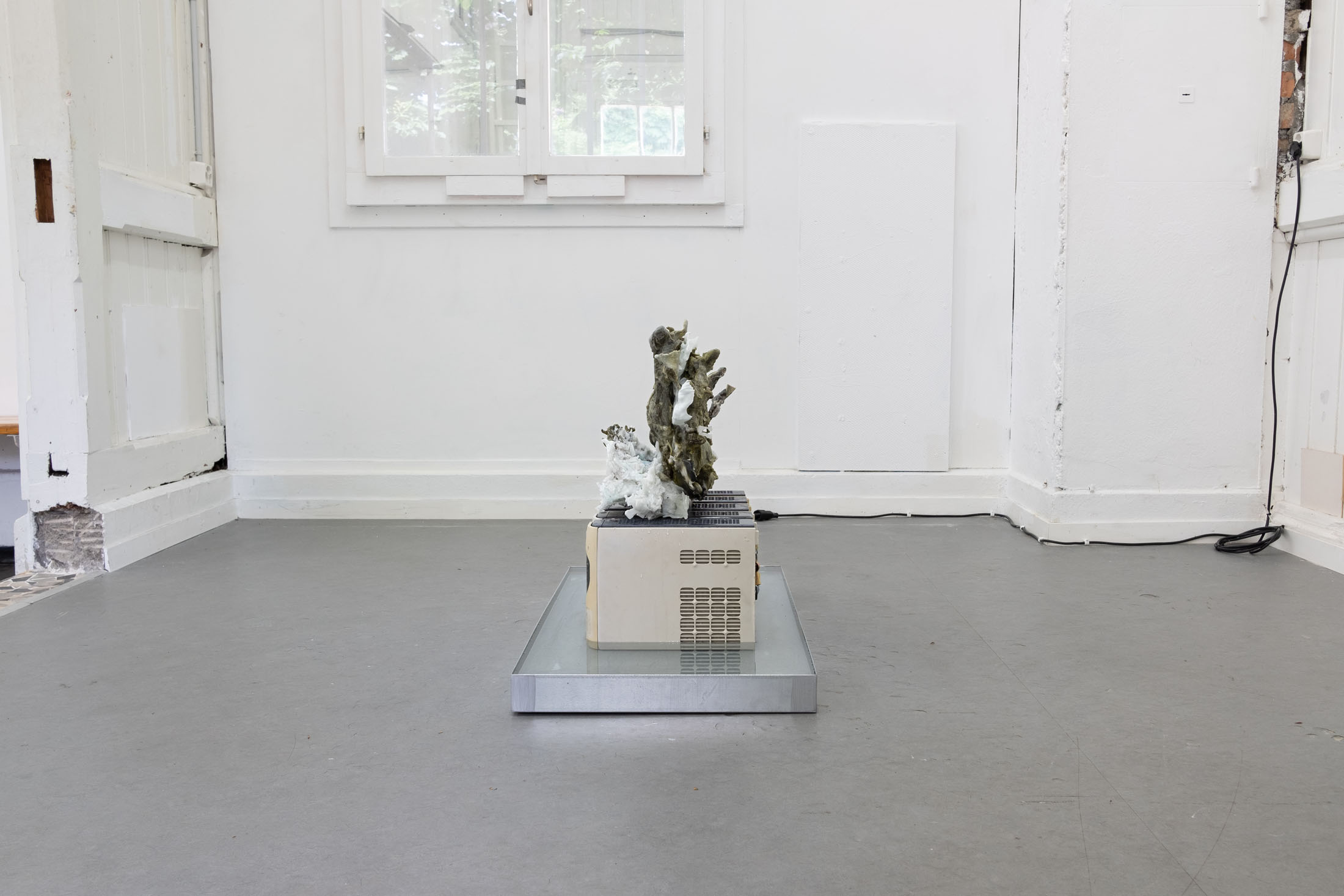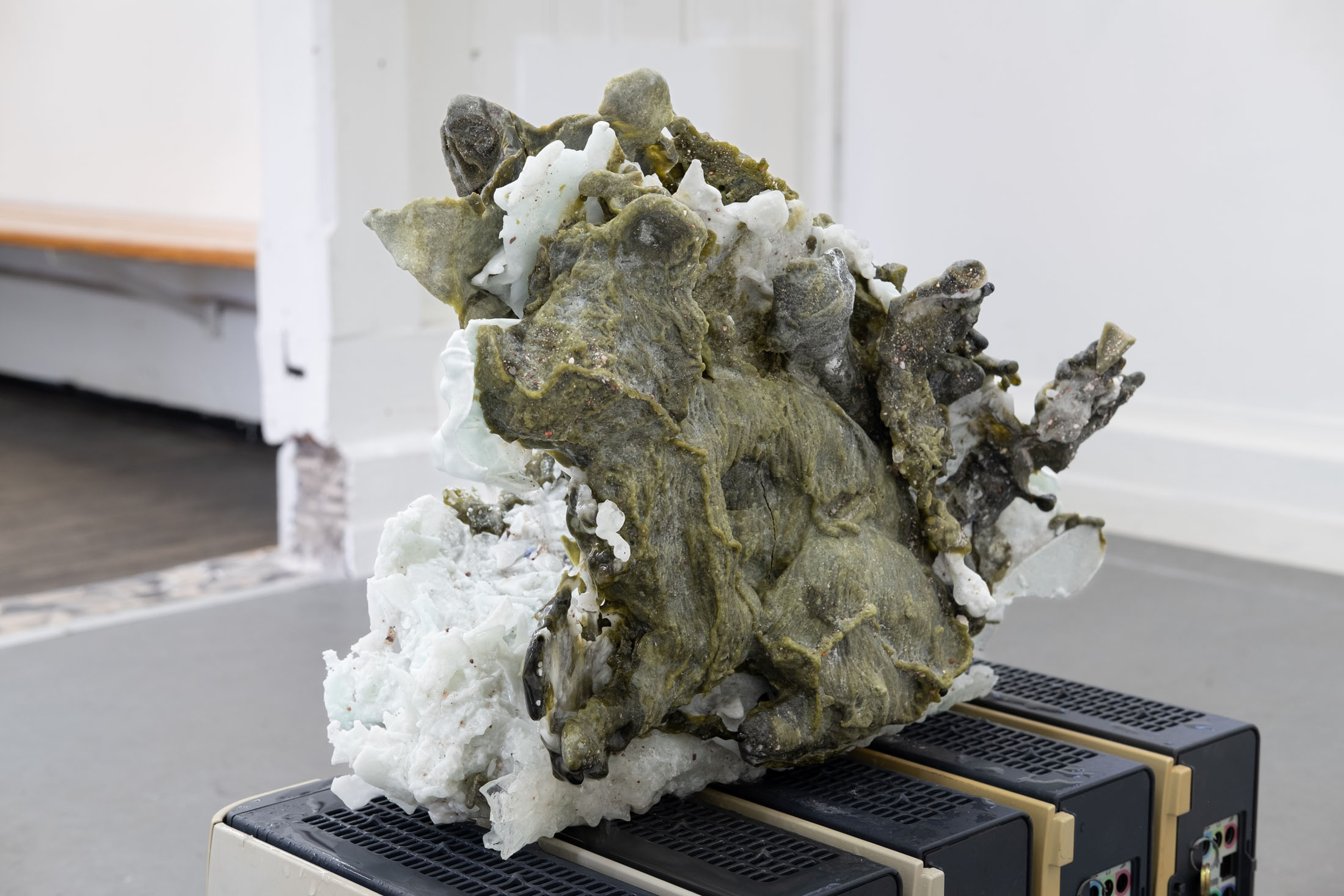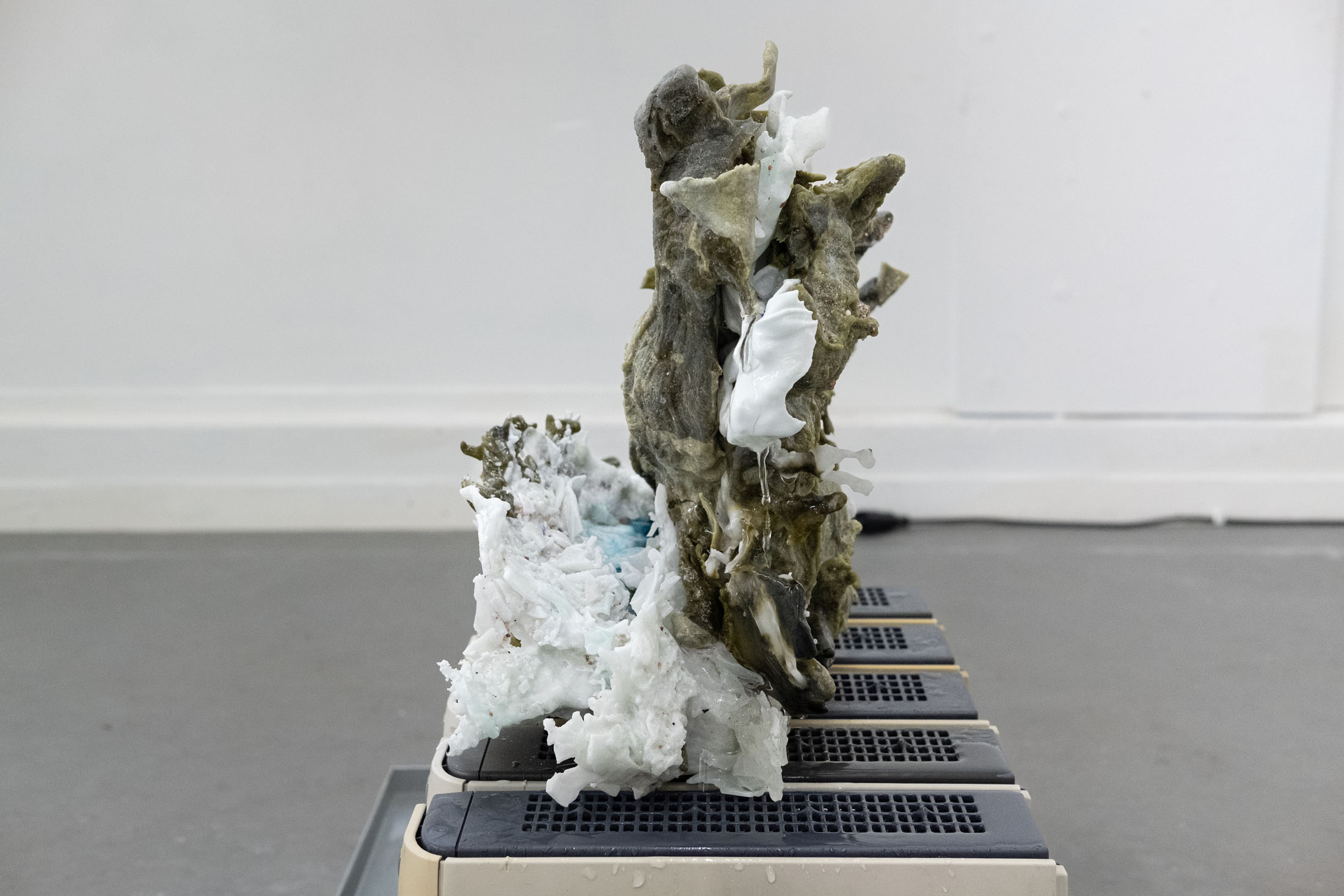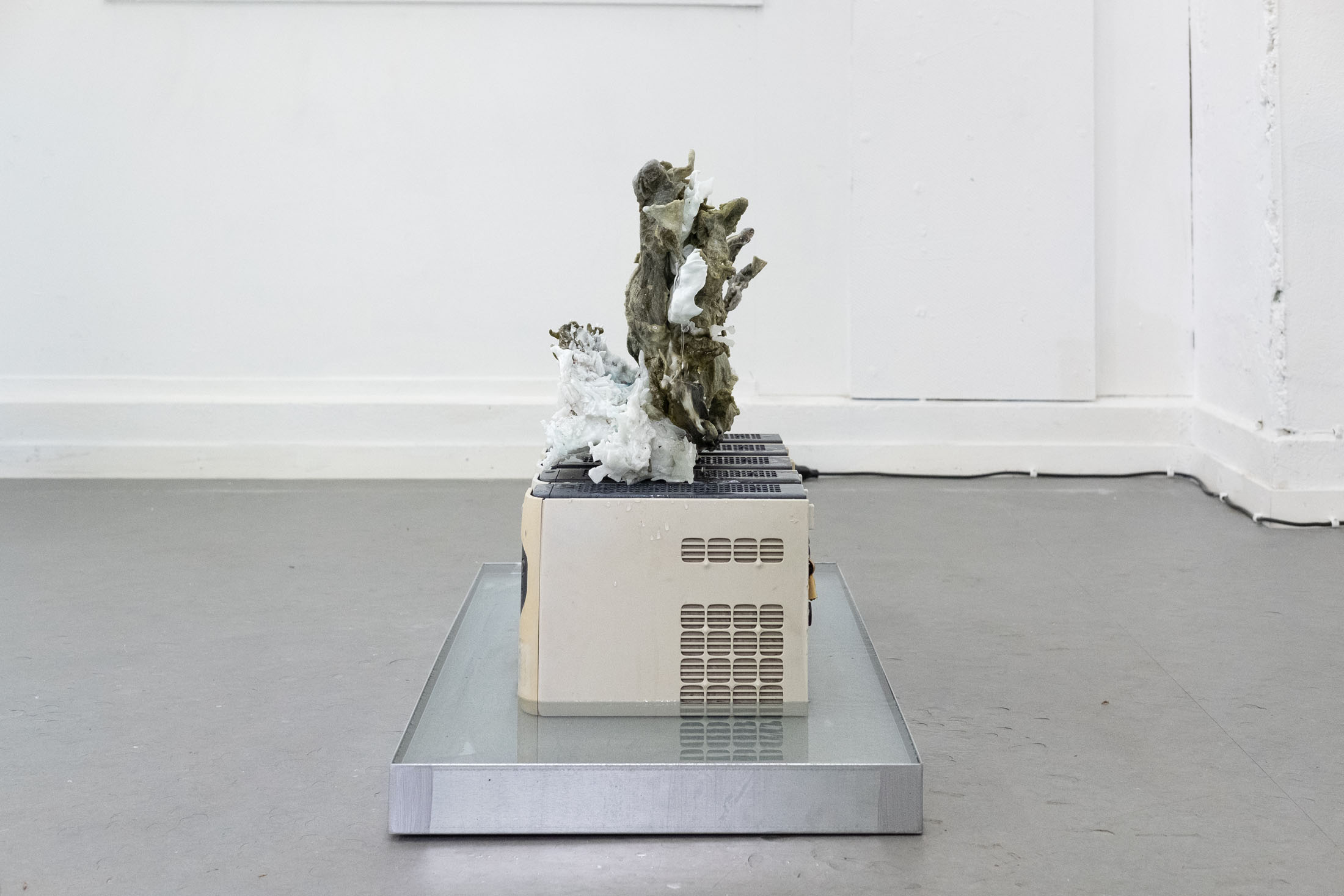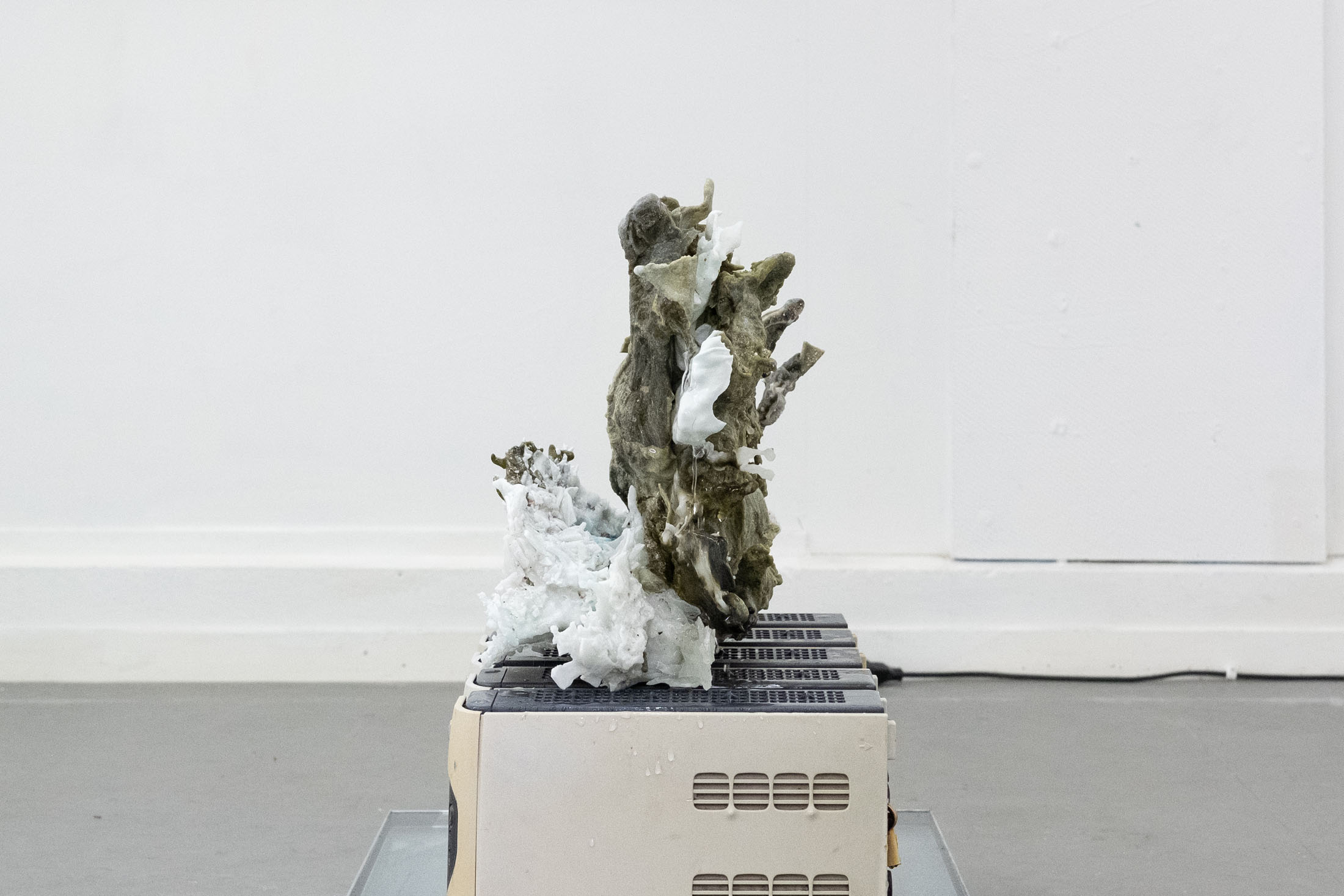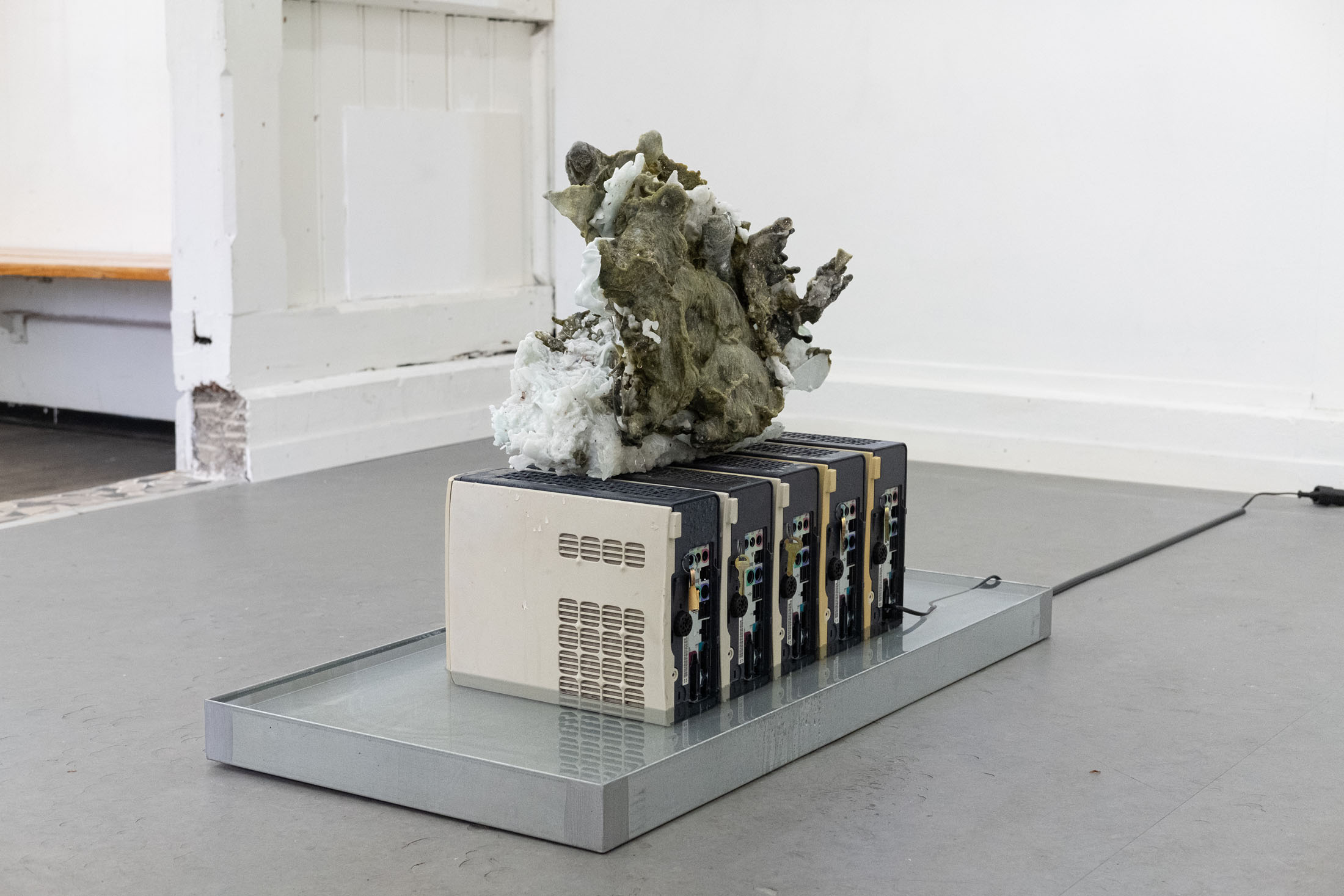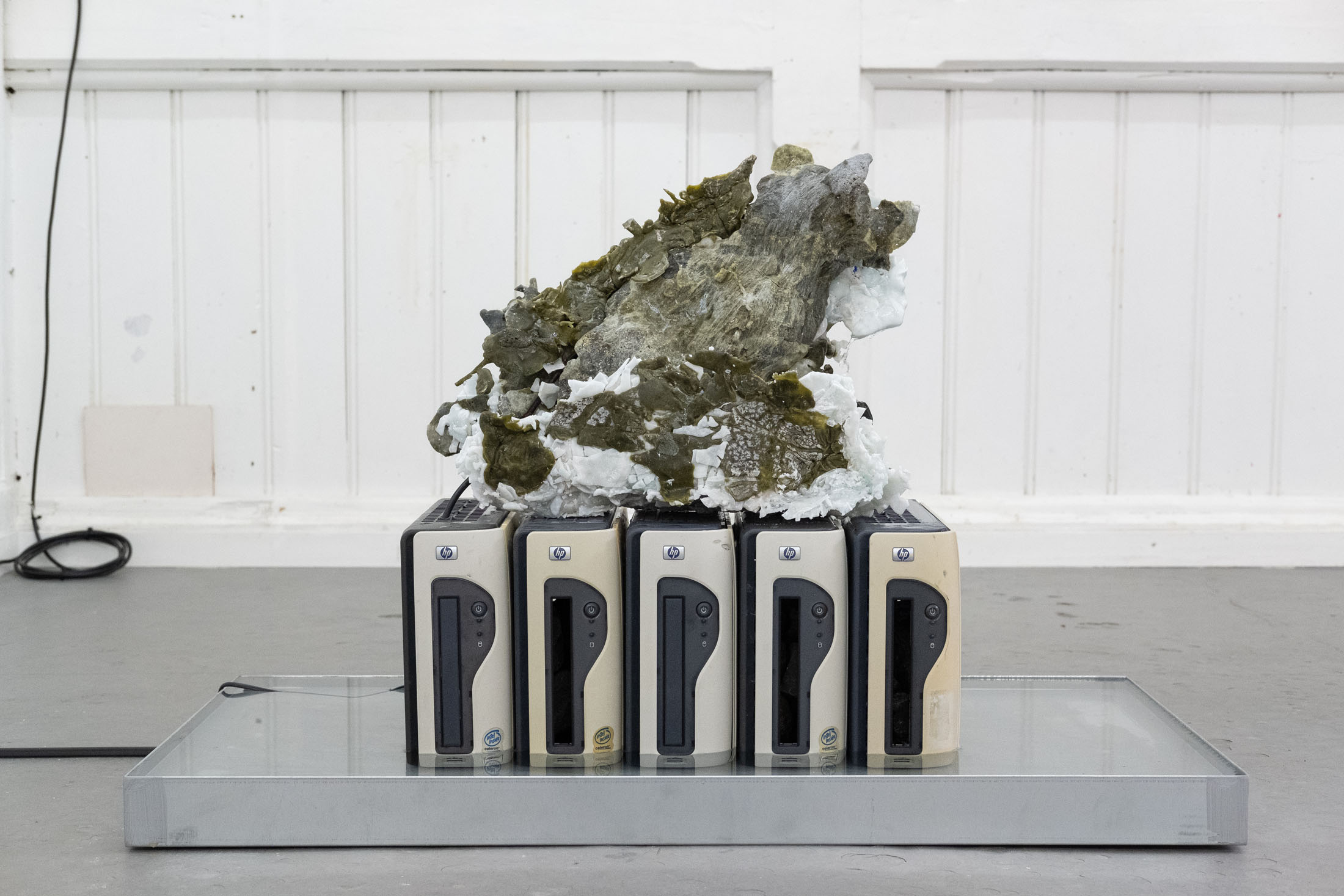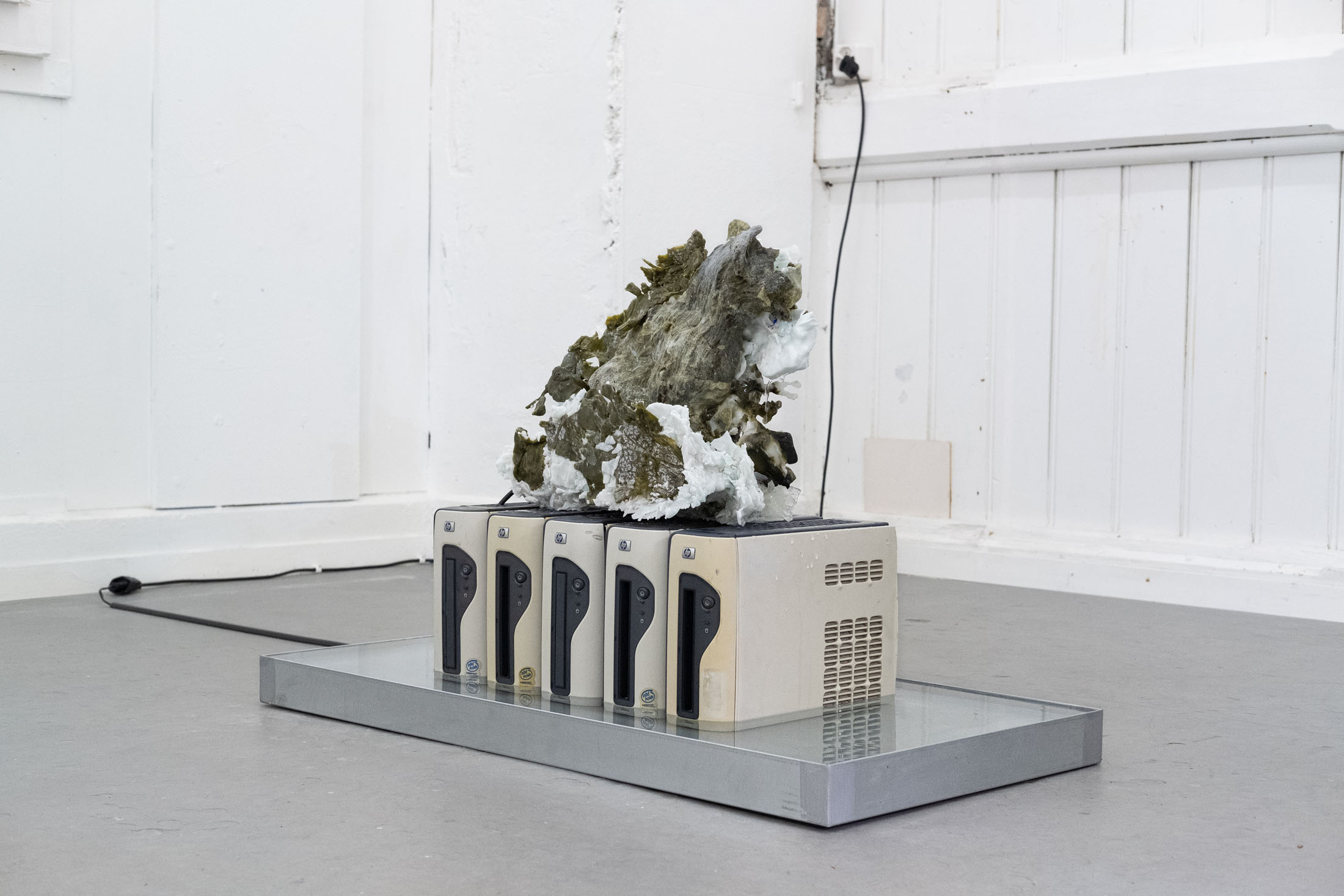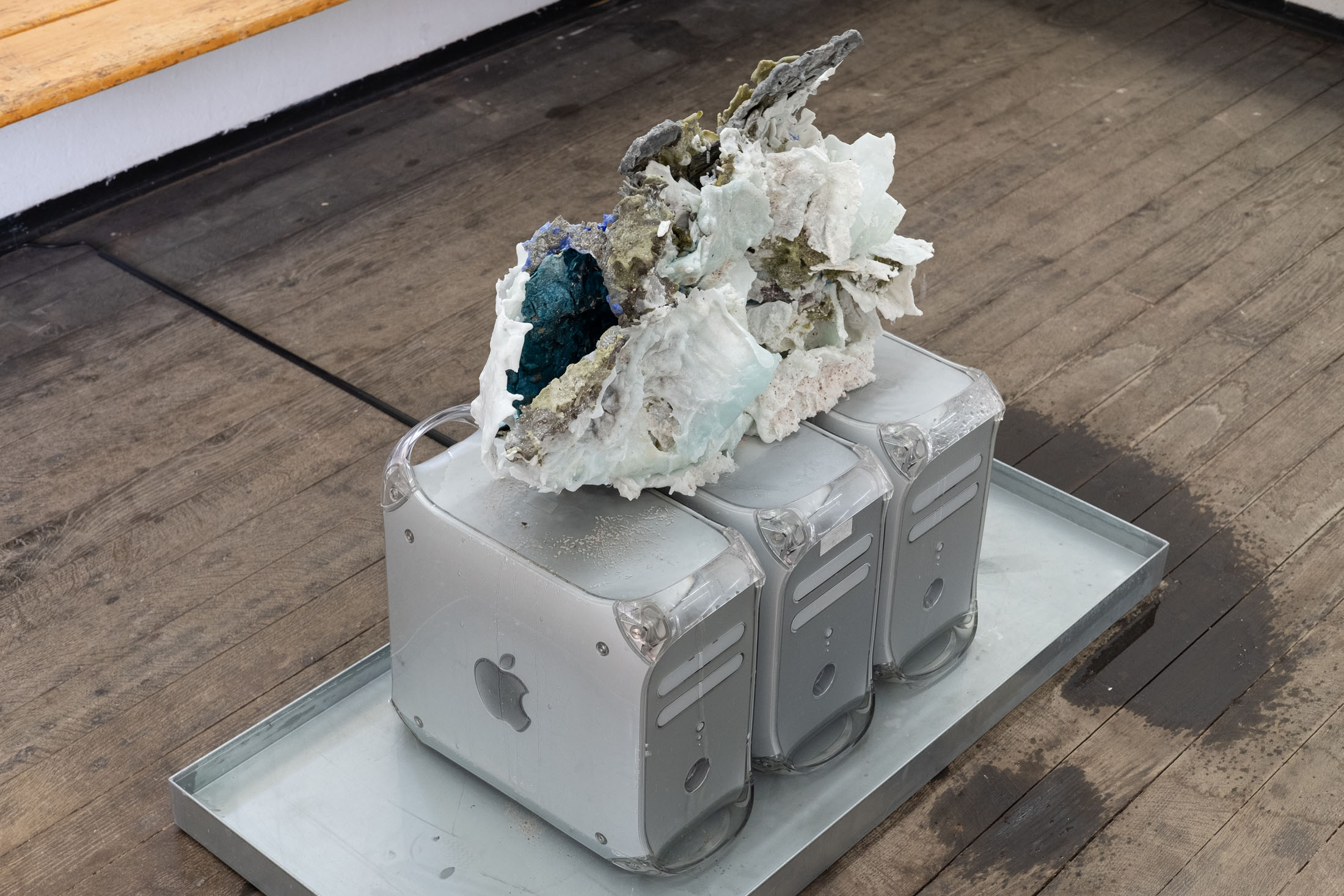
« This exhibition invites you to spend time with two sculptures and the sound of water.
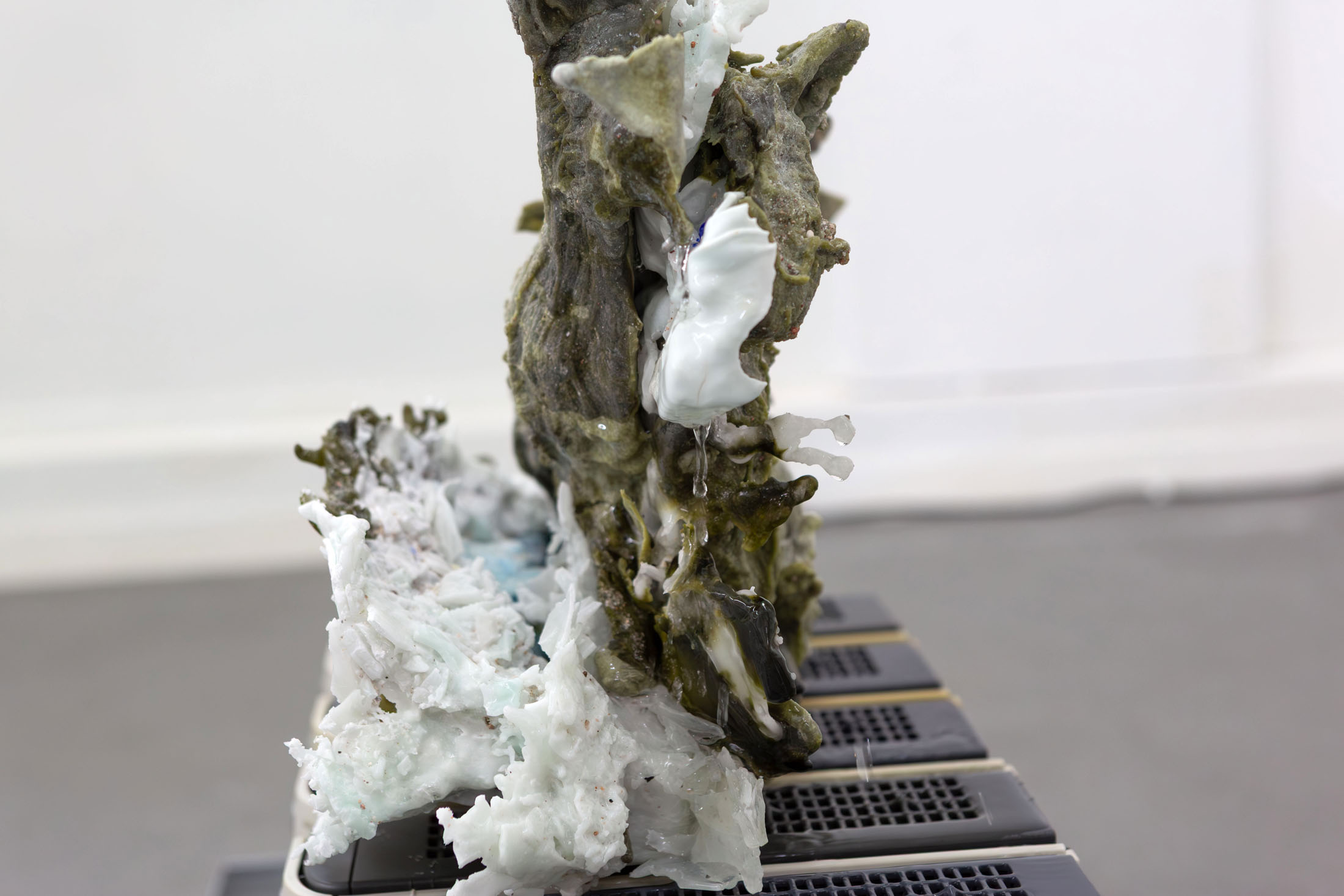
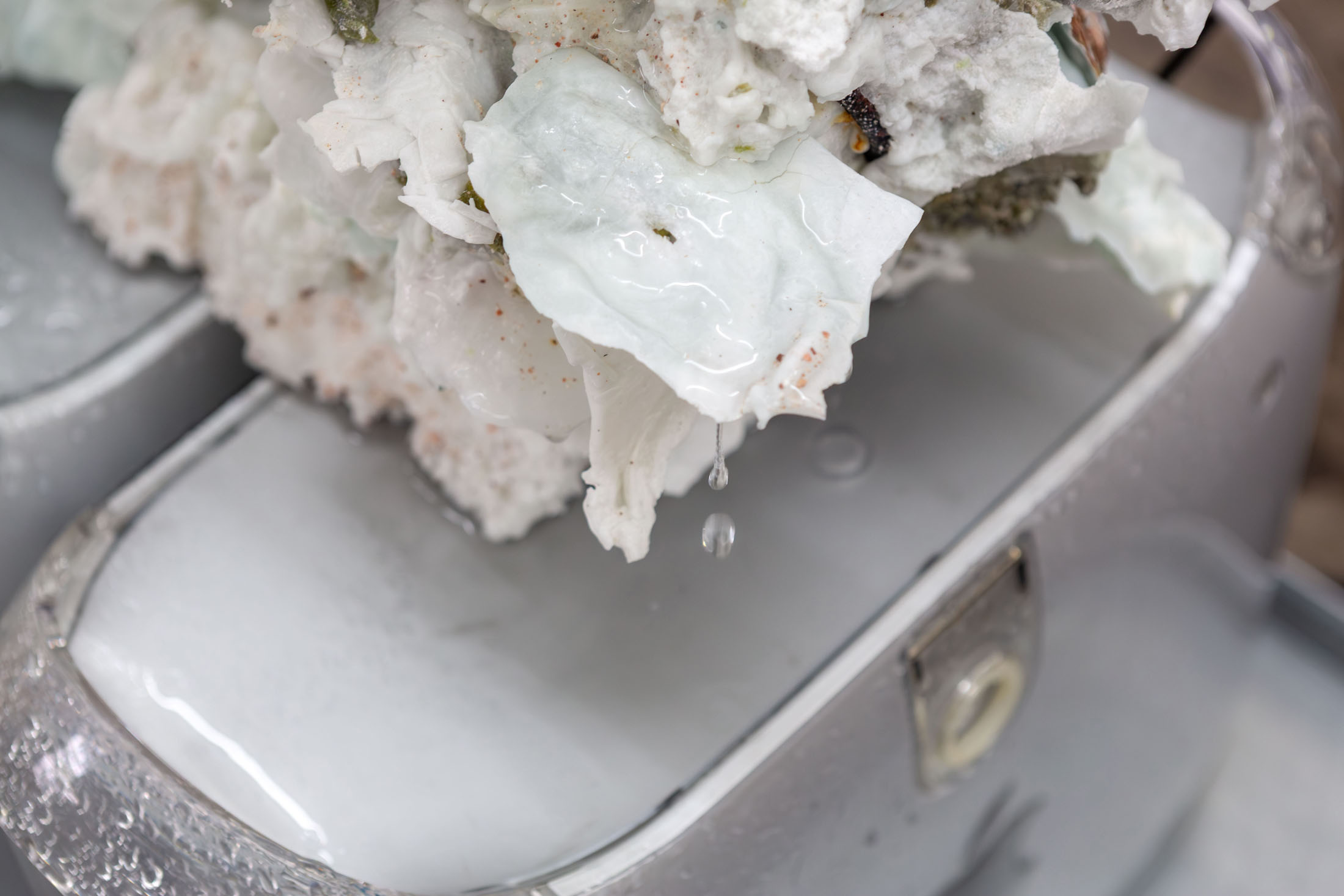
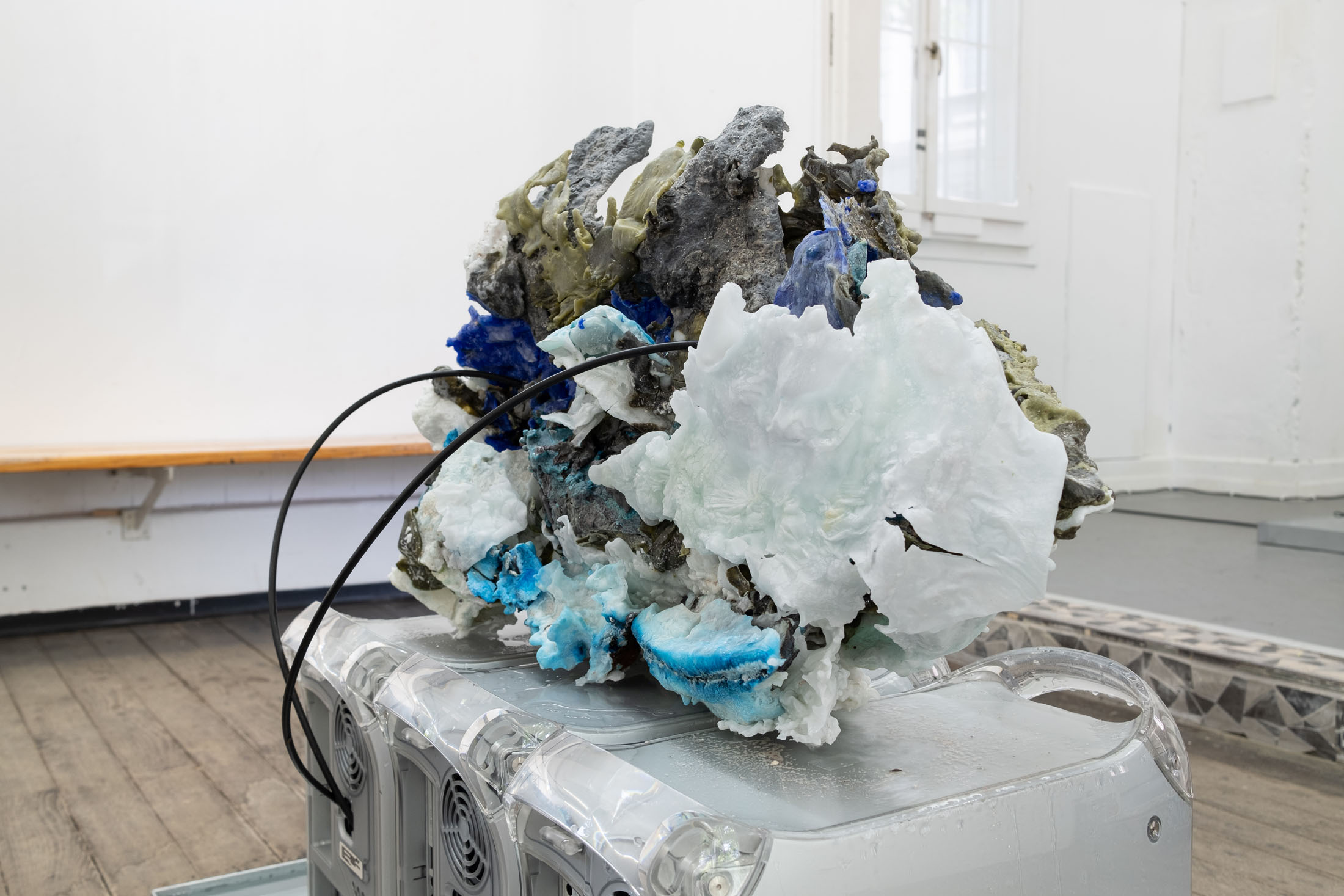
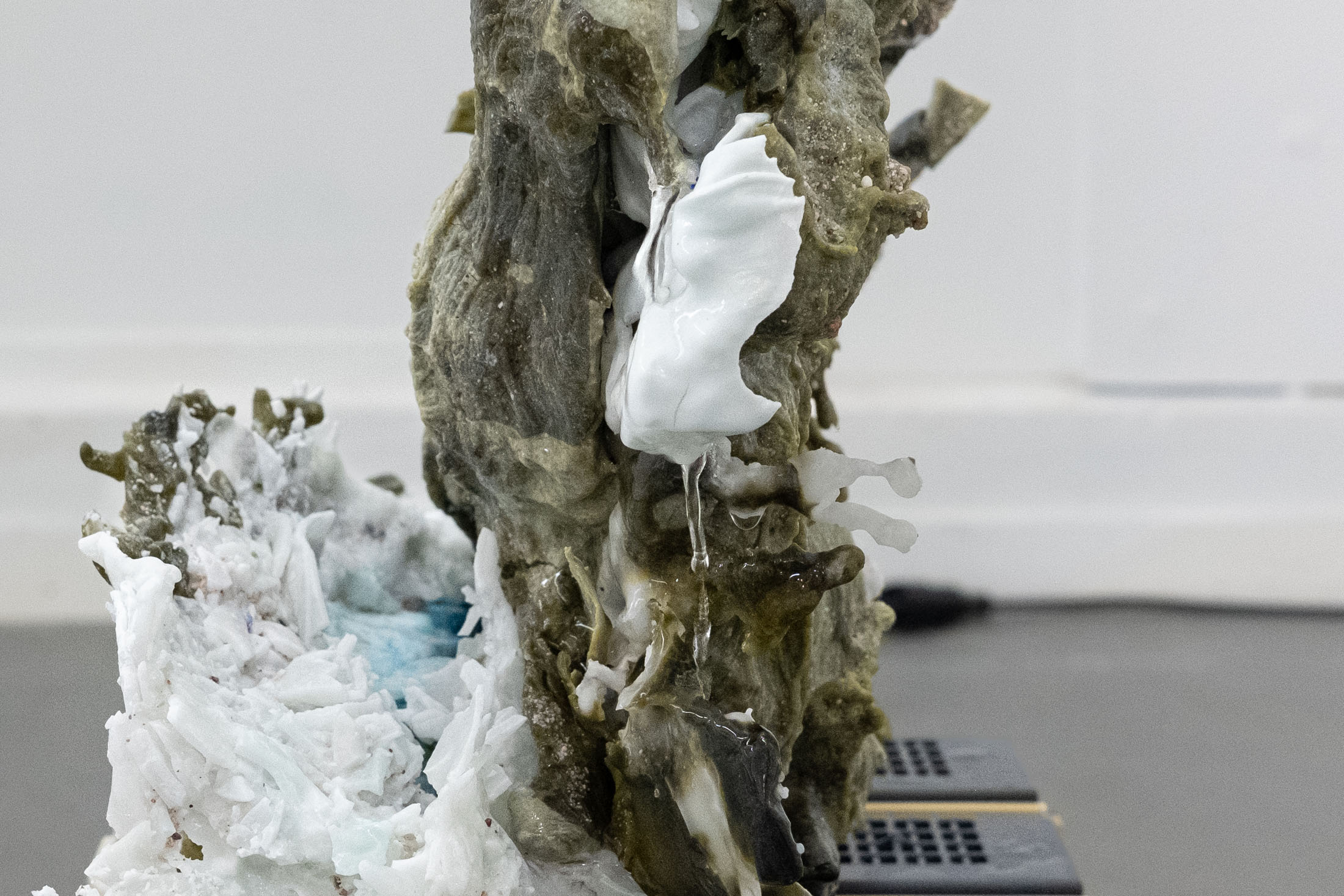
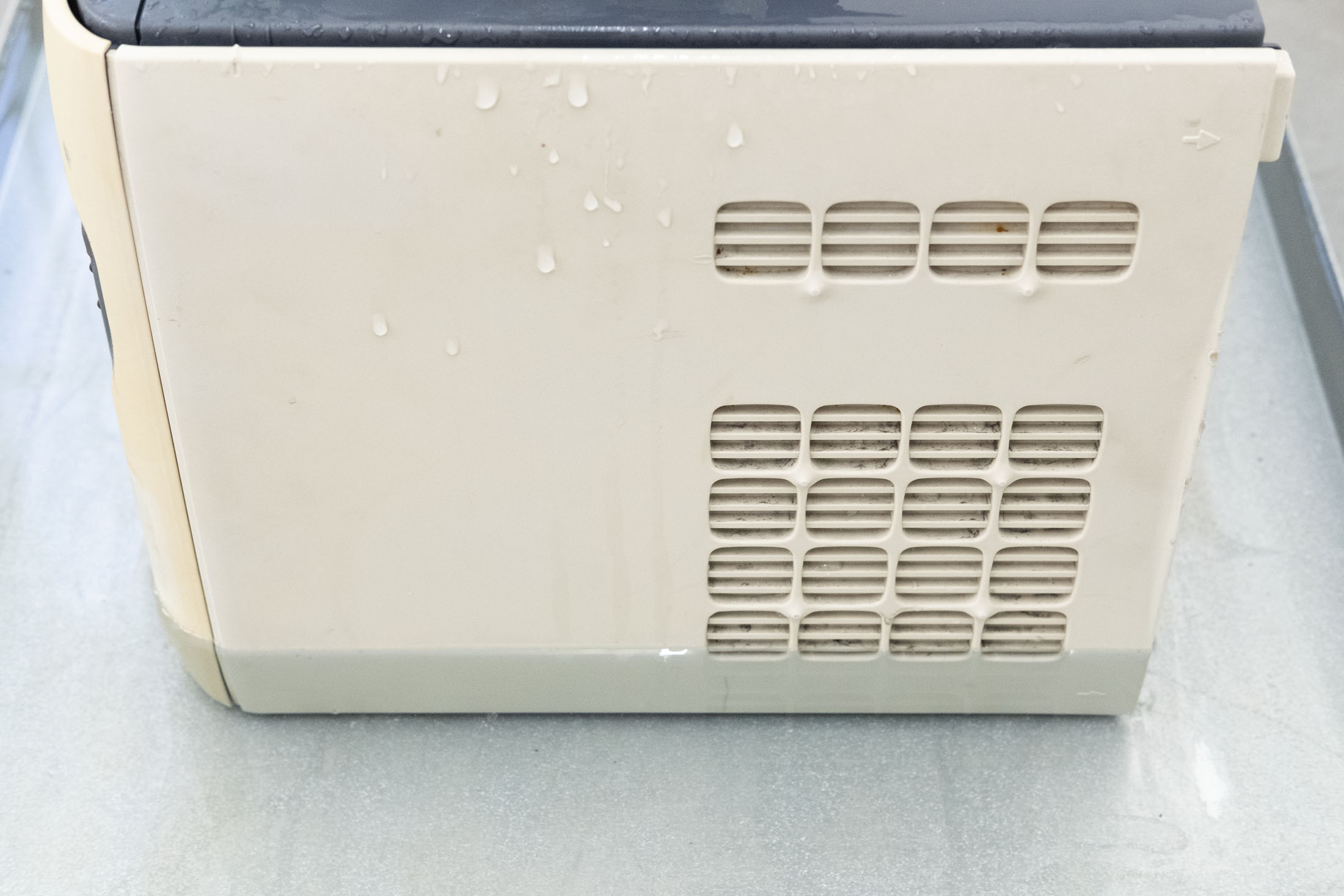
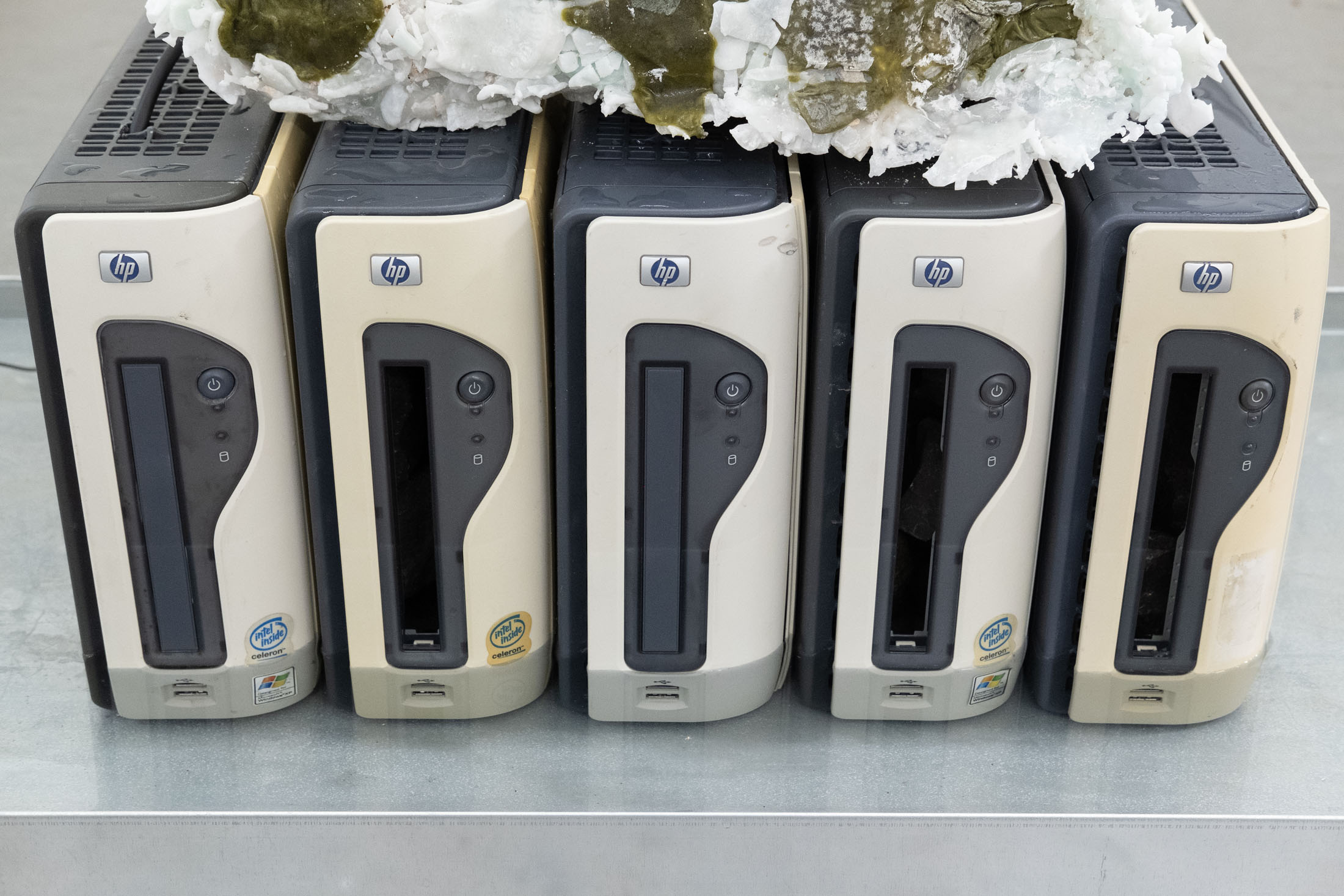
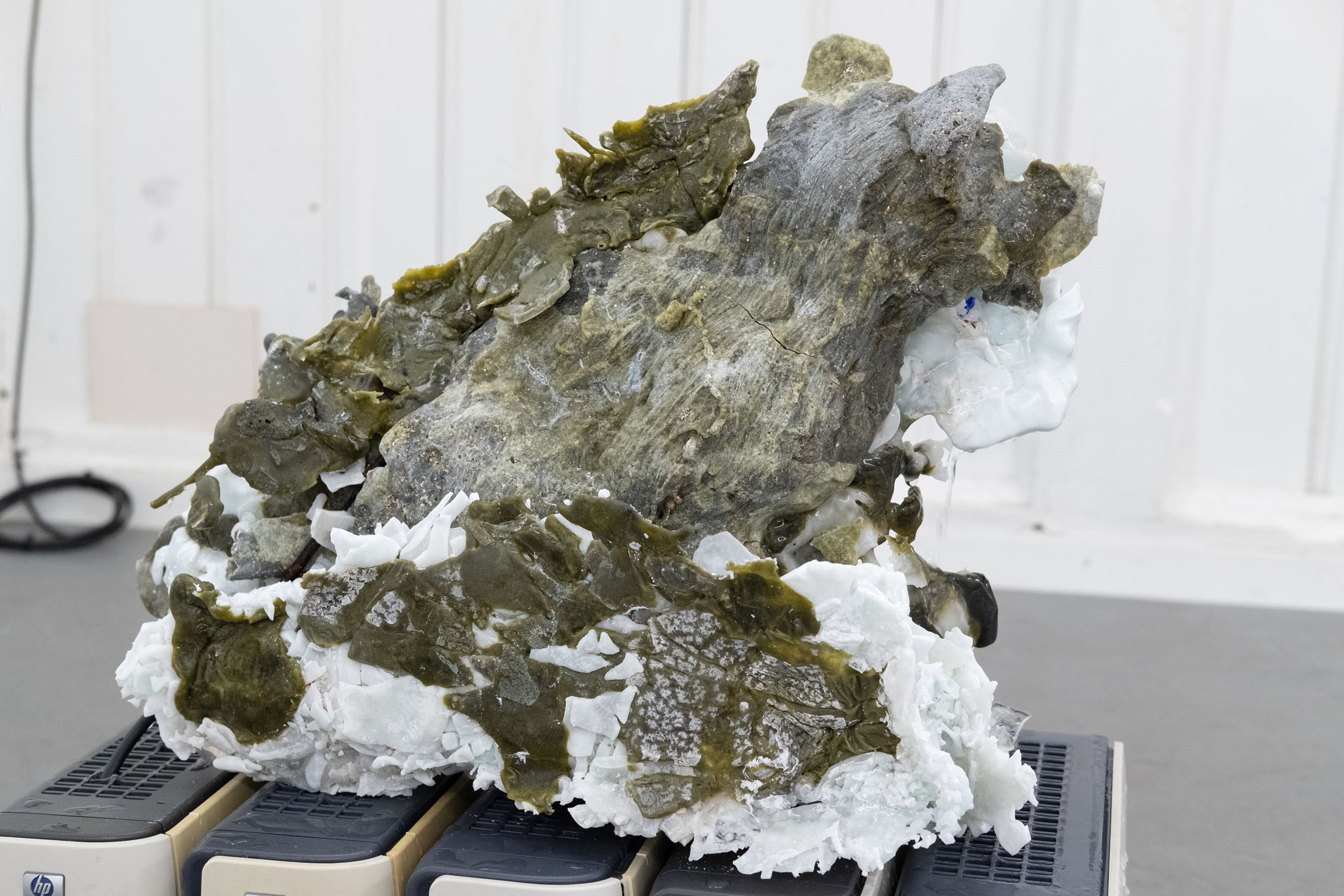
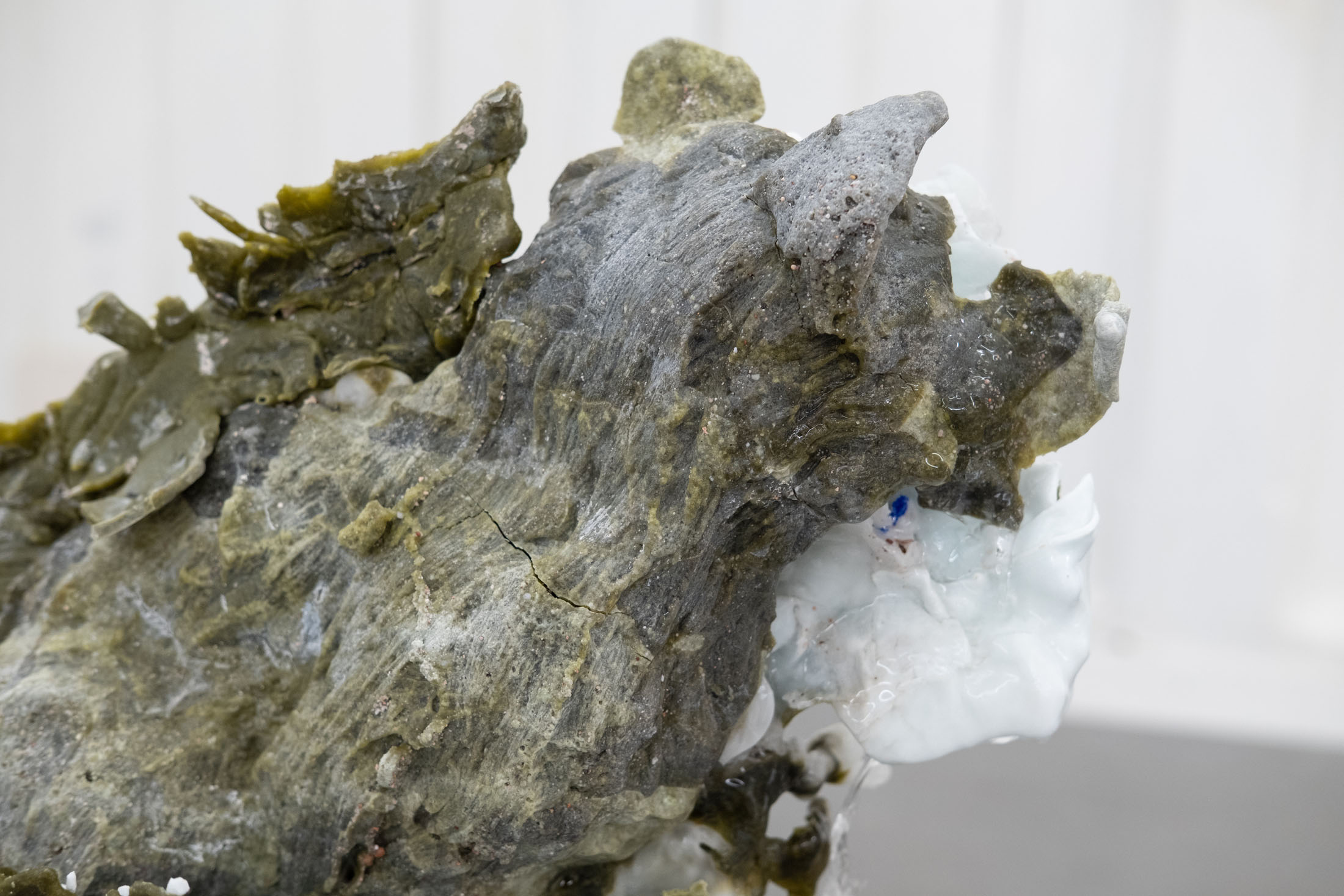
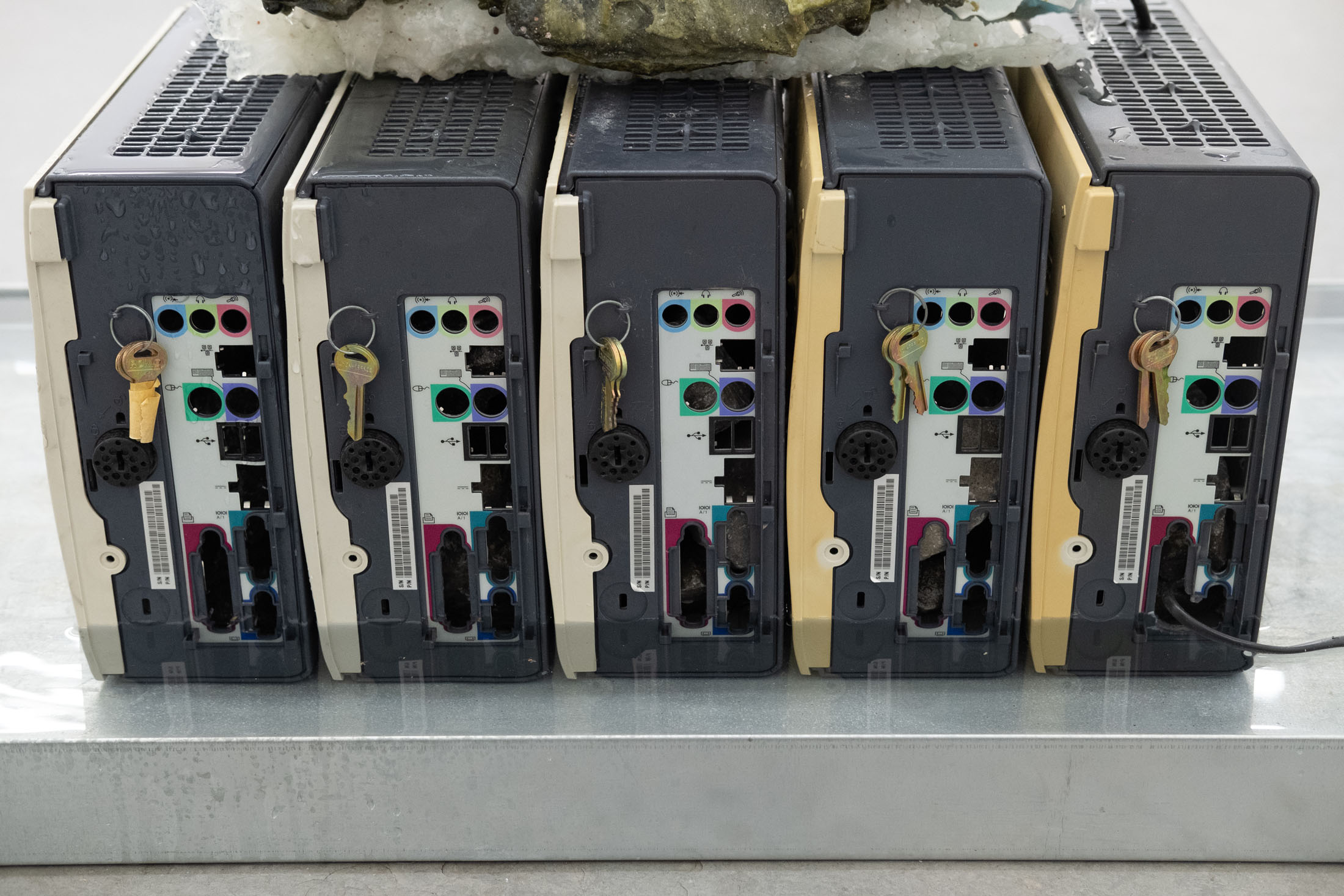
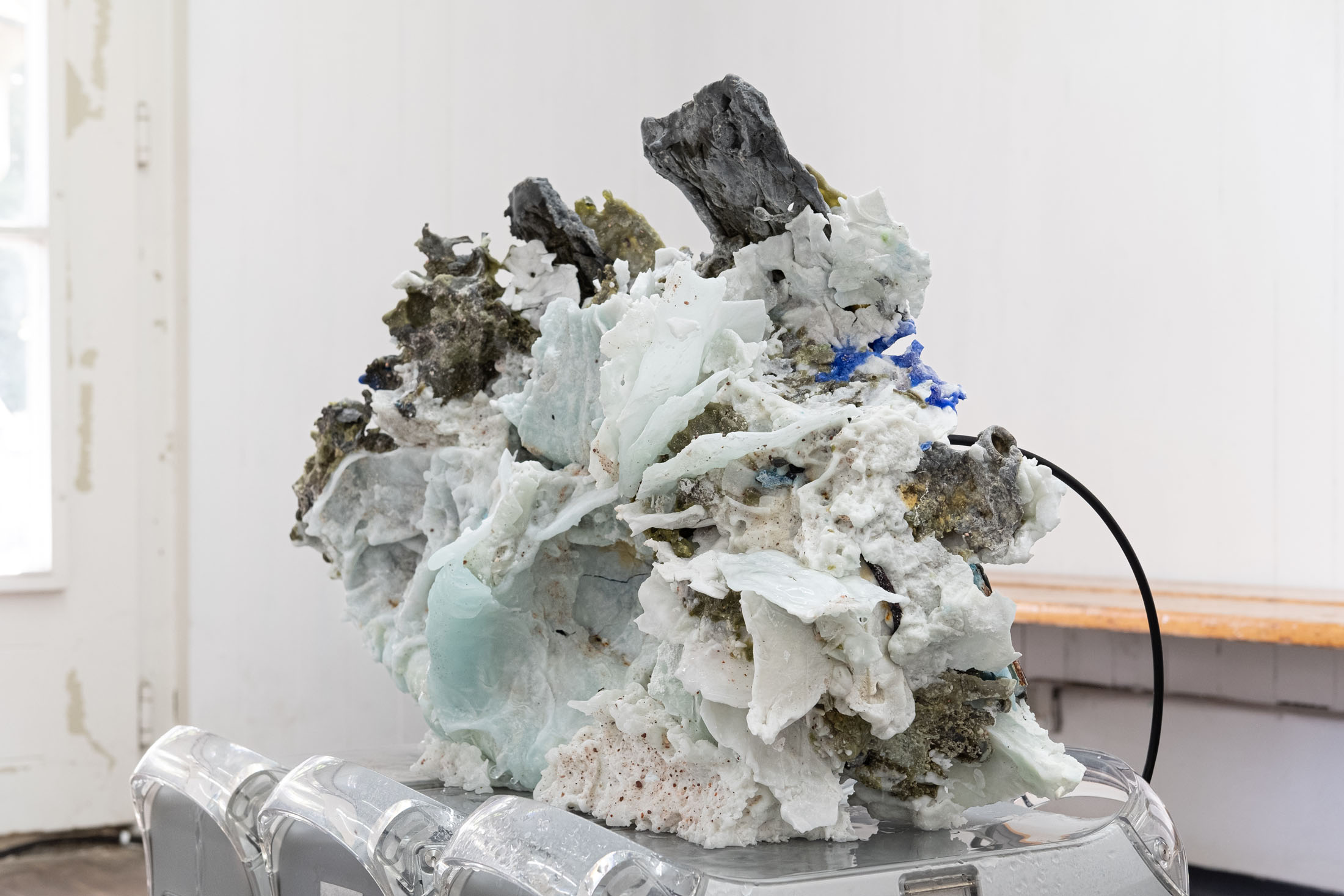
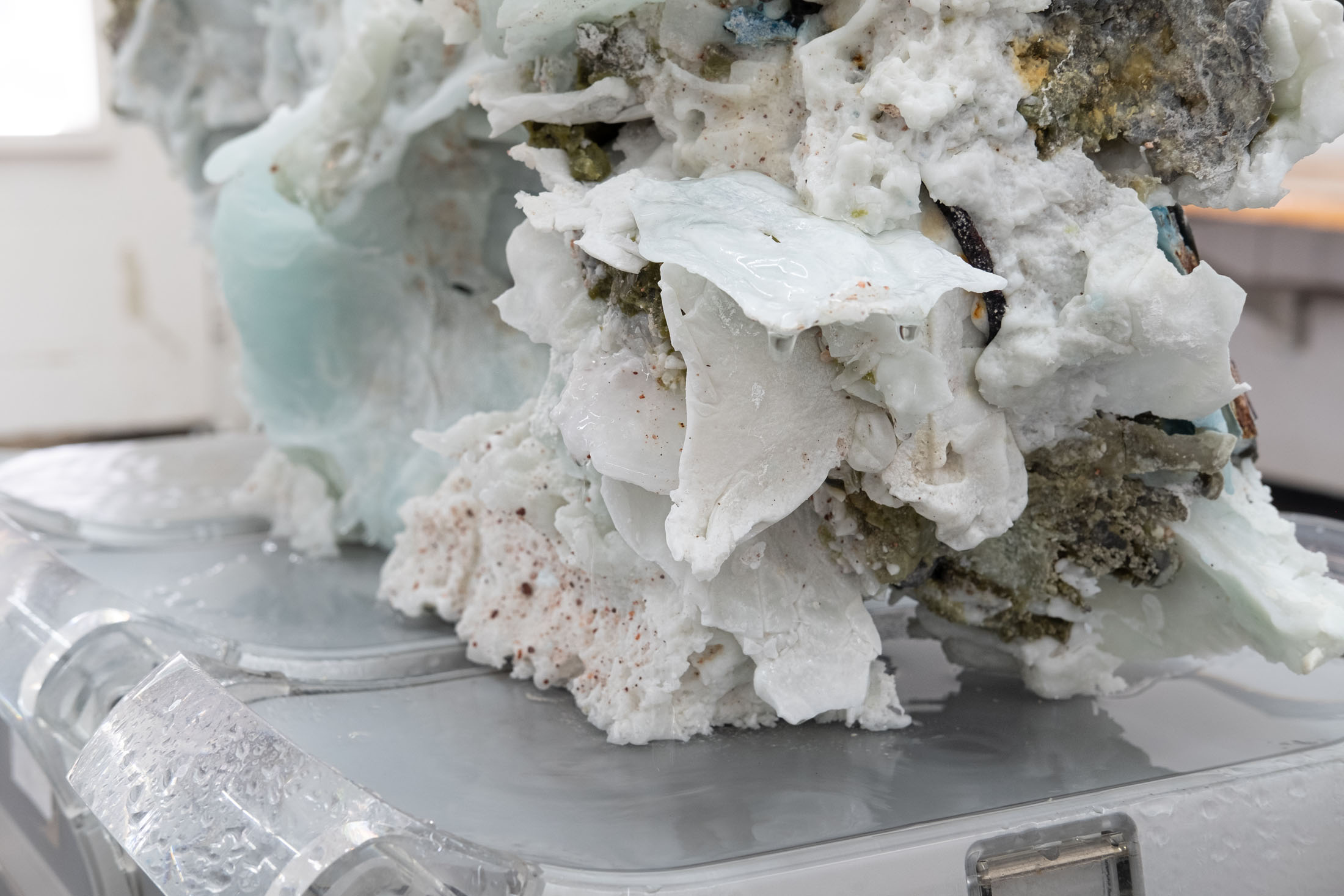
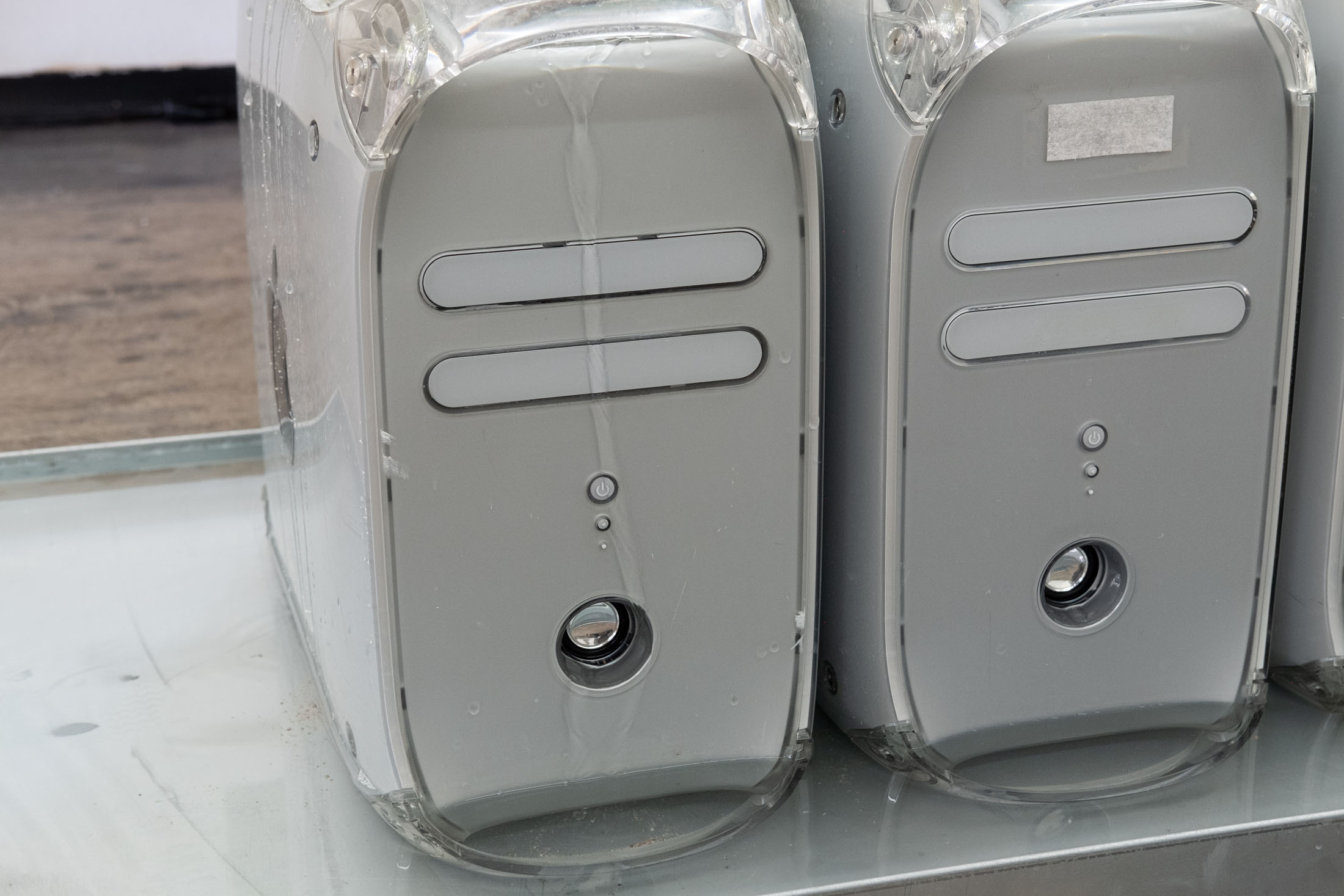
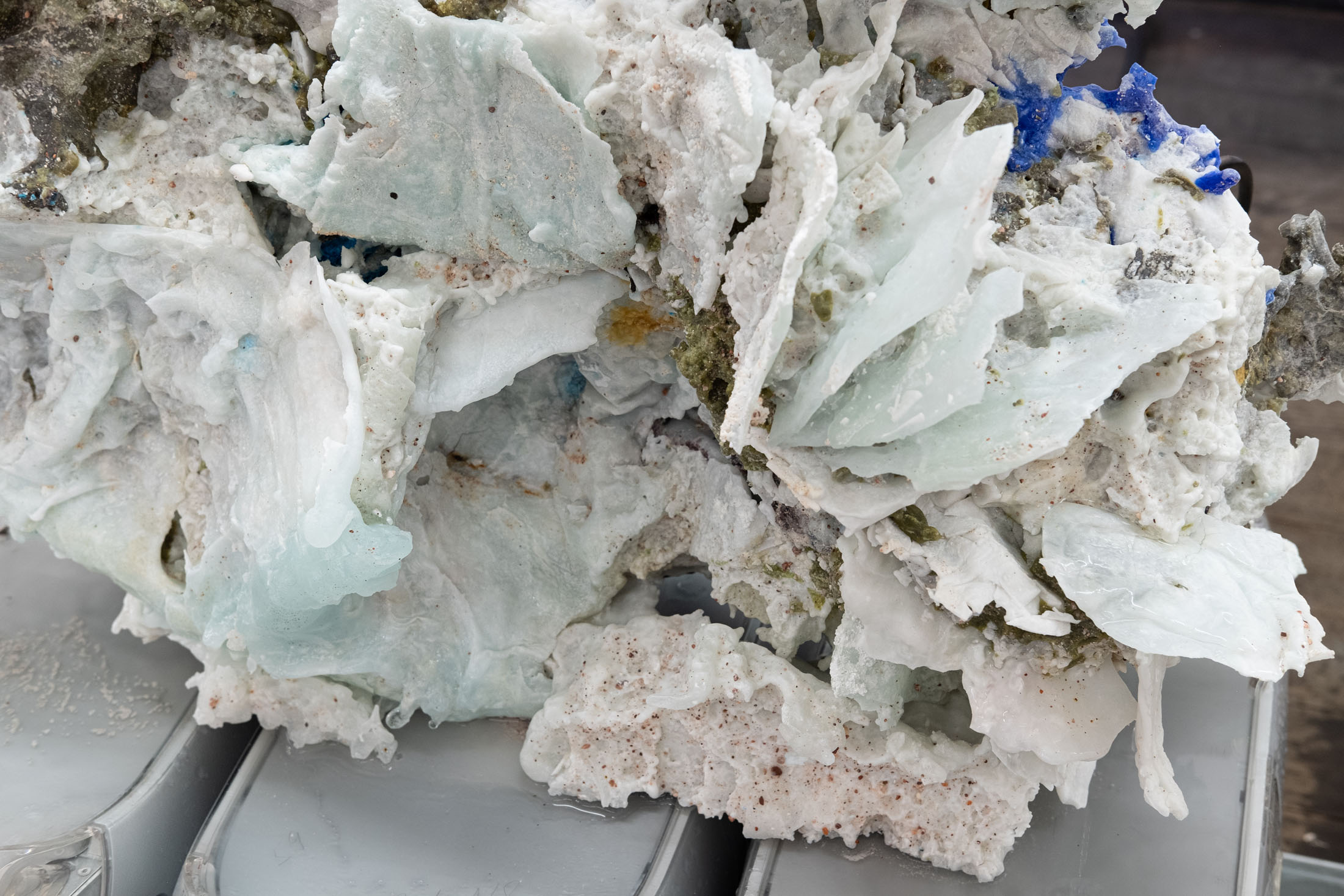
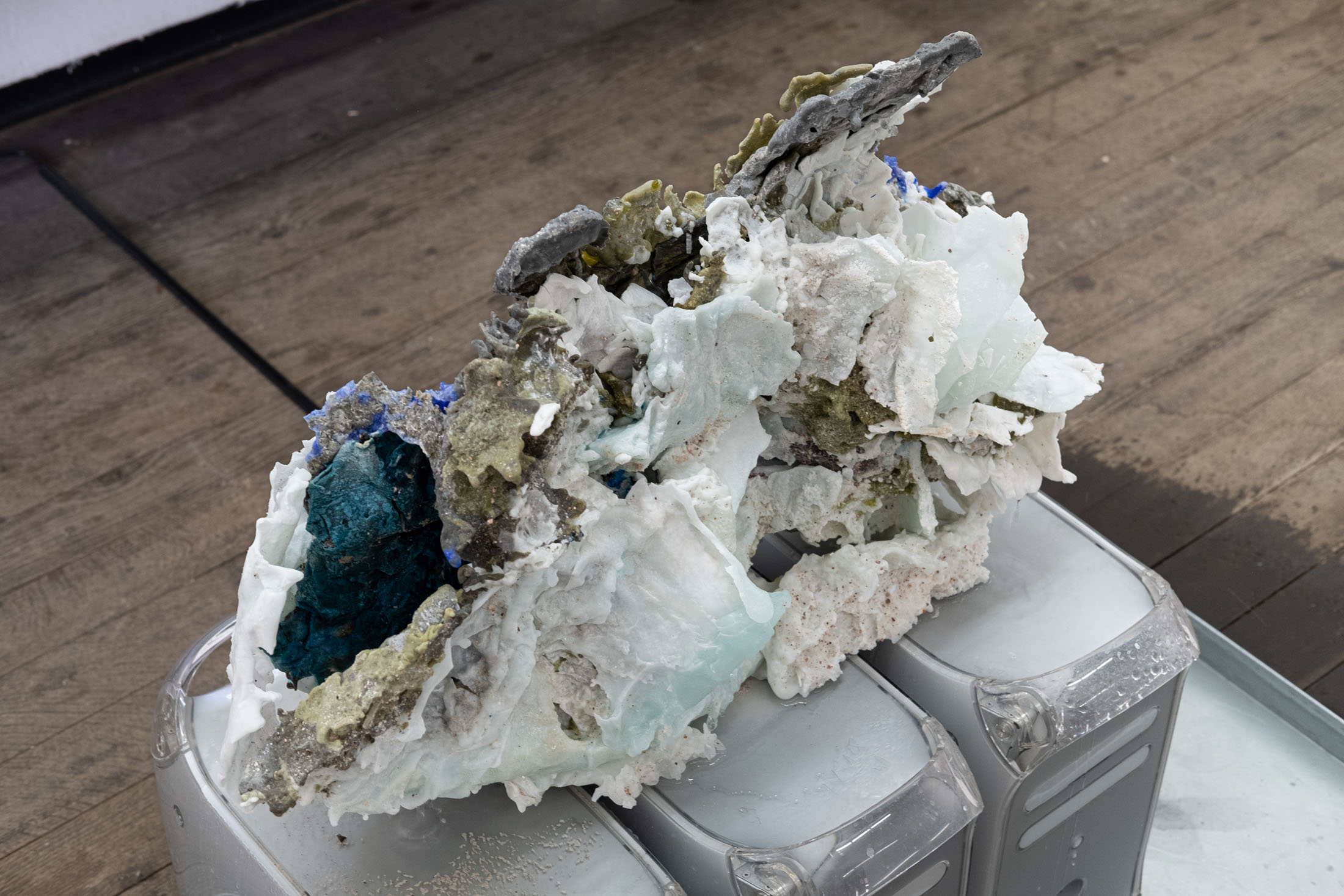
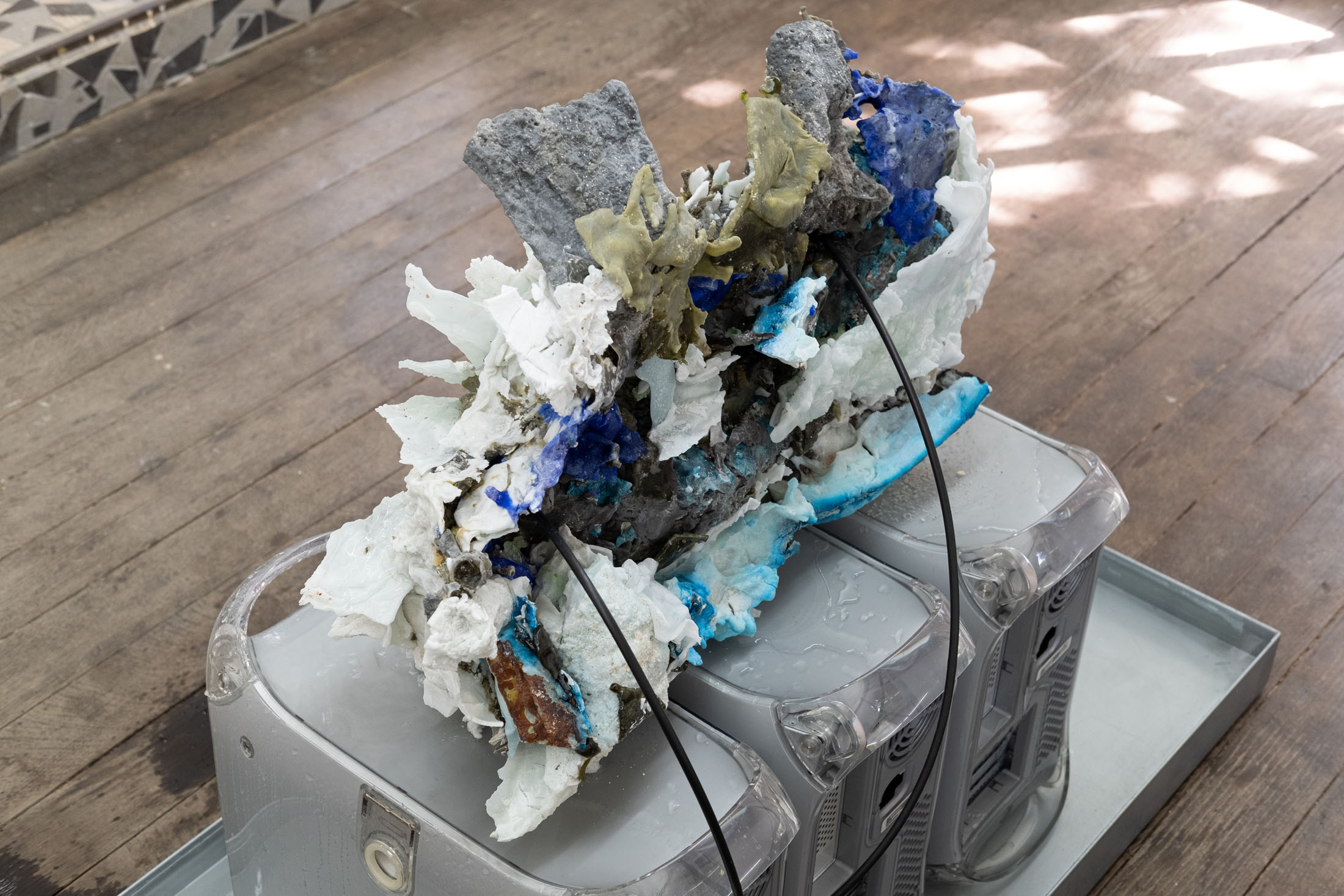
You might think of these objects as fountains, or as features of some unknown future ecosystem in which the obsolete technologies of today have fused with natural processes. The amorphous glass objects rising from a base of old computer-casings have a translucent, ghostly quality, but also appear weathered; lacking the transparency we associate with glass in most contemporary contexts, they appear like the product of years of erosion, exposed to the relentless drip, drip, drip of water in a cave: matter shaped by geological time. There is an absurd incongruity between this image and the clean lines of the implied technological infrastructure. At first glance, the computer cases may seem like plinths, with strange creatures perched on their backs. But it is the water basin that delineates the sculpture from the surrounding space, while all the elements within it are connected by the relentless circular flow of water; the sculptures are more like organic growths than distinct entities.
Sometimes it feels as if, in the art world and beyond, everyone is talking about time. Not just about how fast it is changing, how we have too little of it, or (this may be passé) how we should all be living in the moment; but as a potentially unstable entity with multiple possible shapes and orientations –– linear, circular, horizontal, vertical, deep or shallow, frozen or fluid, stretched or compressed. Speculative fiction has long used the notion of imaginatively moving backwards, forwards or laterally through time as a key device to shift our perceptions of (social as well as ontological) reality, while both philosophy and literature map perceptions of temporality in metaphorical terms. As our world is increasingly diagnosed as suffering from a “polycrisis”, there is a tendency re-imagine its temporality as one of eternal collapse, an apocalypse that is suspended in time rather than moving towards an endpoint on a linear trajectory. This reconfiguring of how we think about time was articulated in the 1980s as a critique of modernity, with its abstract idea of time as progressive flow. One example is the work of Vilém Flusser, who proposed a “crisis of linearity” as a result of technological change: events no longer follow each other sequentially, but rather explode on the surface of screens in a viral, fragmented way. The emergence of this story about time roughly coincided with another, also popularized in the 1980s: the concept of “deep time”, which contrasts the rapid pace of human history with the slow, massive changes of geological time, with reference to the physical depth of geological strata.
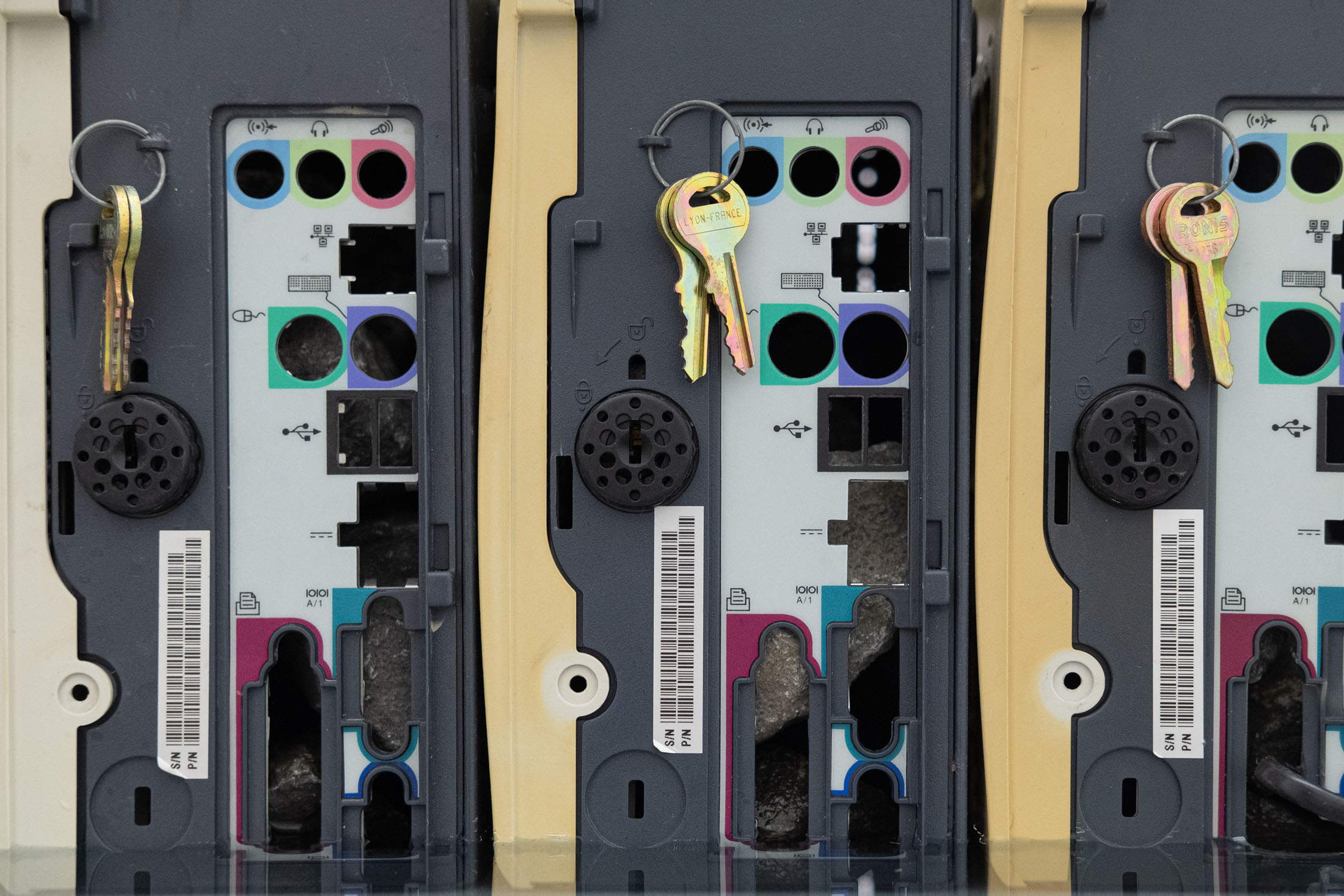
Both these metaphors for our relationship to time rely on the juxtaposition of the rapid and fragmentary with the gradual and inescapable. This contrast is one way of thinking through another metaphor, which Félix plays with in the title of the show: the relationship between the “ghost” and the “shell”. Drawing on the Japanese anime Ghost in the Shell, this figure is deeply inscribed in the cultural history of digital technologies as a conceptual framework for negotiating the relationship between consciousness, body, and technological infrastructure. We could think of the ghost as the fleeting processes of the mind, the shell as the product of slow evolution and subject to fossilization. The shell as a metaphor for technological “hardware” also implies the spectral presence of billions of years of deep time in the material substrate of technology, while the ghost as mind, spirit, soul maps onto our anxiety about these aspects of human existence being penetrated and fundamentally changed by technological intervention. And yet, in the sculptures we are spending time with here, what are these unused pieces of technological trash, these beautiful shells, if not also a type of ghost, haunting our present with a vision of futures past? Their function has not merely been lost through disuse: the artist has emptied them of the hardware they once contained, the original keys for unlocking the cases remain as an indication that these objects have an outside and an inside. They have been weighed down with stones, gathered from railway tracks (itself a technology both strangely nostalgic and futuristic). Just as the plinth and the sculpture can’t always be separated from each other or their environment, the ghost and the shell may collapse into each other and swap signifiers, depending on our perspective. This is further complicated when we grapple with the materiality and complex cultural associations of glass, which is at the heart of Félix’s artistic practice.
For several years, Félix has collected used glass in various everyday contexts, an exploratory process akin to the situationist dérive, recycling trash into sculptural pieces that reference layers of time and memory. By fusing glass of various colours, qualities and origins, he creates new shapes, subject to a range of uncontrollable factors –– for example, the colours are a consequence of chemical reactions during the melting and cooling process. The resulting objects are charged with both the memory of their past and speculative narratives that use glass to mediate between technology and time. Vitrification occurs when rock melts and cools rapidly, hardening into glass instead of forming crystals. This happens in nature for example in the case of volcanic glass (obsidian). Most human-made glass involves heating sand rich in silica, soda ash and limestone –– using the results of processes rooted in deep time to create objects of everyday use and infrastructures associated with transcendence, communication, speed, or ephemerality: from stained glass windows to fibre glass cables, from “crystal” chandeliers to mobile phone screens and AI microchips. But the relationship of glass to time is also interwoven with its material properties: Whether glass is solid or liquid is a question of timescale. Glass is a nonequilibrium material, which means that the atomic structure is not either a liquid or a crystal state. As one researcher in the field puts it: “Consequently, all glasses have two options: to continuously relax toward the equilibrium liquid state or undergo a phase transition into the crystal state. It therefore appears solid on a short time scale but continuously relaxes towards the liquid state. This process is so slow that from the human observation time, glasses appear solid.” From the perspective of deep time, we might see them as liquids –– leaking all over the Anthropocene.
While glass is therefore chemically very different from a rock- or ice crystal, their appearance has long been associated in the popular imagination, both associated with refraction, multiplicity, fragmentation, displacement, repetition, stillness or freeze –– and thus also as a metaphor for imagining time, be it as paralysis or progress. In 1967, Robert Smithson coined the term “time-crystal” to evoke an endless, nonprogressive temporality in which “both past and future are placed into an objective present”. Félix is also interested in non-linear temporality. But taking the material properties of glass into account, we might characterise it more specifically as a temporality dependent on perspective, on scale –– much like “deep time”, it resonates because it is relational. The speculative present, placed into both past and future.
Experience suggests that we should keep our personal technology away from water. Water penetrates the shell, damages the hardware. Its force is corrosive. However, we have recently been collectively forced to reframe how we think of the relationship between water and technology, due to a growing awareness of the immense amount of water required to cool AI data centres. On both levels, seeing water seep through and around even the empty shell of technology triggers a sense of unease. Water is the ultimate signifier of instability. “A being dedicated to water is a being in flux”, writes Gaston Bachelard in his strange but compelling essay Water and Dreams, “something of its substance is constantly falling away”. However, this quality of transition and continuous erosion also engages the imagination, invites reverie and reflection: “I cannot sit beside a stream without falling into a profound reverie”. If water dripping on (melted) rock evokes the depth of time, it may also invite a depth of attention. While the sculptures we encounter here may remind us of the artificial natural forms of baroque or romantic landscape architecture, fountains have historically been associated with many aspects of both urban and domestic life, one of which is to pause, to converse or to reflect. Think of sitting in a waiting room, with time to kill before the next train departs, a fountain splashing gently beside you. Where does your mind go? What do you hear? What spectres appear?»
—Text written by curator Kate Whitebread @gram_of_bread
- Gaston Bachelard, Water and An Essay on the Imagination of Matter, trans. from the French by Edith Farrell (Dallas: Pegasus, 1983), 8.
- See g. Aleida Assmann, Is Time of Joint? On the Rise and Fall of the Modern Time Regime (Ithaca: Cornell University Press, 2020). On metaphors of time see also the classic Stephen Jay Gould, Time’s Arrow, Time’s Cycle (London: Penguin, 1987).
- See g. the work of Jenny Stümer at the Centre for Apocalyptic and Post-Apocalyptic Studies, University of Heidelberg. https://www.capas.uni-heidelberg.de/en/about-us/team/dr-jenny-stumer.
- Vilém Flusser “Krise der Linearität” (1988), in Vilém Flusser, edited by Silvia Wagnermaier and Nils Röller (Freiburg: orange press, 2003). Flusser proposed that humanity must move from linear literacy to “techno-imagination” –– a new way of creating and reading technical images (like photographs or computer graphics) to understand and live within this new digital, computed, and non-linear, post-historical
- Coined by John McPhee in “Basin and Range” (1981, republished in John McPhee, Annals of the Former World, Farrar, Straus & Giroux: 1998), the term developed into a useful and resonant shorthand for geological time – the depth of measurable strata aligning with a sense of immeasurable temporal depth and dizzying immensity.
- Ghost in the Shell (Kōkaku Kidōtai) is a cornerstone of global science fiction, evolving from a 1989 Japanese manga into a franchise that profoundly influenced Western cyberpunk, philosophy, and digital-era thought.
- “What is glass and how is it shaping our world?”, Interview with Katelyn Kirchner, phys.org, March 28 2023, accessed 12 May 2026, https://phys.org/ news/2023-03-glass-world.html . See also her paper: Katelyn A Kirchner et al, “Beyond the Average: Spatial and Temporal Fluctuations in Oxide Glass-Forming Systems”, Chemical Reviews (2022).
- See Robert Smithson, Collected Writings, edited by Jack Flam (Berkley: University of California Press, 1996), in particular “Ultramodern” (1967, 62–65) and “Quasi-Infinities and the Waning of Space” (1966, 34–37), also Amelia Barikin, “Robert Smithson’s Crystal Lattices: Mapping the Shapes of Time”, Holt-Smithson Foundation, 2019, accessed May 12 2026, https://holtsmithsonfoundation.org/robert-smithsons crystal-lattices-mapping-shapes-time.
- Bachelard, Water and Dreams,
- Bachelard, Water and Dreams,
- For the concept of “deep attention” see g. Bernhard Stiegler, For a New Critique of Political Economy, trans. Daniel Ross (Cambridge: Polity Press, 2010).