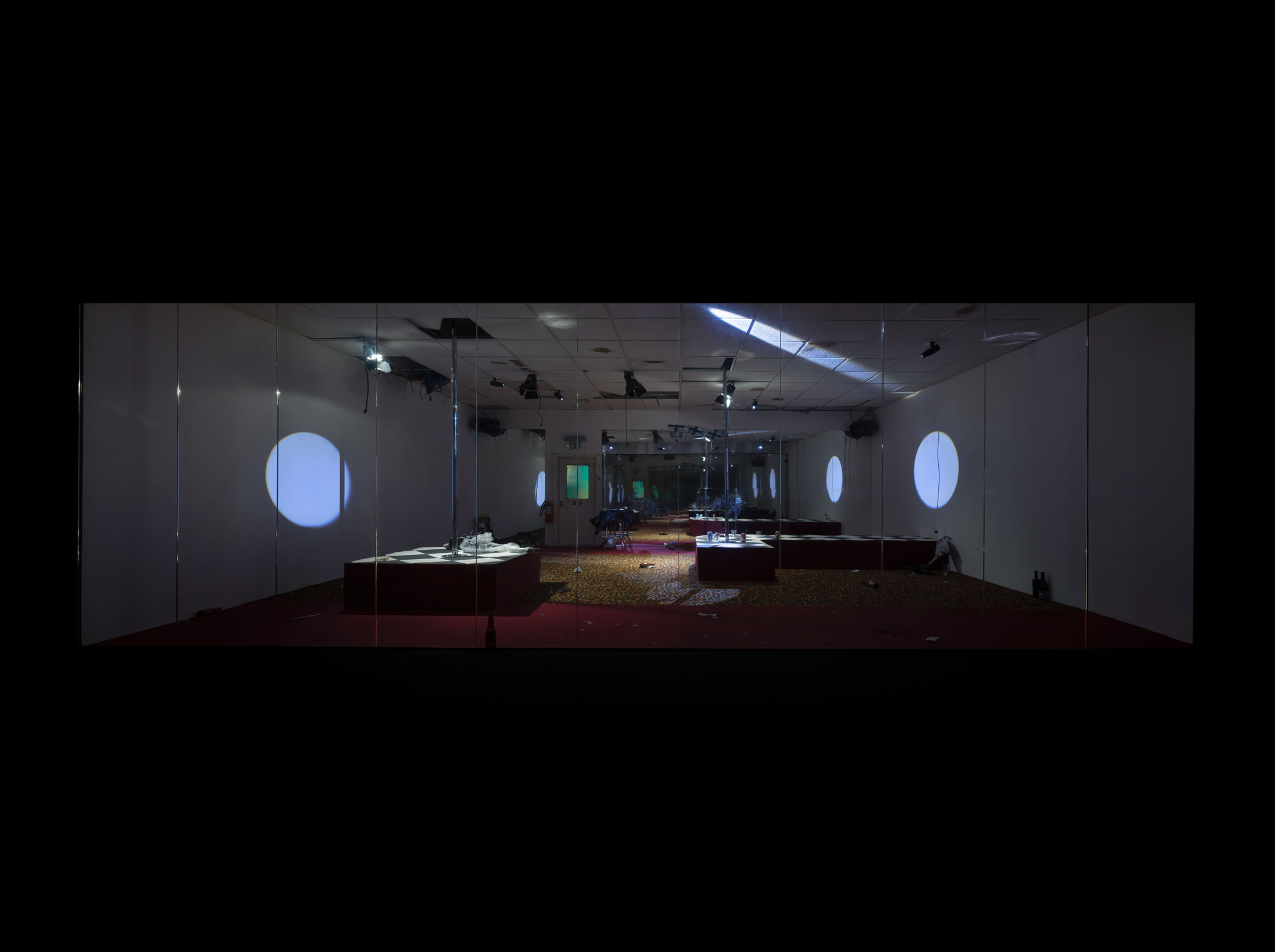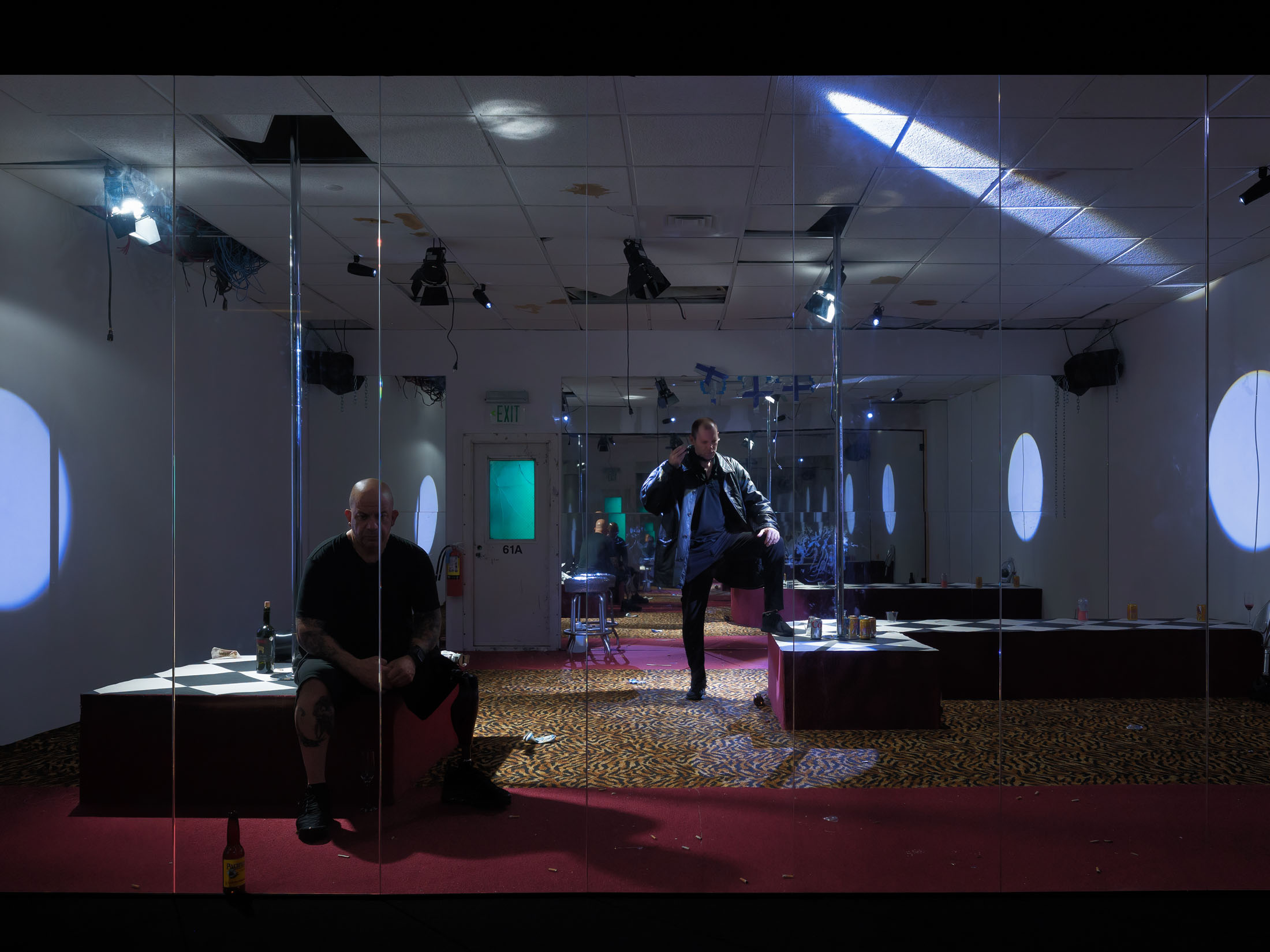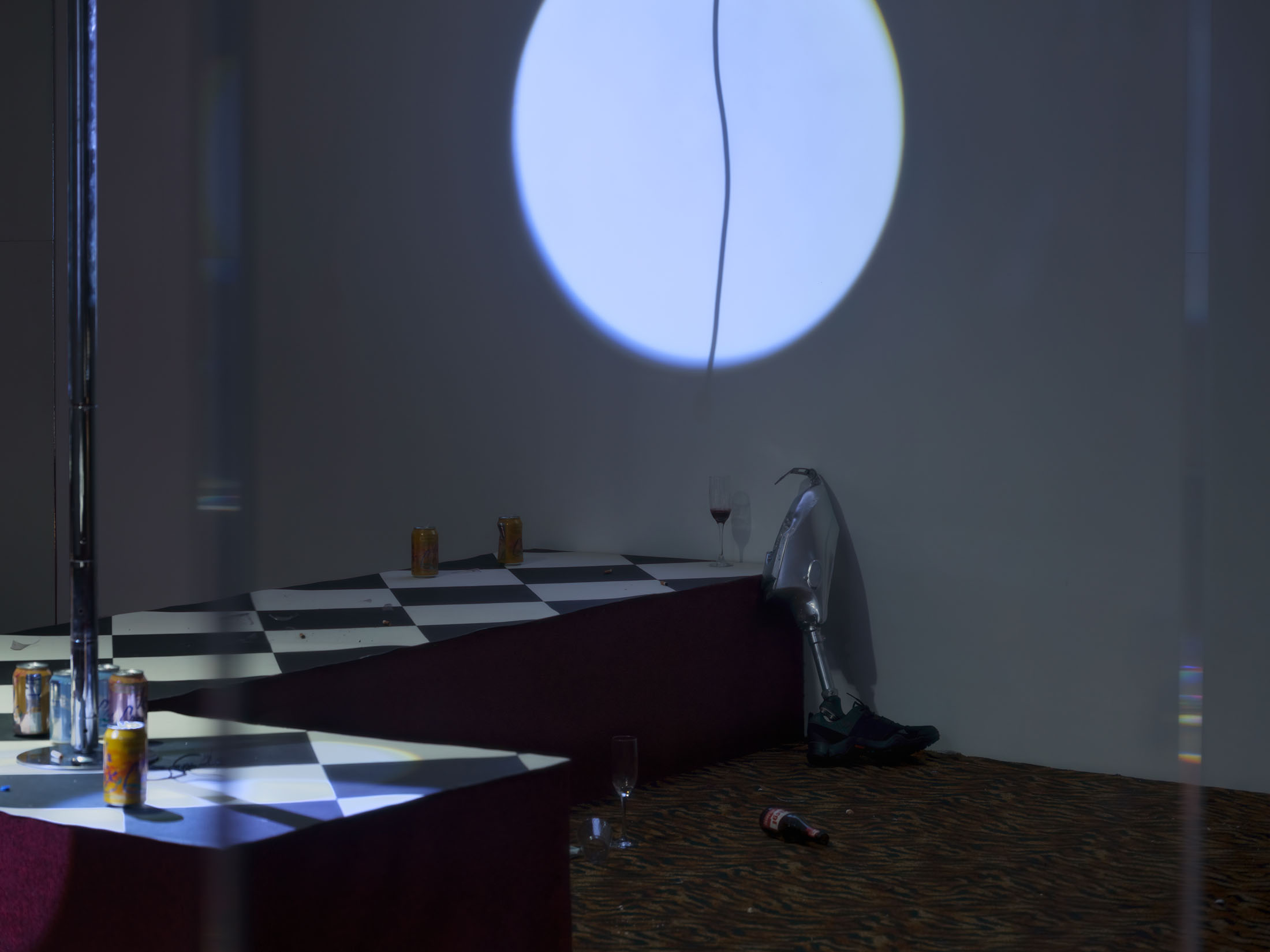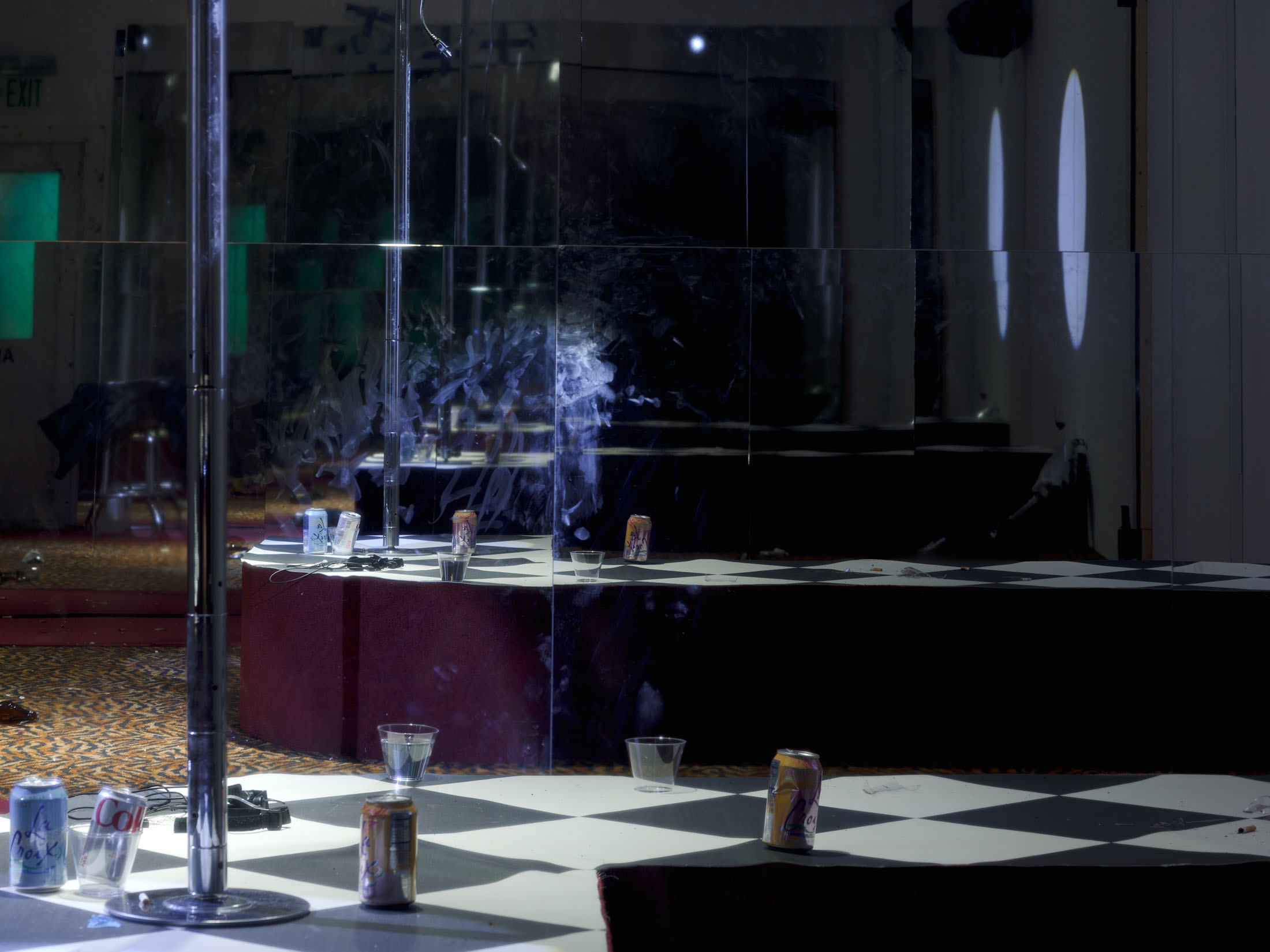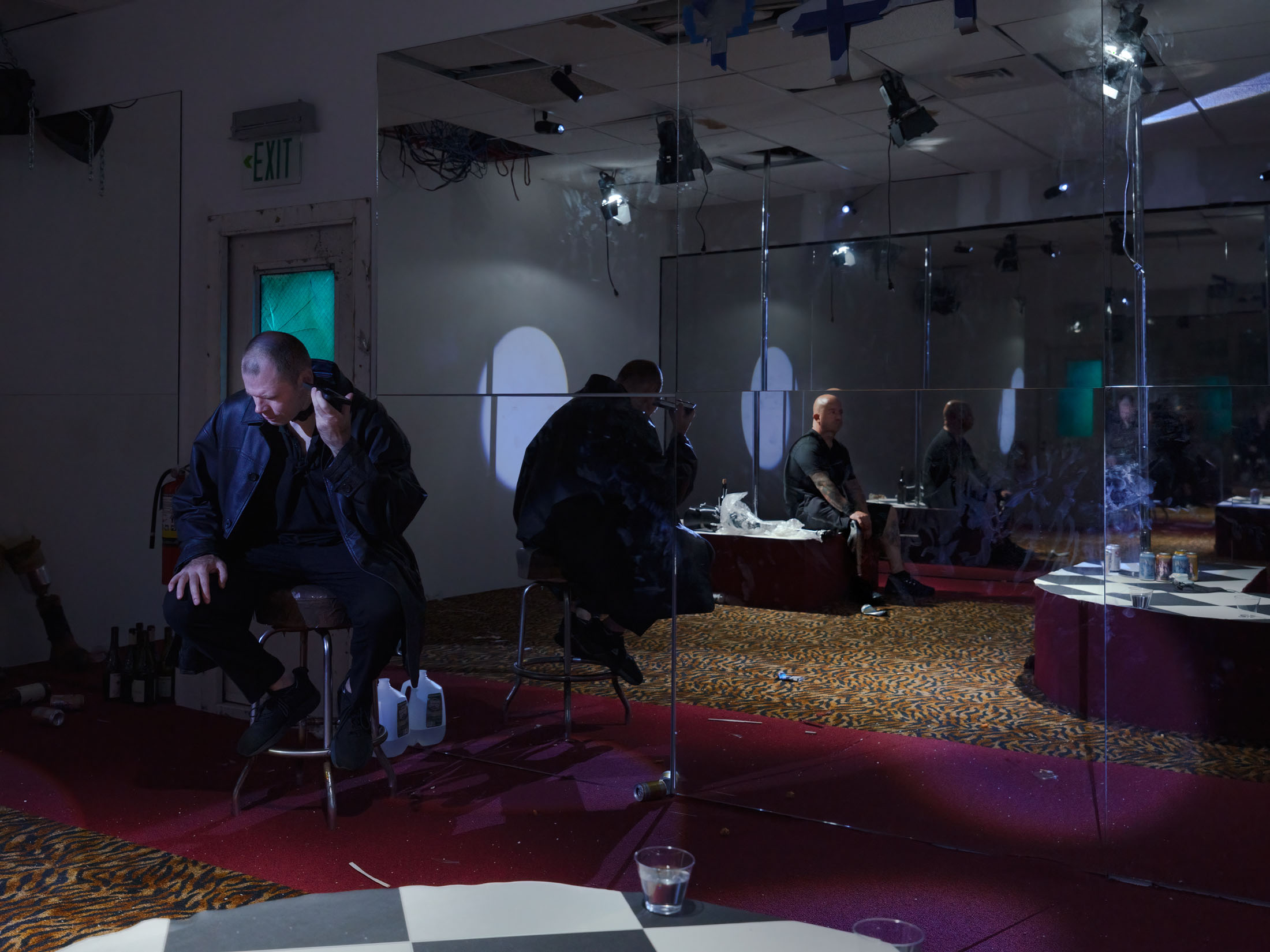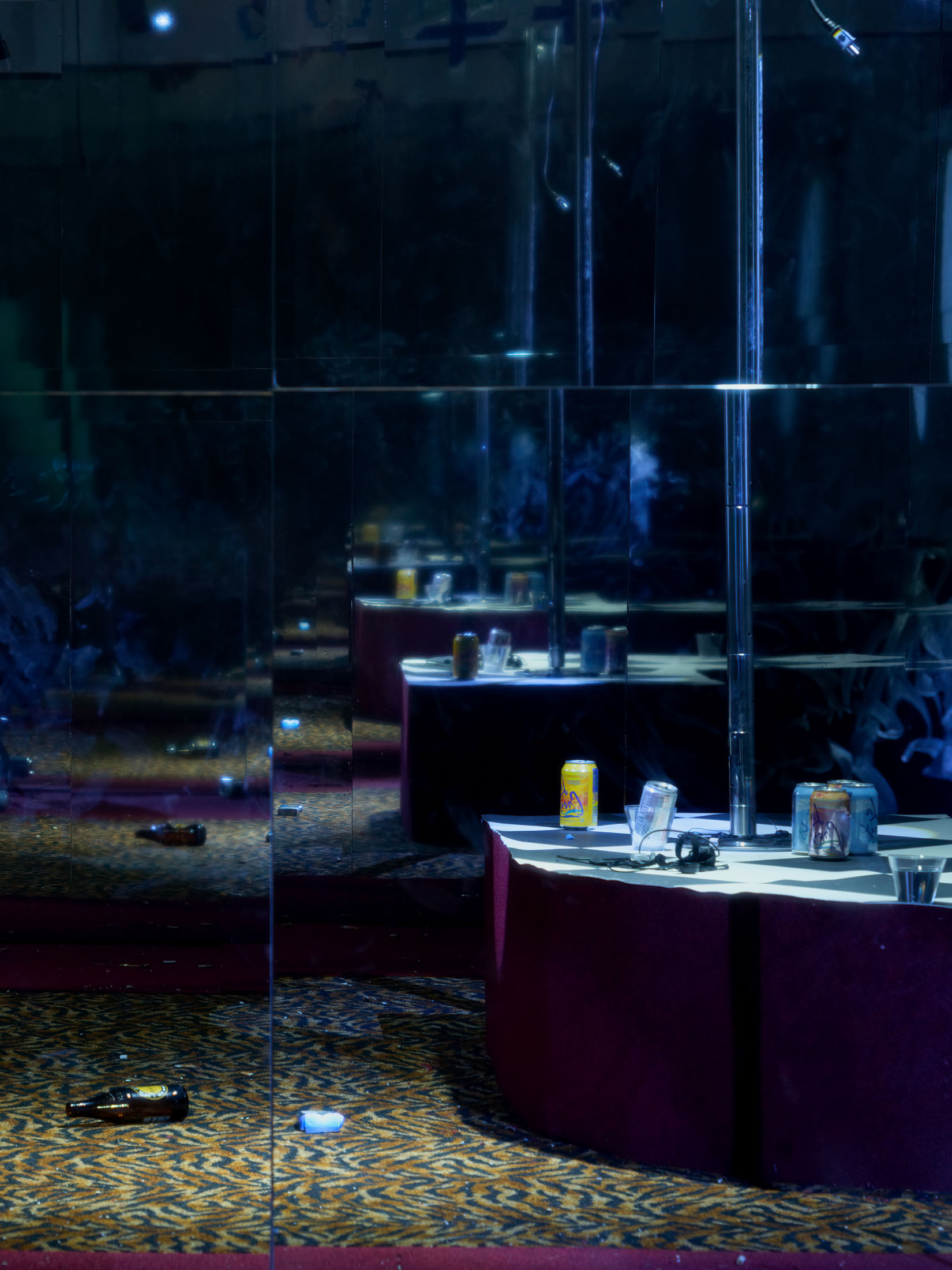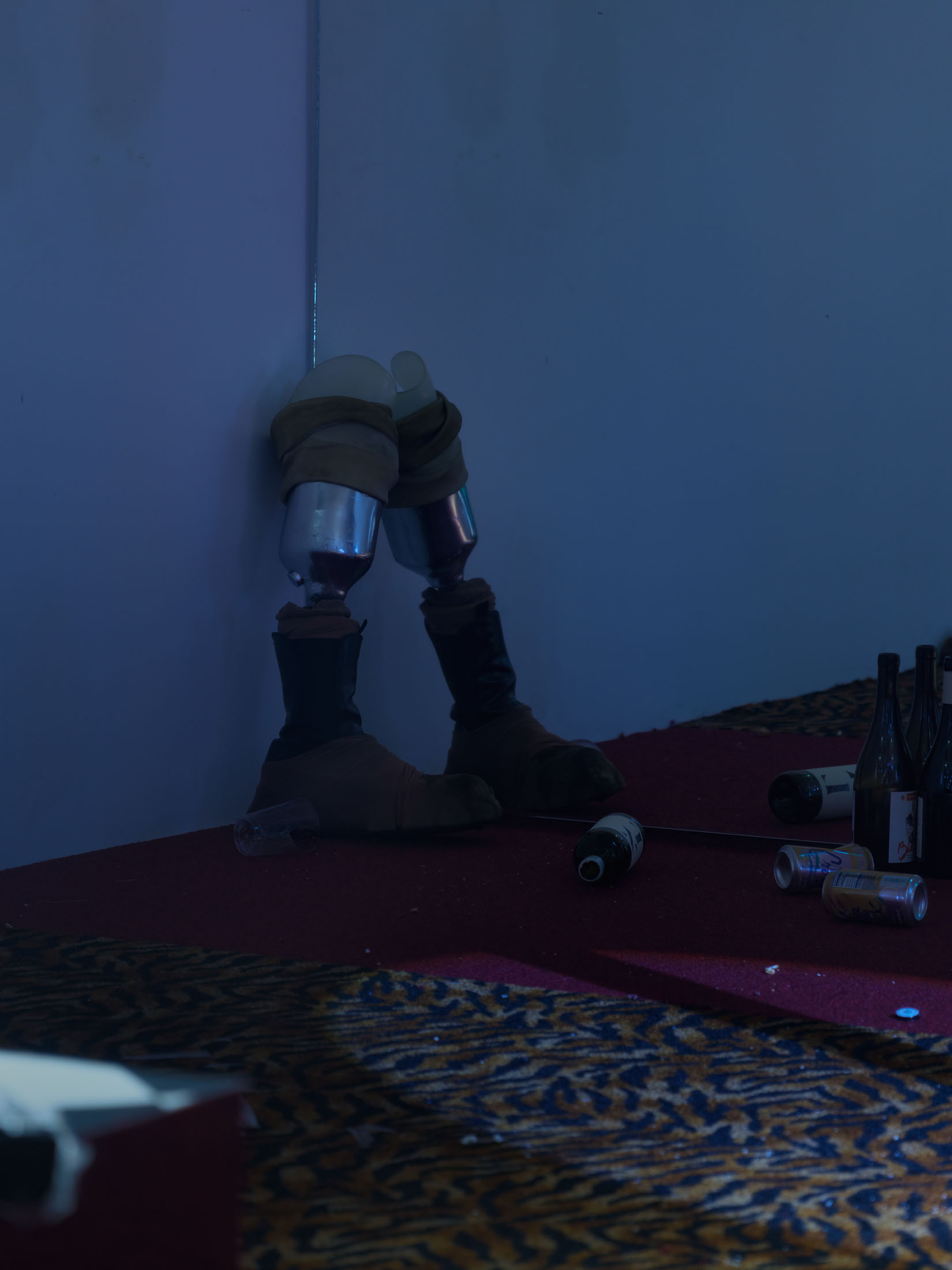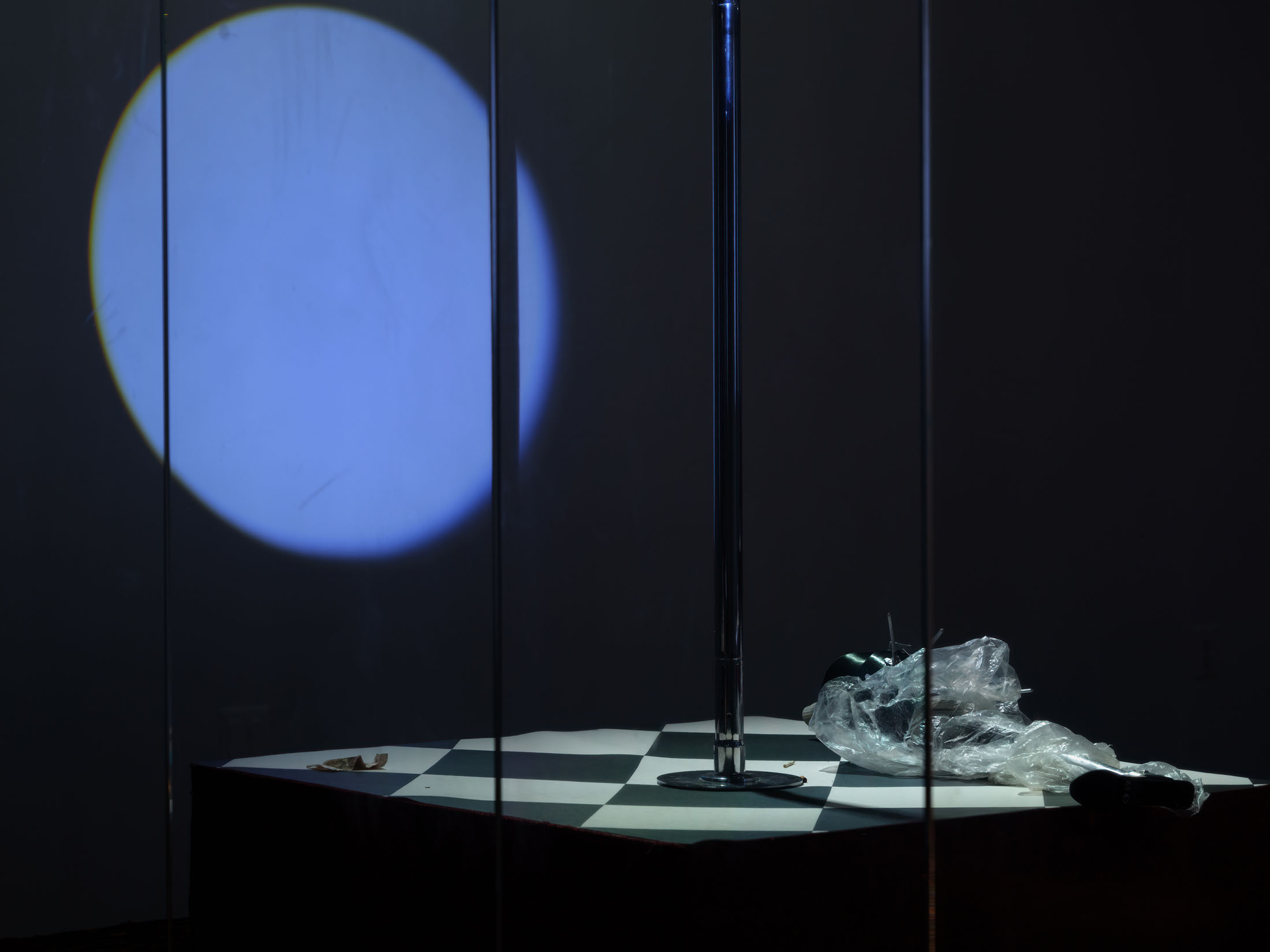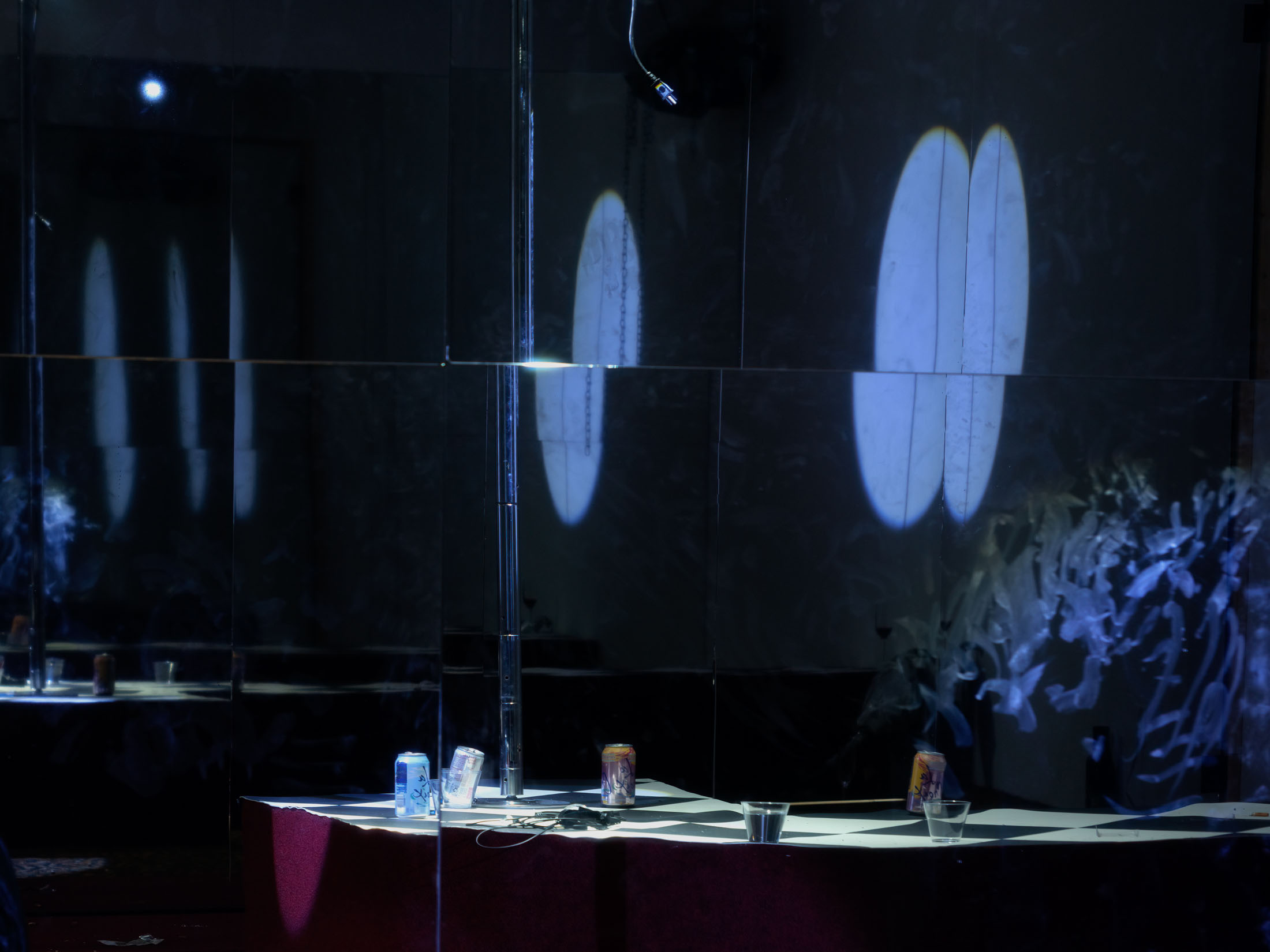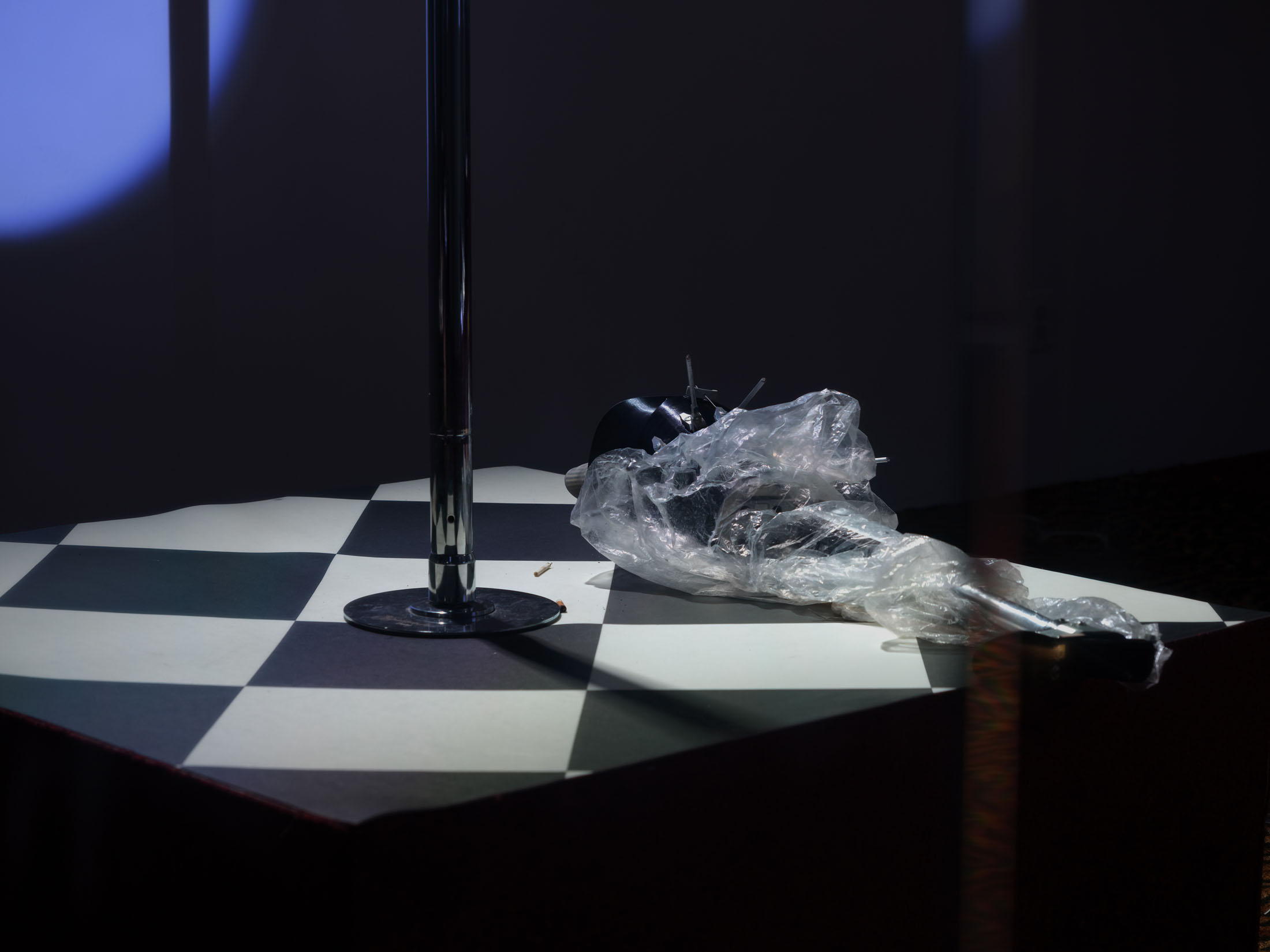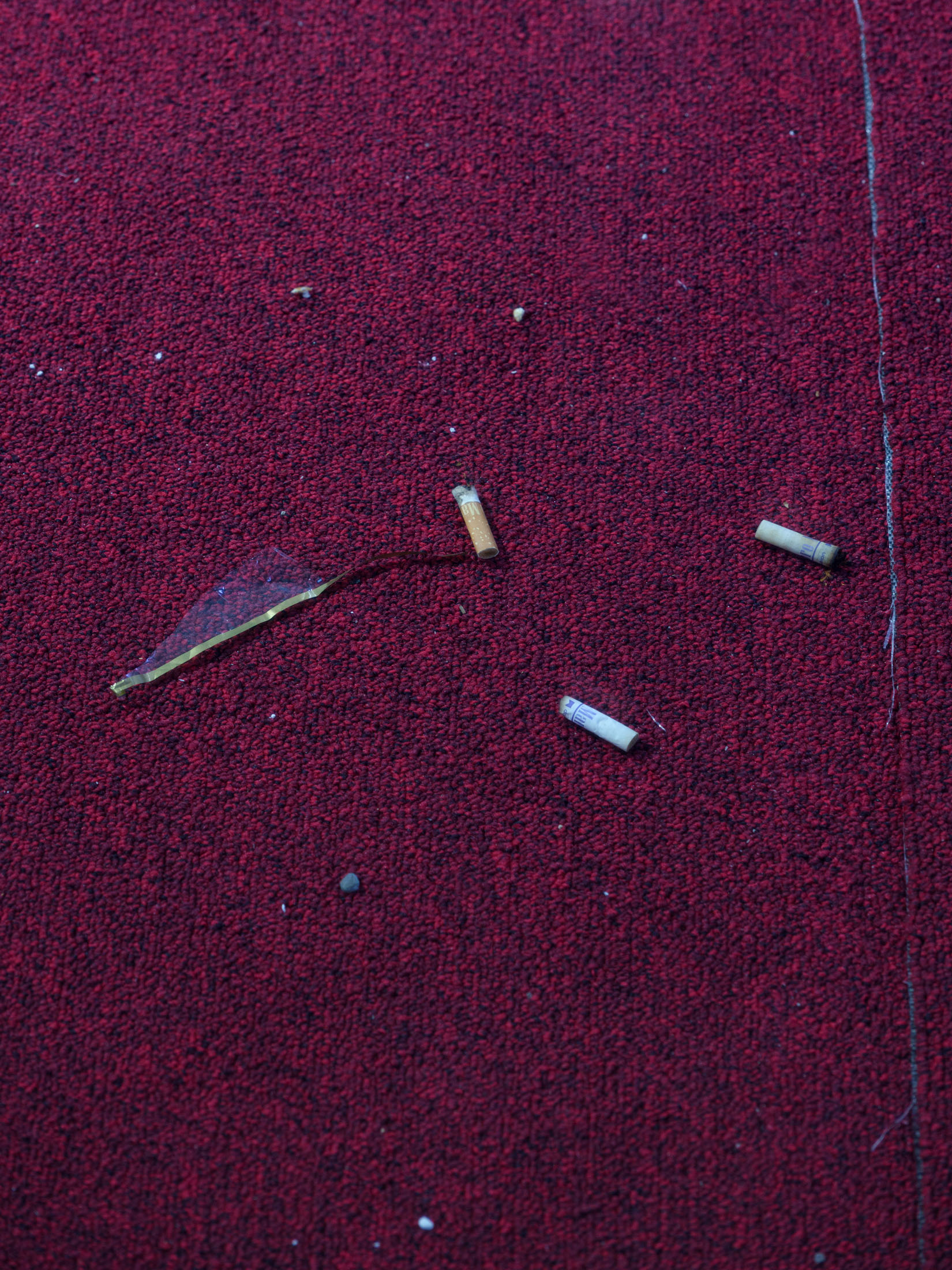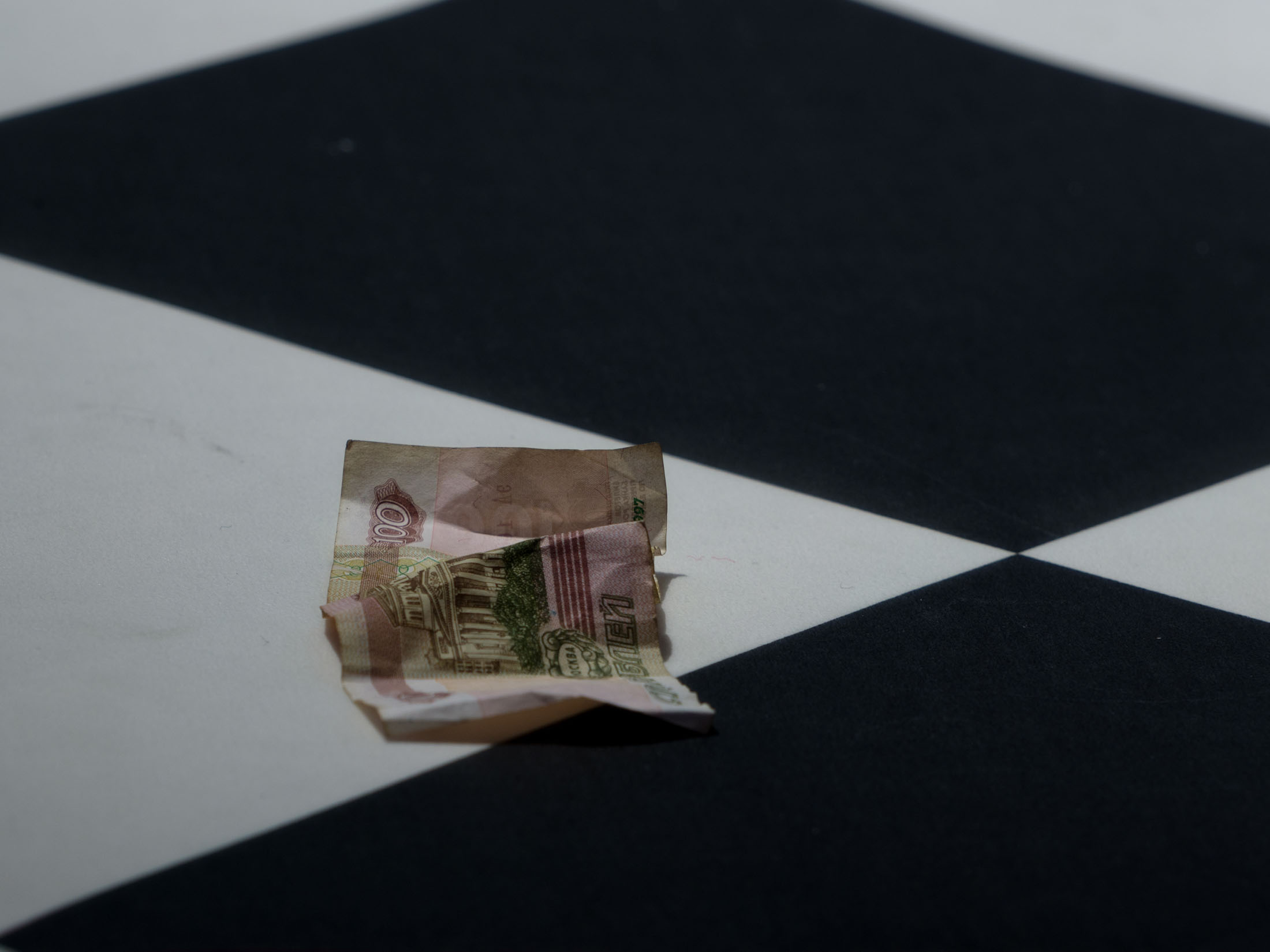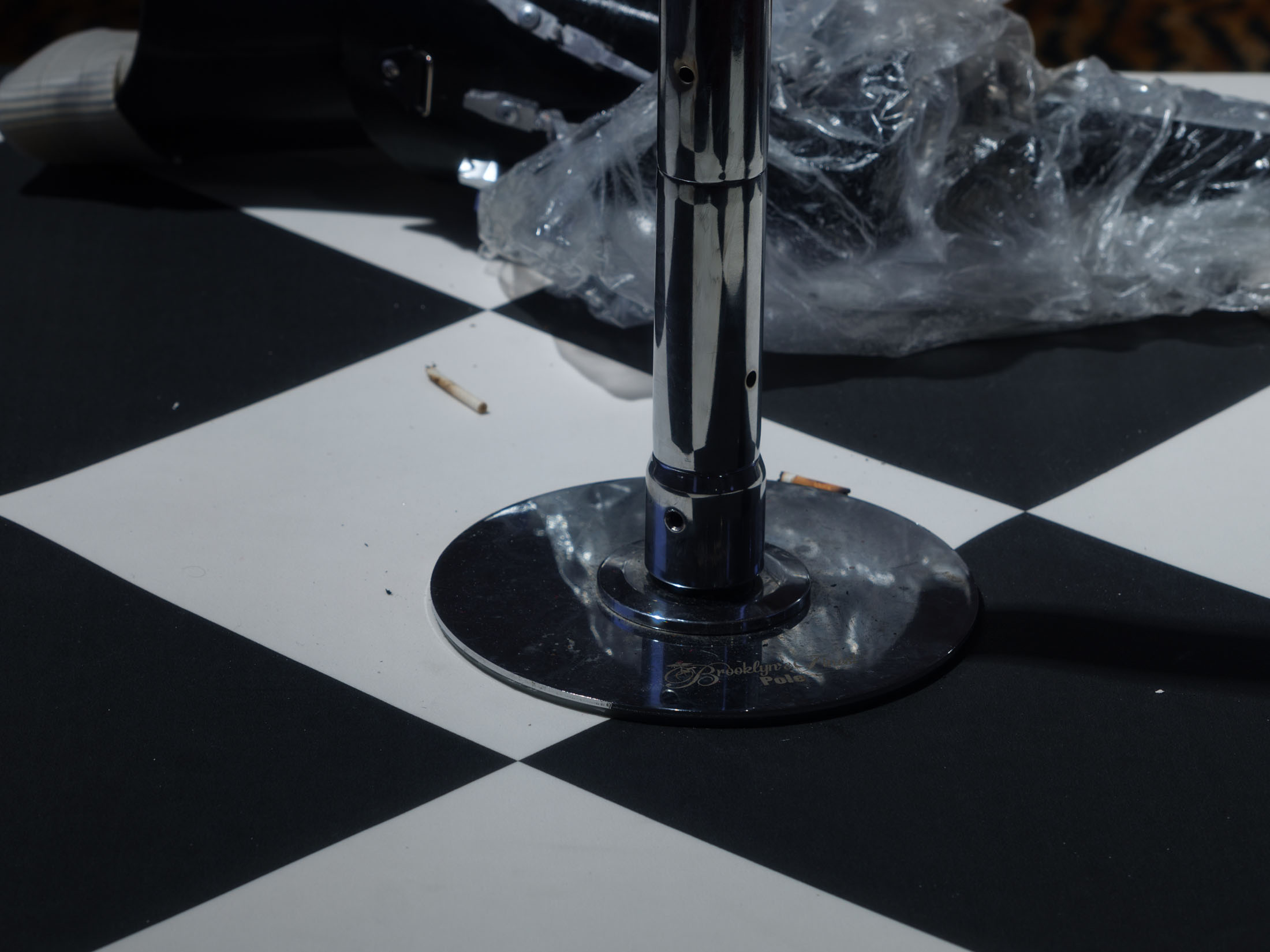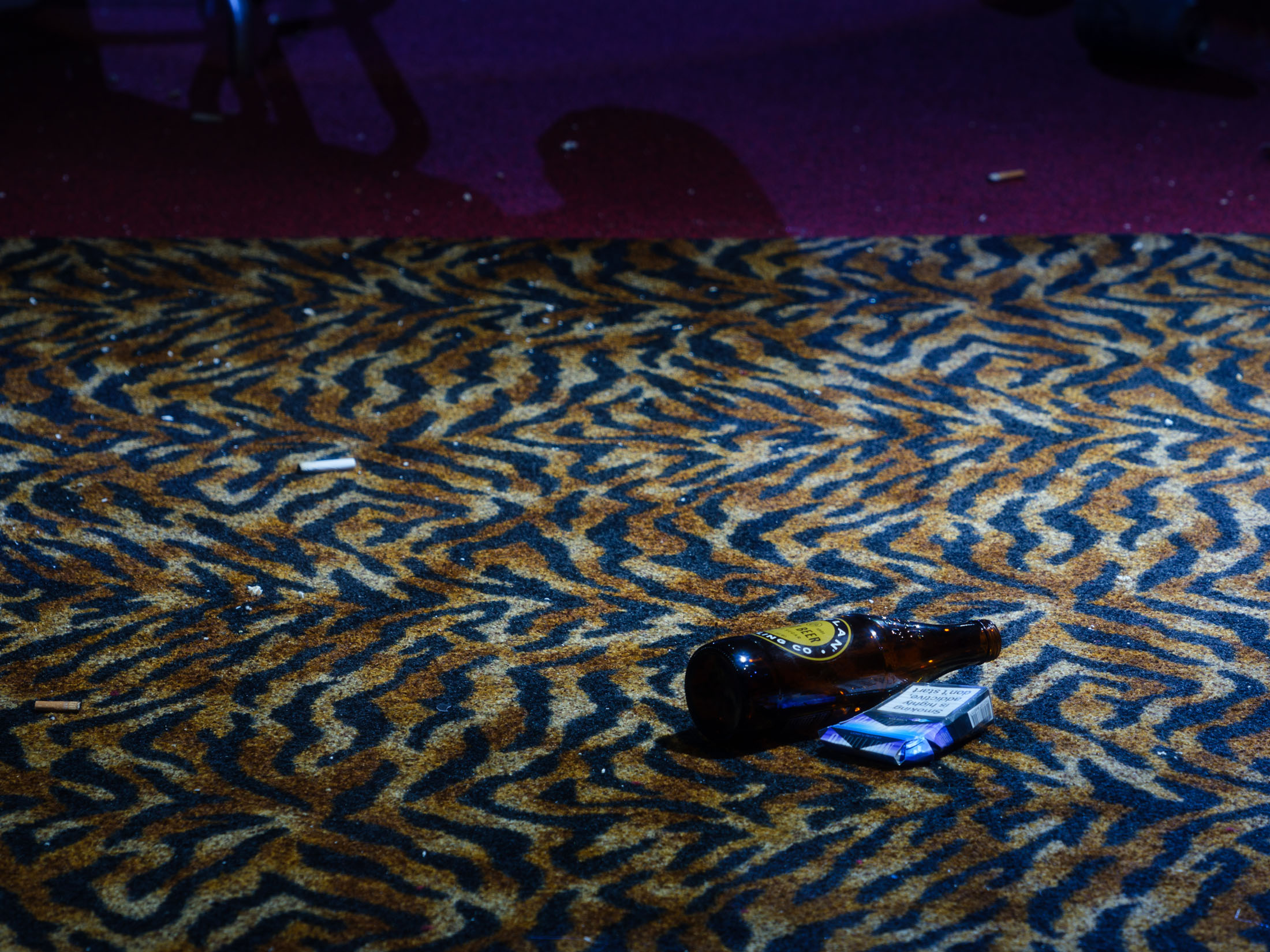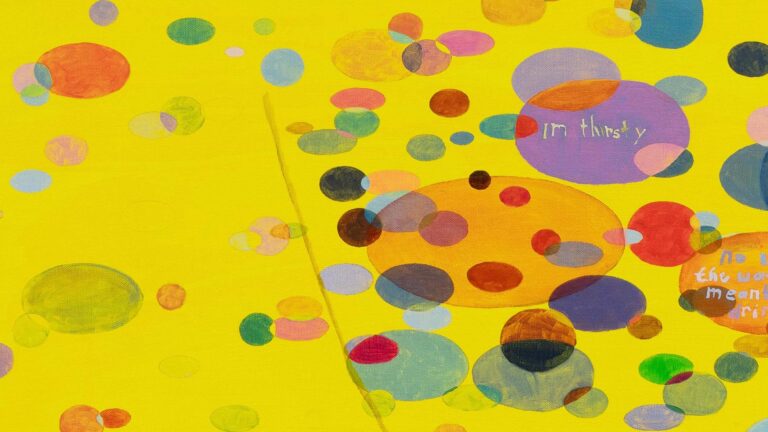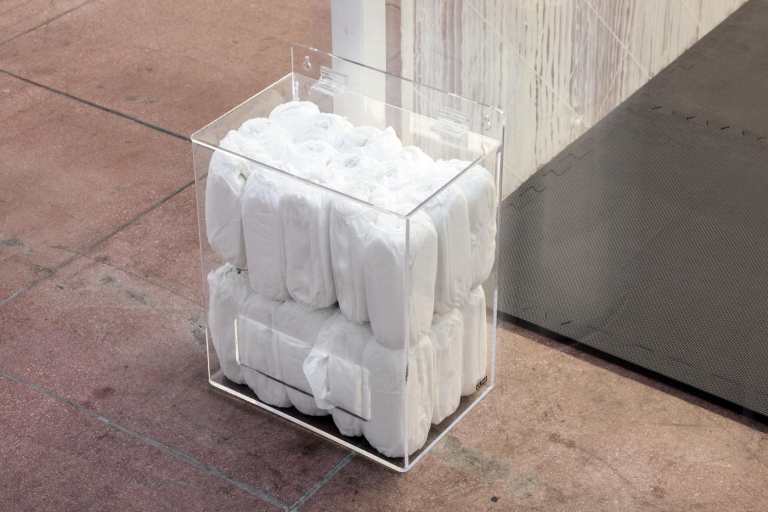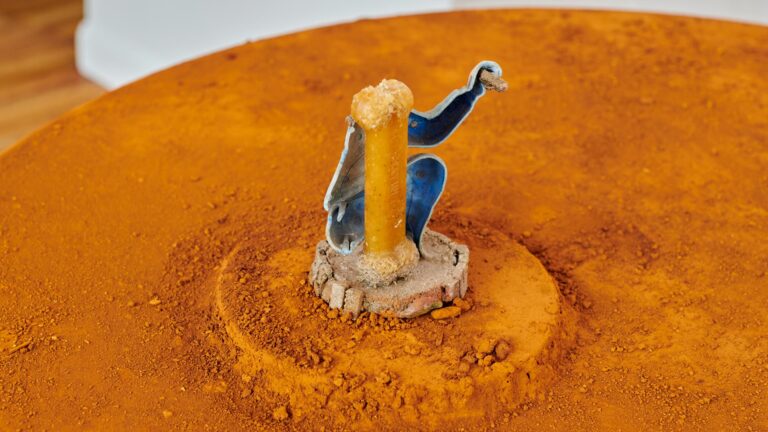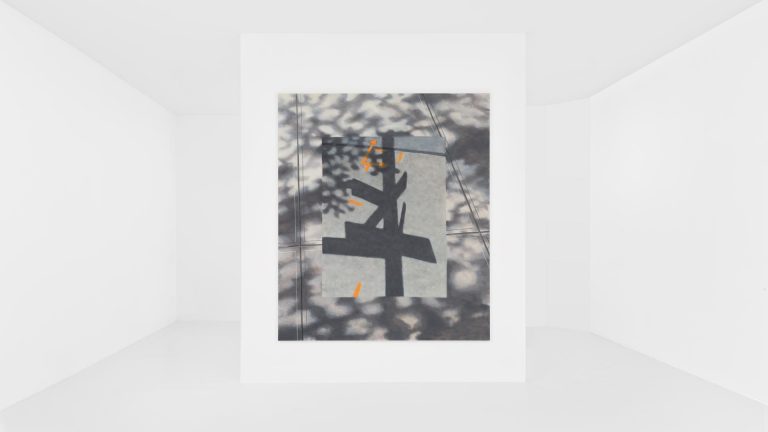
Management is pleased to present OBJECTS IN MIRROR MAY BE CLOSER THAN THEY APPEAR, the second solo exhibition of New York-based Vladislav Markov at the gallery. Markov created an environment reminiscent of a seedy strip club that viewers are able to observe from within a black box behind a one-way mirror wall, not unlike that of a monitoring room in an interrogation context. The performers in the space are amputees Markov contracted online, for whom he has created custom prosthetics for the duration of the exhibition. The sound playing inside the exhibition draws on the tradition of world-specifc entertainment radio for various video games like the Grand Theft Auto series. Performances take place every Saturday.
Sound mix by ssaliva.
Sound contributions from ssaliva, Vipra Sativa, emma dj, and Jon Rafman. Special thanks to Fish Witcher, Caroline Drevait, Giga Meladze, and Ted Riederer. Text by Nicolas Bourriaud.
———
Since the beginning of the century, there have been three signifcant moments in the relationship between art and technology. First, there was post-internet art, a term coined by artist Marisa Olson in 2008, which encompassed artistic practices that occur “online but can and should also take place ofine,” raising questions about the relationships between the real and the virtual. Next, a new generation of painters, including Kelley Walker and Wade Guyton, integrated computing into painting, sourcing their subjects by browsing the internet. The third moment is the confrontation between subjectivity and robotics, between human desires and algorithms. For artists today, the issue is no longer how to transition from online to ofine but rather how humans can negotiate their relationships with machines that transform reality. What was termed “zombie abstraction” ffteen years ago seems to have become the norm. Current exhibitions showcase zombie fgurative art, zombie installations, and even zombie identity politics. When forms become automatic, our brains hit pause, and power loves it. Nowadays, most artists produce visuals — images meant to be vaguely “received,” much like a QR code scanner receives a QR code. Yet, great artists are distinguished by their ability to create not just visuals, but images: an image is alive, complex, unsettling, resilient. Truly contemporary forms, those that could not have been produced yesterday, are still rare, yet Vladislav Markov is among those artists who “feel” their time. In 2022, I was struck by his series of paintings depicting a worn and tattered world, afected by an inexplicable spatial and temporal disintegration, as if the overall coherence of the universe had collapsed — paintings that reveal “accidents of things.”
When the frst digital images emerged in the 1980s, humanity’s and art’s history took a decisive turn: because these images are the result of computation, they no longer bear the trace of anything. In other words, the image is no longer connected to reality by analogy—the link that once existed between the senses and the world has become secondary. In Blade Runner, Philip K. Dick envisioned robots that could only be distinguished from humans by their lack of emotions and the implanting of artifcial memories devoid of any trace of real events. What is known as the “Mandela Efect” demonstrates a similar disconnection from the information provided by reality. The normalization of false memories and mental illusions, along with the emergence of “alternative truths,” indicates that Dick’s replicants are now among us. An artist seeking to represent the world as it is can no longer merely depict reality; they must incorporate this hallucinatory dimension, linking themselves to a world of disconnection, a realm liberated from the laws of physics, information, and scientifc principles. Born in Russia, Vladislav Markov is well-positioned to perceive the invisible toxicity that shrouds what we call “reality” and to discern the forms of global chaos in which we operate. In the exhibition OBJECTS IN MIRROR MAY BE CLOSER THAN THEY APPEAR, he integrates bugs, remote control, the dark web, buzz, and flters that distort or color reality. We now perceive the world through interfaces that shape our perception: the optical and mental illusions referenced in the title of the exhibition are now embedded in reality. Markov constructs spaces that seem to have been produced by a malfunctioning computer, in a world riddled with glitches. OBJECTS IN MIRROR… is an image composed of deteriorated code fragments from social life, of declining or dilapidated forms of existence, capturing the most toxic elements foating in contemporary society: voyeurism, masculinism, police apparatus, and ubiquitous surveillance. Thus, Markov’s work proves to be strikingly realistic, in the sense that Gustave Courbet attributed to the term in the 19th century, because it brutally illuminates the dimly lit corners of existence, its most grim recesses, revealing, through battered and bumpy forms, the gradual dissolution of reality. This is why his work will stand as emblematic of our era, just as Courbet was for his.
— Nicolas Bourriaud
Vladislav Markov (b. 1993 in Magadan, Russia; based in New York) holds a BFA from Parsons School of Design and an MFA from Cornell University. Recent solo exhibitions include Blood thinner, low-dose aspirin, best painkillers for kids at The Address, Brescia, Italy; Eight Feet Under at Management, New York; Vladislav Markov (solo) at M 23, New York; Extra Medium at Spazio Orr, Brescia, Italy. Recent group exhibitions include the 15th Gwangju Biennale, South Korea; NULL-Object at Commune, Vienna, Austria; Local Objects, International Objects, New York; eddy., M 23, New York; –itis, Cornell University, New York; Markov’s work has been written about in Artforum, Flash Art Italia, King Kong, Numero Berlin, Elle Japan, and other publications. His work is included in the collections of the M Woods Museum, China, and the Jumex Museum, Mexico City.