“A ideia de progresso é a que sustenta a destruição de tudo em nome do futuro.”
Ailton Krenak, Ideias para adiar o fim do mundo
Broken lines that pretend to be straight. To think from the idea of lineage is to confront a promise of continuity, of orderly passage, of an inheritance that flows without resistance. It tells us that we come from a clear, universal place from which we move toward another equally legible one. Beneath its soft appearance, lineage draws a straight path and demands fidelity: to origin, to form, to rhythm. Everything that does not conform to that line—what deviates, fragments, bifurcates, or is interrupted—falls outside the narrative, suspended in a time that does not progress and cannot become genealogy. To name lineage is also to decide which memories may be inherited and which must disappear. For this reason, to speak of what exists outside lineage is not to deny the past, but to listen to what insists when the line breaks. When linear temporality becomes a tool of hegemonic power, resisting definition, classification, and inheritance turns into a device for survival.
In a context of intensified neo-imperialism, where old logics of domination reappear under renewed technological, economic, and cultural languages, Outside Lineage emerges as a space of friction: a series of twelve videos that think and practice resistance from the margins of inheritance and outside the temporality that sustains it.
Imperialism—yesterday and today—does not only occupy territories; it administers time. It decides which temporalities are valid, which are relegated to backwardness, and which are declared obsolete. As Ngũgĩ wa Thiong’o has noted, colonial violence also acts upon the imagination, breaking the relationship between language, memory, and history. Added to this rupture is another: the imposition of a single time that invalidates rhythms, cycles, and durations not aligned with the logic of power. In response, many contemporary practices operate from bastard genealogies that cannot be cleanly inherited, and from presents that refuse to be read as a transition toward a predetermined future.
In dialogue with this condition, the notion of ch’ixi memories developed by Silvia Rivera Cusicanqui allows us to think overlapping temporalities that neither merge nor reconcile—layers of time that coexist without integrating into a single narrative, without obeying the imperial chronology of progress. Outside Lineage situates itself precisely there: in the friction between times, in the refusal to order the present as a promise of the future, and in resistance to the dominant languages that organize thought—toward a rebellion against the end of the idea of the world… of “one world.”
The twelve episodes of the program bring together artists who work from visions historically linked to resistance against hegemonic power— orality, opacity, myth, linguistic disobedience, the body, the night, fragmentation—activated as contemporary strategies that disrupt the linearity of time. Languages that do not move toward synthesis, but insist, reappear, fold back on themselves, and refuse closure.
Outside Lineage does not propose a new canon or an alternative genealogy. Nor does it propose a new chronology. It proposes something else: breaking with the idea of an inheritance without fissures. To think and create outside lineage also means to think and create outside imperial time, where history is not inherited or advanced, but contested, interrupted, and reactivated.
At a moment when neo-imperialism flourishes massively and at speed, this program affirms that resistance cannot be limited to a single language, a single era, or a single tool. It must be activated from all the times power has tried to erase, and from all the forms of knowledge it has never fully managed to domesticate.
***
EPISODE 17: aparición, pétalo y lengua
apparition, petal and tongue
16mm film, 2024
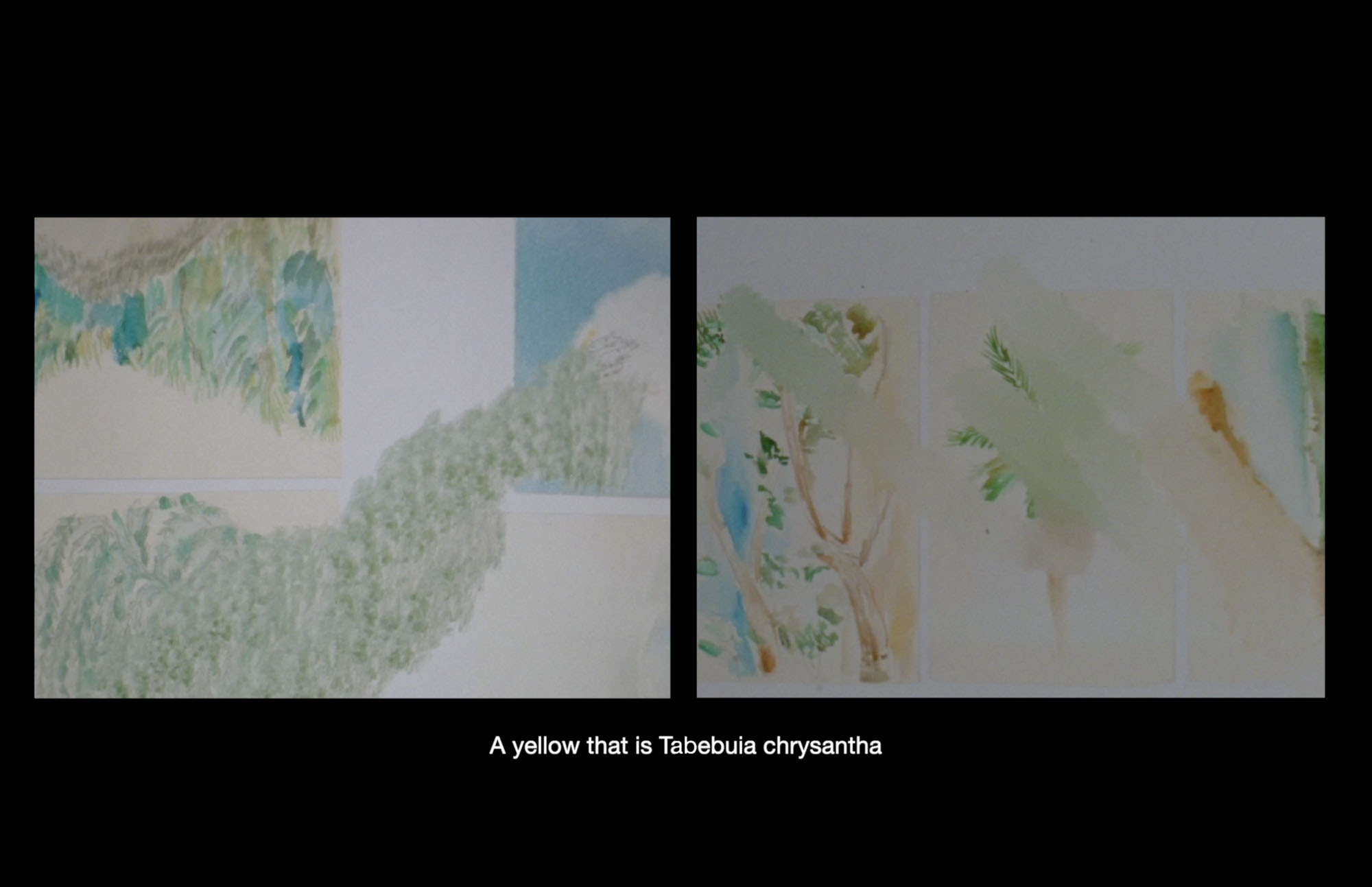
Guayacan blue, not Prussian blue.
Dream at a distance; a dream is distance. Reading a dream—its interpretation—is almost impossible beyond the phenomenological experience of the dreamer. Yet it does allow others to take part through subjective, vital, emotional, and geographical references at the moment dreams are shared. In the act of sharing, all distance is erased: the dream ceases to be distance and becomes a cognitive element of contagion, connection, and belonging.
Cochinilla red.
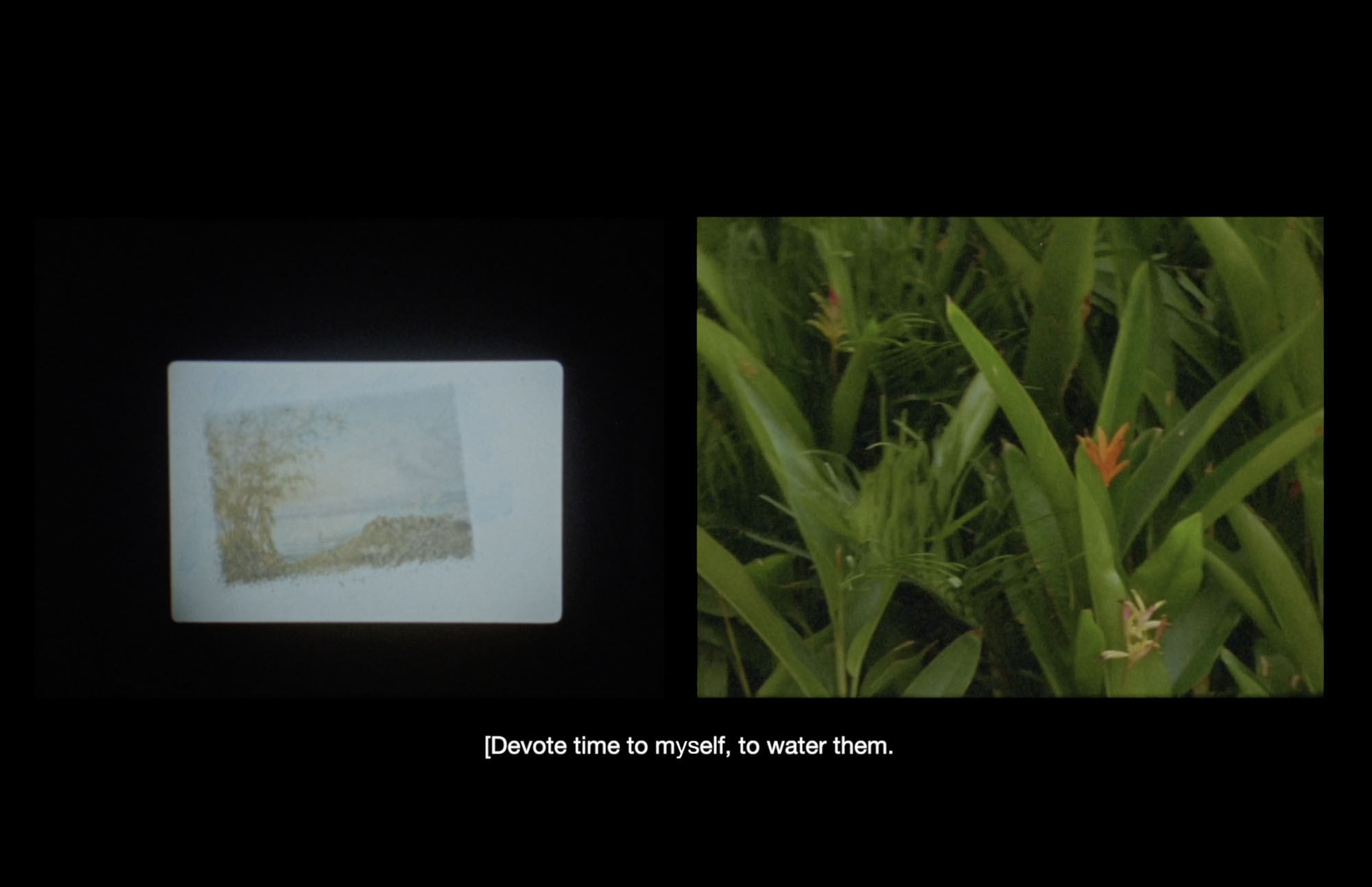
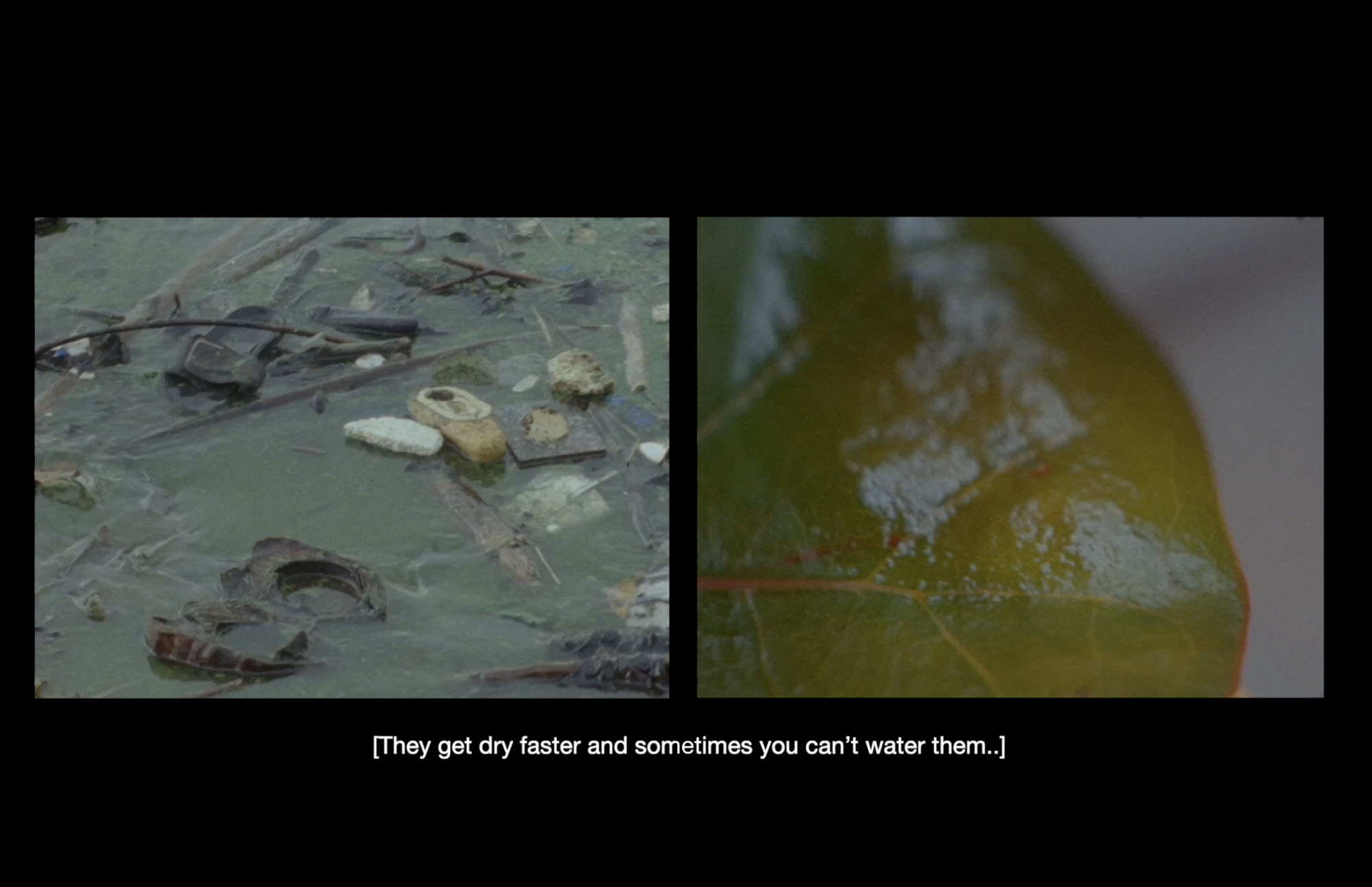
The landscape leads you toward colors that uncover languages—languages that locate territories, words you cannot hear and words you cannot translate. There is no electricity, the water is contaminated, and life somehow finds a way. Words appear and disappear. Can dreams be measured through the gaze of geopolitics exogenous to life?
Thank you for reading this corota
Valentina Alvarado Matos (1986, Venezuela) is a visual artist and filmmaker. Her work engages with questions of memory and territory through a dialogue with the materiality of film, paper, voice, and ceramics. Her practice, closely aligned with collage, weaves together reflections on diasporic identity, memory, and landscape.
Her work has been exhibited at La Virreina Centre de la Imatge, California Museum of Photography, Queer Circle, Victoria and Albert Museum, Artium, LIAF Biennale, Pesaro Film Festival, Viennale, International Film Festival Rotterdam, Punto de Vista International Documentary Film Festival, Xcèntric, San Francisco Cinematheque, S8 Mostra de Cine Periférico, LOOP Barcelona, Cineteca Madrid, Filmoteca de Catalunya, Microscope Gallery, Los Angeles Forum, Centro Cultural Conde Duque, Salzburger Kunstverein, Fabra i Coats, and La Capella, among others.
She has been an artist-in-residence at Hangar, La Escocesa, Cultura Resident, Fora de Camp, LIFT, Dirdira Lab, Matadero Madrid, and Visual Studies Workshop.
At the beginning of 2024, she opened in Barcelona—together with Carlos Vásquez Méndez—El otro aquí, a solo exhibition at La Capella, and Totalmente rostro en, curated by David Armengol.
She combines her artistic practice with teaching and has given classes and workshops at institutions such as BAU, Escola Massana, Máster LAV, EINA, Can Felipa Arts Visuals, CC Albareda, Universidad del Zulia, Universitat de Barcelona, Cinema en Curs, and EICTV.
Some of her films are distributed by Light Cone and are part of the Xcèntric Archive and HAMACA catalogues. Her work has also been included in the book Remains–Tomorrow: Themes in Contemporary Latin American Abstraction by Cecilia Fajardo-Hill.