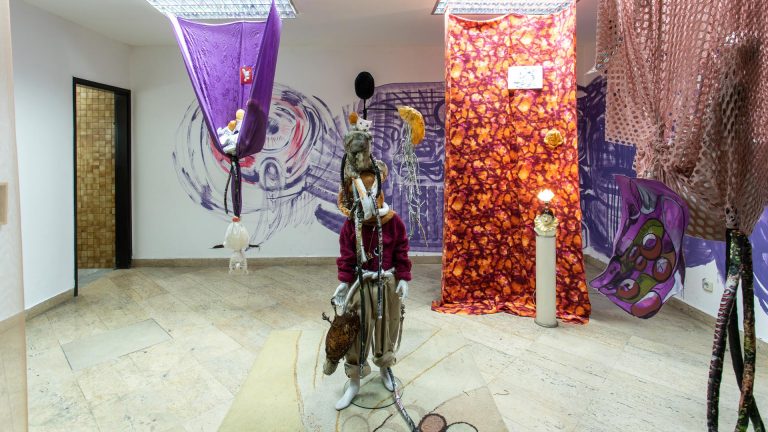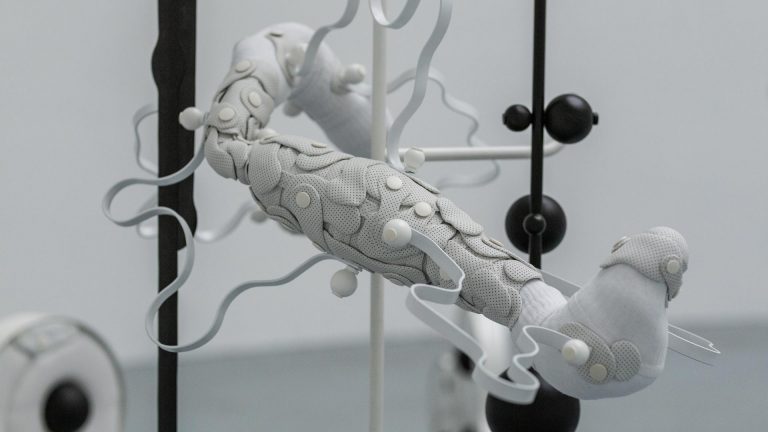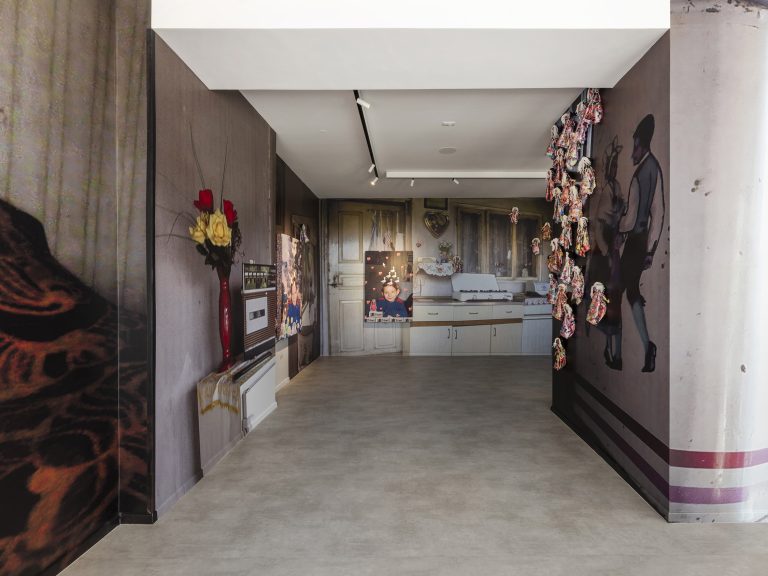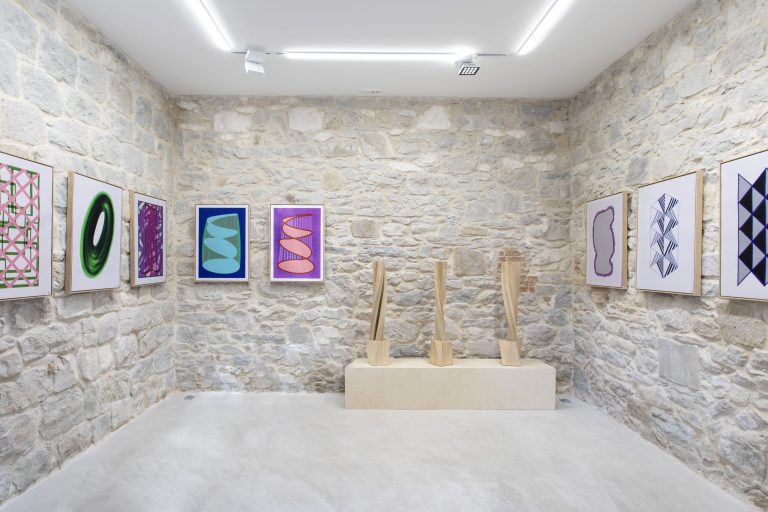
Trotoar is pleased to present Unravel, a group exhibition featuring Ines Matijević Cakić, Zlatan Vehabović, and Nikola Vrljić. Across painting, sculpture, and drawing, these Croatian artists explore lived time as a series of interruptions and adjustments. Personal narratives intersect with broader cultural frameworks, linking individual experience to questions of ecology, fiction, and identity. Curated by Martina Rodrigues, Unravel frames vulnerability and endurance as a critical approach — a way of inhabiting the uncertainties of transition.
From the exhibition text:
Not all moments can be overcome. Some wrap themselves around us and cling there – heavy and hardened. Some things pass, others do not; they settle in deep and ask us to endure.
This exhibition is shaped by the experience of retention, of remaining with what overwhelms us. It does not search for resolution nor action, but rather inhabits the sediments of time. The works of Ines Matijević Cakić, Zlatan Vehabović, and Nikola Vrljić articulate waiting – the ethical act of staying with what cannot be rushed, resolved, or forgotten.
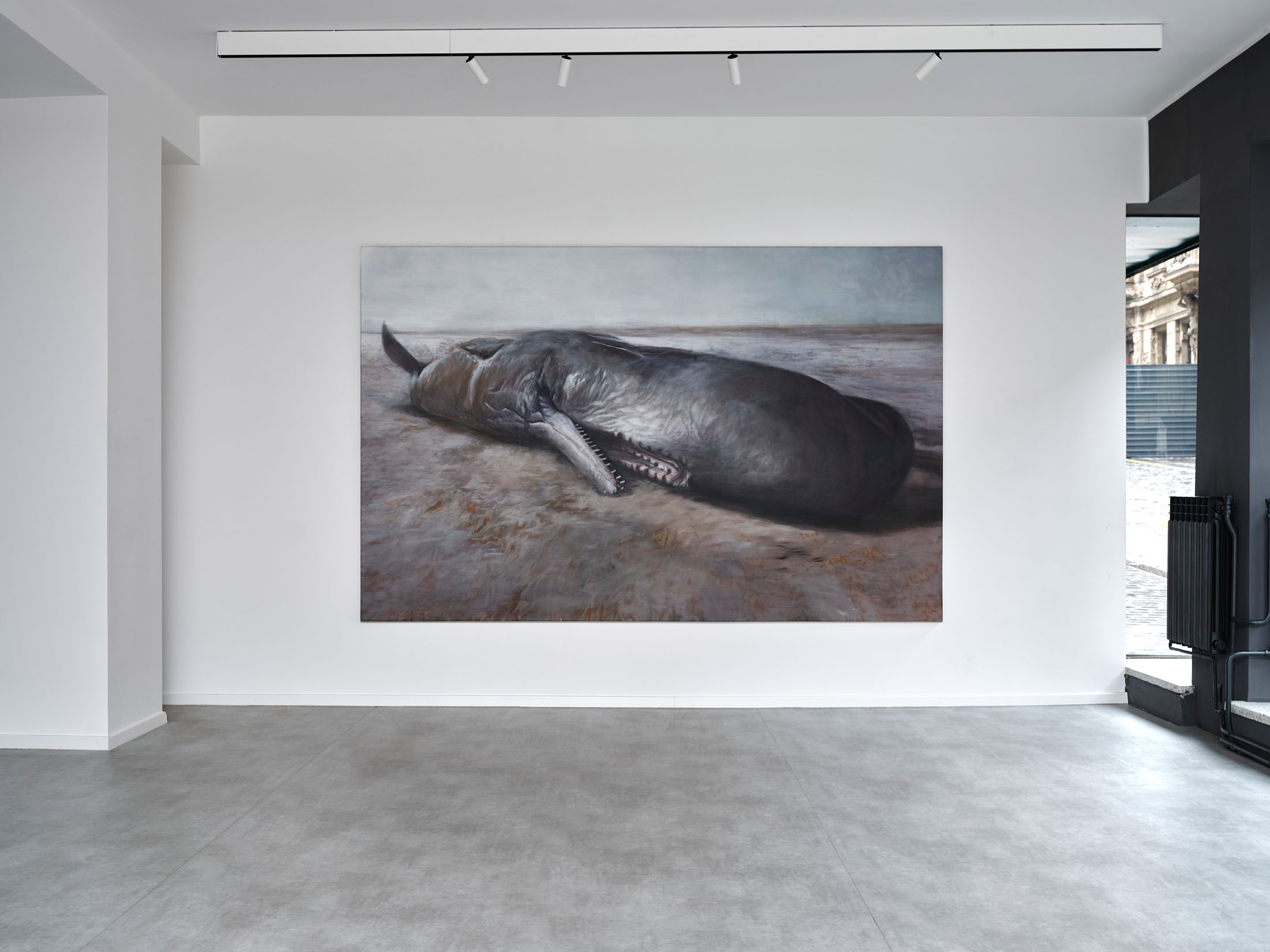
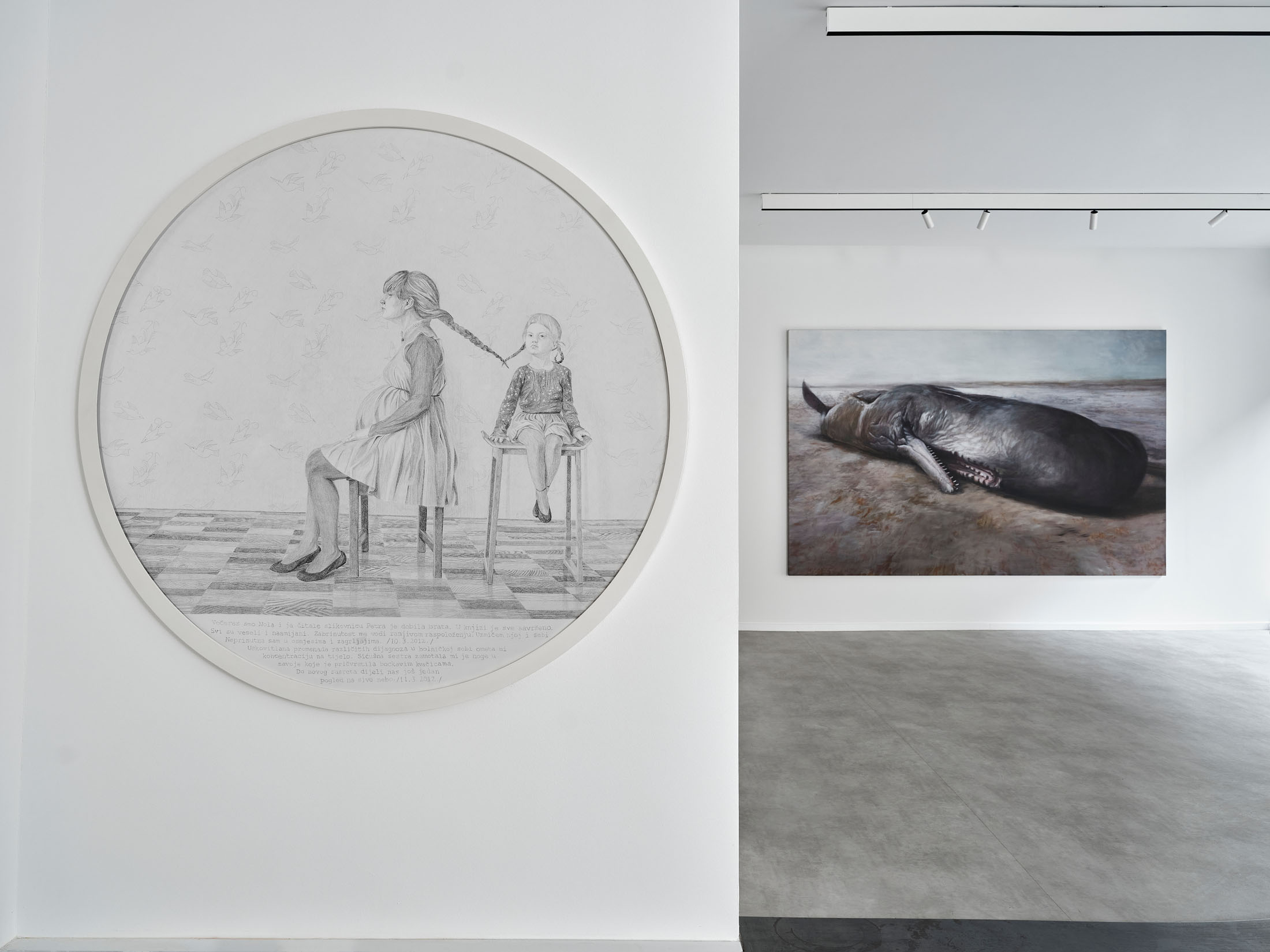
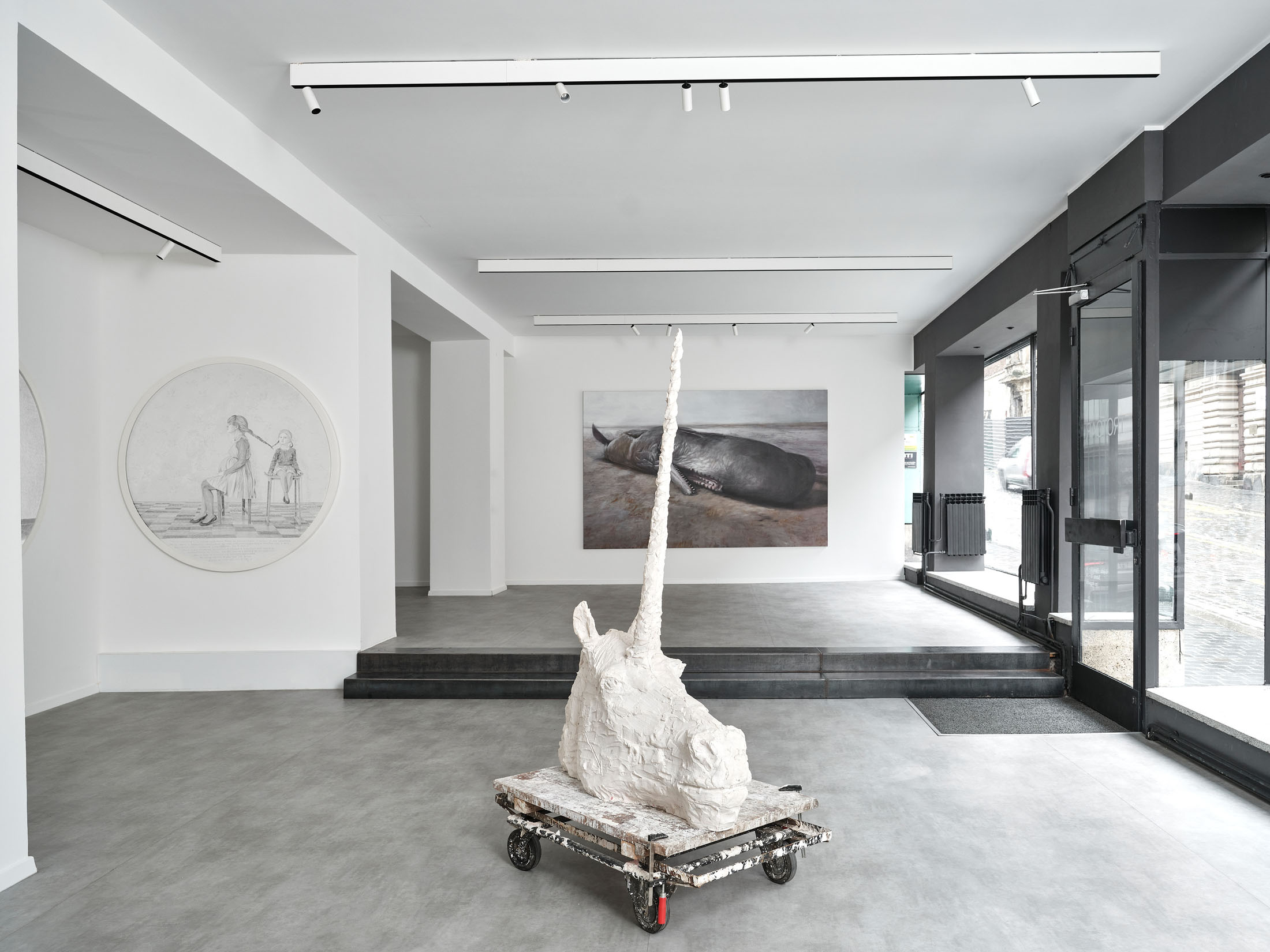
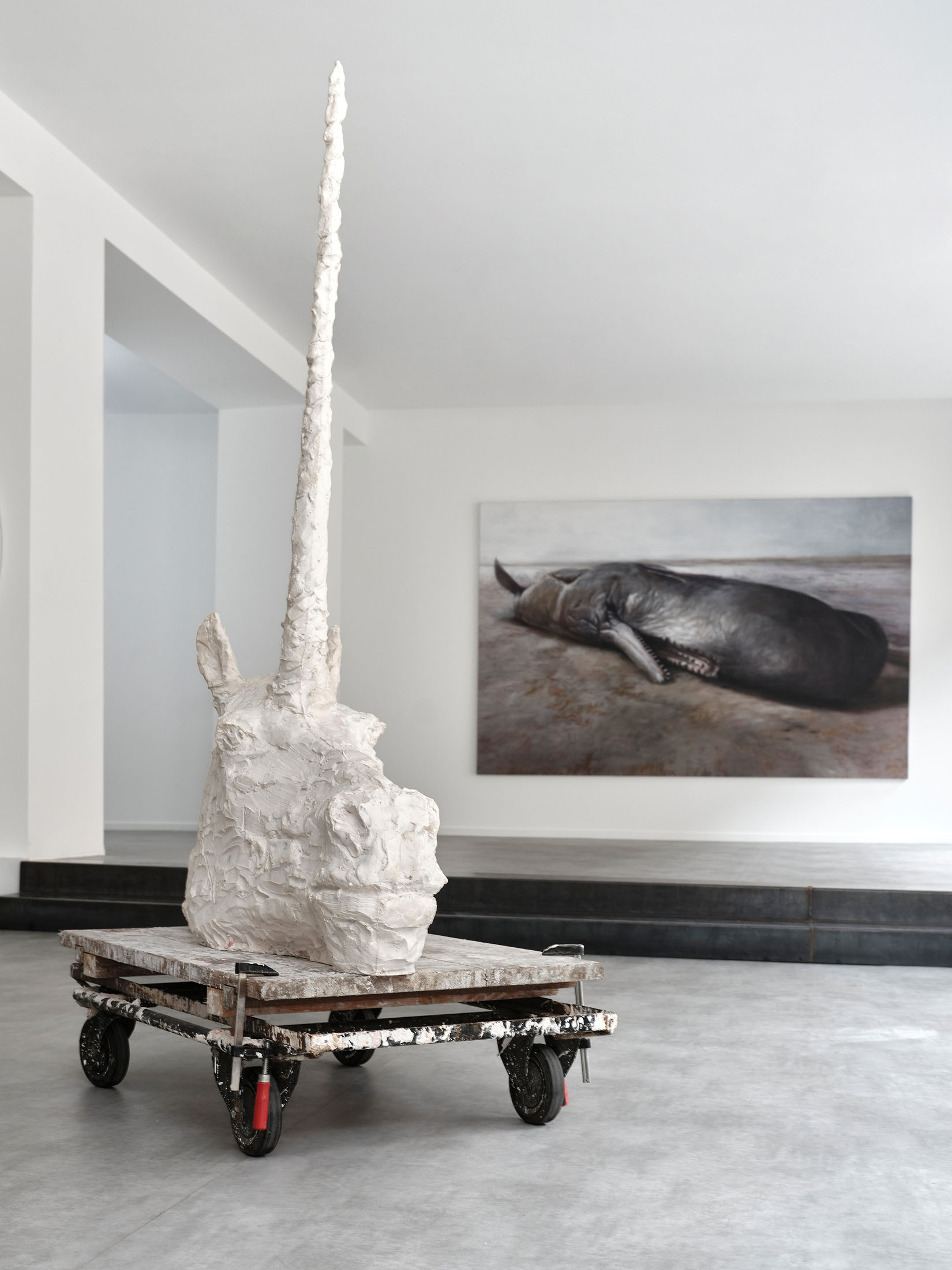
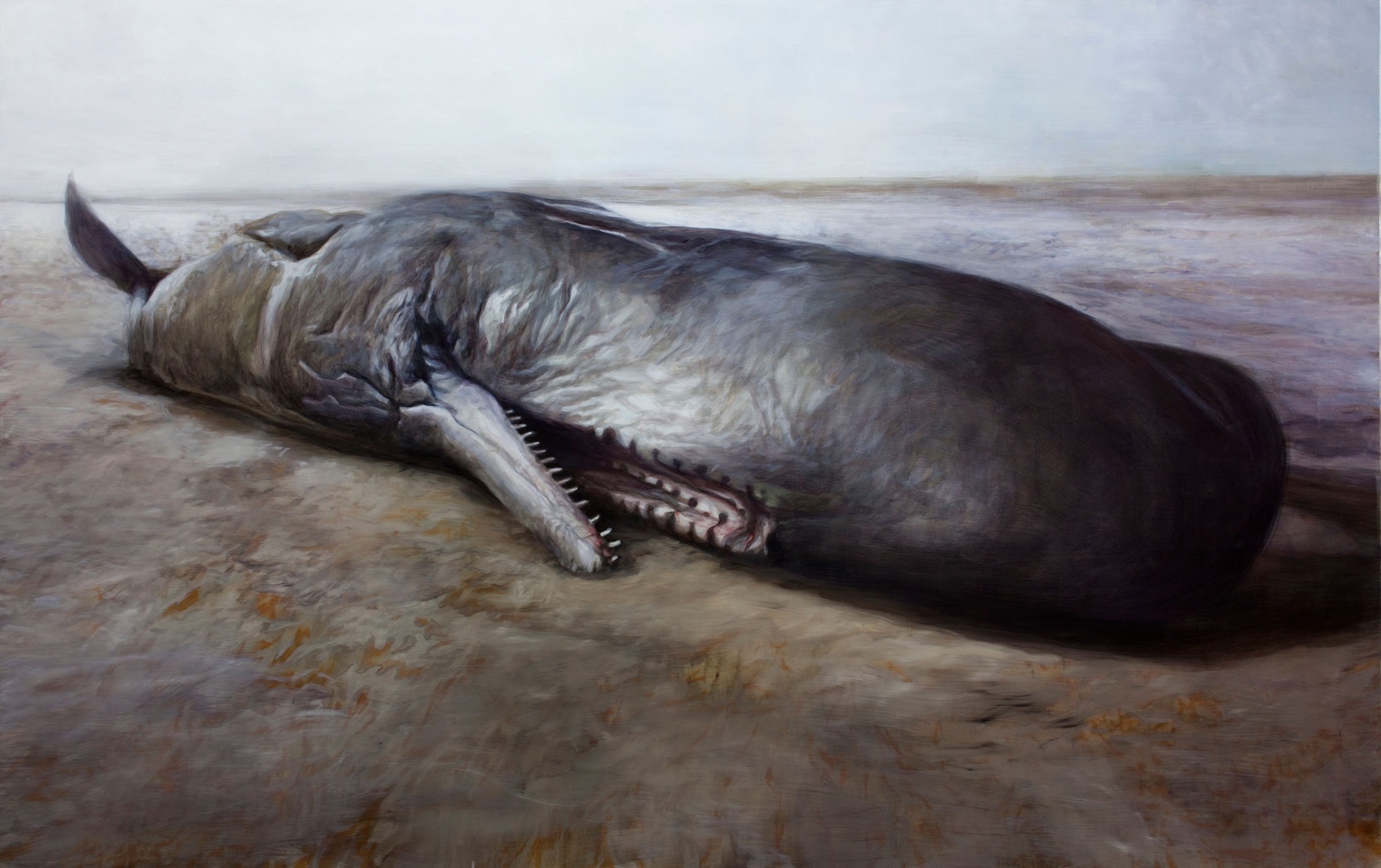
Vehabović’s Leviathan (2013) calls to mind the invisible cost of comfort. The song My Donal, narrated by a whaler’s wife, tells a story of loss. She addresses “Ye ladies wha’ smell o’ wild rose,”[1] reminding them that their perfume, extracted from the bellies of whales, is paid for in blood, fear, and solitude. It contrasts the brutality of departure with the uncertainty of those who are left behind, performing the emotional labour of waiting.
The heaviness of an inert body bears down on the painting’s atmosphere; the impossibility of action described in the poem is now pressed into the decaying matter itself. There is no heroic hunt, no romantic, wide-open sea. There is only the flat line of the ground and a monumental carcass, beached and discarded as excess. The scene exposes a fissure in the relationship between society and the environment – what John Bellamy Foster calls the “metabolic rift”.[2] A resource torn from the ocean has become a vast, viscous mass emerging from the rupture of systemic exploitation. In gazing at Leviathan, we are not observing nature, but the consequences of our own needs, trapped in a time that no longer flows, but slowly sediments.
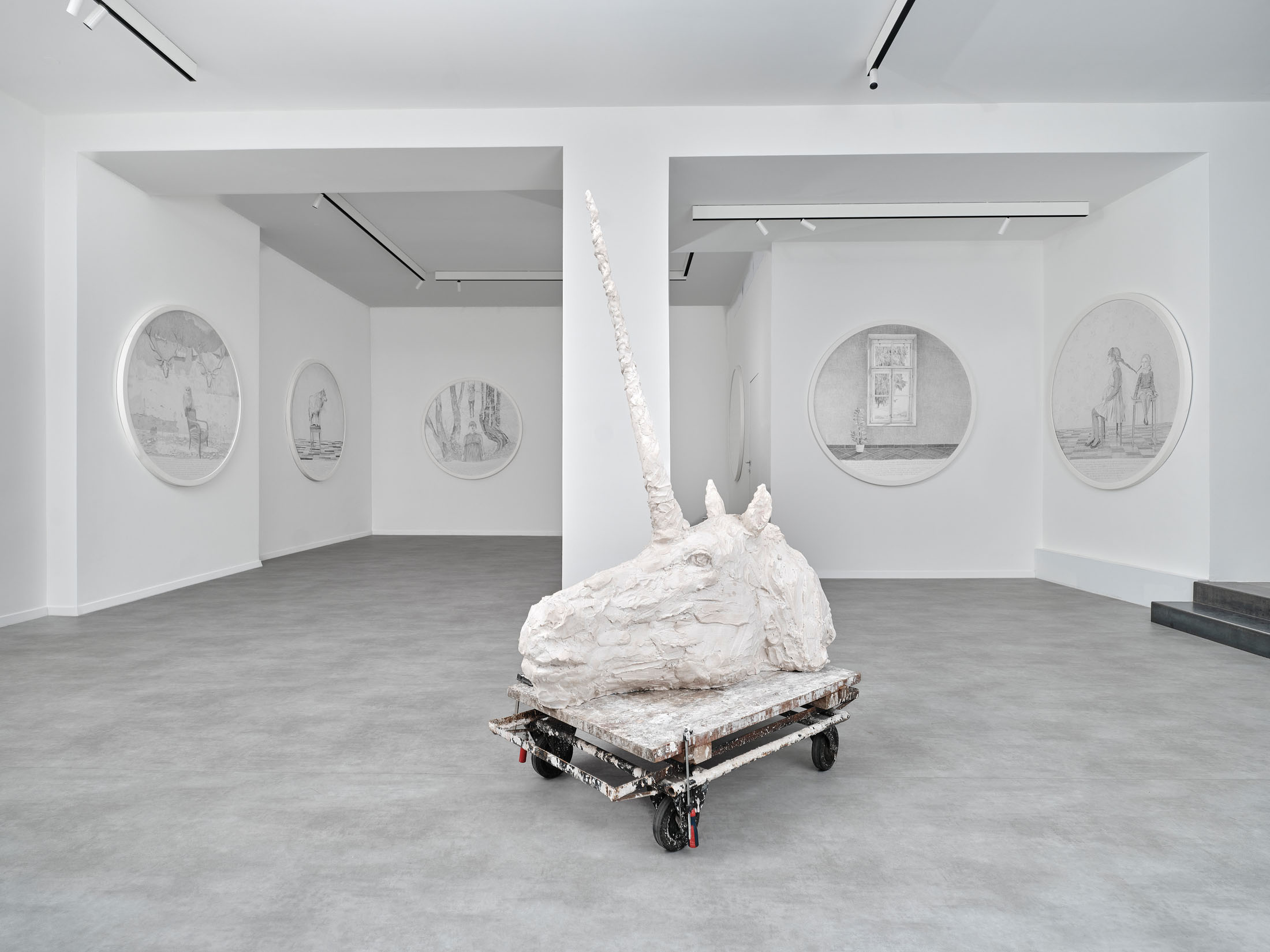
For Nikola Vrljić, enduring means being left with a fantastical loss. His Trophy (2017) is an inventory of wrecked imagination. We are faced with the oversized head of a unicorn. It has
been severed. What was once a symbol of unparalleled purity is reduced to an artefact mounted onto a trolley cart. The work rests on a chilling paradox: the unicorn is visible only to the innocent, yet to prove it has been sighted, it must be captured. Innocence is verified only through the act of its own destruction. This myth has become the roadkill of folklore, a casualty of our drive to own the unattainable. Placing it on a cart completes the demystification; the unicorn is no longer a mystery to be guarded, but rather a heavy load to be shoved into a corner as soon as it ceases to be interesting. Such was the transaction: we traded our imagination for a tangible object of achievement.
The Trophy does not represent a victory; it is the flaunting of emptiness. It proves not that the unicorn existed, but that it can exist no longer. Caught in the space between desire and appropriation, the sculpture becomes a suspended act of waiting – a fixed moment in which the myth is maintained only through its own loss.
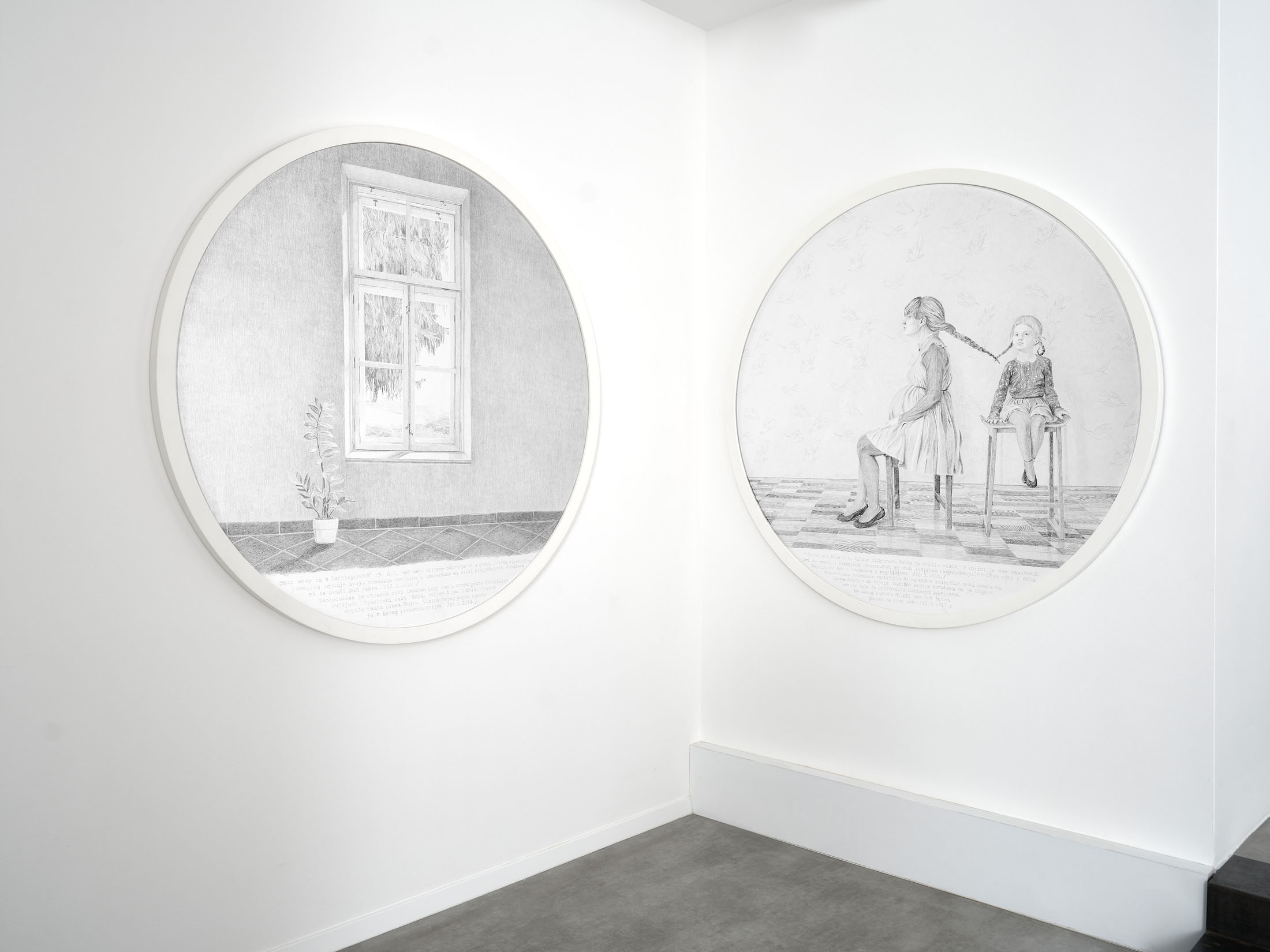
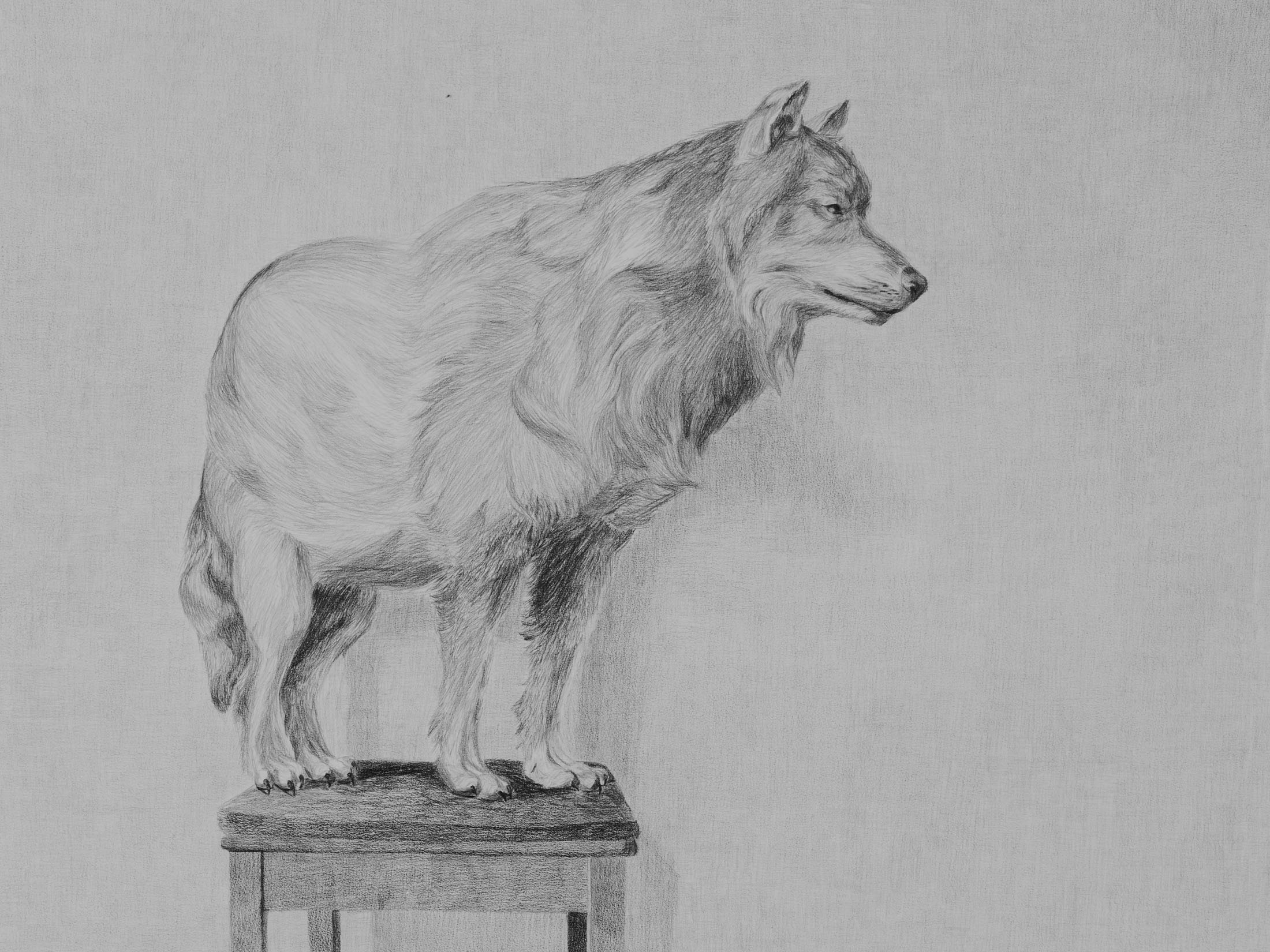
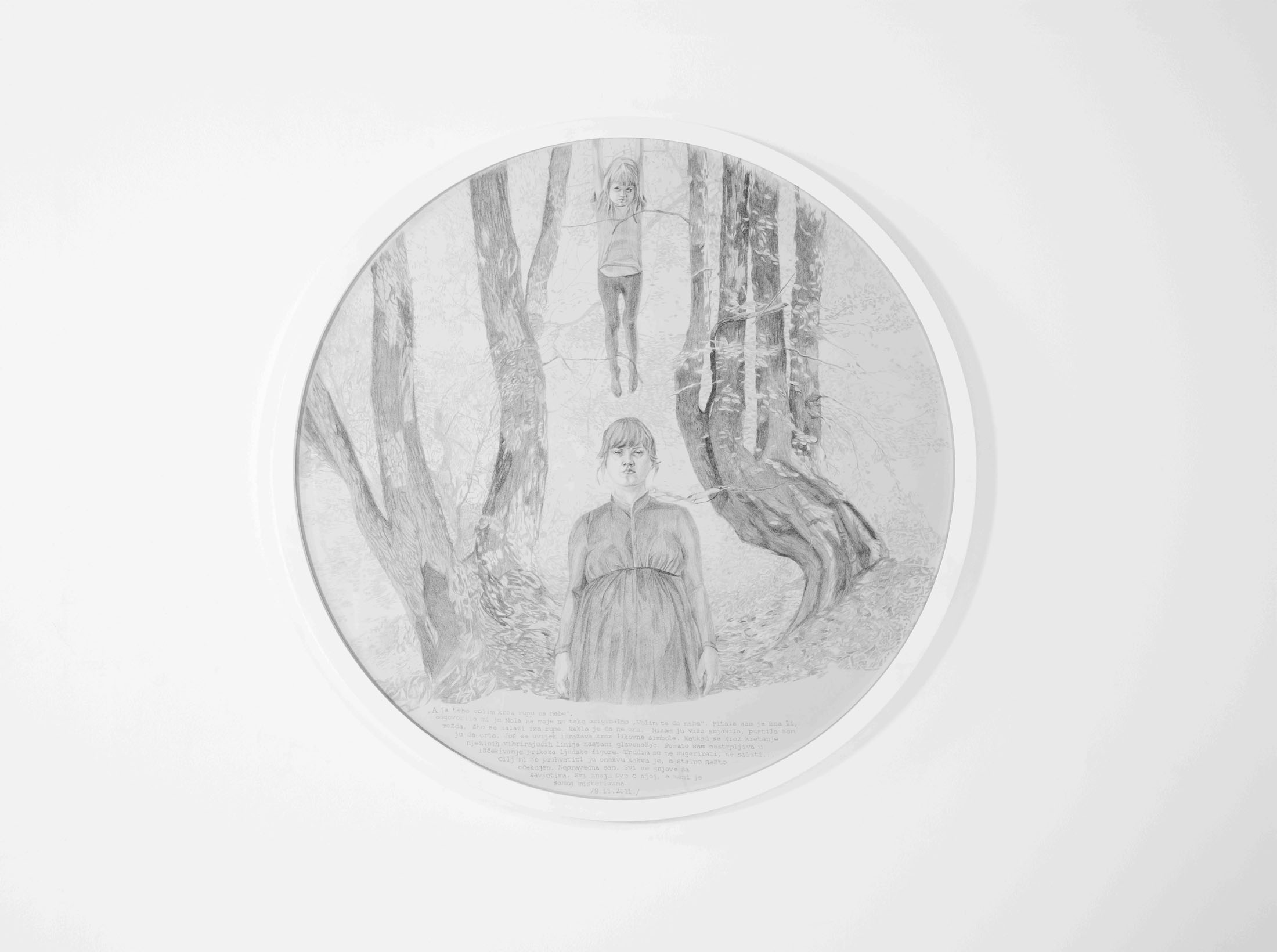
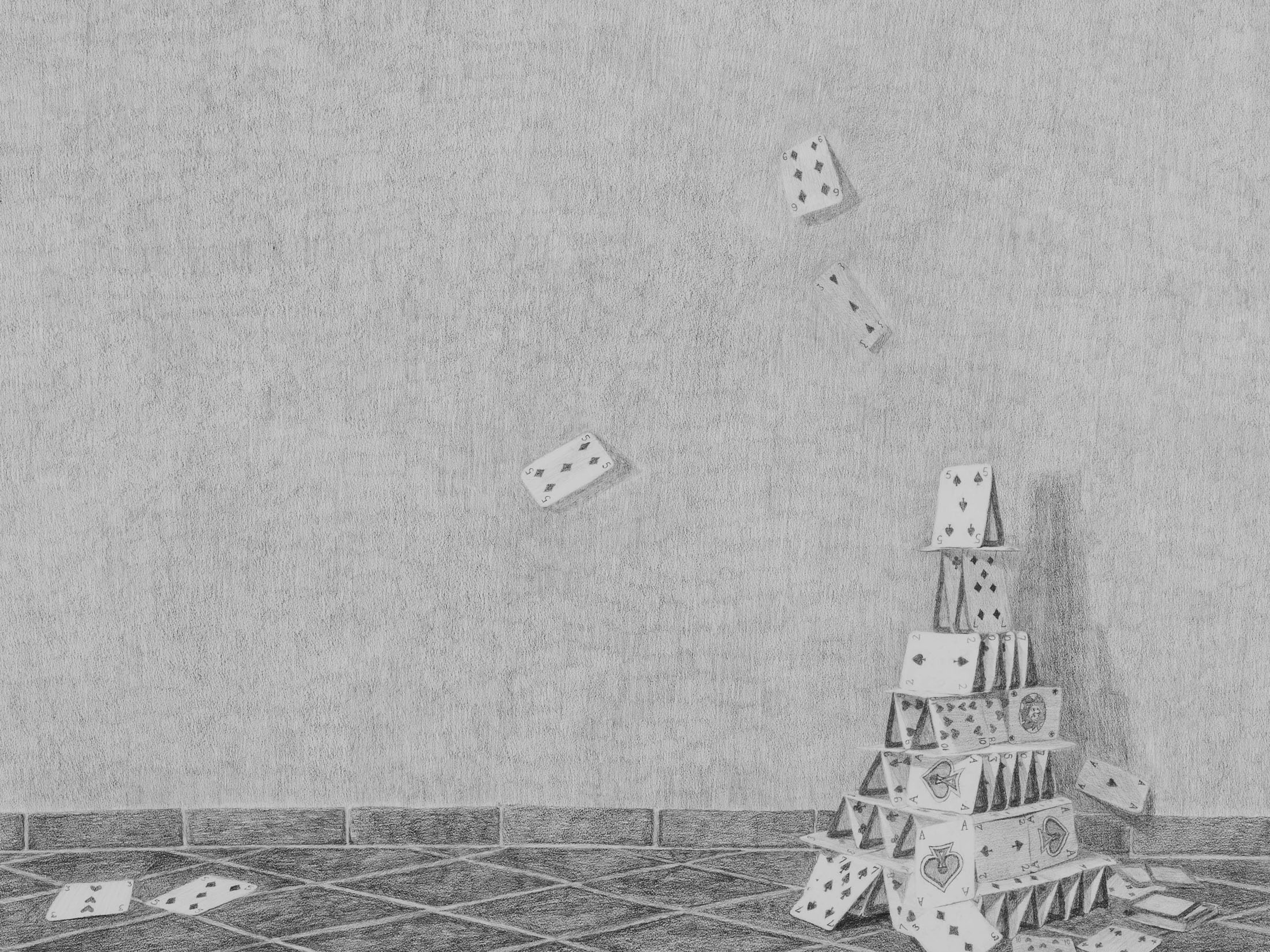
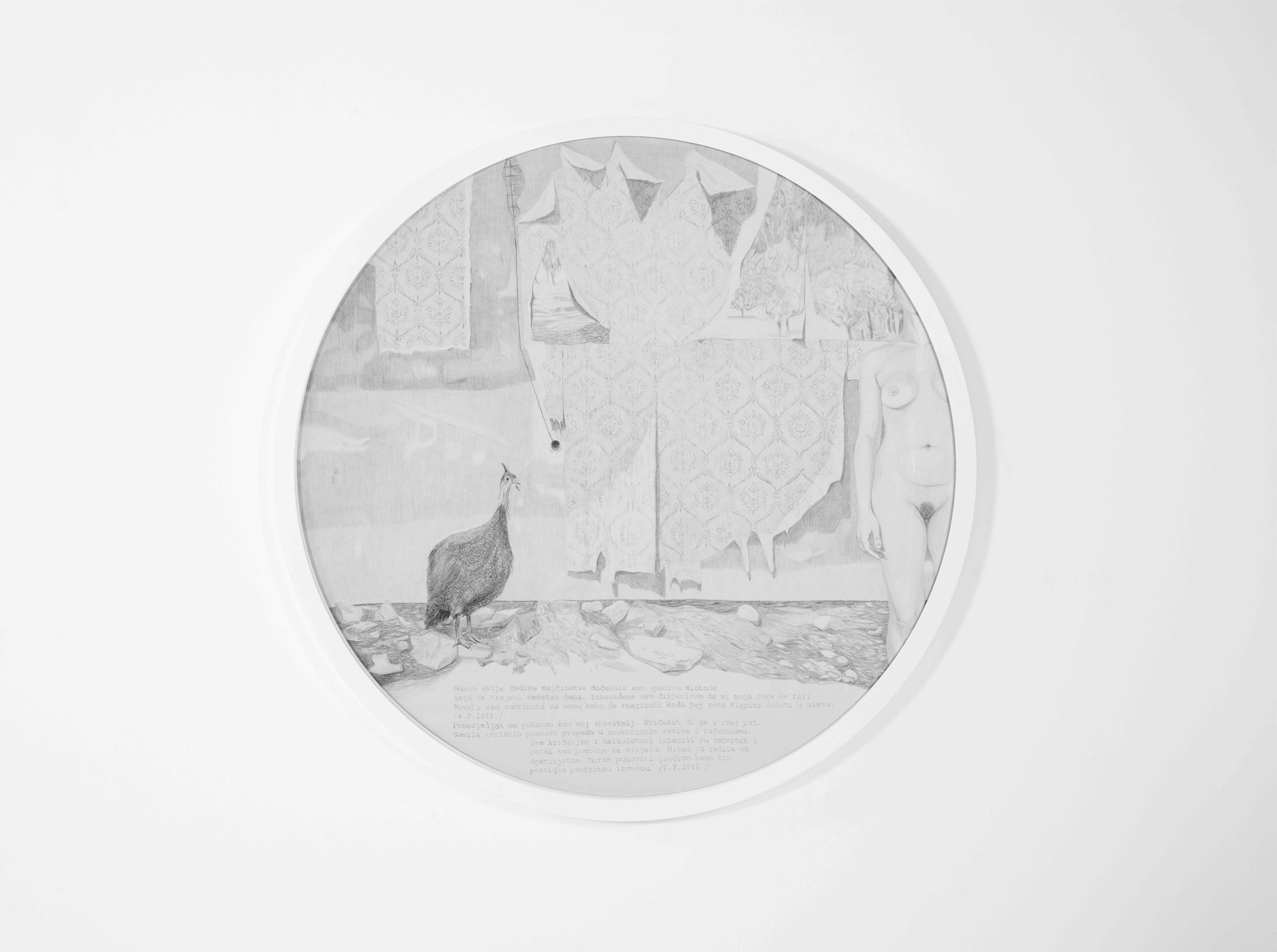
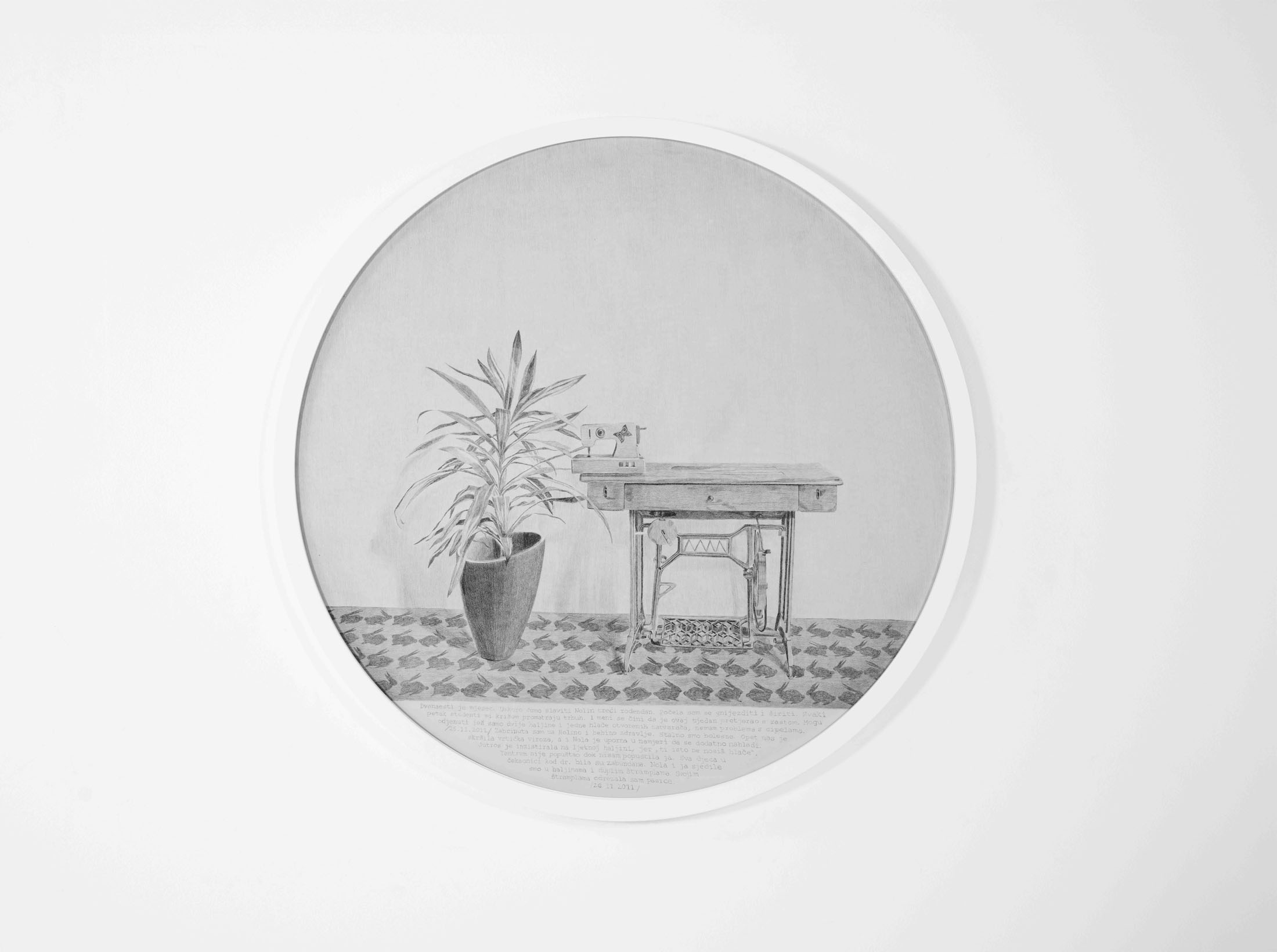
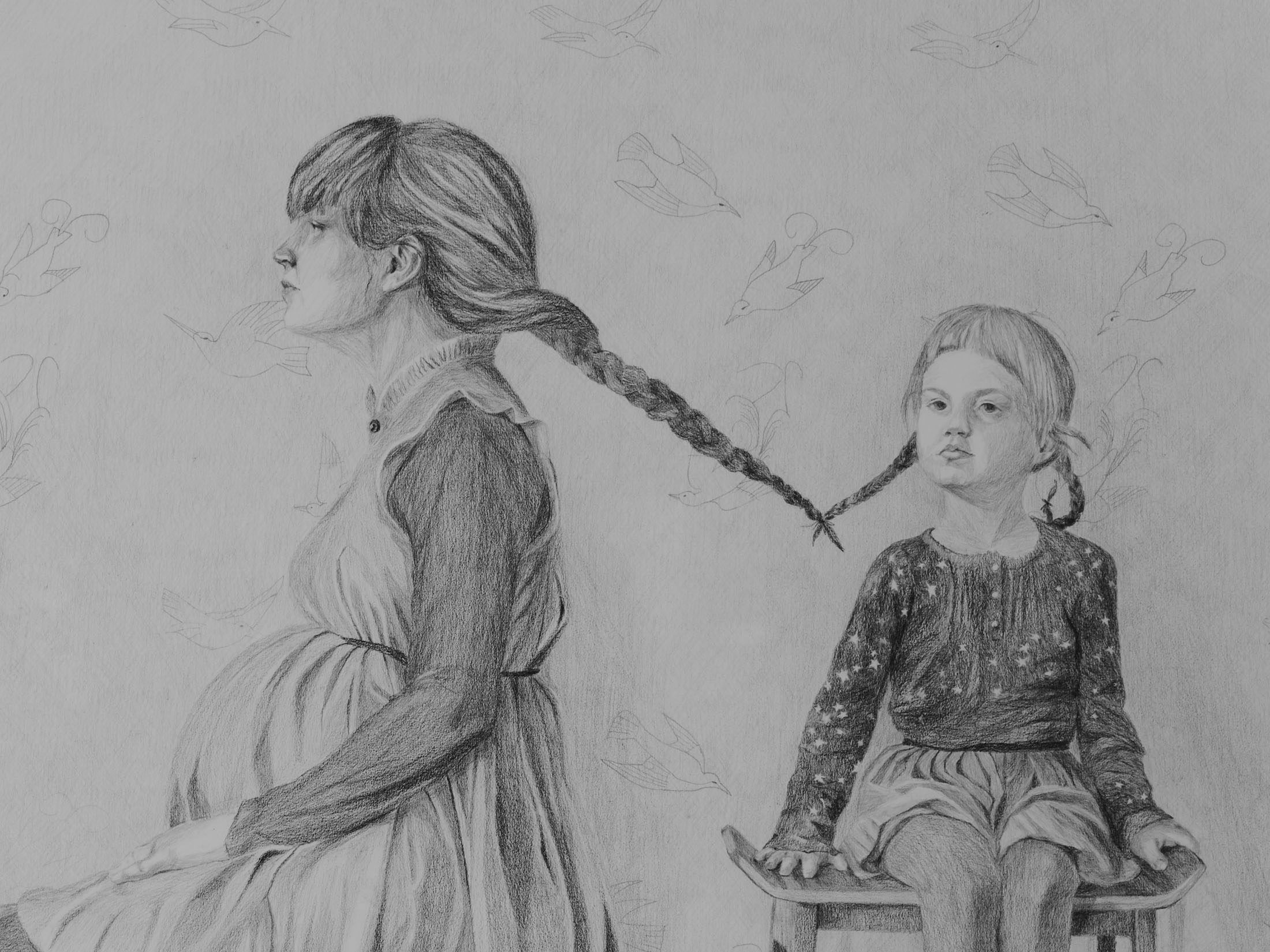
Pulling the weight of the outside world into the intimacy of the body, Ines Matijević Cakić’s Matrixial Narratives (2011–2014) offers a quiet counter-narrative. Through nine drawings created in the real time of pregnancy, the cycle functions as a repository of protracted time. A combination of diary and visual notes, it transcends documentation to become a method of self-observation; we are not gazing at a depiction of events, but rather at an anatomy of a process. Here pregnancy is defined not as a heroic feat of creation, but as a practice of staying.
In scenes of chaotic domestication – where a tamed she-wolf occupies a kitchen chair, a house of cards teeters on the brink of collapse, and the braids of a mother and her daughter unravel into one another – the pregnant body renounces its wholeness. It appears only conditionally, in fragments, visualising an integrity undermined by the presence of the other. Lisa Baraitser dubs this “Enduring Time”[3], an experience in which motherhood is neither linear nor productive. Woven from standstills, demands, and endurance, such time leads to no external goal, but to the persistent maintenance of a relation. Refusing to reduce motherhood to biological automatism, the artist examines its full weight – as a complex, exhausting, and deeply transformative labour.
Members of the same generation, Vehabović, Vrljić, and Matijević Cakić react to our collective exhaustion by withdrawing from grand narratives of progress and embracing a realism of privacy. This is a deliberate shift in scale: a move toward micro-histories and intimate mythologies. Whether they are deconstructing spectacle, digging through museum archives, or mapping the home, the emphasis rests on the materiality of the work itself. Offering no promise of conclusion, these works act as a brake on time, lingering with what is lodged in the layers of the everyday.
Author: Martina Rodrigues
[1] Owen Hand, “My Donal”, a Scottish song from the 1960s (it refers to ambergris, an ingredient used in perfumes).
[2] The term “metabolic rift” is used by Bellamy Foster in reference to the consequences of industrial exploitation in Marx’s Ecology: Materialism and Nature. New York: Monthly Review Press (2000).
[3] The terms “enduring time” and the ethics of care are based on Lisa Baraitser’s research in Enduring Time. London: Bloomsbury Academic, (2017).
ABOUT THE ARTISTS
Ines Matijević Cakić (1982) is a visual artist working in the fields of drawing, graphic art, and installation art. In her work, she focuses on questions of space, habitation, and subjective narratives, using her personal history as an analytical and transformative framework. She thematises the home, body, time, and motherhood as fragile and ambivalent spaces of experience, and emphasises slowness and empathy.
She has exhibited at numerous exhibitions, including her solo exhibitions House Without Ground (French Pavilion, Zagreb, 2025; Museum of Modern and Contemporary Art, Rijeka, 2022) and Matrixial Narratives (Museum of Fine Arts, Osijek; PM Gallery, Zagreb, 2014). She has also participated at exhibitions at the 54th Zagreb Salon of Visual Arts (Croatian Association of Artists, Zagreb, 2019); Collection for the Future – Acquisitions 2009-2019 (Museum of Contemporary Art, Zagreb, 2019); the HT Award (Museum of Contemporary Art, Zagreb, 2017); Exporting Zagreb (National Museum, Gdańsk, Poland, 2016); and the 28th Ljubljana Biennale of Graphic Arts (Tivoli Gallery, Ljubljana, 2009).
She studied graphic art at the Academy of Fine Arts in Zagreb, graduating in 2005. In 2016, she completed a PhD in painting. Since 2011, she has been working at the Academy of Arts and Culture in Osijek. Her works are kept in the collections of the Museum of Contemporary Art in Zagreb, the Museum of Modern and Contemporary Art in Rijeka, the National Museum of Modern Art in Zagreb, the Museum of Fine Arts in Osijek, and the Department of Prints and Drawings at the Croatian Academy of Sciences and Arts, as well as in private collections.
Zlatan Vehabović in his work explores the relationship between visual heritage and contemporary artistic expression. From figurative painting and narrative structures, he has gradually turned towards painted collages, in which he connects historical and contemporary motifs. His work is characterised by the transformation of motifs, an interest in visual memory, and the multilayered nature of perception.
He has exhibited at numerous institutions and galleries, including the Museum of Contemporary Art and the National Museum of Modern Art in Zagreb, the Civico Museo Revoltella in Trieste, the Museum of Modern and Contemporary Art in Rijeka, the National Museum in Gdańsk, the Hudson Valley Center for Contemporary Art (now Hudson Valley MOCA) in New York, and the Essl Museum in Vienna. His solo exhibitions include The School of Raging Thought (Marc Straus Gallery, New York, 2024); An Atlas of the Lesser World (National Museum of Modern Art, Zagreb, 2023); Dark White Earth (Art Pavilion, Zagreb, 2018); Foundations in Mud (Museum of Contemporary Art, Zagreb, 2015); Cursed Crew (Lauba – The House for People and Art, Zagreb; Marc Straus Gallery, New York, 2014); and Sweeping Confetti From the Floor of the Concrete Hole (Lauba, Zagreb, 2011).
He studied at the Academy of Fine Arts in Zagreb, where he has been an assistant professor in the Department of Painting since 2016. His works are kept in both public and private collections, in Croatia and abroad, including the European Central Bank’s art collection (Frankfurt); the Essl Museum (Klosterneuburg, Austria); the Albertina Museum (Vienna); the European Parliament’s art collection (Brussels); and Lauba and Erste Bank’s collections.
Nikola Vrljić studied sculpture at the Academy of Fine Arts in Zagreb, graduating in 2007. His artistic practice primarily focuses on figuration. Through the mediums of sculpture and drawing, he explores the complexities of the human condition and its place in society, often infusing his work with humour and (self)irony. He employs classical techniques and works with various materials, frequently making the deliberate choice to reveal not only the original material but also the procedure of its primary manipulation, thereby enhancing the raw believability of his works.
He has exhibited his work at solo exhibitions at various galleries and museums, including a retrospective at the 15th Ivo Kerdić Memorial at the Museum of Fine Arts, Osijek (2025) and solo exhibitions at the Božidar Jakac Gallery, Museum of Modern and Contemporary Art, Kostanjevica na Krki, Slovenia (2024); Trotoar in Zagreb (2023); the Meštrović Gallery in Split (2022); the Meštrović Pavilion in Zagreb (2021); Poola Gallery in Pula (2021); the Josip Račić Gallery, the National Museum of Modern Art in Zagreb (2018), the Museum of the Town of Kaštela (2017), the HAZU Glyptotheque in Zagreb (2014), and the basement halls of Diocletian’s Palace in Split (2014). His group exhibitions include Panorama40+ at Bažato Gallery in Ljubljana (2023), the 12th Triennial of Croatian Sculpture in Zagreb (2018-2022), and the HT Award exhibition at the Museum of Contemporary Art in Zagreb (2015).
His works are part of the permanent collections at the National Museum of Modern Art in Zagreb and the Vukovar City Museum, and are also held in private collections. Vrljić currently teaches at the Academy of Fine Arts in Zagreb, Croatia.