The Silences of Raquel Algaba as Metaphors of Oblivion
By Anna Adell
Ulysses, the Homeric hero who emerges victorious from the Trojan War, whose cunning led him to conceive a hollow wooden horse to infiltrate enemy territory, and whose return to Ithaca is filled with challenges he overcomes with courage and wit, is turned by Raquel Algaba into a fragile puppet. Algaba’s jointed-body Ulysses moves at the mercy of the winds. It is doubtful he will ever reach home. Fragments of his frail figure are left behind along the way. He is a castaway from himself. He stumbles over too many obstacles in the turbulent sea that churns in the pit of his stomach.
A few years ago (in the exhibition The Silence of the Sirens, 2020), the Madrid-based artist staged her puppet antihero for the first time, offering her own version of Book XII of The Odyssey: the episode in which Homer recounts how clever Ulysses and his crew escape the lure of the sirens’ song. On that occasion, Algaba showed us—or so it seemed to me—a Ulysses torn between duty and desire: we saw him tied to the mast to resist the temptation of throwing himself into the sea, but at the same time (as if by a sort of splitting of fate) he was being dismembered by one of those raptorial birds with voluptuous female torsos.
The project’s title mirrored that of Kafka’s story. In The Silence of the Sirens, the Czech writer introduces the idea that by wielding “a weapon more terrible than song” (that is, silence), the sirens might be mocking Ulysses—or perhaps the hero is ultimately deceiving these deadly-beautiful birds. For maybe the hero, knowing that this time the sirens would not sing, still tied himself to the mast just to keep up appearances, to remain true to himself and to the role he had been given as protagonist of the great epic. However, Algaba’s Ulysses no longer wants to play Homer’s game. The actors seem to have fallen asleep on stage. They forgot their lines and adopted the stillness of stones.
In their Dialectic of Enlightenment, Theodor Adorno and Max Horkheimer interpreted Ulysses’ journey as the birth of human self-awareness in its struggle to preserve the species against the dissolving or mimetic forces of nature. With cunning, Odysseus evades brute force and magical power embodied in primordial deities and creatures he encounters on his way. Homer casts Ulysses into oceanic whirlpools and sexual temptations (the sirens, Circe, Calypso, the lotus-eaters…) that attempt to make him forget himself.
But by prioritizing duty over instinct, by purging our natural side, the authors write, Ulysses inaugurates the race of maimed beings we have become after paying the price of civilization.
We are a race of alienated beings, as Freud had also revealed before Adorno, fearful of the destructive force of our instincts. By repressing them, we maim ourselves. Paradoxically, the more we believe we control them, the more subjected we are to them.
In Algaba’s fragmented Ulysses, we see ourselves reflected like in a mirror. A liquid mirror that is a threshold between the cyclical time of myth and the progressive time of Logos. An uncertain threshold because, according to Adorno, there is no clear separation between logos (reason as organizing principle) and myth, since logos becomes myth: the myth of progress.
We continue sailing with Algaba through this ocean where myth and history blur. We leave behind the island of the sirens, with its tricks and false promises, and arrive at another voracious island, that of the lotus-eaters. In Homer’s tale, this is the first island obstacle the crew encounters after leaving Troy, but Algaba inverts the legendary map and travels it according to other coordinates—those of her own mental geography. For the silent geography of the mind knows neither before nor after.
For her current exhibition, Algaba has chosen a title that paraphrases a verse from T.S. Eliot’s poem Burnt Norton: In silence the lotuses rose. Once again, silence prevails. Both silences—the sirens’ and that of the world in which the lotuses rise—point to a crossroads that splits the sailor’s heart: the internal struggle of someone facing the possibility of breaking a spell that annihilates the self while being tempted to surrender to it (into the jaws of the bird-women); the existential dilemma of someone torn between surrendering to the amnesic power of enchantment (the lotus fruit) or fleeing that false Eden.
The silence of the sirens had stripped the bold gesture of tying oneself to the mast or plugging one’s ears with wax of meaning. The silence of the island of the lotus-eaters is more ambiguous. If we recall Eliot’s poem, the silence of the garden where the lotuses rise refers to a sudden shift in perception just before a cloud darkens the light over the pond. The “water of sunlight” that had caused the lotus flowers to bloom evaporates, and what remains in view is a concrete skeleton, the drained pond. The magic dries up when we stop looking through the eyes of children hiding among the leaves, because that paradise is their home—not ours.
The bird that guided us among the hedges and flowerbeds made us believe that wandering among the lotuses would reveal the secrets of the dead, but by obsessing over the echoes of the past, we have turned the garden into a cemetery. We are incapable of holding our gaze on the present, anchoring it in
the here and now of life. When the lotuses rise offering a fleeting image of beauty, the thrush expels us from Eden: “go, go, go, said the bird: human kind / cannot bear very much reality.”
What Algaba criticizes by comparing the community of lotus-eaters to a consumer society increasingly anesthetized only in appearance is the inverse of what Eliot’s poem suggests. The artist laments our forgetfulness and our anchoring in a present severed from time. But in truth, they are speaking of the same thing: the present in which we plunge ourselves amidst simulations and mirages of pixelated happiness is mere surface; it has nothing to do with the continuous present that the poet advocated—interwoven with past and future. The future is unpromising, and the past no longer interests us. All that remains is a weightless, random present like the flutter of a leaf falling onto the concrete of a dry pond.
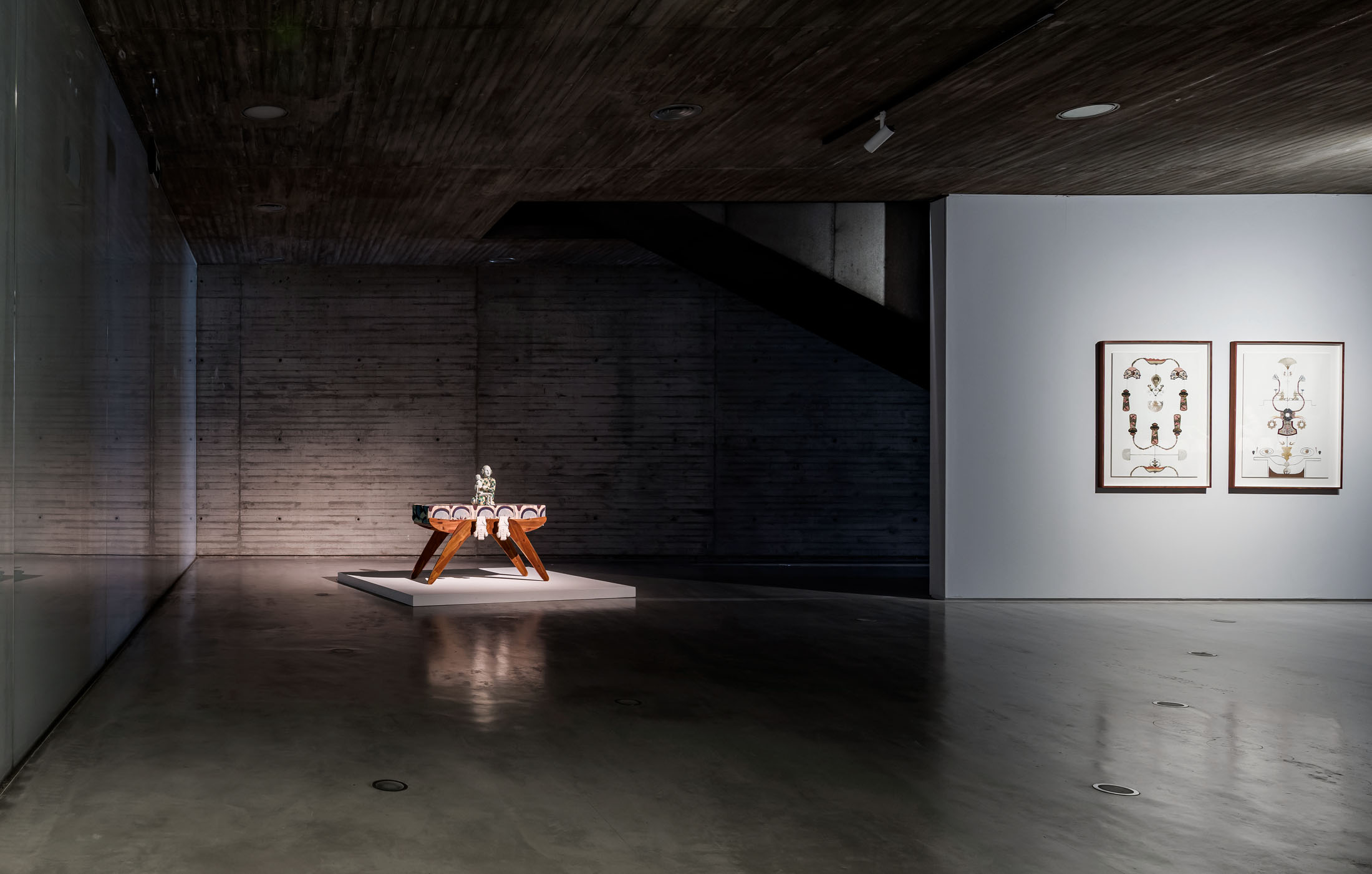
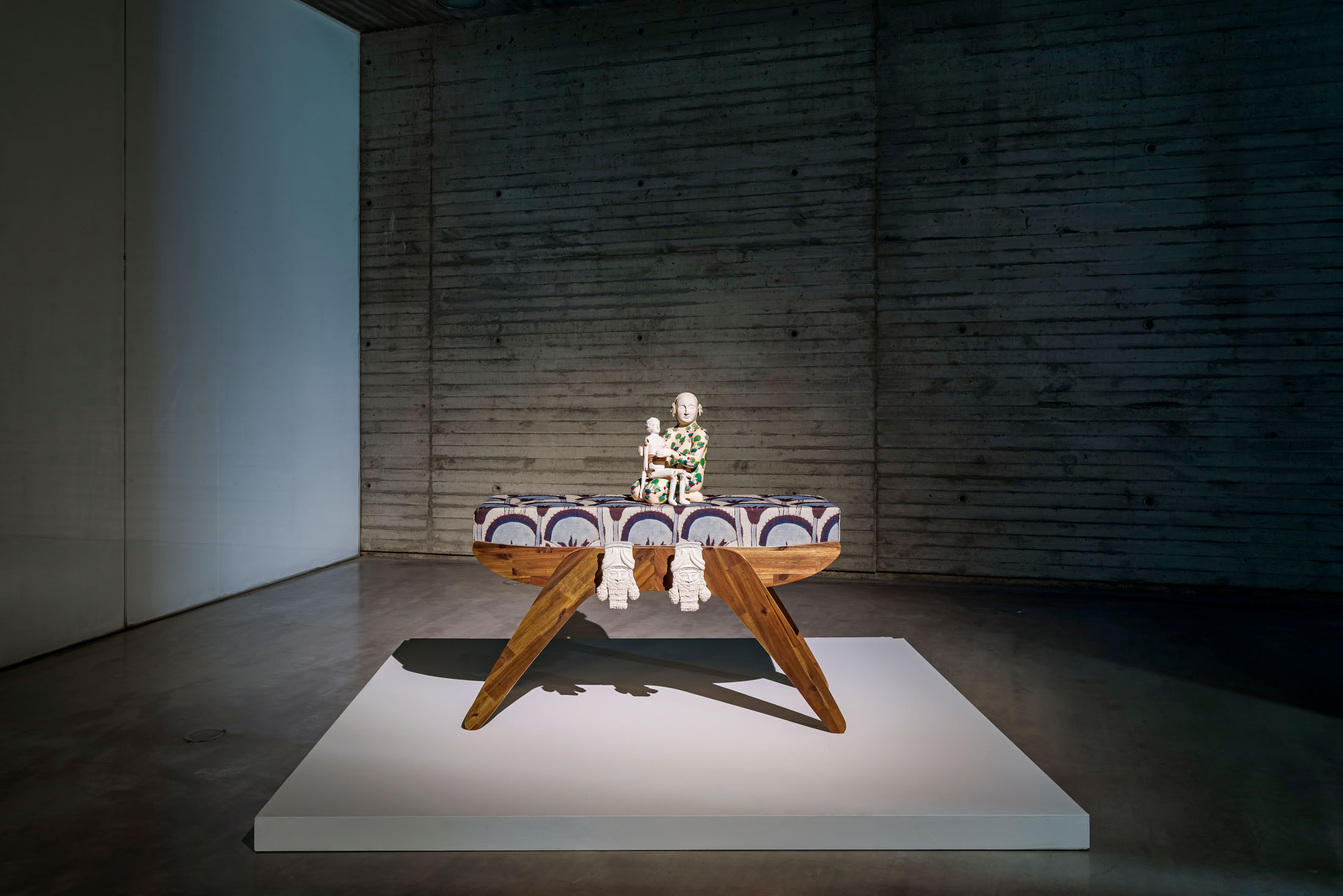
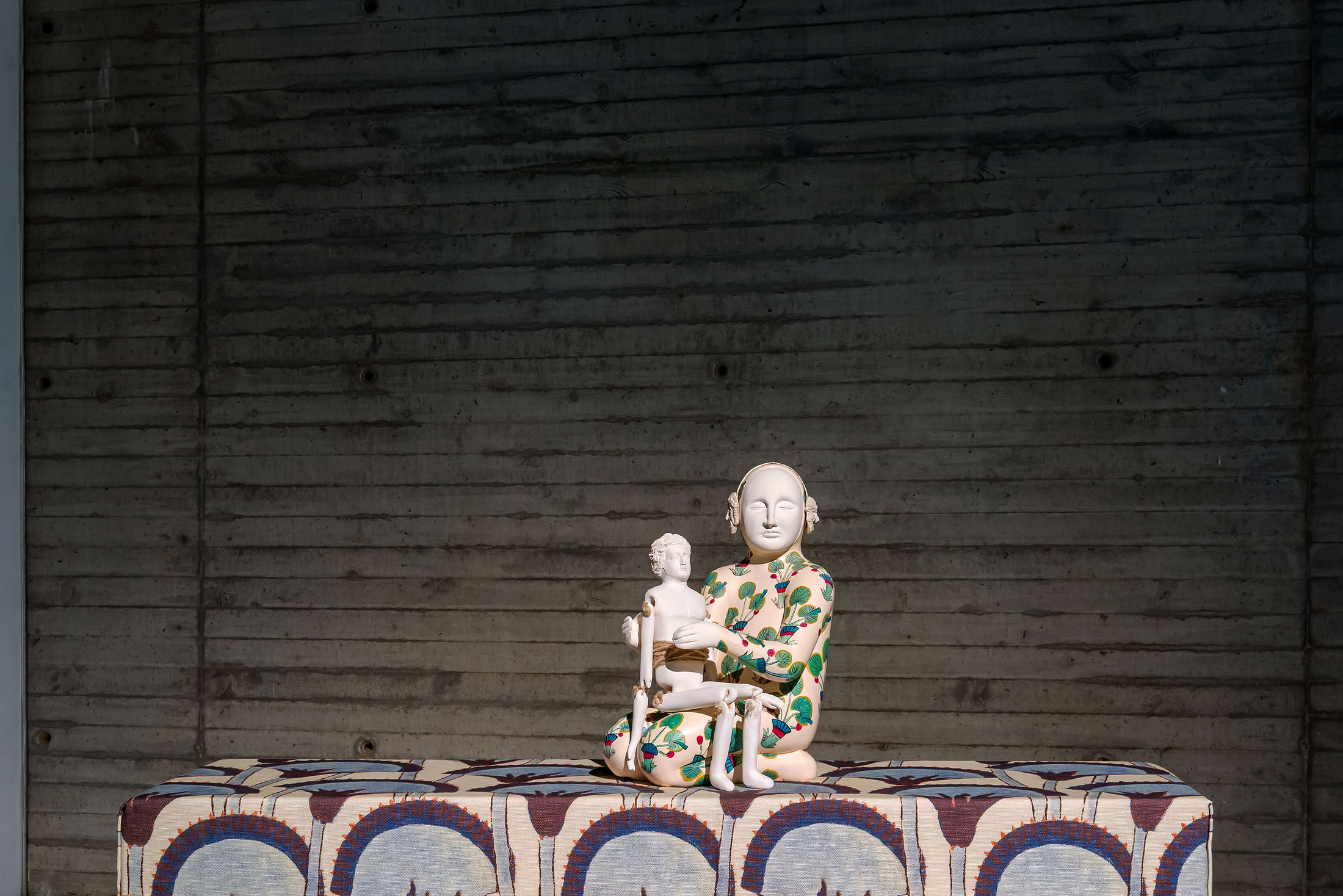
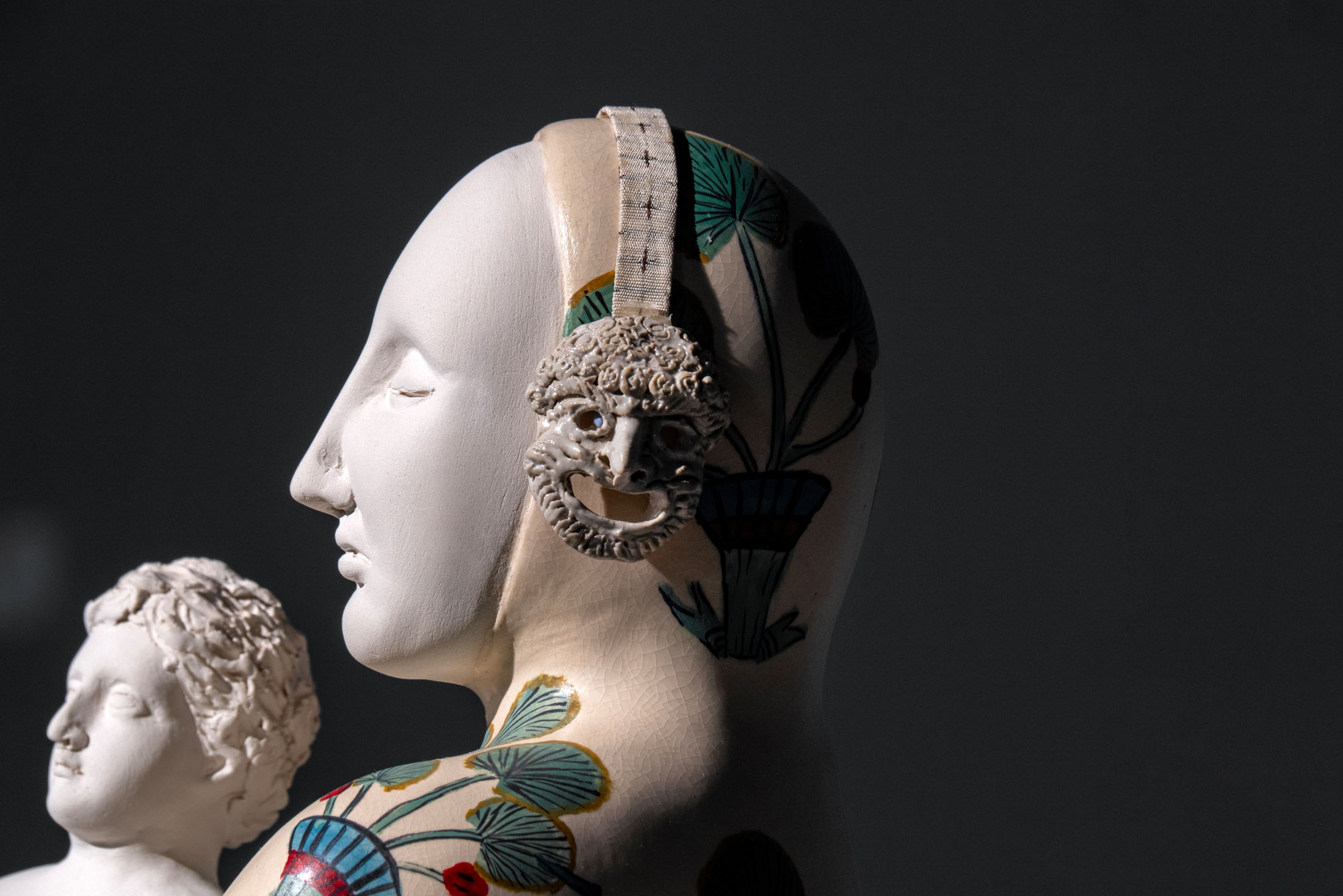
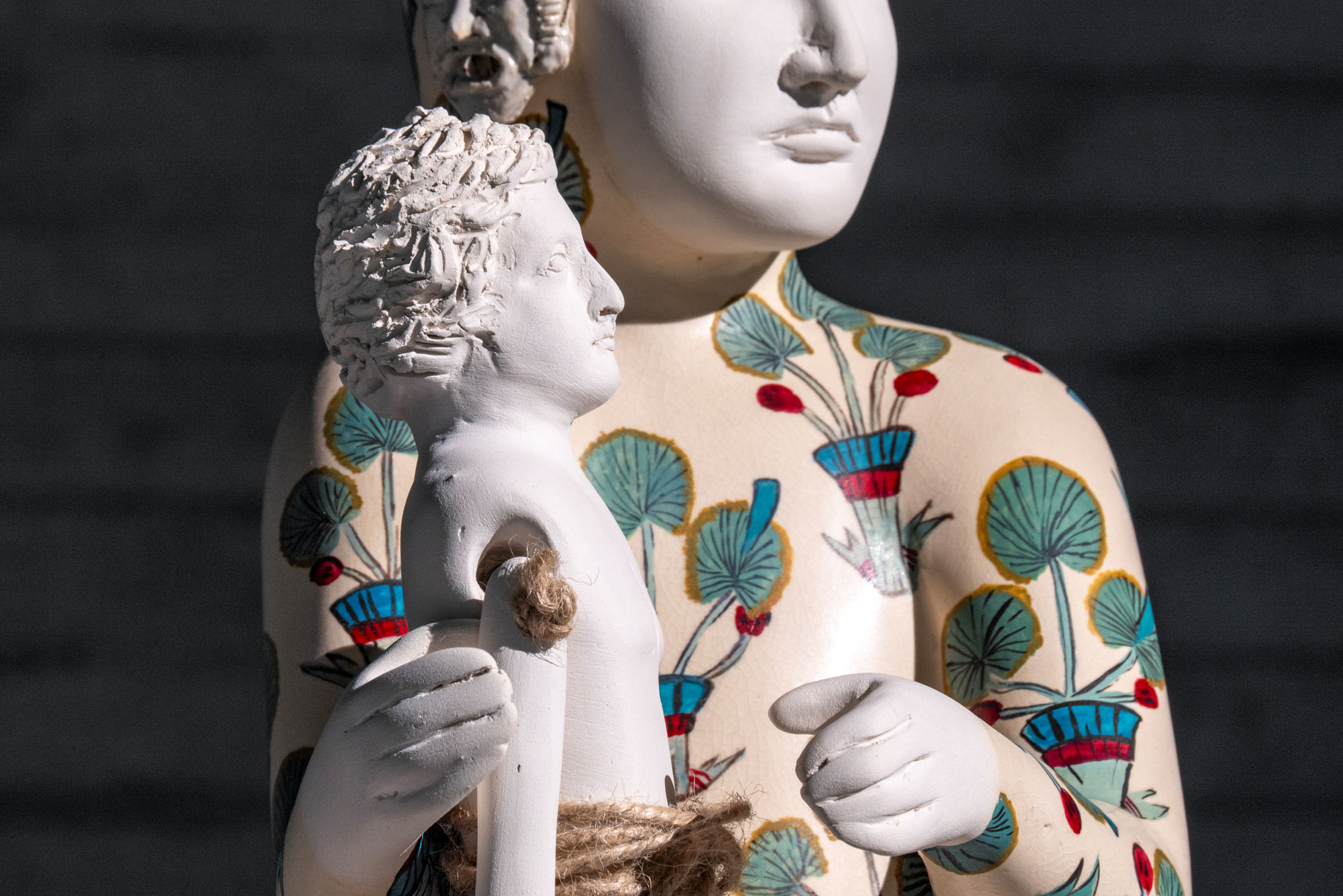
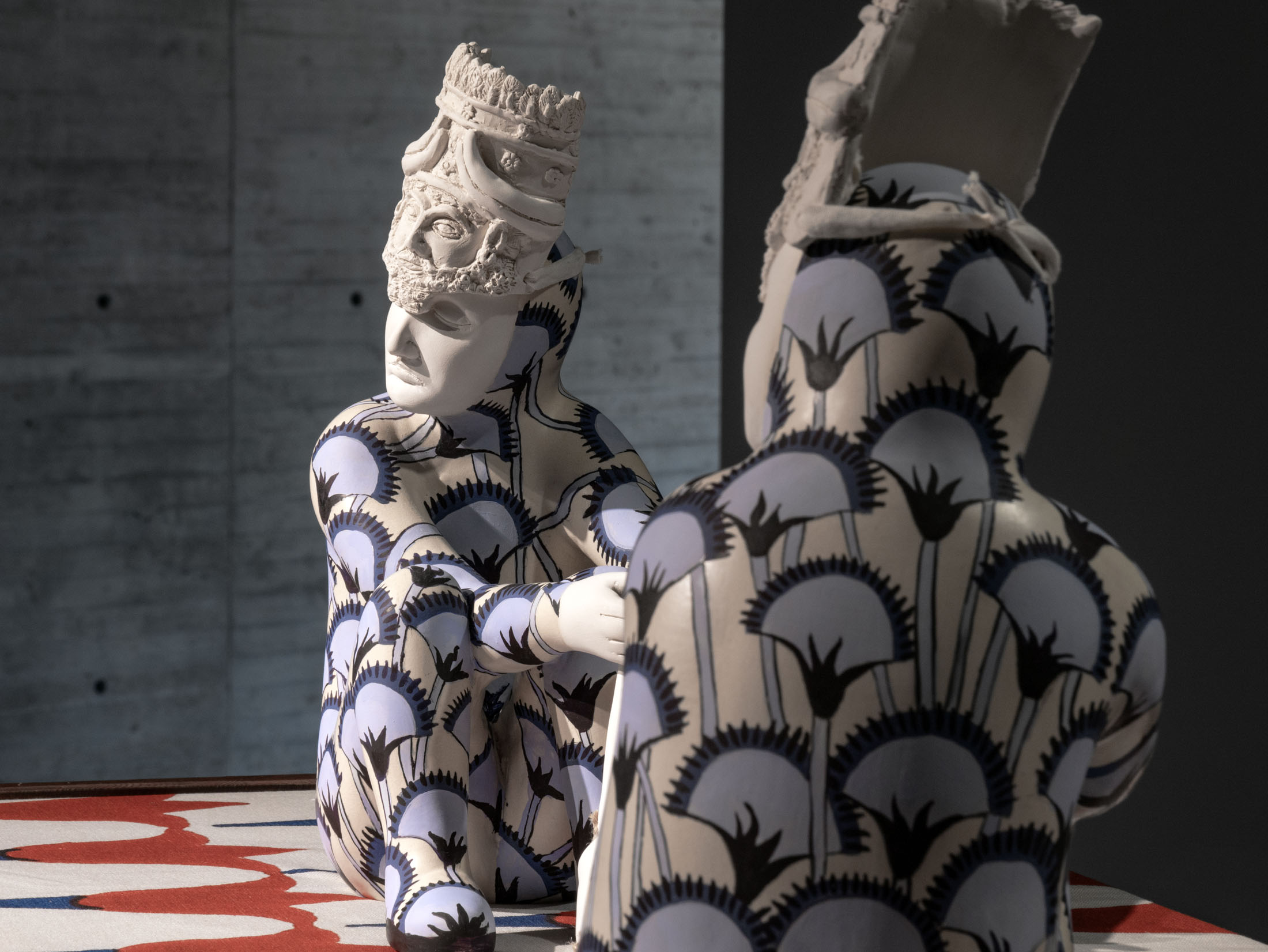
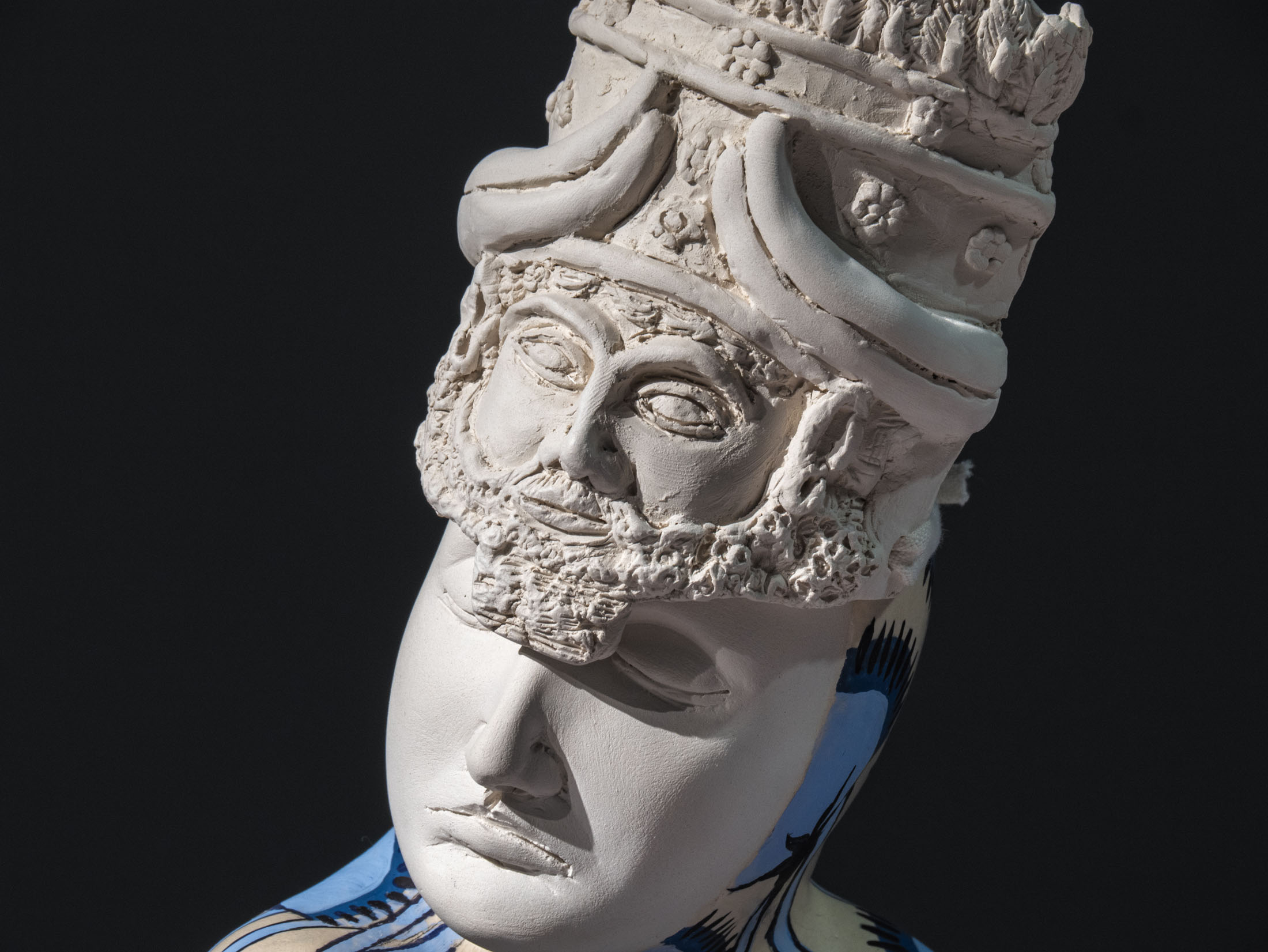
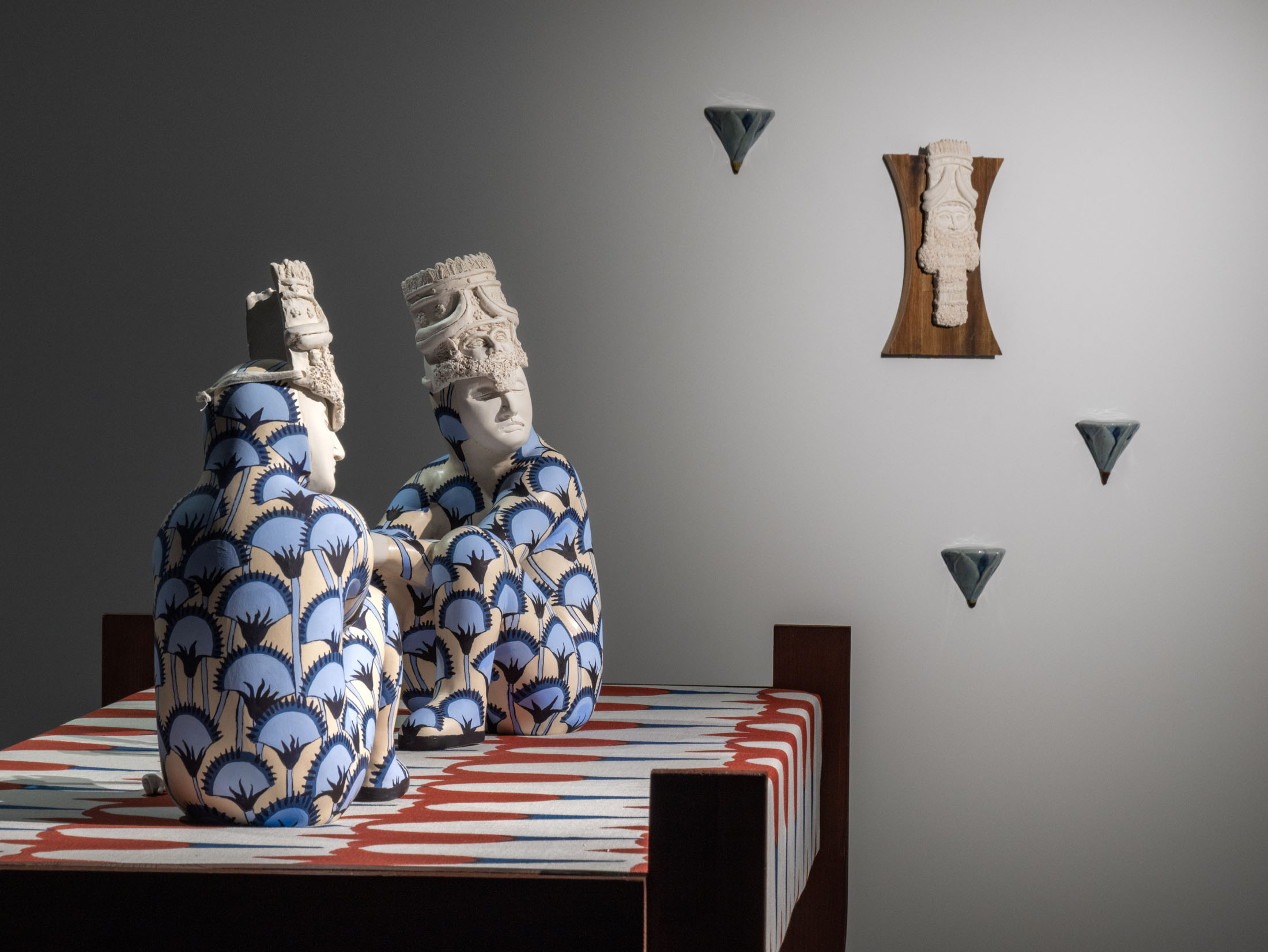
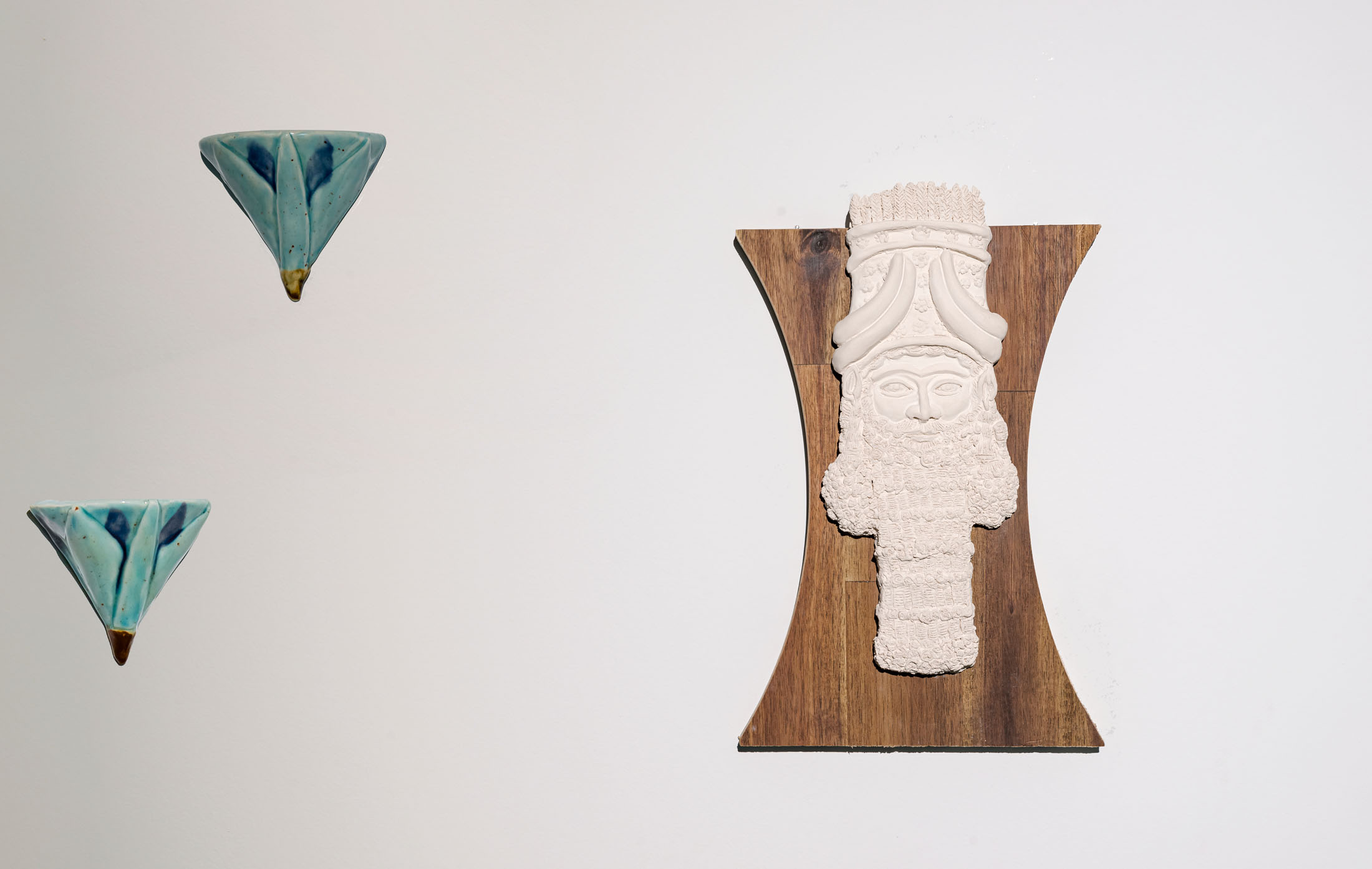
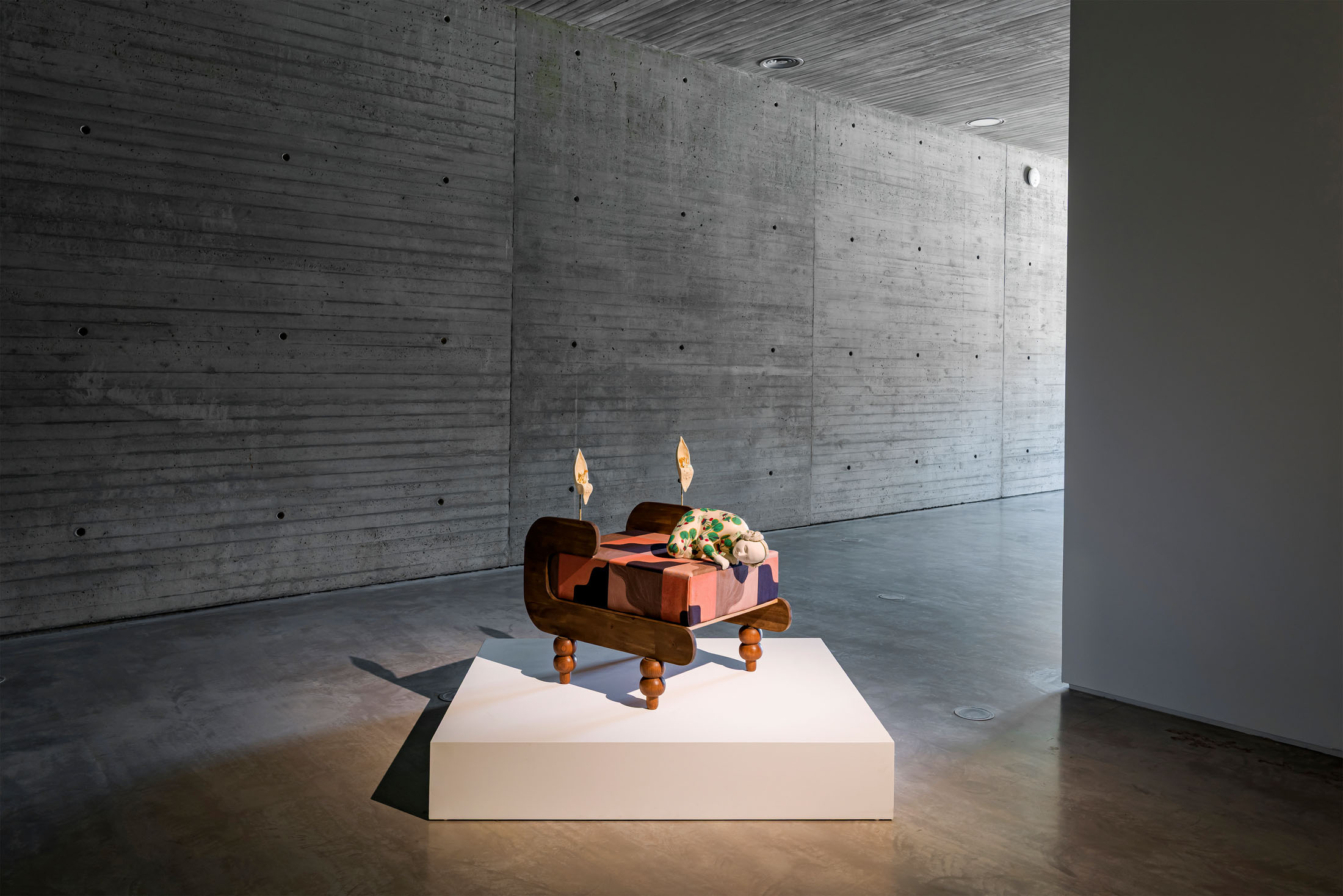
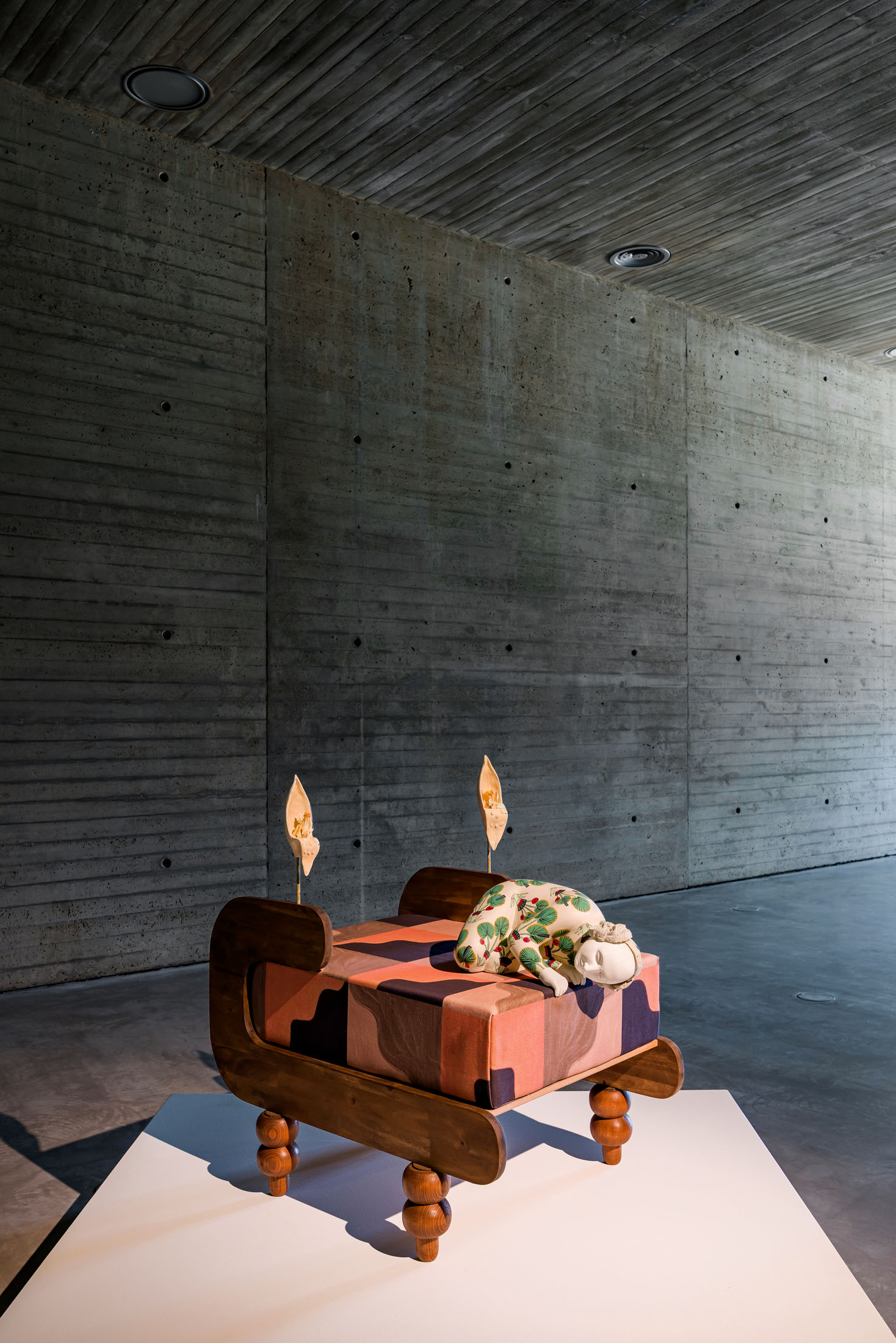
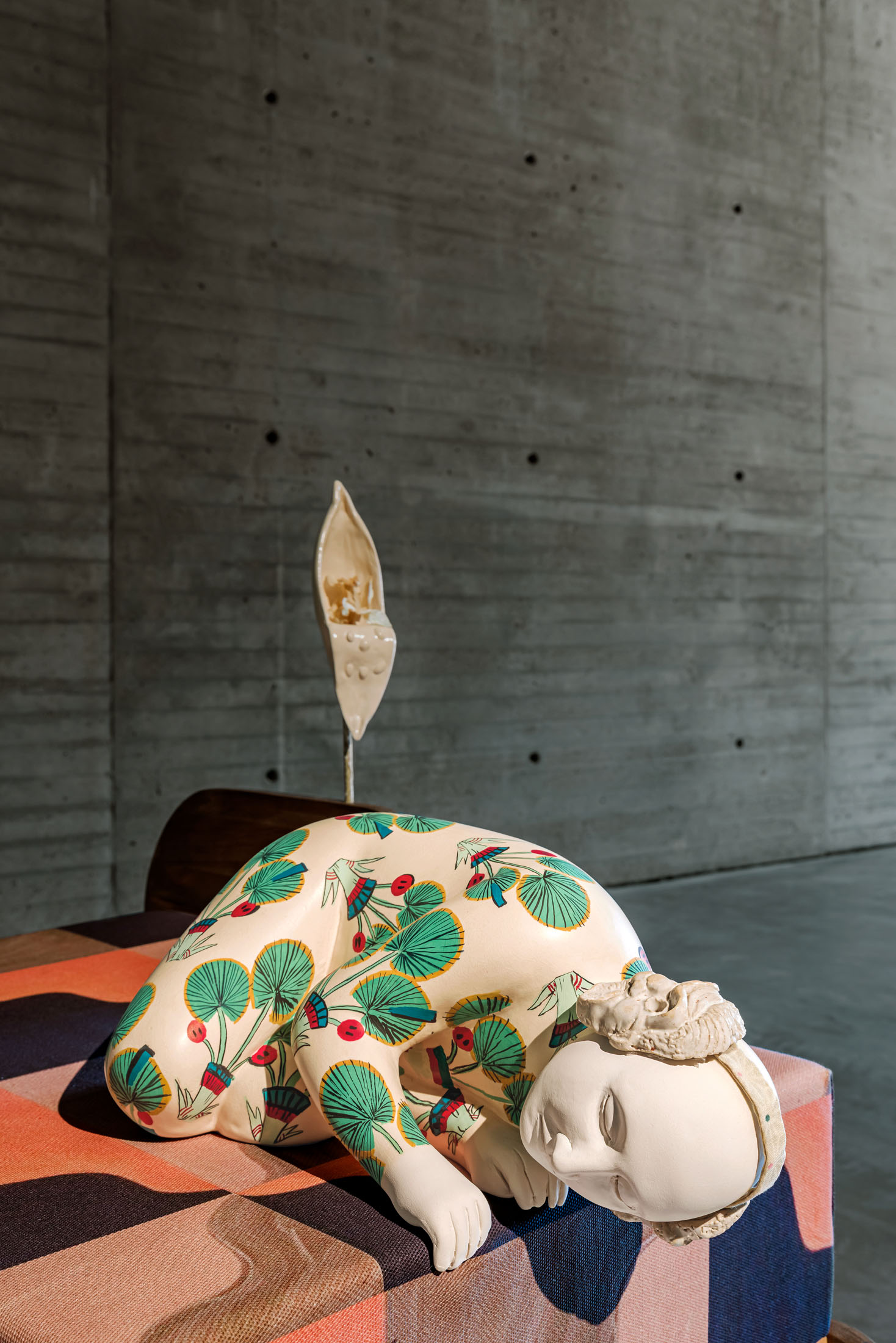
Let us pause at the piece Aaru (2024), where our jointed-limb Ulysses allows himself to be pampered by a maternal figure that symbolizes the power of the lotus. Seated on the lap of this oversized character, magnified by the flower’s spell, the little hero looks tiny and helpless, as if returning to infancy. The lotus-eater, with ceramic skin tattooed with lotus leaves, covers his ears with earmuff-like objects reminiscent of some pre-Columbian terracotta figurines. In fact, cultural syncretism is a constant in Algaba’s imagery, which freely blends subtle references—sometimes formal, sometimes conceptual—to Japanese, Korean, Greek, Egyptian, or Mesopotamian mythologies. In this piece, that syncretism is suggested by the two masks resembling Lamassu heads (protective beings from Assyrian mythology) that guard the island of the lotus-eaters. The very title, Aaru, refers to the Egyptian paradise accessible only to souls lighter than the feather of Maat. Algaba transforms that field of reeds—the fertile wetland of eternal happiness—into a marsh of psychoactive lotuses.
Aaru was a kind of island of the blessed, comparable to the Greek Elysian Fields. By naming the lotus-eaters’ island this way, Algaba infuses the concepts of happiness, time, and forgetfulness with ambiguity. Without intending to appropriate specific iconographic motifs, Algaba manages to awaken in us sensations of familiarity with legends from distant cultures. Wandering among her mysterious ceramic figures perched on minimalist sets, we feel like psychic archaeologists trying to piece together fragments found on the riverbanks where human civilization emerged. As if these ceramic relics could give us clues to understand one another again in an Edenic language, prior to the Babel debacle. Because silence becomes palpable when we approach these closed-eyelid effigies, and it is a silence like that of a sacred space, which suspends the power of words.
Forgetfulness of the Self or Illumination: The Ambivalence of the Lotus’s Power There are symbols that alone can transport us to the most ancient times, more precisely to the birth of epistemological frameworks that split the paths of Eastern and Western philosophies. The lotus may be one such symbol. It is a universal icon which, though nourished by specific attributes in each religion or folklore, is linked in many cultures to the purity of the soul and cosmic perfection.
However, Greek and Roman cultures (from Homer to Pliny the Elder, including Herodotus and Virgil) associated the lotus with all kinds of dangers related to the loss of consciousness, amnesia, unproductiveness, and pleasure for pleasure’s sake. In his Natural History, Pliny uses the term “lotus” generically, applying it to a wide variety of African aquatic plants, but his botanical imprecision is irrelevant here. What matters is that Latin authors perpetuated the Homeric myth of the existence of supposed exotic ethnicities (from present-day Libya or the Tunisian island of Djerba, according to Strabo and Polybius) to whom they attributed an indolent, dazed nature due to the consumption of lotus: “its taste is so sweet,” Pliny writes, “that it even gave this people and their land their name—too welcoming, since it makes foreigners forget their homeland.”
The metaphor of lotus-eaters clouded by apathy reaches all the way to Somerset Maugham’s story The Lotus Eater, which tells of the slow melancholy of a retired banker living in Capri. He eventually commits suicide when he realizes that carefree happiness inevitably turns into a meaningless, aimless existence.
In the East, on the other hand, the lotus has always been associated with purity because its flower grows in stagnant water—becoming a living metaphor of the ability to transcend the muddy cradle in which one is born. In India, the lotus stem symbolizes the axis of the world (the sacred mountain Meru), and the eight-petaled corolla inspires the circular layout of mandalas. The principal gods of Hindu and Egyptian pantheons—like Brahma and Ra—are born from a lotus flower. Buddha’s throne is a lotus, as is the posture of meditation. Egypt’s blue lotus grows from the head of Nefertum, “The Lord of Perfumes,” symbolizing the birth of the sun. Its flower opens at dawn and closes at dusk, symbolizing the daily cycle of renewal and rebirth. Ra and Osiris—the sun god and the god of the dead—were linked to this flower, which blossomed anew every morning on the water’s surface, just as the dead might someday be reborn in the waters of life.
Many Egyptian tomb paintings show figures consuming drinks enhanced with blue lotus. Its sedative and mildly hallucinogenic properties may explain its ritual use in ancient Egypt. It’s believed that during sacred ceremonies, lotus flowers were added to wine or steeped in beer to intensify their effects and foster deeper communication with the gods.
It’s also believed that in ancient Greece, plants were used to induce altered states of consciousness for ritual purposes—especially in mystery rites, which were open only to initiates. These could be called the “B-side” of public worship of the Olympian gods. Eastern influence is clearly felt in the Dionysian and Eleusinian mysteries. Both focused on aspects overlooked by official religion: esoteric experience, fear of death, belief in rebirth, spiritual trance.
Several Greek authors speculated about Dionysus’s travels to India, and some theories even connect him indirectly with the lotus flower: Dionysus was born from Zeus’s “thigh,” a body part called meros in Greek, which is also the name of the sacred Indian mountain associated with the lotus flower. Thus, although born of an Olympian god, Dionysus is etymologically linked to Indian theogony. He is the son of the cosmogonic force embodied in the lotus flower and is thus identified with the Hindu god Shiva. Dionysus-Shiva symbolizes the destructive-creative power of the cosmic dance and mystical intoxication.
The ecstatic rapture brought about by dancing and narcotic substances during Bacchic festivals enacted precisely what Homer’s Ulysses feared most: the loss of self, the dissolution of individuality, alienation. It’s said that these festivals of Asian origin initially attracted marginalized groups in Athenian society—women and slaves. Thus, intoxication shaped a different kind of community: free and ephemeral. The Dionysian rite dismantled all allegiance to the symbolic order, which in terms of Hindu mysticism would be equivalent to tearing the veil of Maya—the illusion that separates us from ultimate reality. Between its shreds, the Titans emerged—inhabitants of the chaotic era that classical Greece had erased from its land, replacing them with Olympian gods. According to Nietzsche, the Greeks sought a balance between the Dionysian pull of the abyss and the Apollonian harmony. Balance is essential, because if the state of tearing through the veil of appearances lasted too long, the human world would disappear with it. Although Eastern and Western philosophies diverged (mainly due to the excess of rationality and abstraction in the latter), a common underground current remains. Aldous Huxley called this the Perennial Philosophy—the intuition of a single reality manifesting in the multiplicity of phenomena. This revelation is reached through spiritual intoxication that dissolves the ego into the All and frees consciousness, allowing it to participate in a refined reality. Mystics of all creeds recognize this (Sufis, Christians, Hindus, Buddhists…). Huxley spoke of a “reducing valve” in the brain that adjusts our perception to utilitarian ends. We need this valve to live and communicate, but certain altered states of consciousness (achieved through fasting, hypnosis, visionary drugs, or meditation) break the valve and, paraphrasing William Blake, open the doors of perception to show the world as it truly is: infinite. In Island—Huxley’s final novel—the inhabitants of Pala use moksha-medicine to gain glimpses of the
Other World, like the mystics of old, but without forgetting their bodies, their here and now. In fact, they combine the use of this substance with tantric-inspired sexual practices meant to expand awareness and strengthen communal bonds. The island of Pala is a utopia not because the islanders’ way of life is inconceivable (they prioritize human values over economic ones), but because the rest of the world conspires to destroy it. This utopian island is the reverse of the “brave new world” Huxley introduced in his earlier novel—a dystopia set in a far-off future but eerily close to our own 21st-century reality. In Brave New World, individuals are conditioned to “love their servitude.” Soma is the drug of obedient happiness, taken to “take holidays from reality.” Any sign of melancholy or critical thinking is neutralized with a few grams of soma. Consumerist throwaway logic applies to all aspects of life (recreational sex, superficial relationships, empty pleasures), and soma ensures sacred communion with that model. Soma is the opium of the people—just like, in real life, today’s pharmacopoeia of antidepressants and the sophisticated media sensory overload that dulls the lives of the “happy world.”
While soma strengthens the veil of Maya, the moksha of Pala pokes holes in that dense fabric of consensual reality and lets in flashes of an unnameable truth. Moksha is a Sanskrit word meaning “liberation,” and in Hindu philosophy, it’s associated with the revelation of the unity between the individual soul and the Absolute. Huxley strove to fuse aspects of different philosophies and religions on that island, believing that, stripped of dogma and specific precepts, they were rivers of self-knowledge flowing through different valleys into the same sea.
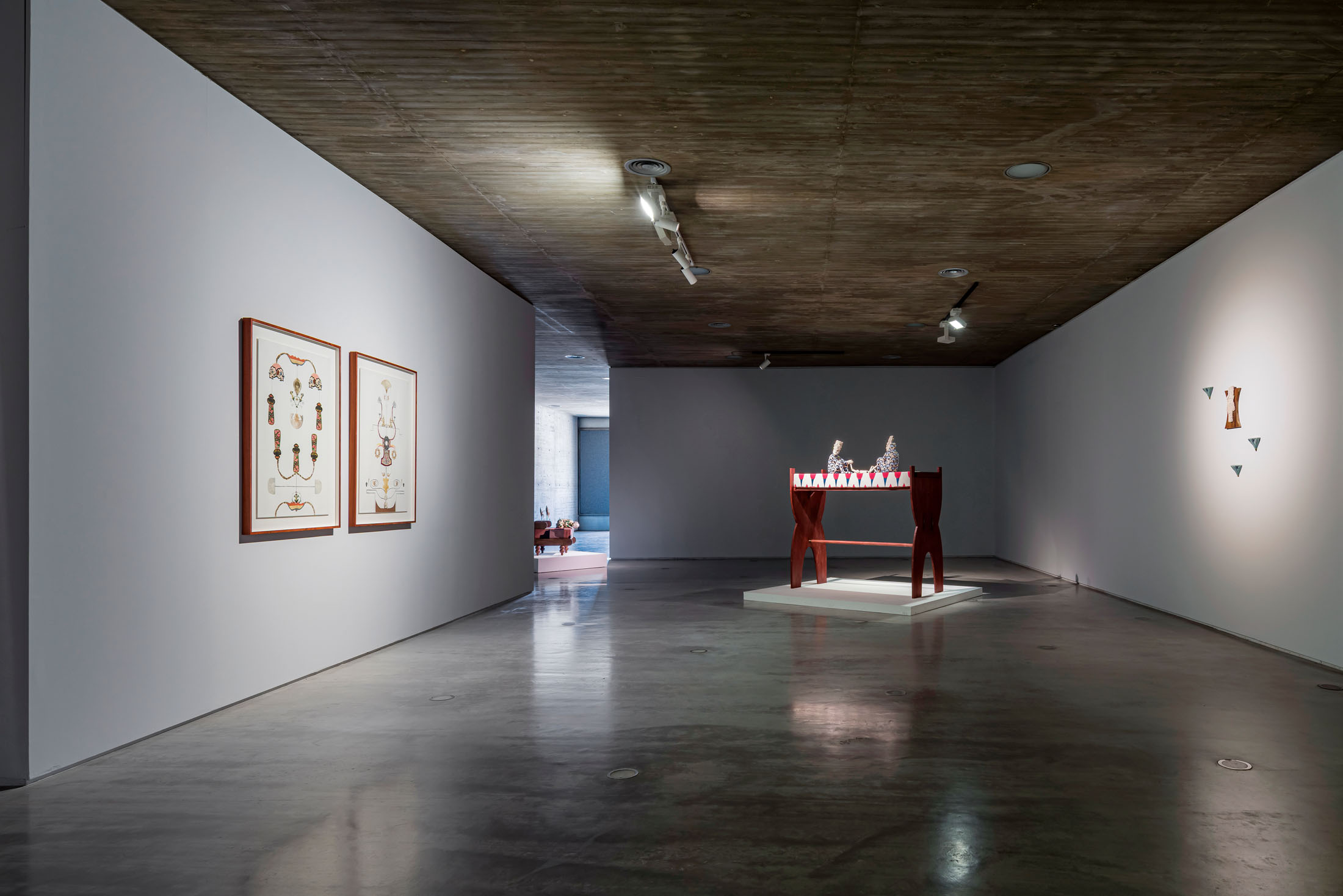
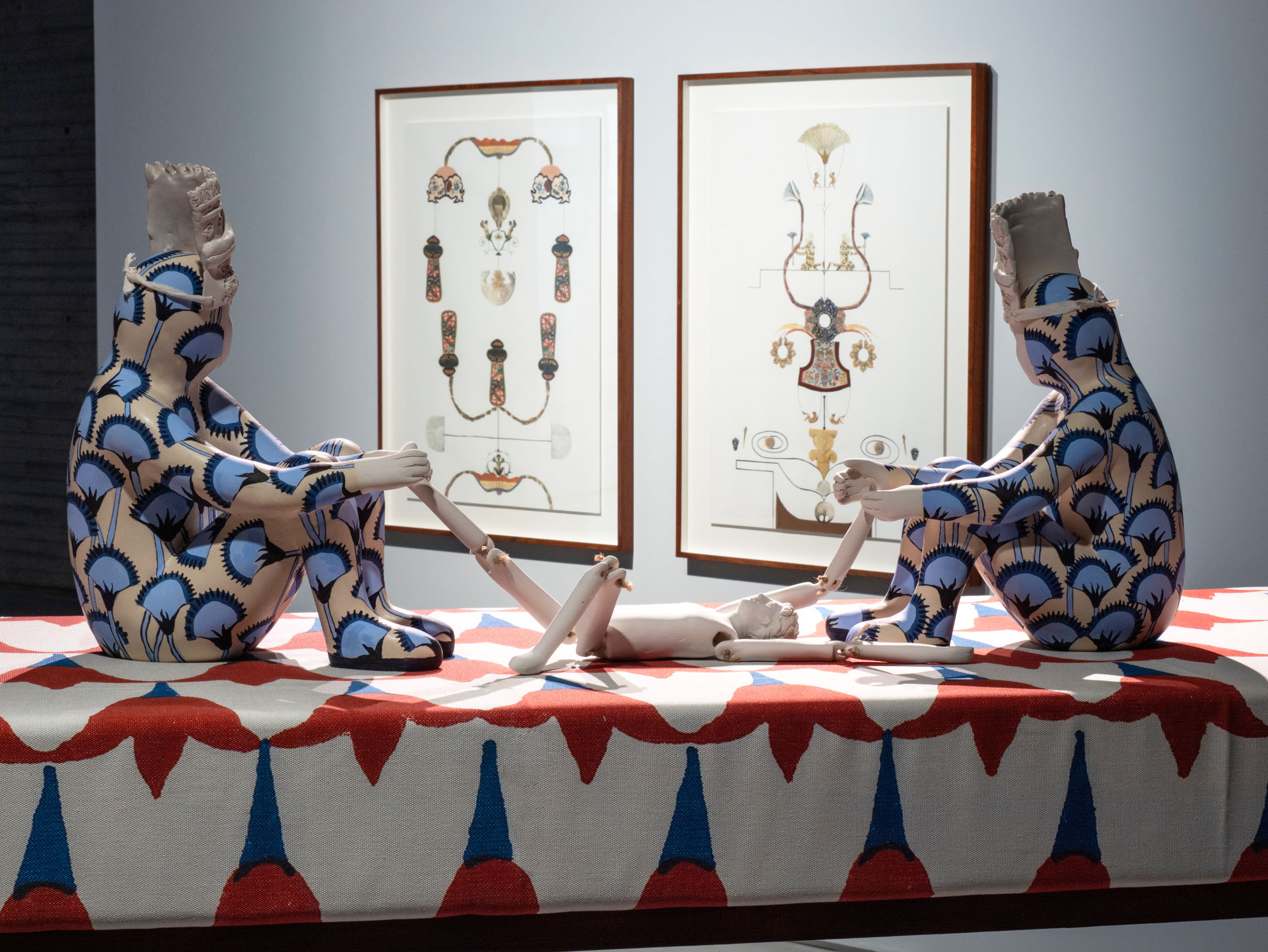
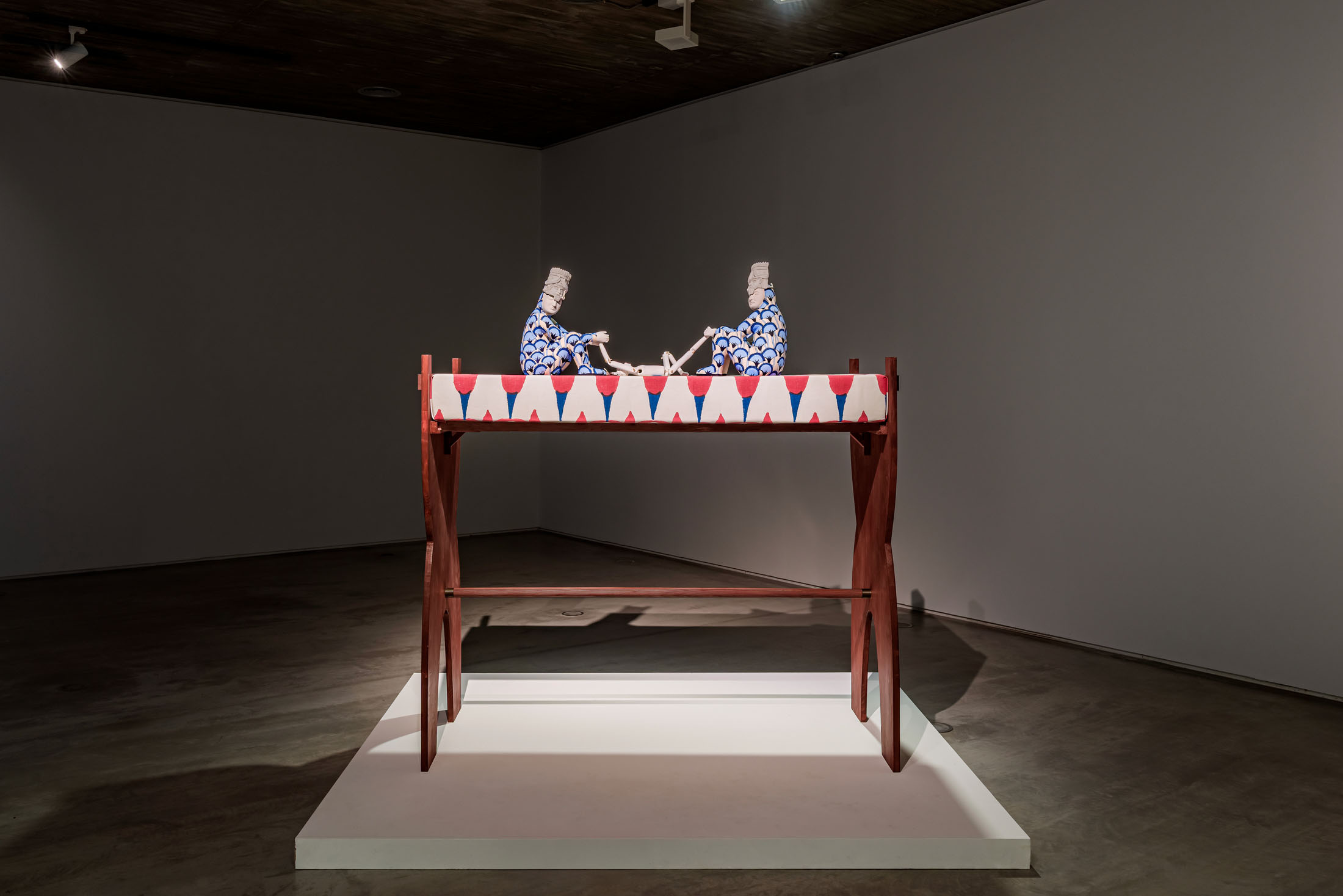
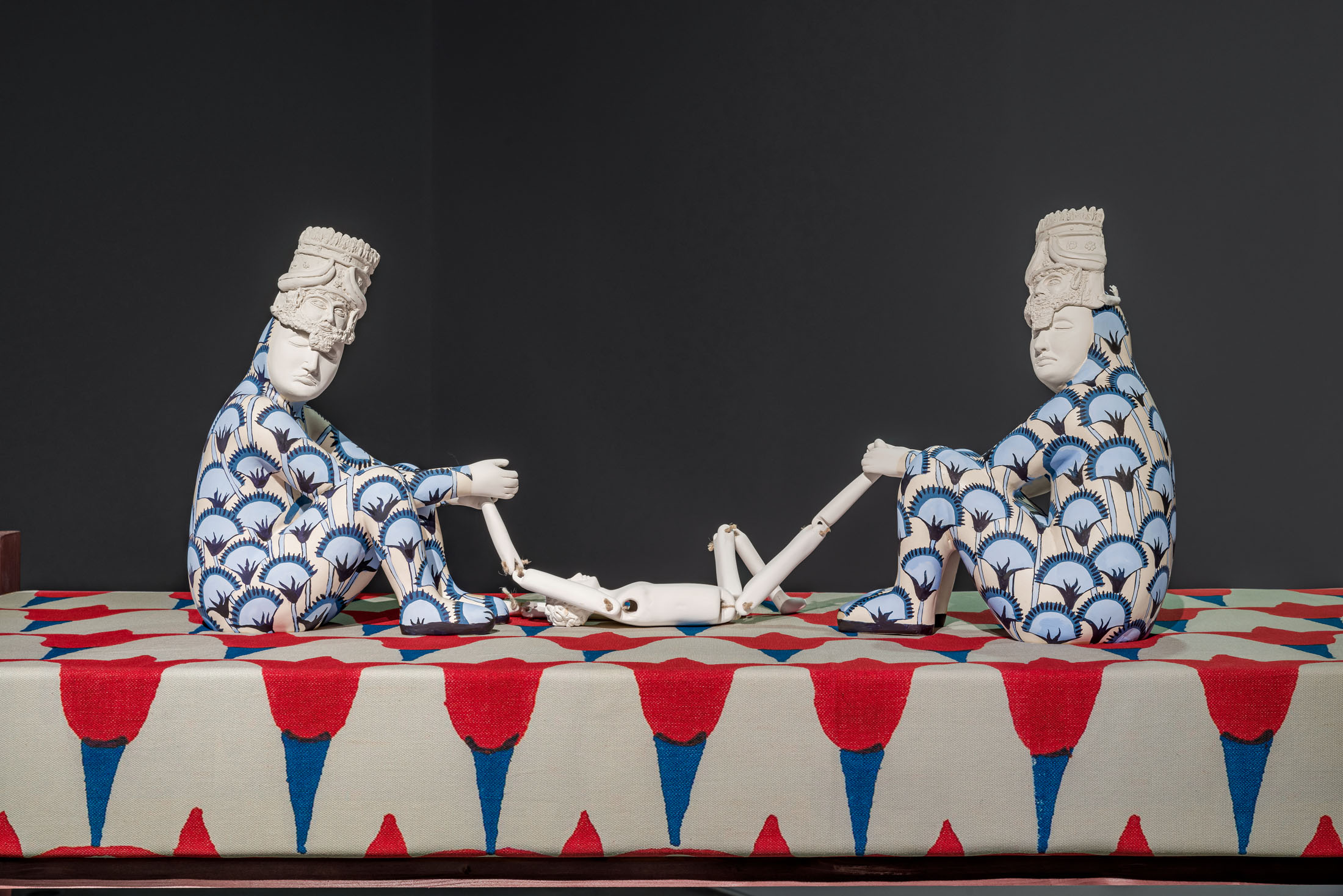
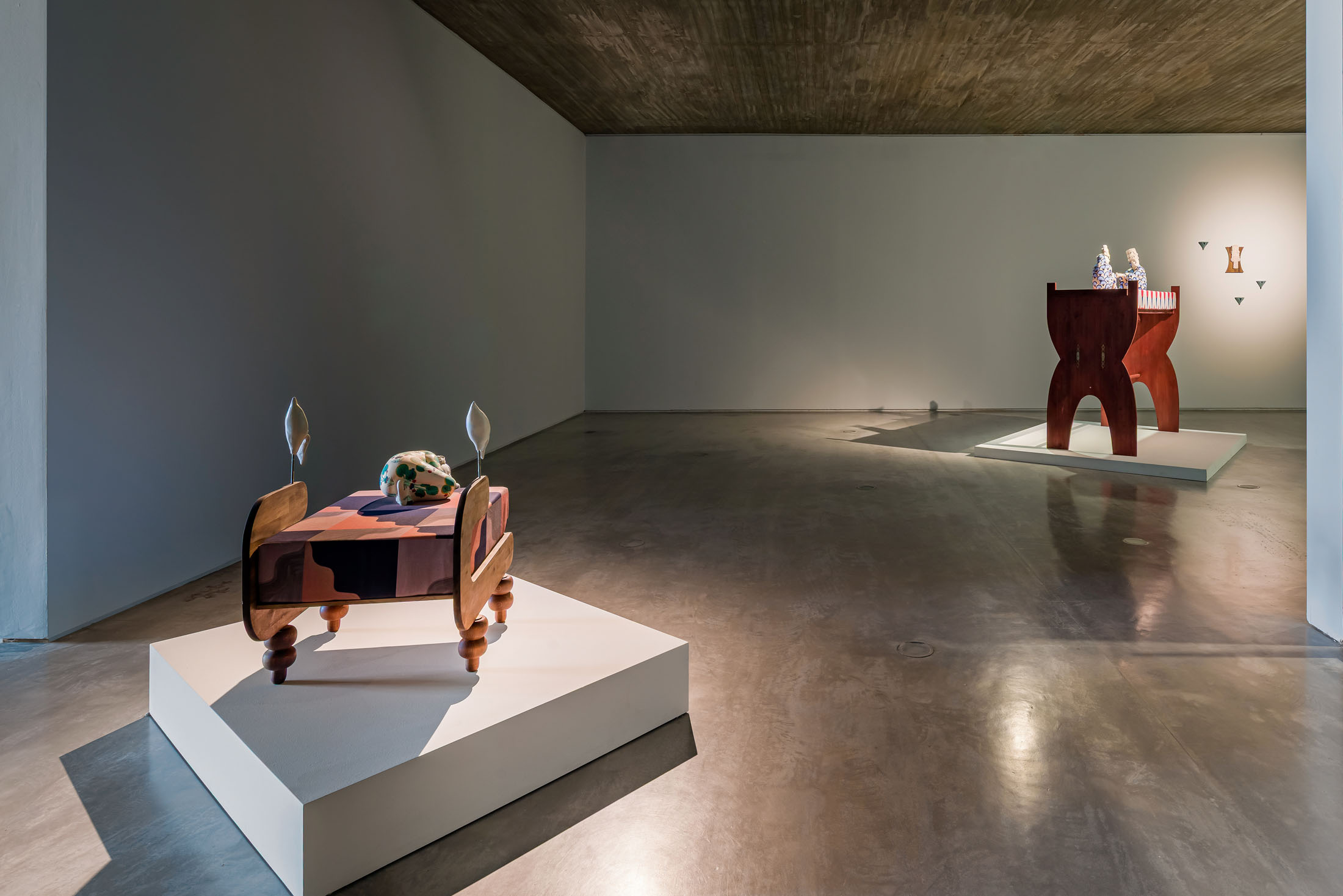
Algaba’s 2024 sculpture Maclíes shows two lotus-eaters grabbing the little Ulysses by the limbs and stretching him as if to perform some gruesome medieval torture. But the Maclíes weren’t inquisitors of medieval Europe—they were a supposed Berber people the popular imagination associated with the lotus-eaters. According to Herodotus, they were so given to communal orgies that no one knew who fathered whom. Hellenic historians saw their Mediterranean neighbors as a kind of avant la lettre hippies—polyamorous and hedonistic. From this point of view, our ceramic Ulysses is not to be tortured with endless pain but with overwhelming pleasure. One Maclí grabs him by the feet, the other by the hands, and they swing him like airing a bedsheet. His helpless body is drugged with the soma of standardized happiness—an opiate joy that nullifies free will.
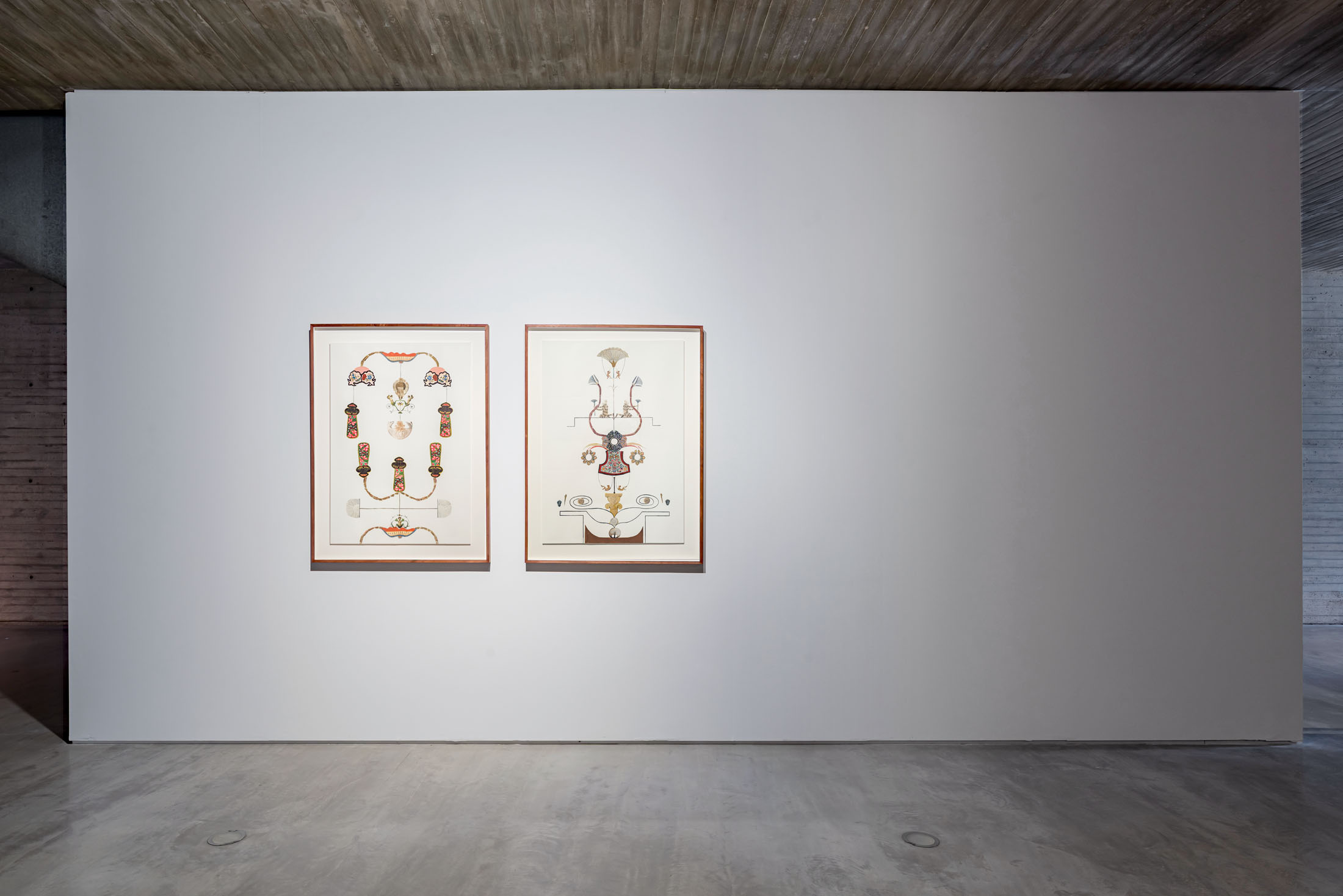
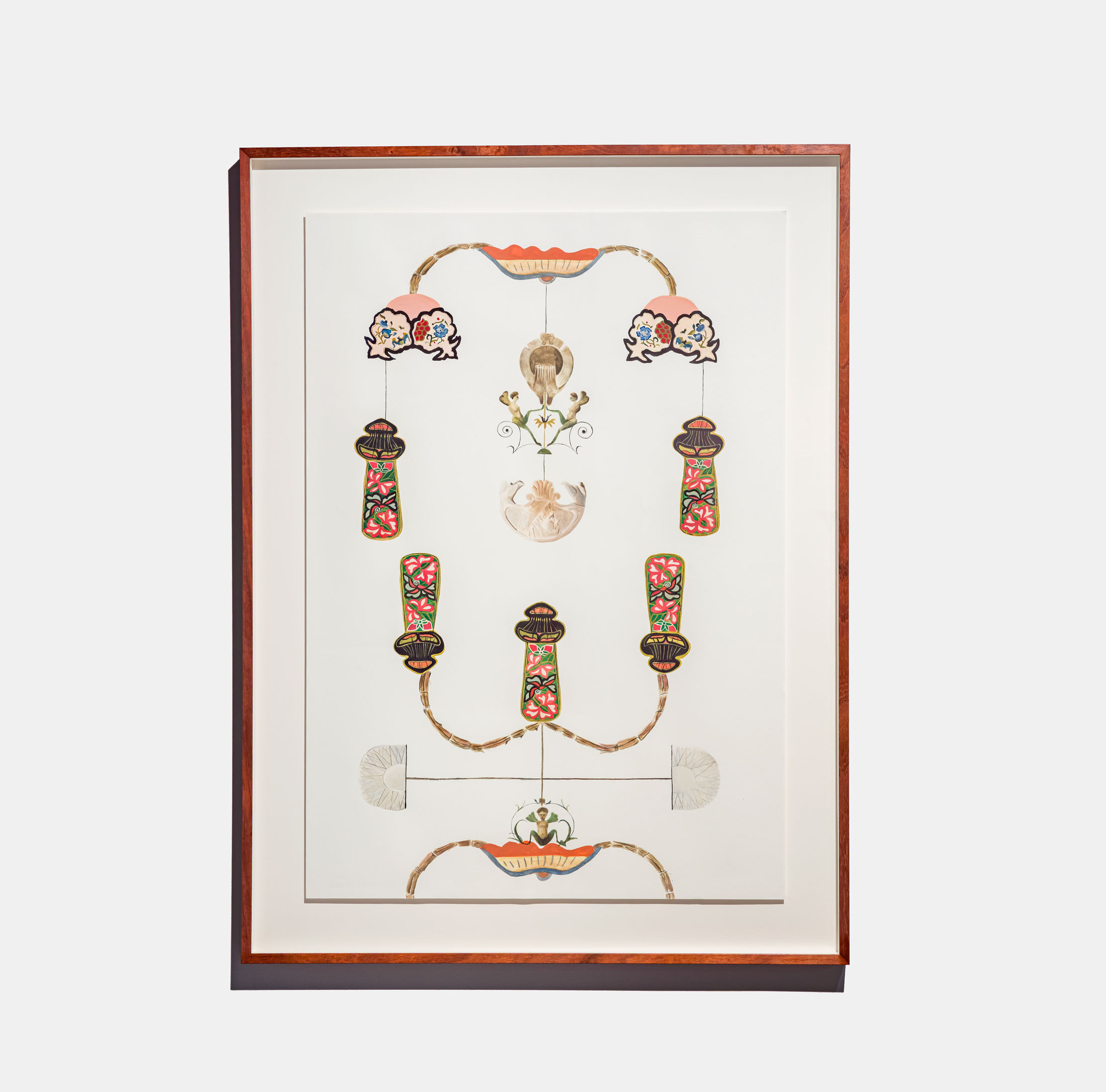
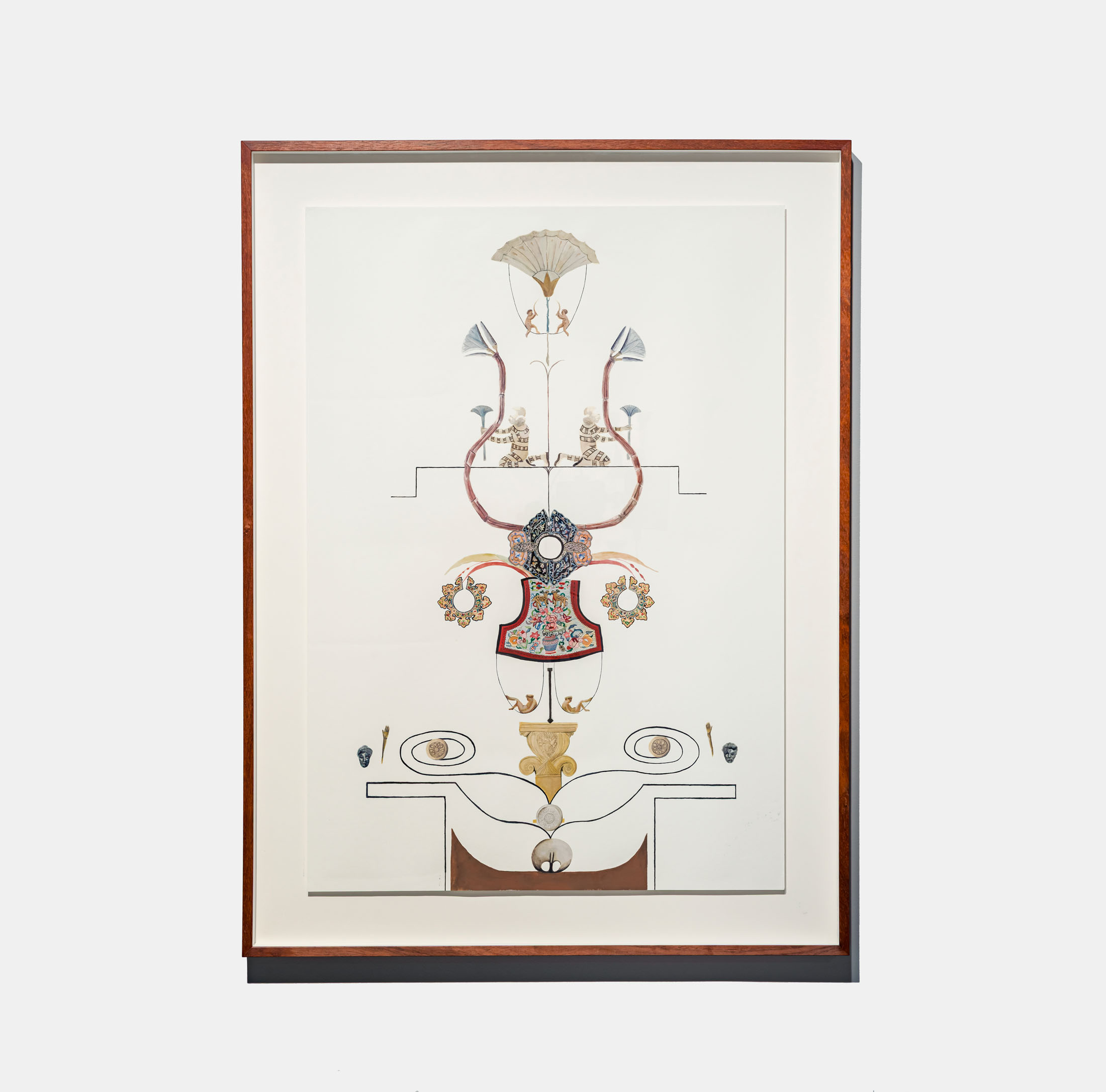
This sculptural group is accompanied by a large-format drawing. It depicts a stylized lotus flower transformed into a kind of fountain. Tiny figures swing from filament-like stamens sprouting from the plant. To a certain extent, the coexistence of plant, mineral, and anthropomorphic forms evokes the grotesque paintings on the walls of Renaissance palaces, while also revealing the influence of Eastern art.
A particularly compelling aspect of Algaba’s work is that, by reducing narrative to minimal elements, she leaves space for interpretative ambivalence. Without denying the lotus’s purifying power, she warns of the danger of being scorched within its fiery petals. The lotus would then become a metaphor for what, in the right measure, enlightens us—and in excess, blinds us. Sacred texts sprout gods and bodhisattvas from this numinous flower, but To Emerge from a Flower Doesn’t Offer Better Views (2024), warns one of the exhibition’s titles: a ceramic sculpture decorated with lotus flowers lies sideways, like a fallen idol or a germinal creature in eternal slumber.
Beyond the lotus’s symbolism in various traditions, in Algaba’s project it may symbolize the failed yearning to transcend ourselves. It stirs within us a genuine need to escape our banal daily lives. For this, we can take the shortcut of soma— instant gratification offered by commodified leisure—or the path of moksha, a more arduous journey that forces us to face our inner monsters before breaking our material chains. The latter is difficult, because most of us lack the ascetic qualities of Golden Age mystics—but that doesn’t doom us to the theme park of packaged happiness.
Between the paradise of artificial pleasures and that of the enlightened, we ought to dream together of a third model of Edenic insularity. Perhaps the best strategy is to widen the frame and observe our ideal island as part of an archipelago. Islands as closed-off entities cannot survive. The archipelagic must replace them as the stage for communal utopias. Hölderlin already dedicated a long poem— The Archipelago—to the shores bathed by the Aegean: an elegiac ode to a mythical time as an ideal of harmony between pantheistic feeling for nature, artistic flourishing, and political freedom.
The cradle of Western civilization is an archipelago. In fact, the word originally referred exclusively to the Aegean Sea. Later, by metonymic extension, it came to mean the group of islands bound together by the same sea.
Weary of the monarchical absolutism of his time, Hölderlin did not want to return from his poetic voyage, preferring to sink into the ocean’s depths—and he ends thus: “Let me finally and forever in your depths remember silence.” For that ideal collectivity, harmonious in its differences, separated and yet united by the sea, will not return—because it never truly existed—but the poet immortalizes its possibility on the page. Silence for Hölderlin, just as for Algaba, is not complicit or resigned. On the contrary, it is an accusatory and uncomfortable silence—one that clears the fog concealing the bars of our gilded cage.