MARIANNA MARDINI
UNDER THE PILLOW
Dark Materiality and the Forensic Imagery of Childhood
Marianna Nardini’s work revolves around a figure that never enters the frame yet is undeniably present – the Tooth Fairy. A secret protagonist, she acts from the shadows, from “under the pillow,” from that sliver of childhood between sleep and waking, between trust and fear. In the exhibition Under the Pillow, the fairy is no longer a benevolent gift-giver, but an ambivalent presence, at once tender and menacing, a sovereign of imagination who supervises and reshapes the child’s world. A seemingly innocuous childhood ritual – placing a milk tooth beneath the pillow – is transformed into a point of contention, an intersection where fantasy, corporeality, pain, inherited narratives, and their unexpected twists converge.
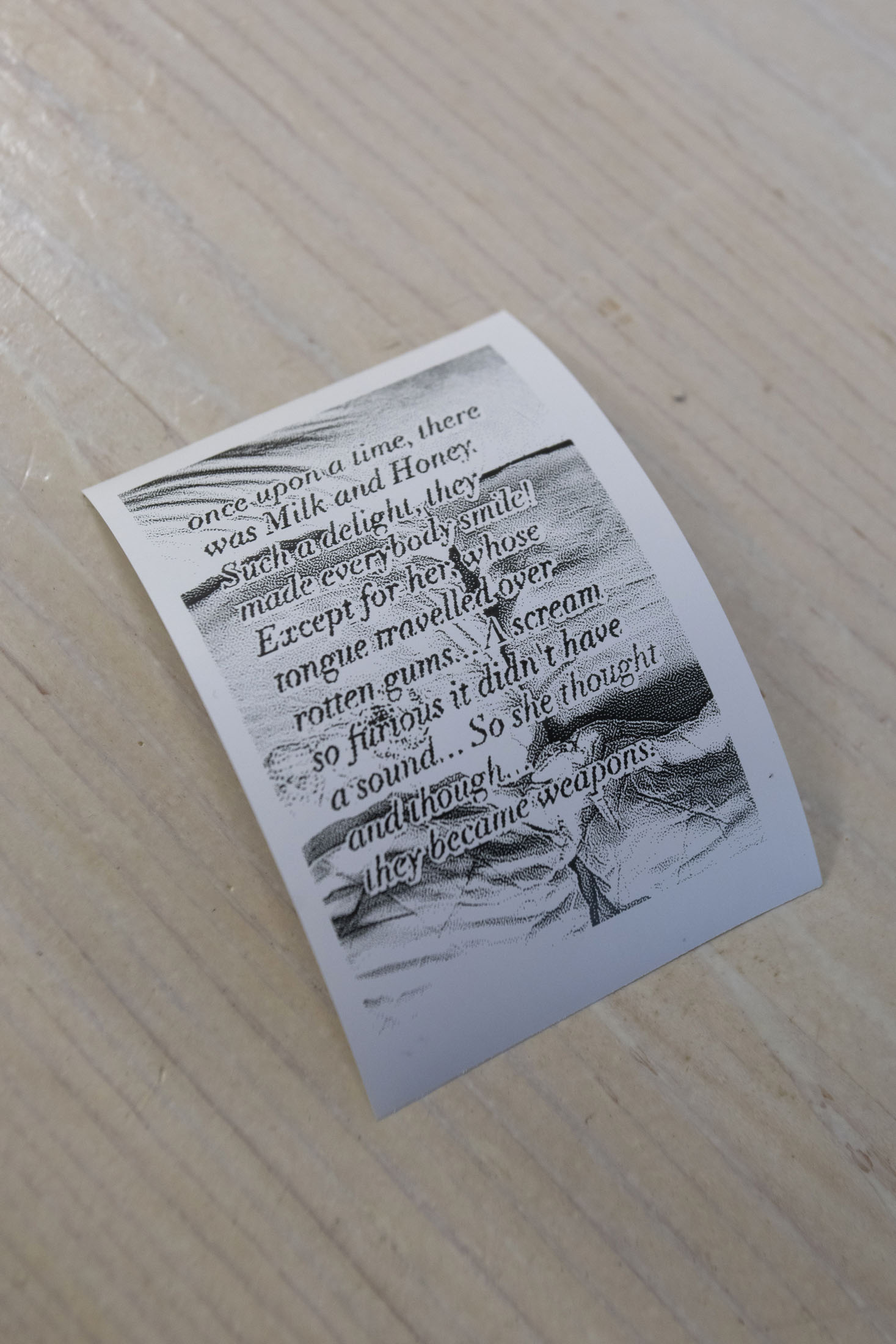
The story underlying the exhibition begins with the familiar formula: Once upon a time, there was Milk and Honey. Such a delight, they made everybody smile! Yet what follows departs from convention. Instead of sweet innocence, a vast crack appears: Except for her, whose tongue travelled over rotten gums… A scream so furious it didn’t have a sound… So she thought and thought… they became weapons. This abrupt shift – from milk and honey to decay, suppressed pain, and rage – is a crucial interpretative pivot. What once symbolized comfort becomes a thing of revulsion and resistance; what was intimate and friendly to children, in Nardini’s interpretation, turns into weapons and unease. In the fantasy world of childhood, where anything is possible, Nardini locates a metaphor of psychological self-defense, a mechanism in which the fantastic is recast into an instrument of strength, as well as a signal that childhood is not only a paradise lost but also the source of future fractures and vulnerabilities.
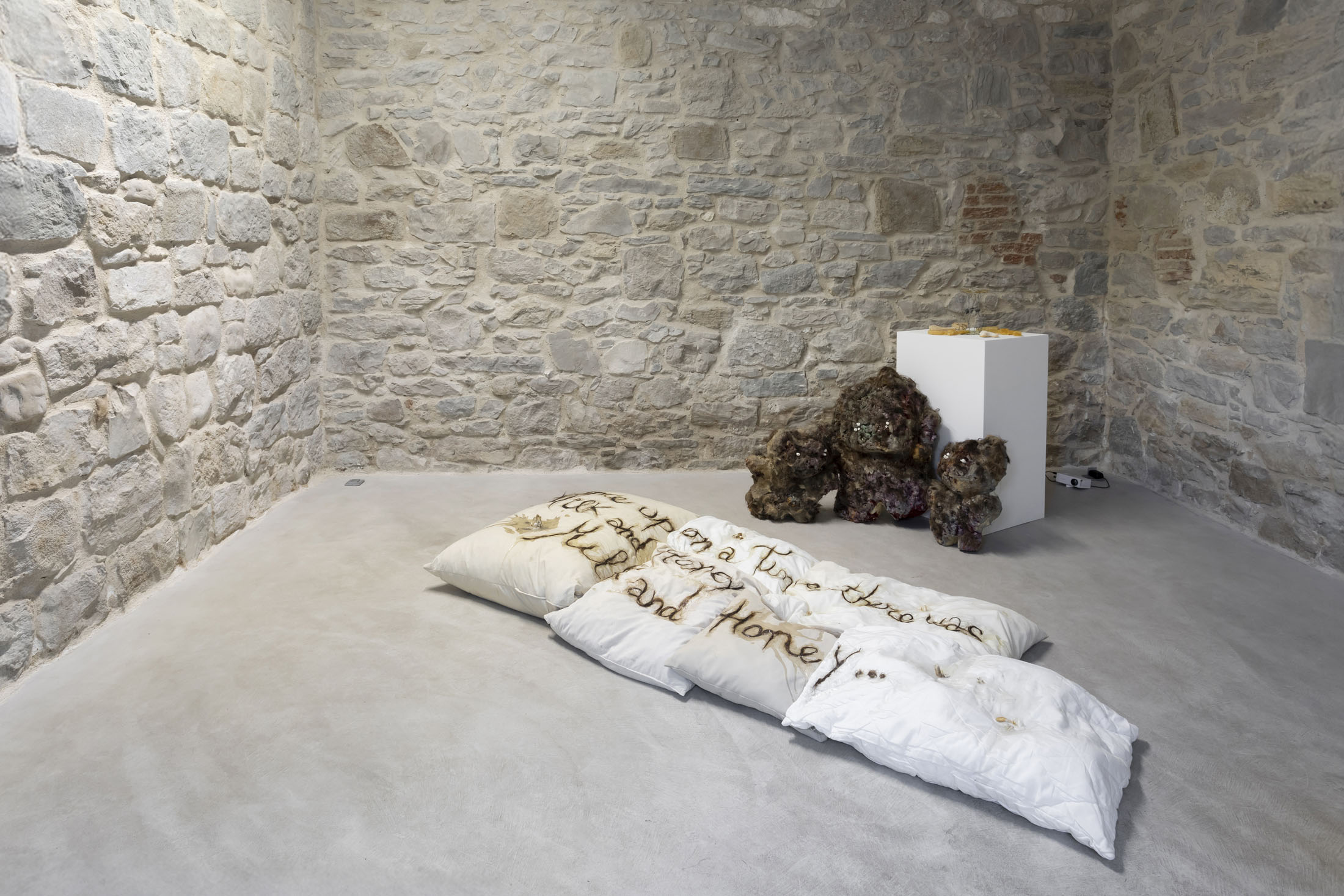
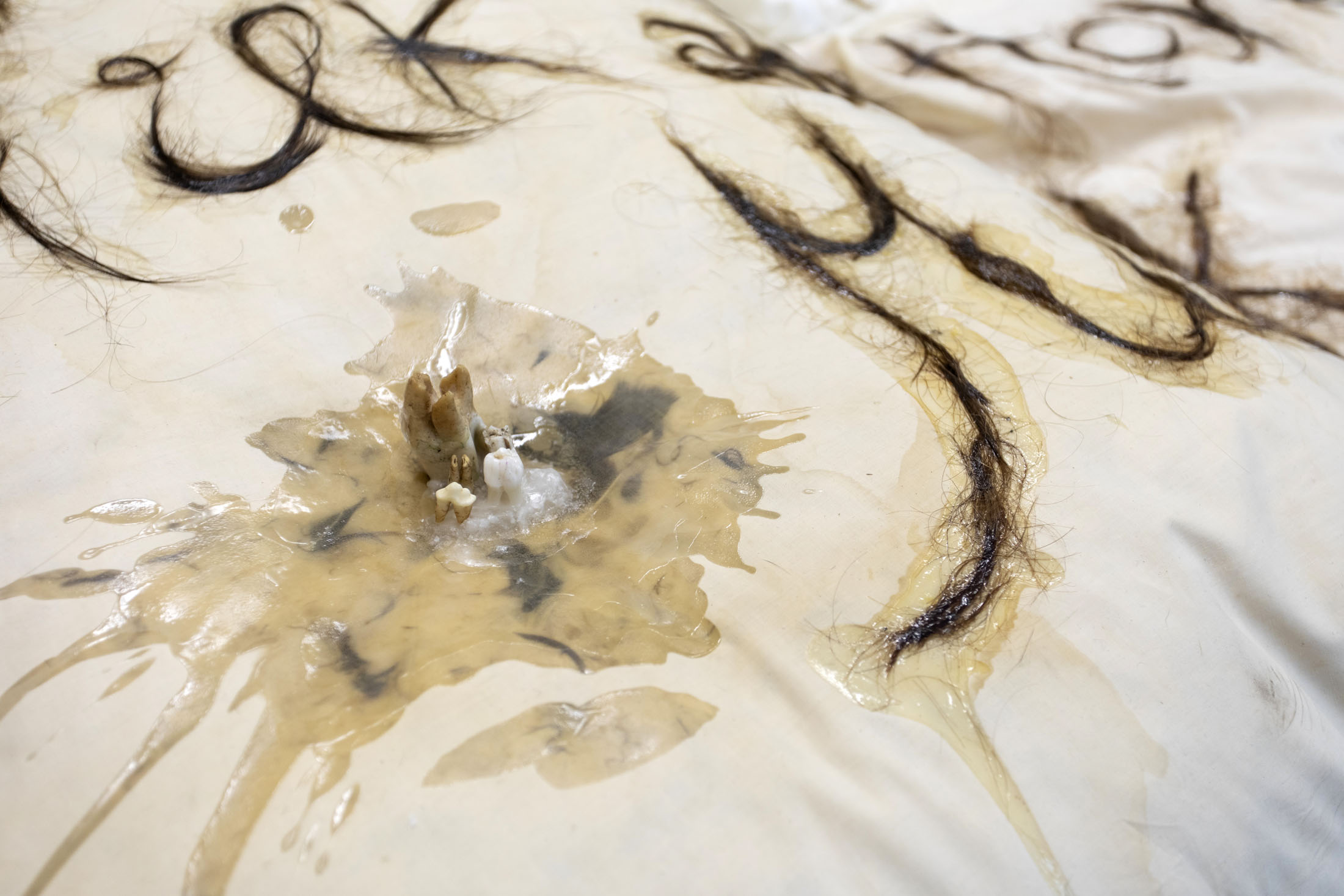
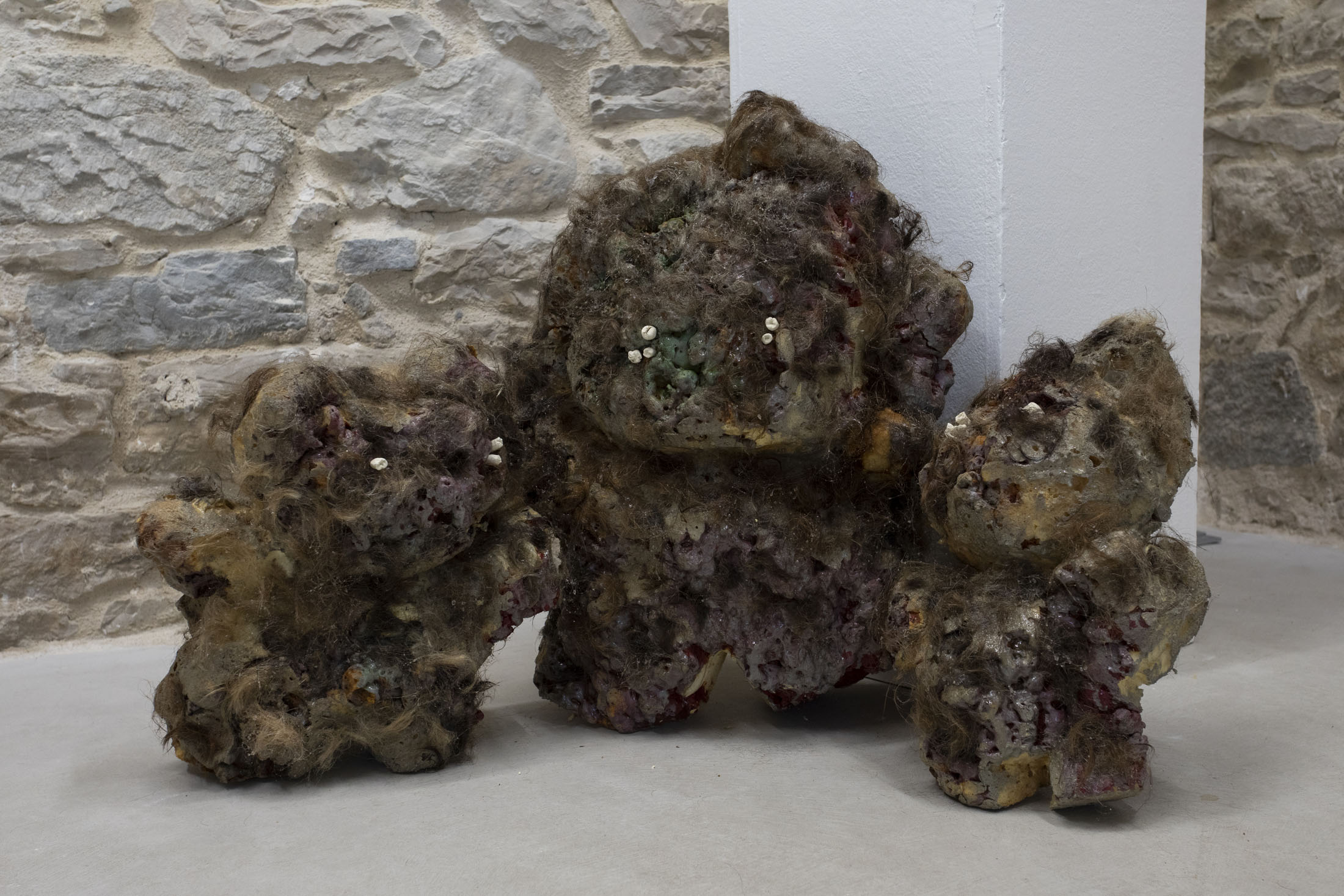
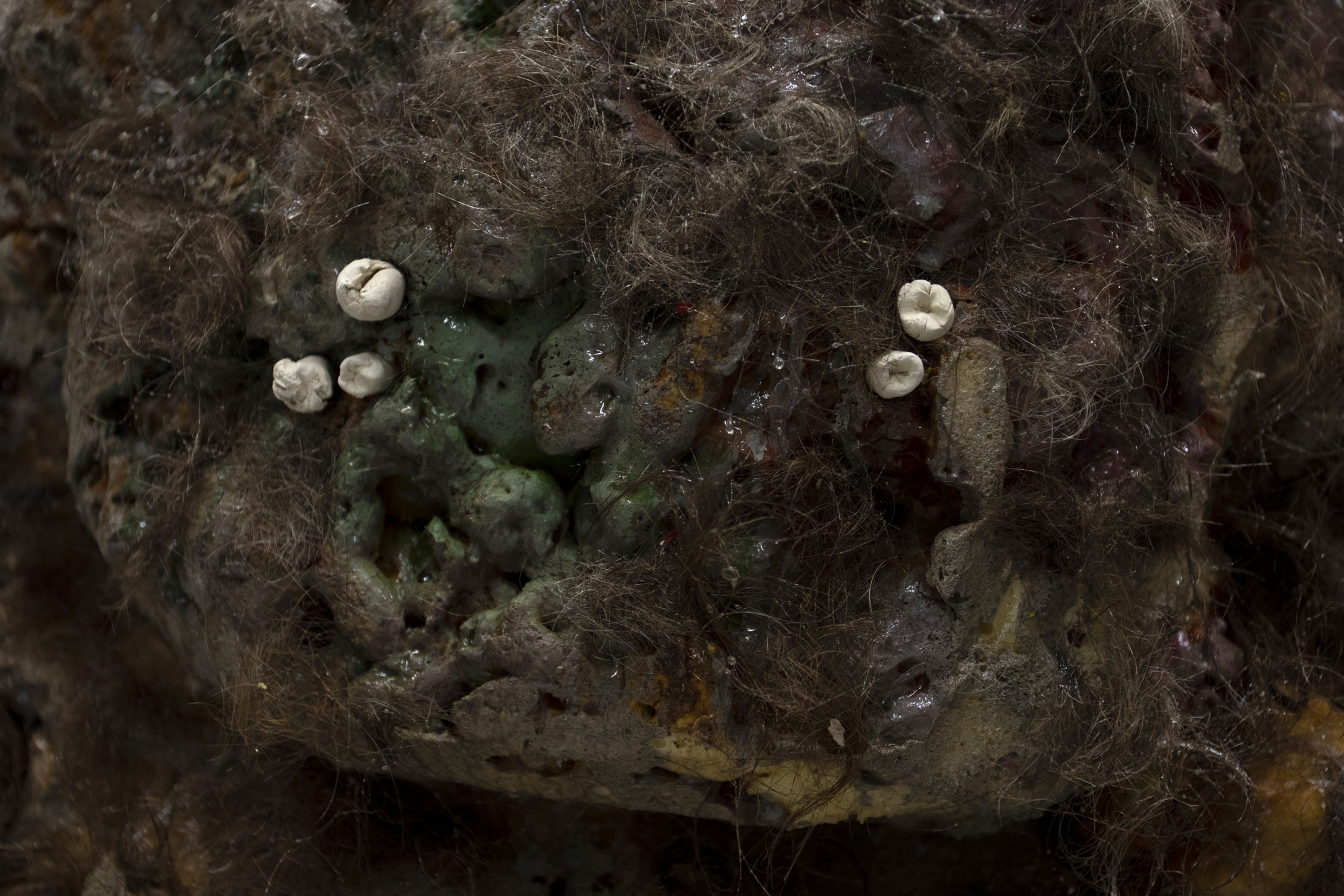
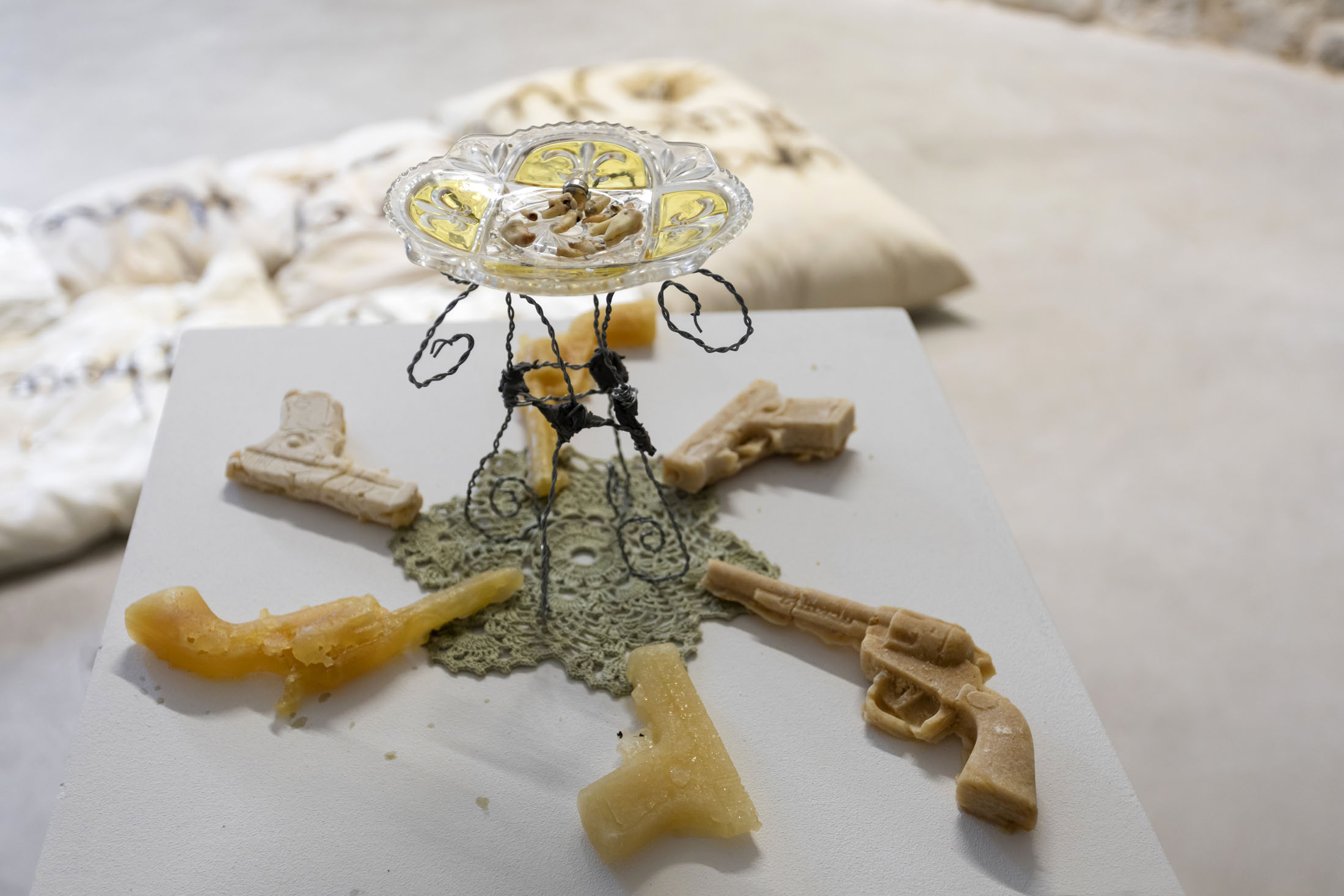
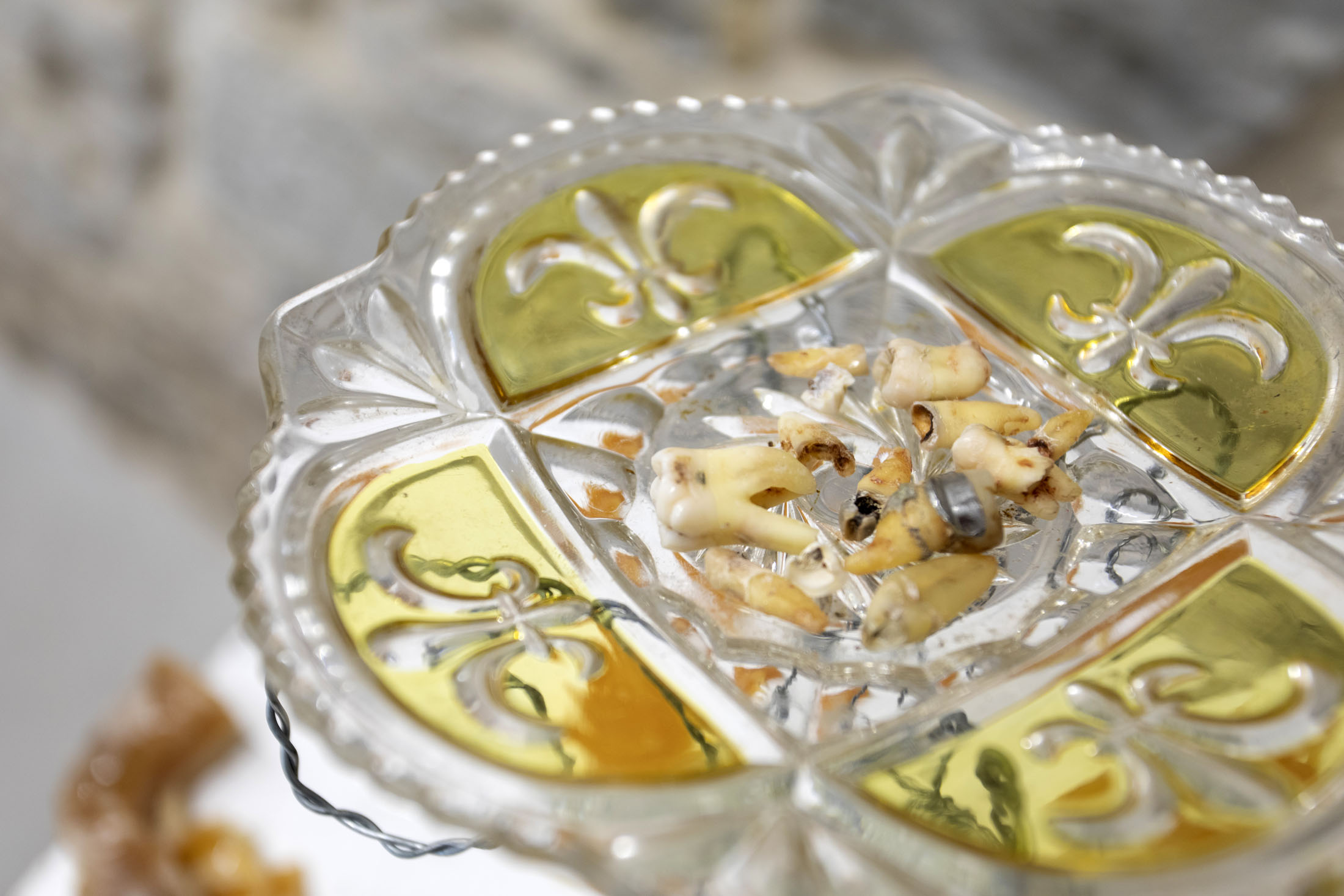
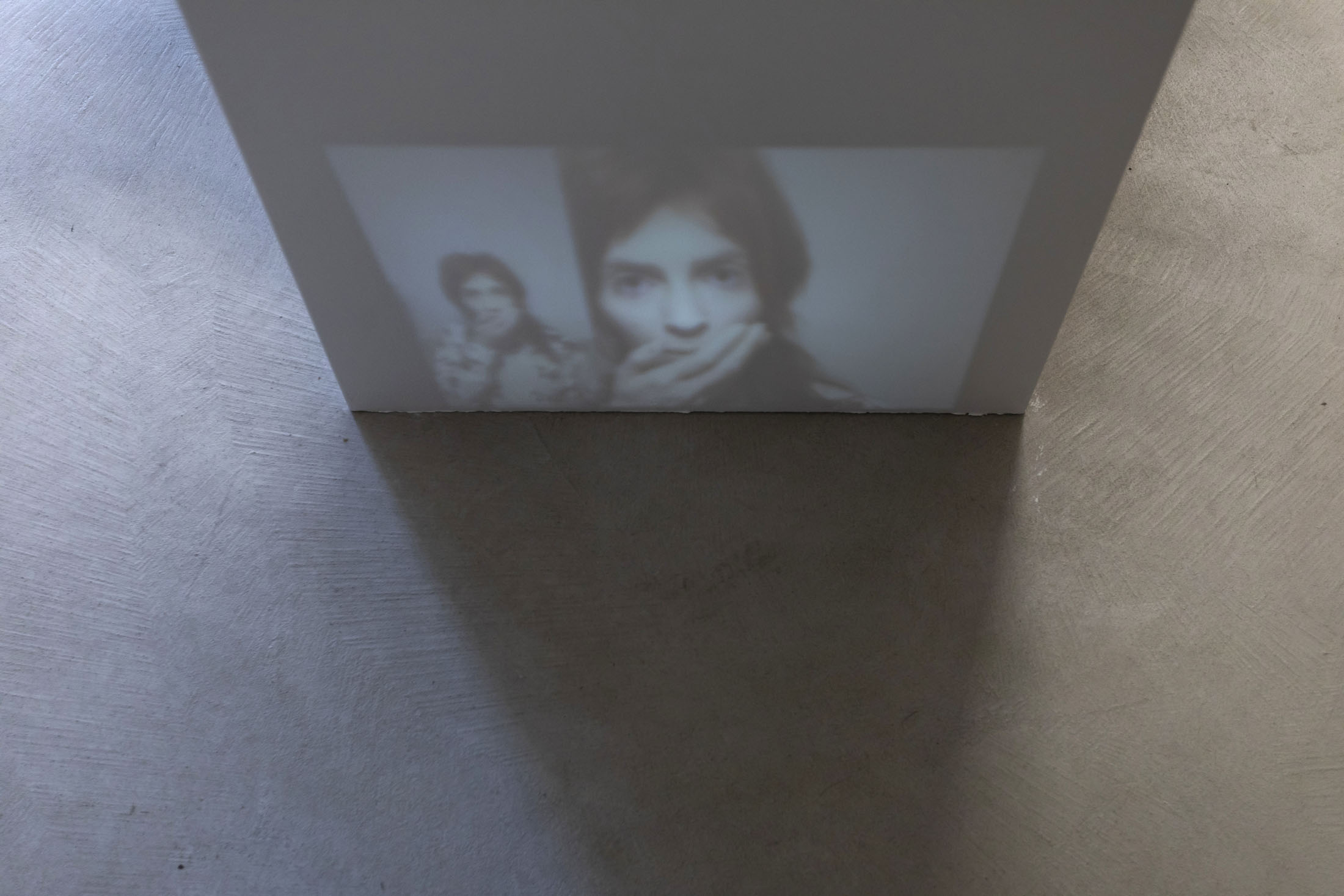
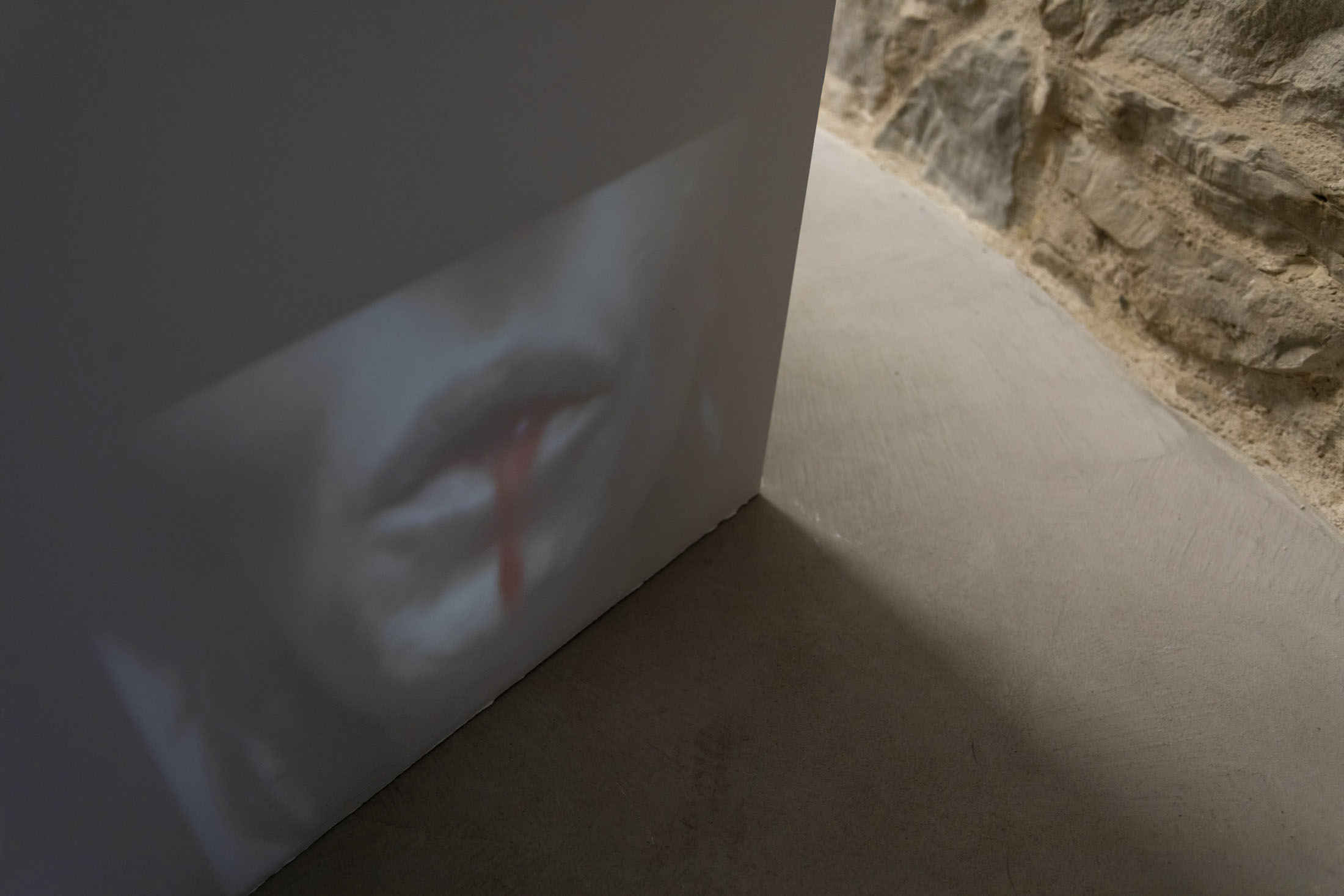
In the small space of Manuš Gallery, the artist stages a scene in which friendly teddy bears – icons of childhood trust – turn into guardian-traitors and mischievous accomplices of the ominous, invisible protagonist. Their softness is no longer neutral; made of polyurethane foam and various sticky substances, their repulsive appearance is ironic and unmistakably dangerous. They guard a pedestal holding objects that appear both fragile and threatening: weapons made of sugar, a material that symbolizes sweetness but, under the pressure of a hand, reveals its potential for harm. Nearby, collected teeth are displayed like a forensic inventory, a catalog of what was once alive, organic, part of a body, now functioning as evidence of an unspoken, unknowable, painful history. This forensic aspect of the installation creates psychological tension: the space the viewer enters seems to hold the echoes of suppressed screams that have long since become tangible, evident, almost documentary. This psychophysical register of discomfort is further intensified by video footage of teeth, cast from the same sugary material, being spat out. This act, artificial and visceral at once, amplifies the sense of unease. The video functions as a micro-performance of internal erosion, a visualization of the moment when fantasy sheds its protective shell to expose its underlying vulnerability. It also introduces a somatic inversion, presenting a body that communicates through its own disintegration, through expulsion, through symptom rather than language. Thus, the fantastical register of the story is refracted through the materiality of the oral cavity – a site where both language and pain are formed.
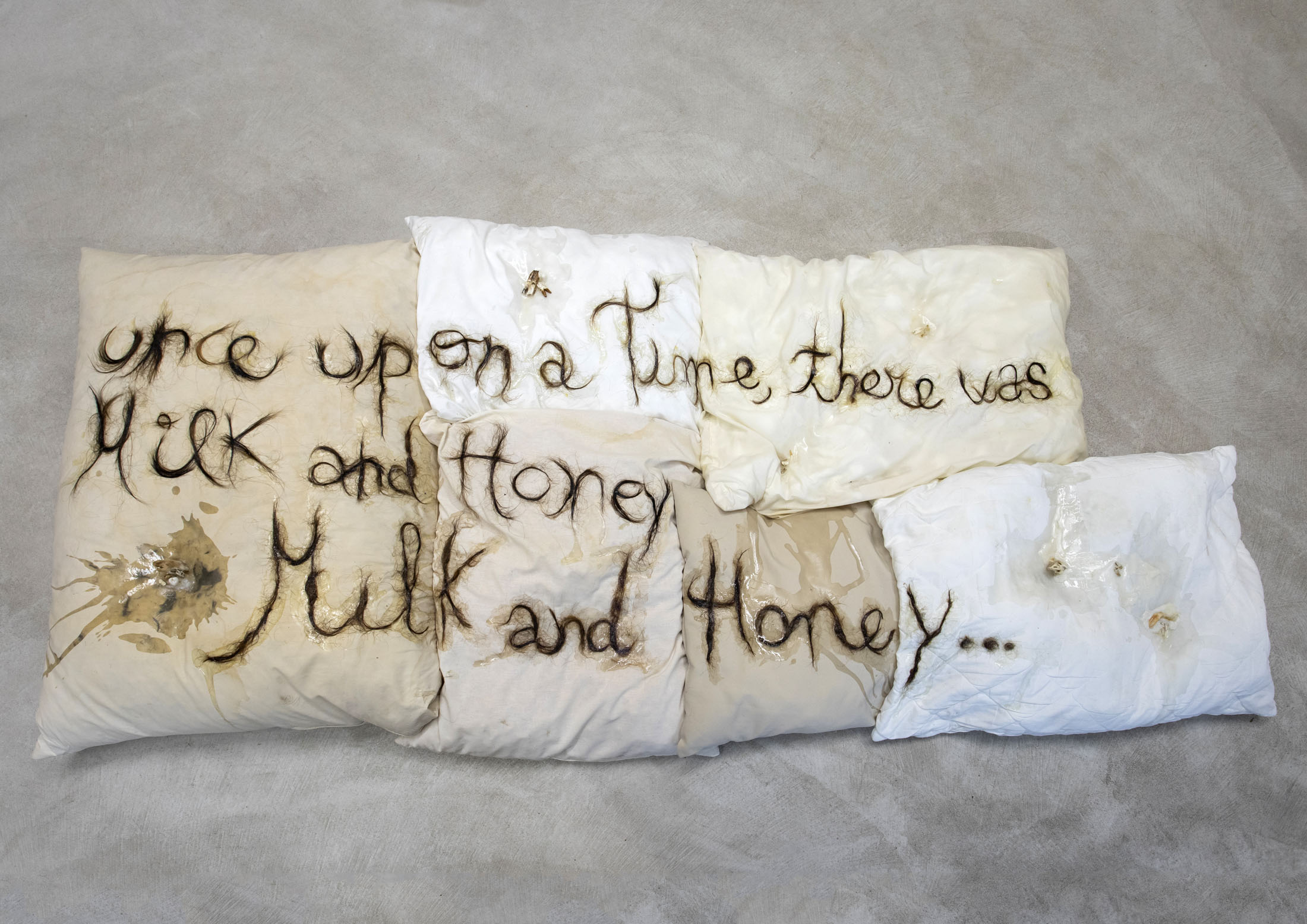
The materiality of the installation extends to its textile elements as well. Pillows, visibly worn, bear traces of prolonged use and bodily intimacy. On them, the opening sentence of the story – Once upon a time, there was Milk and Honey… – is inscribed not in ink, but with the artist’s own hair, collected over many years. Hair, as an autobiographical material and carrier of genetic information, functions as an index of personal time, loss, and change, while simultaneously serving as a symbolic extension of a body that never appears in the work yet is continuously invoked. Writing with hair recalls a lineage of women artists who have employed the body, or its remnants, as vessels of meaning – a quiet but powerful feminist gesture. Pillows and hair blend into a hybrid of the bodily and the narrative, a site where material and affective histories converge. The pillows also introduce an undercurrent of discomfort – an aversion to uncleanliness, to matter that retains the memory of breath, sweat, dreams, or anxiety. Their worn surfaces are not aesthetic flaws but a deliberately exposed tragedy of intimacy, its shadowy and unglamorous side. Combined with the hair and teeth – materials that anthropologists might describe as biographical remains or fragments of bodily archaeology – the installation takes on the character of an internal archive. These materials, once belonging to a living body, are now extracted and displayed as evidence of physical and psychological processes, as inanimate witnesses to what the body has experienced, endured, or repressed. This interplay of intimacy and revulsion, of the abject and the affective, heightens the psychological tension of the show, causing the entire mise-en-scène to breathe with the unease of a place where childhood, as already noted, appears not only as a realm of play but also as the cradle of future fractures, fears, and defensive mechanisms. Indeed, every element in the compact gallery space can be read as a stage prop of an absent performance, traces of an implied act of discomfort that has already occurred or will soon continue.
In this sense, Under the Pillow may be seen as the stage for an absent player, a meticulously constructed environment awaiting the potential performance of an invisible protagonist. Although the Tooth Fairy never enters the field of vision, her energy, actions, and ambivalent logic scaffold the installation’s entire structure. What is hidden (beneath the pillow) becomes visible; what is private becomes public; what is childish becomes profoundly adult. Nardini not only reconstructs the space from which the fairy operates, but also transforms it, shifting it from a site of gift-giving to one of metamorphosis – from sweetness to subversion.
The exhibition thus speaks not only of childhood, but of growing up as a process of reinterpreting myths, of re-encountering figures that shaped the imagination but now appear in a darker and more complex light. In a sense it enacts a subtle perversion of the fairy tale, a genre that offers comfort in childhood, but in adulthood becomes a site of confrontation with fears that never disappeared but merely changed shape. What was once sweet now becomes a weapon; what was gentle becomes strategy; what was hidden is now performatively revealed. This reversal is the central point of the exhibition – the ability to transform everyday objects and traces of biological life into metaphors of inner struggle, and children’s stories into a field of aesthetic and psychological resistance. After all, nothing in childhood is ever entirely innocent.
–Dalibor Prančević
Marianna Nardini graduated at the Academy of Fine Arts in Zagreb. Her work is focused on an investigative approach with a thematic emphasis on ontological, metaphysical, marginal, ambiguous and humorously grotesque areas. She has exhibited her work in a number of solo (“From dust ’till dawn”, Dom Mladih, Split, ¨SHUT-IN¨, KUĆĆA, Zagreb, “This empty space without me is my home¨ GMK, Zagreb, “Don’t kill the grasshopper”, Apoteka, Vodnjan and KUĆĆA) and group exhibitions (“Creeps and butterflies”, Organ Vida, MSU, Zagreb, “37th and 36. Salon of Youth”, HDLU, Zagreb, 63rd Poreč Annale, ¨They told me that the planet has nerve endings¨, Istarska Sabornica, ”Voyeurism”, Galerija Siva, Zagreb).