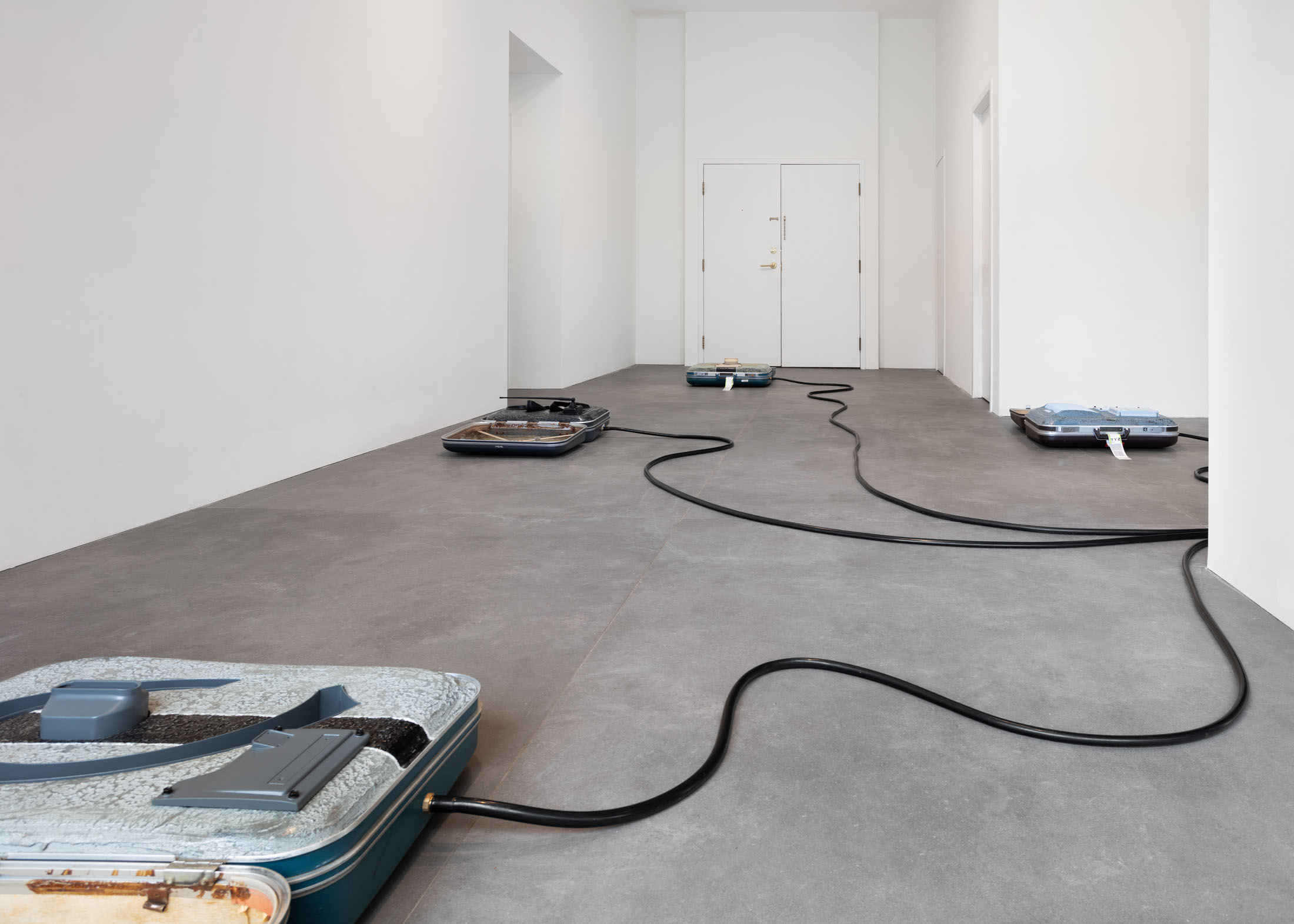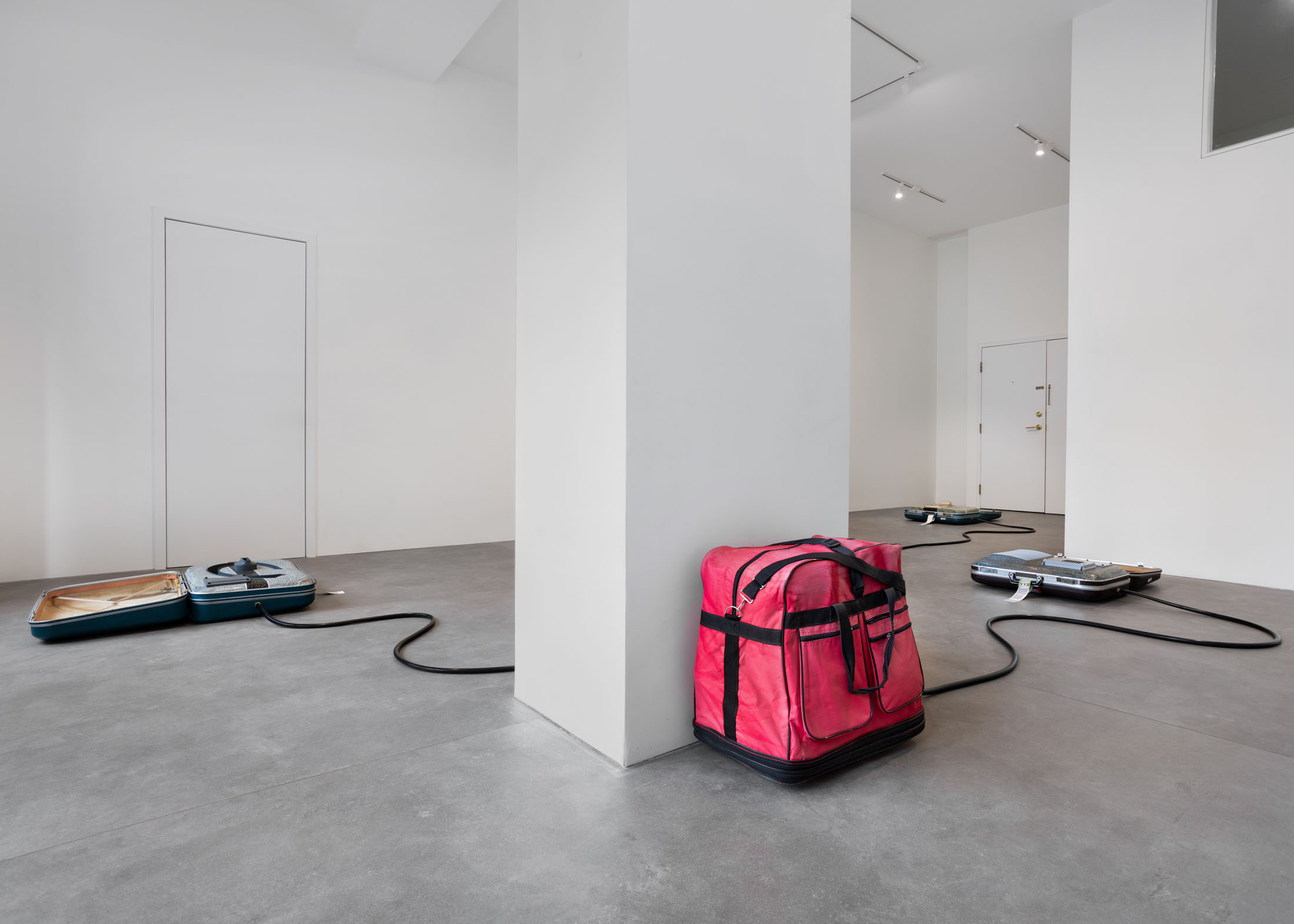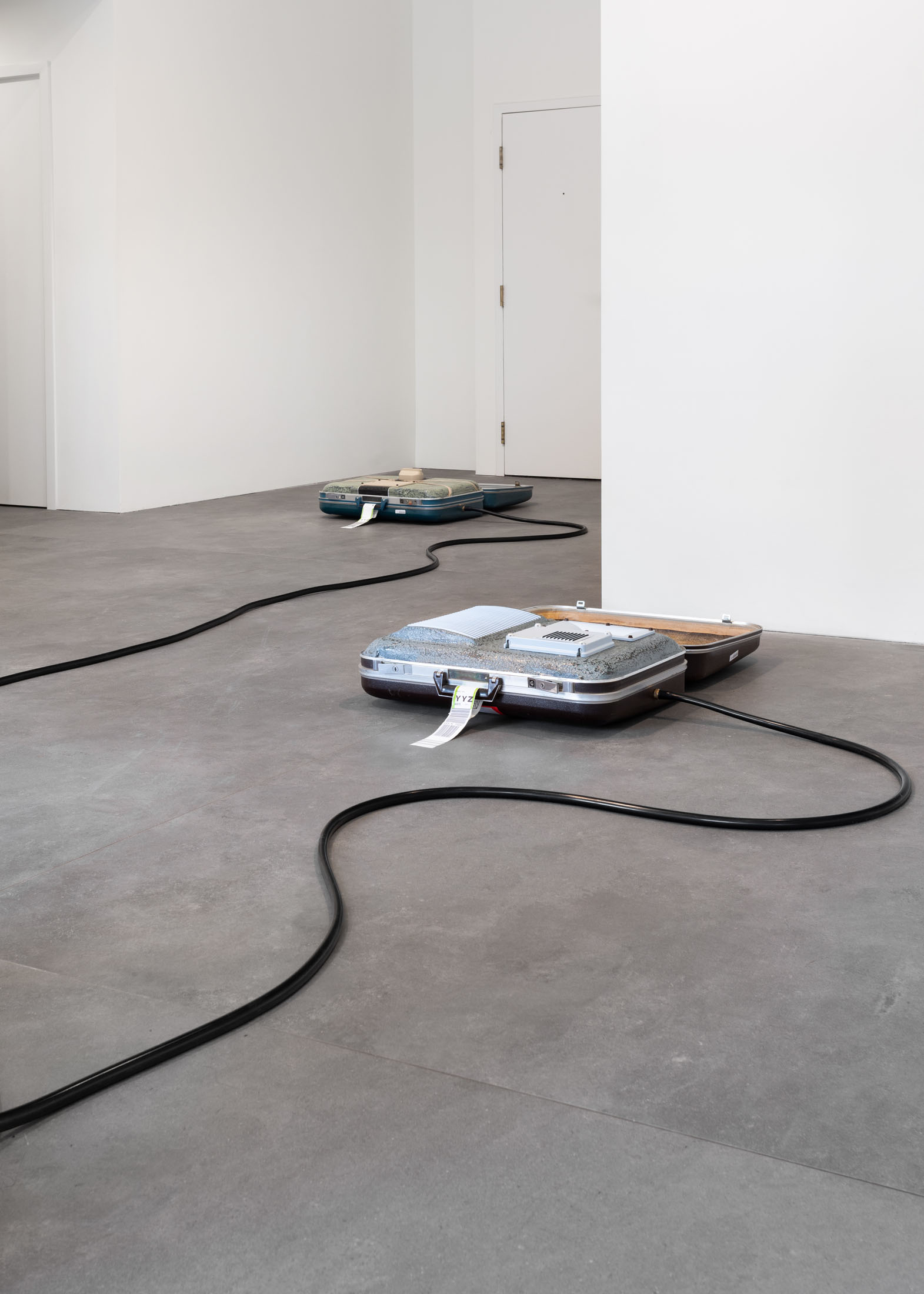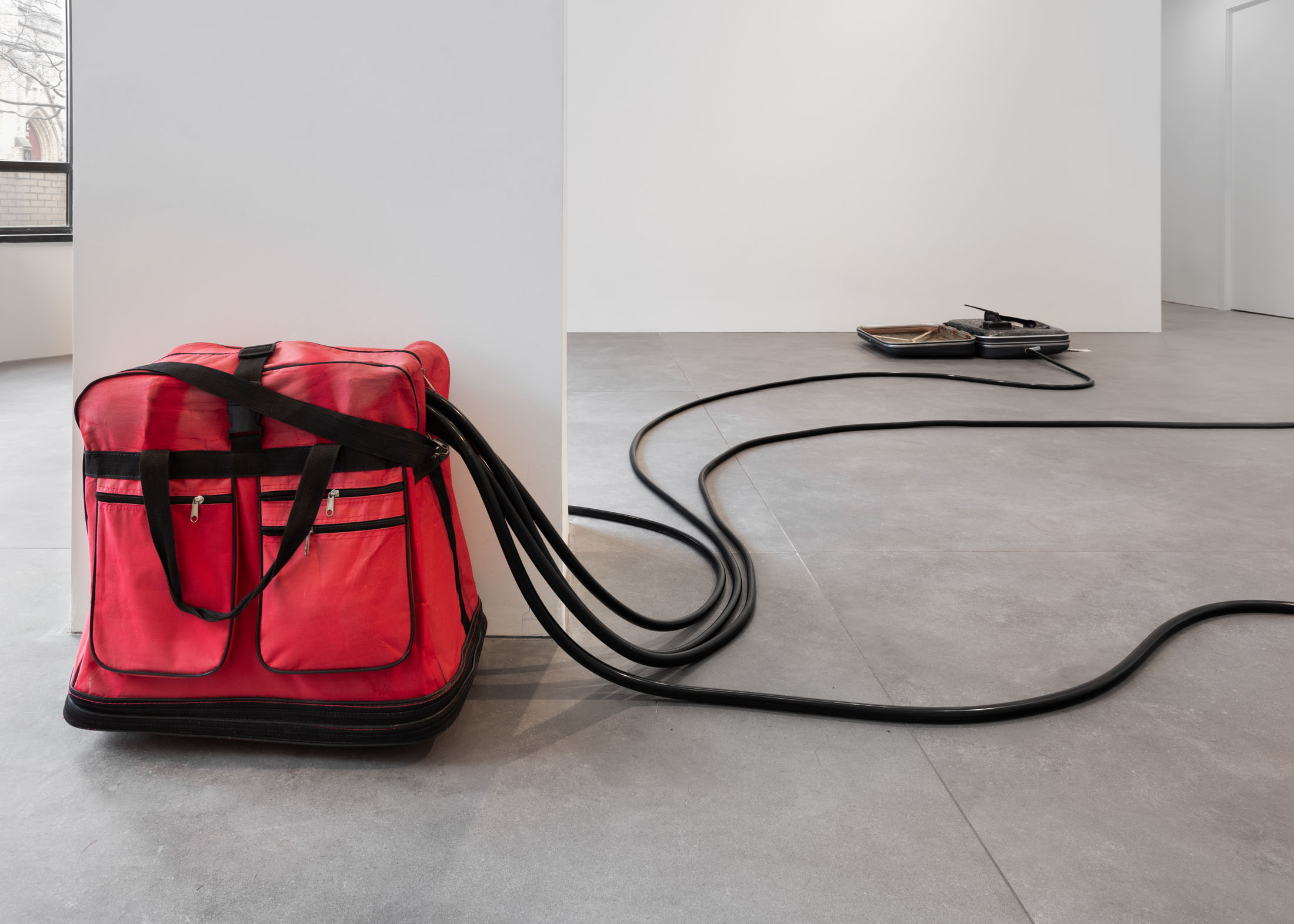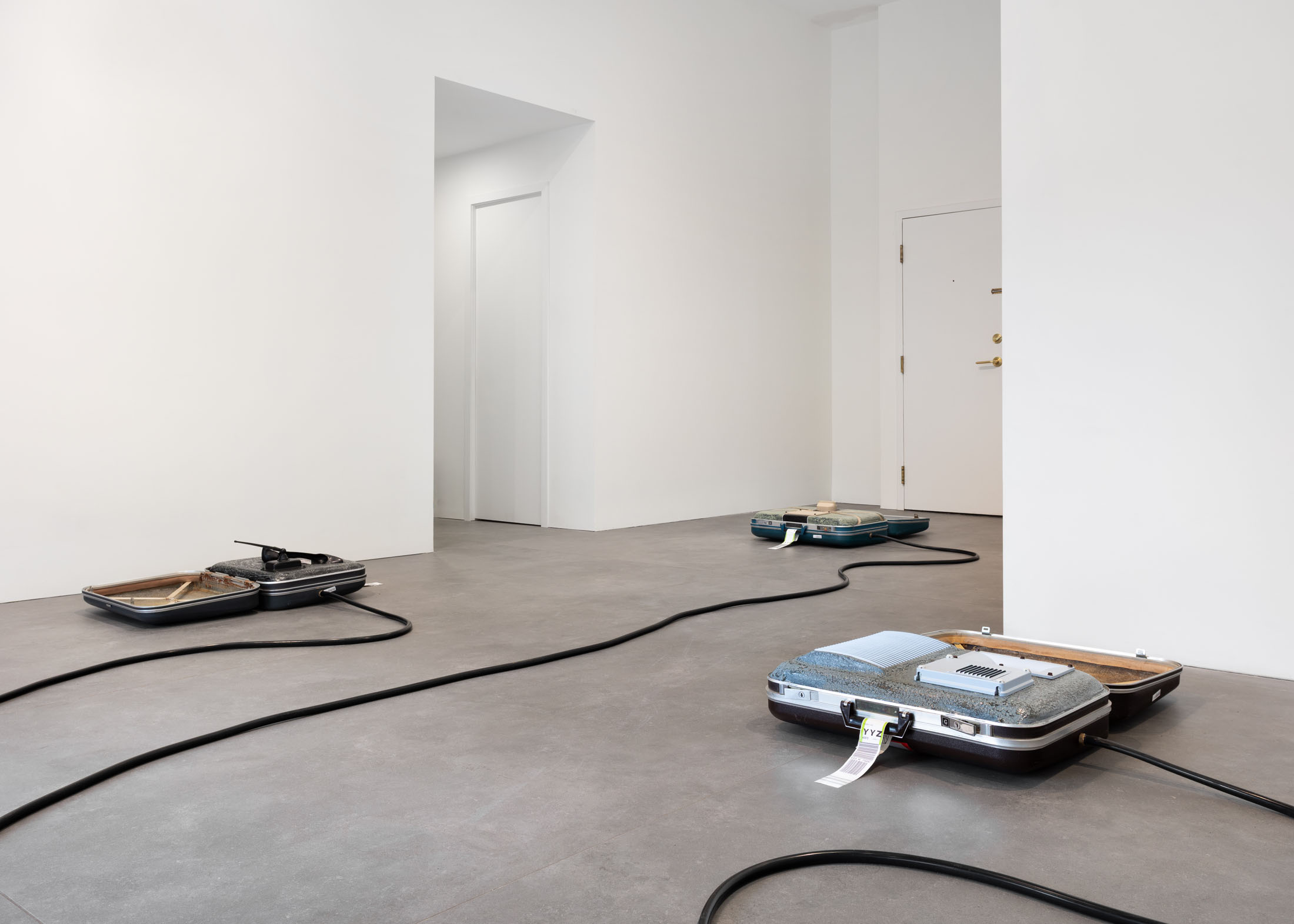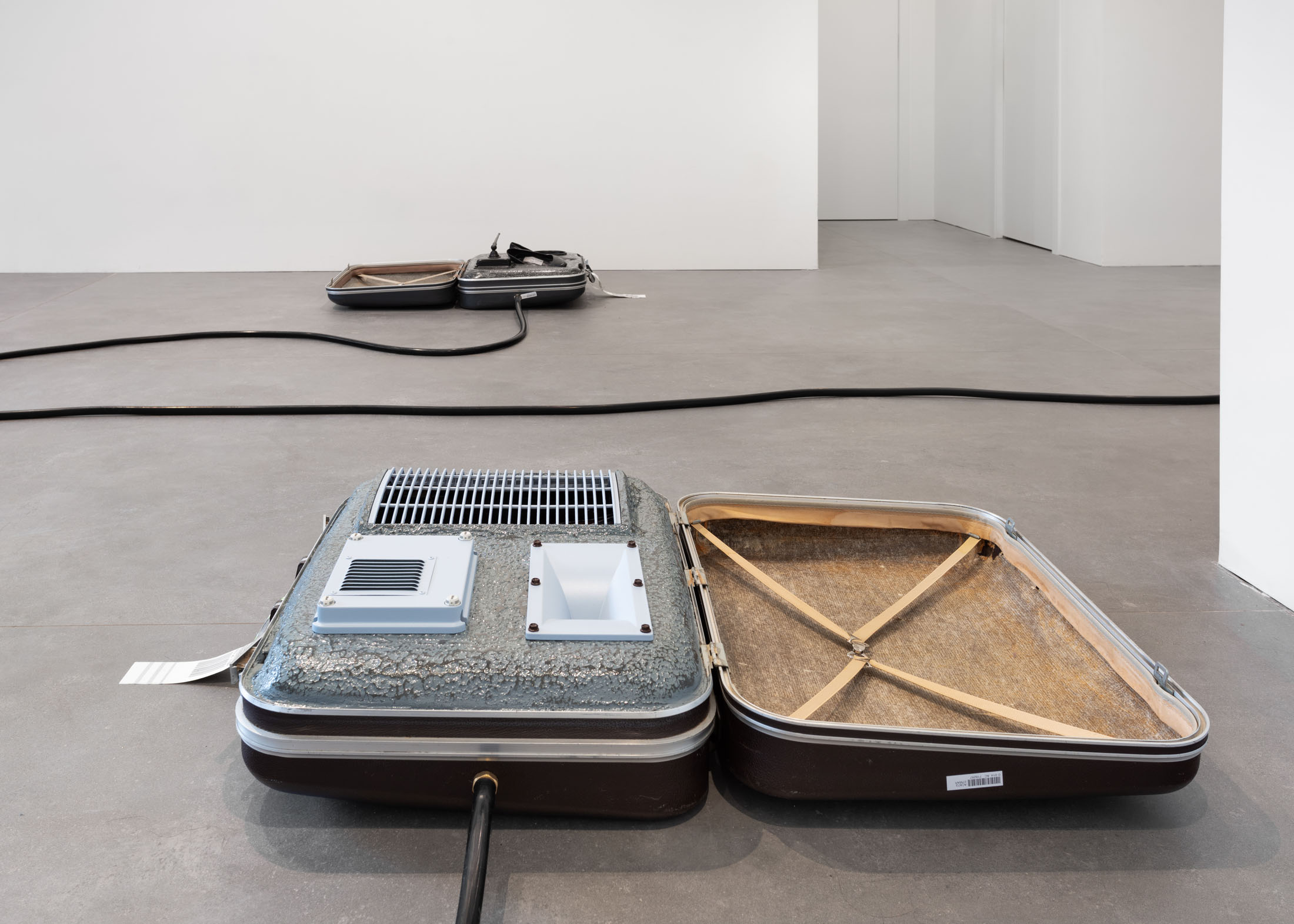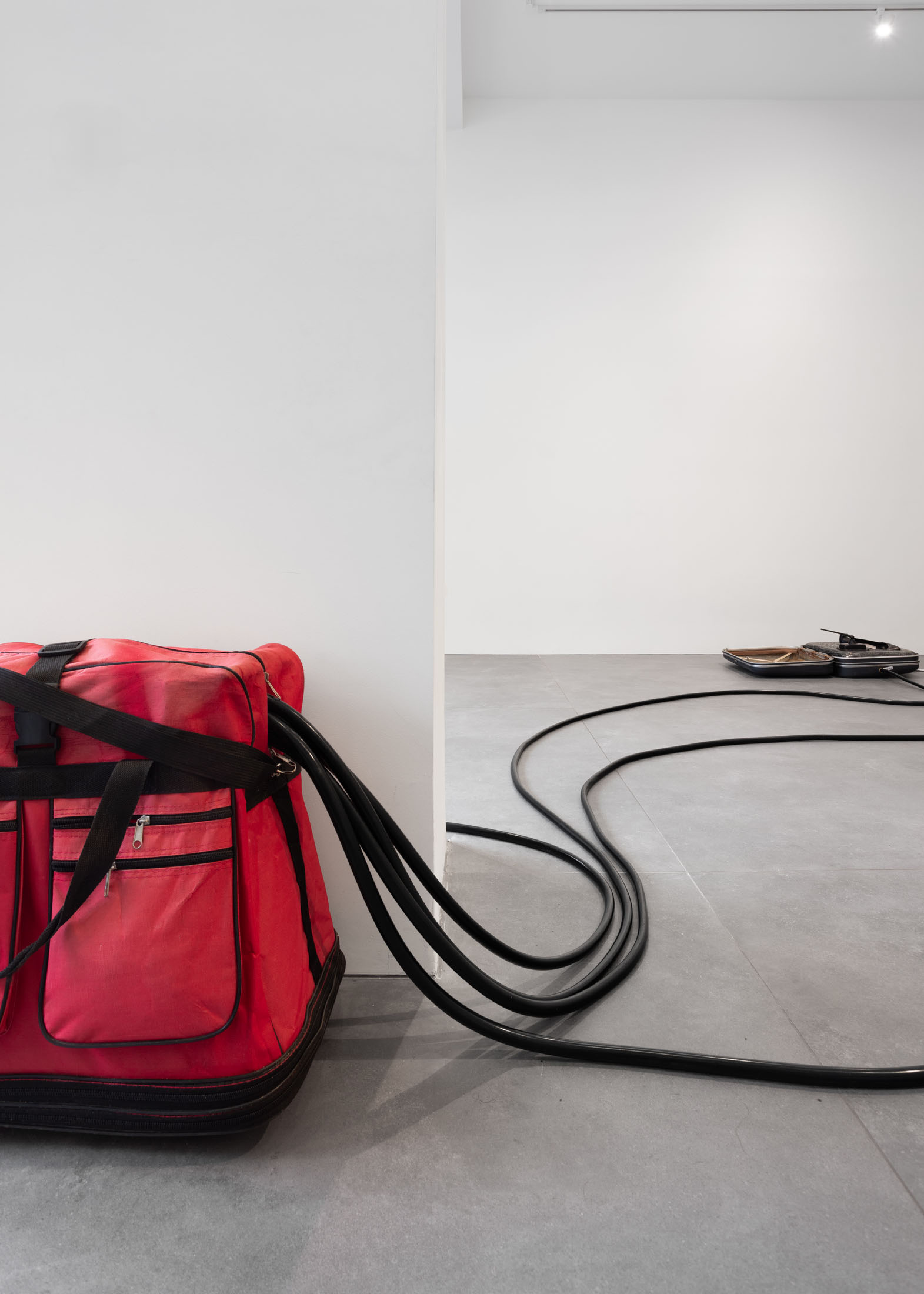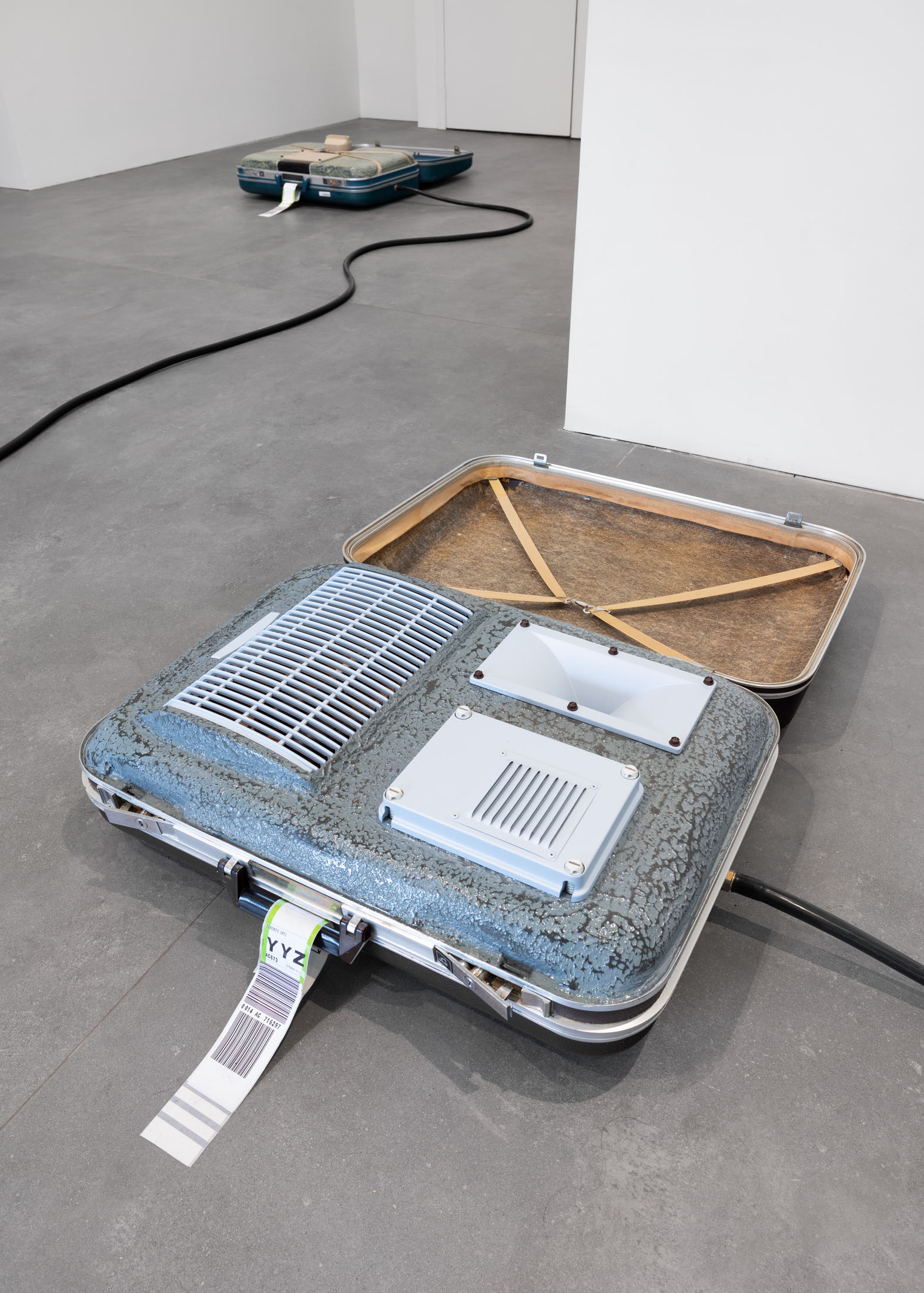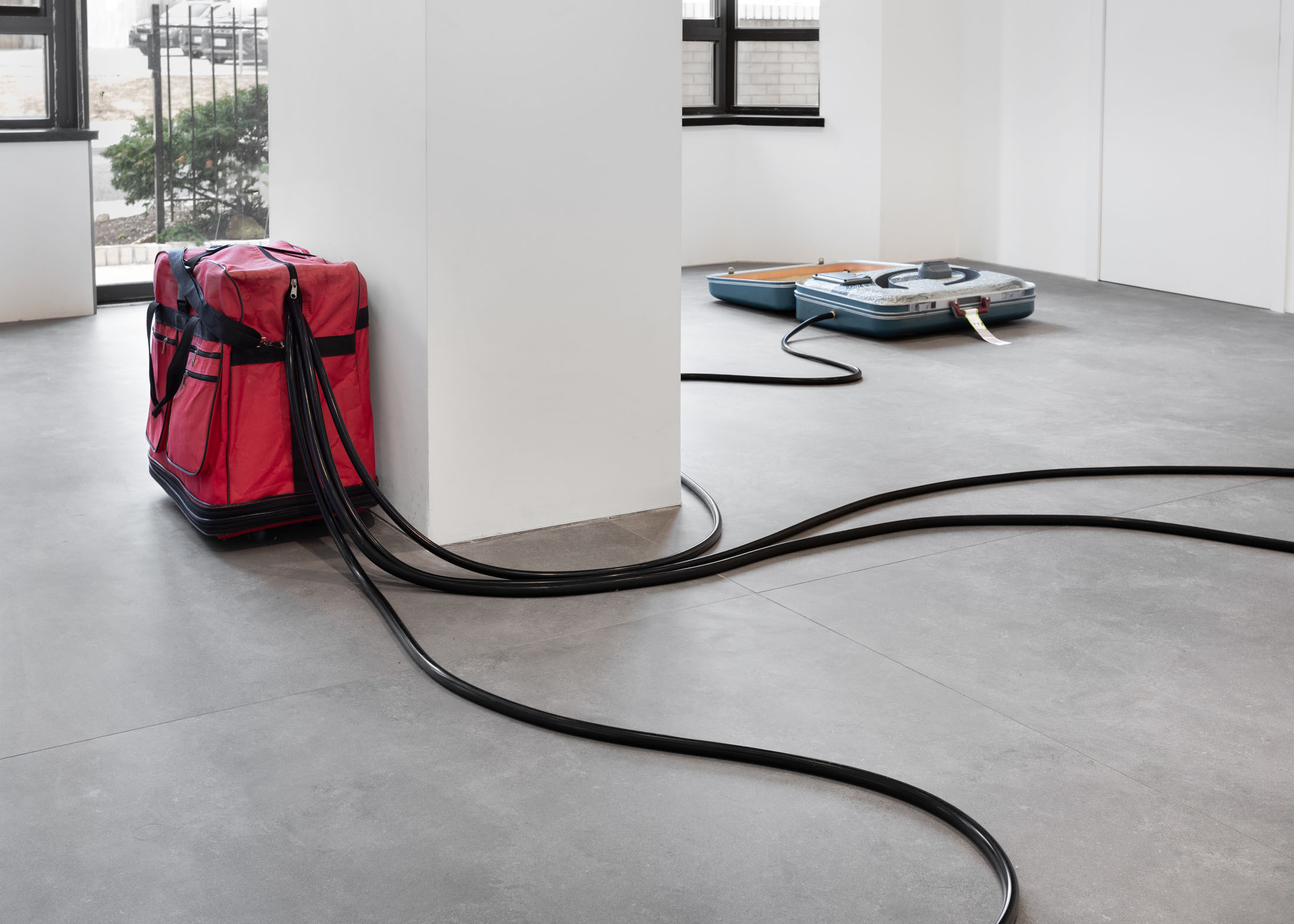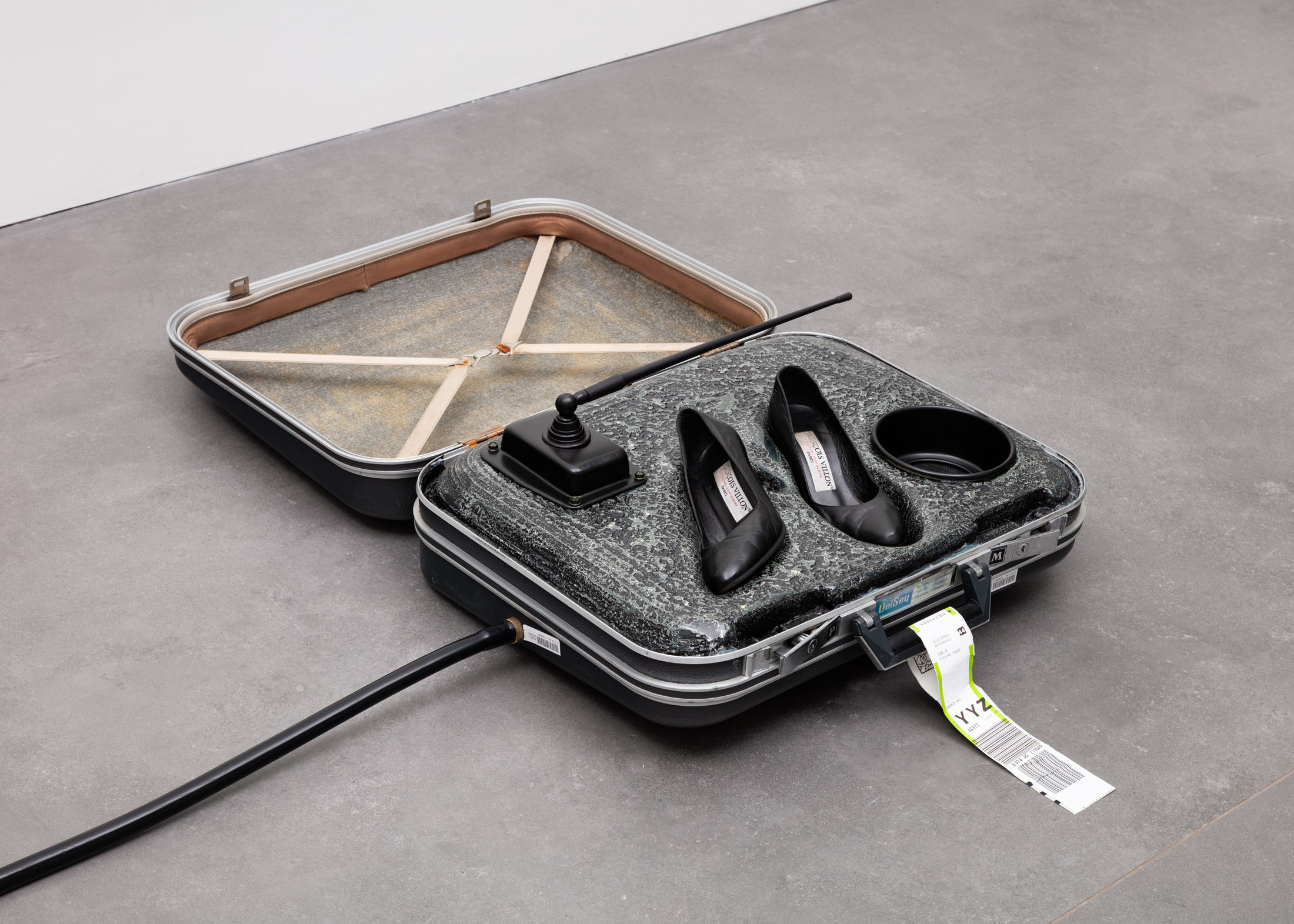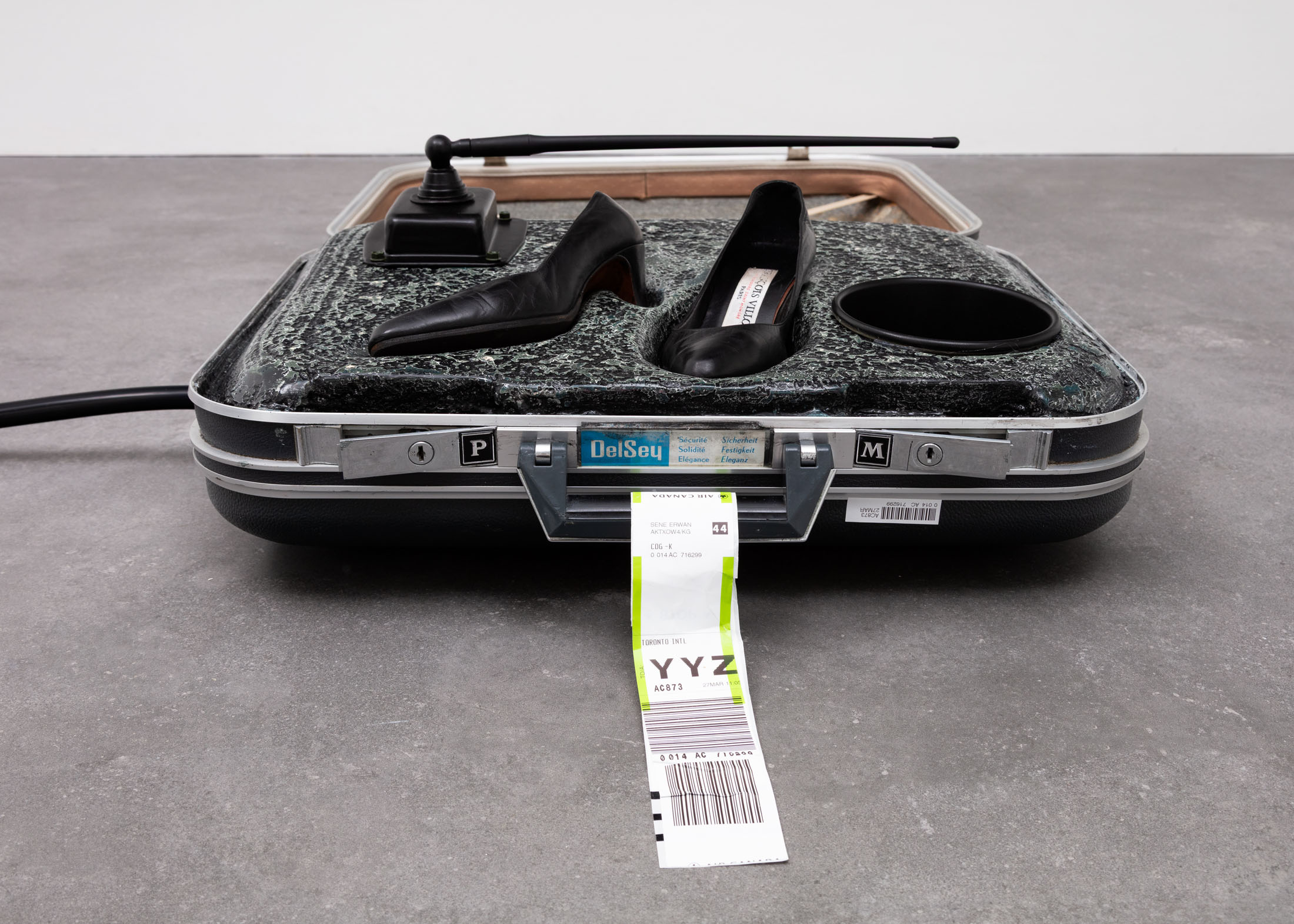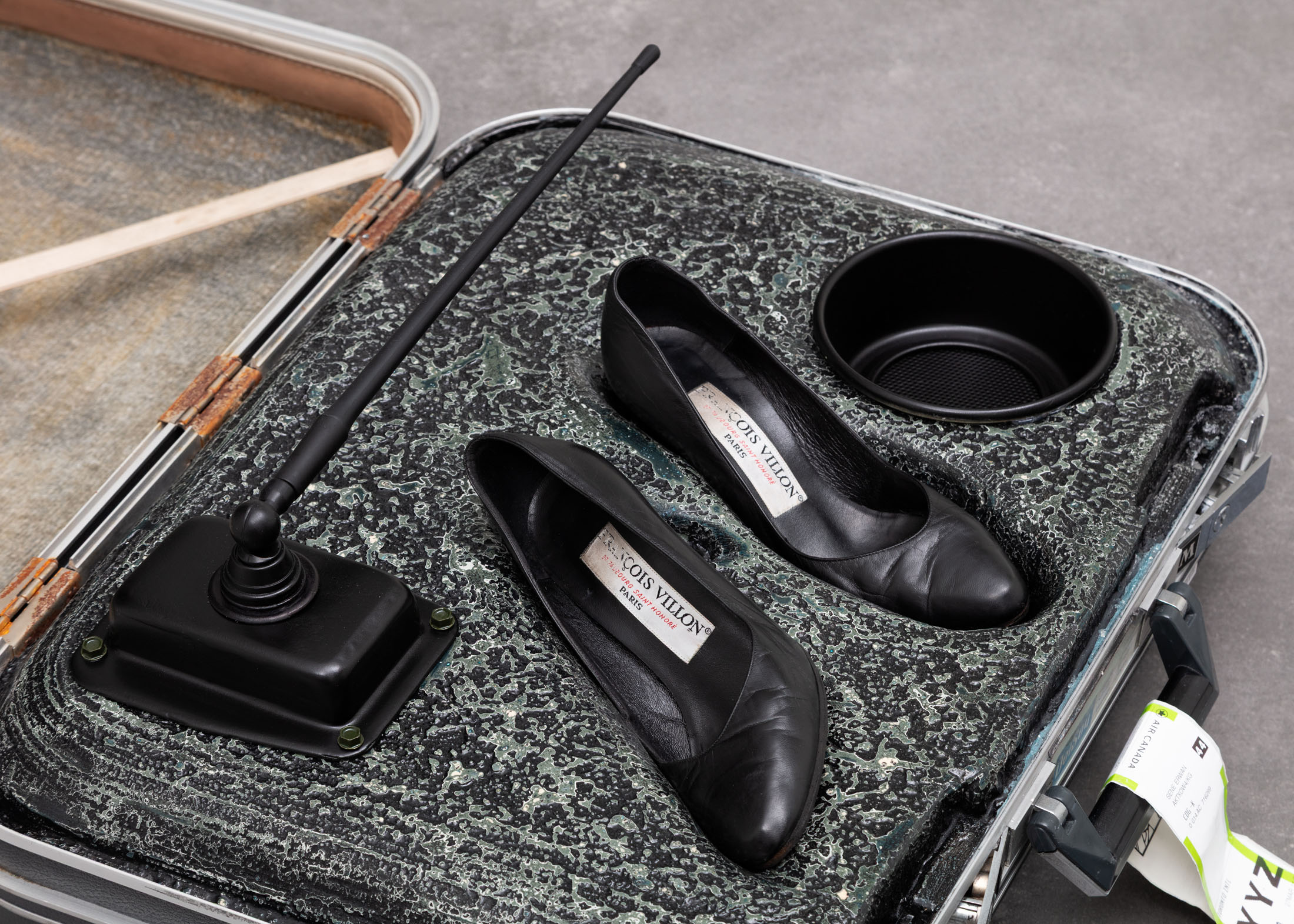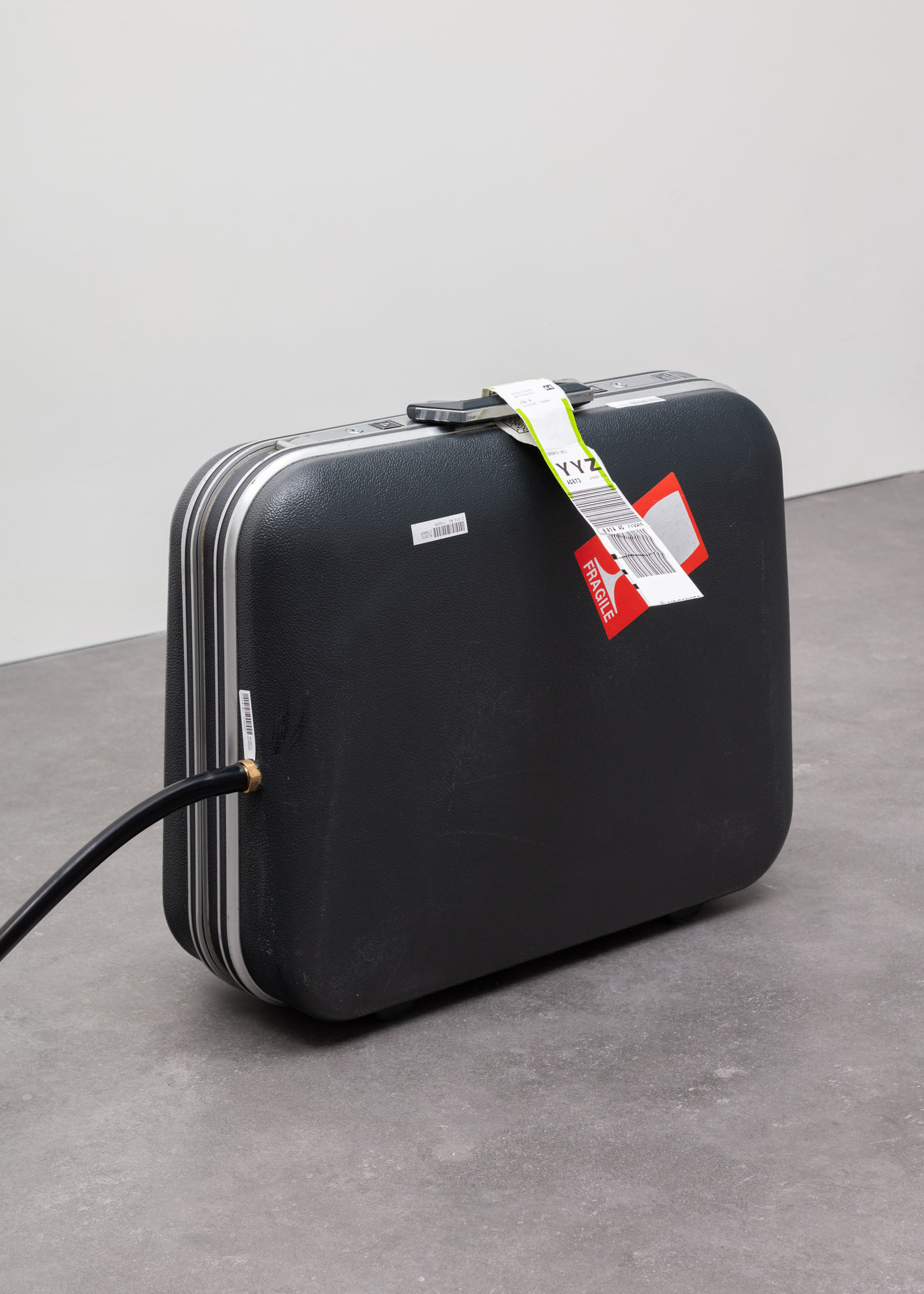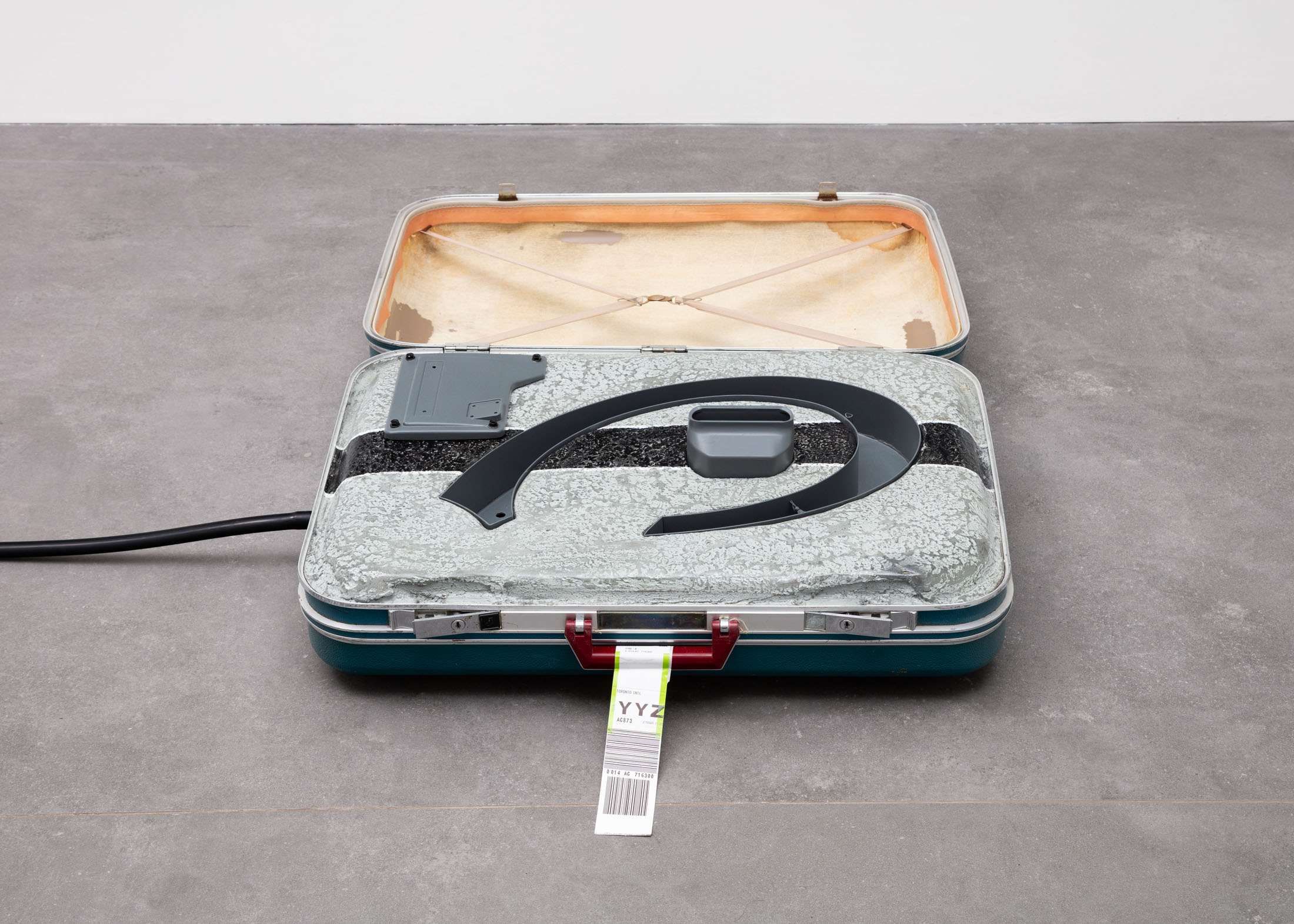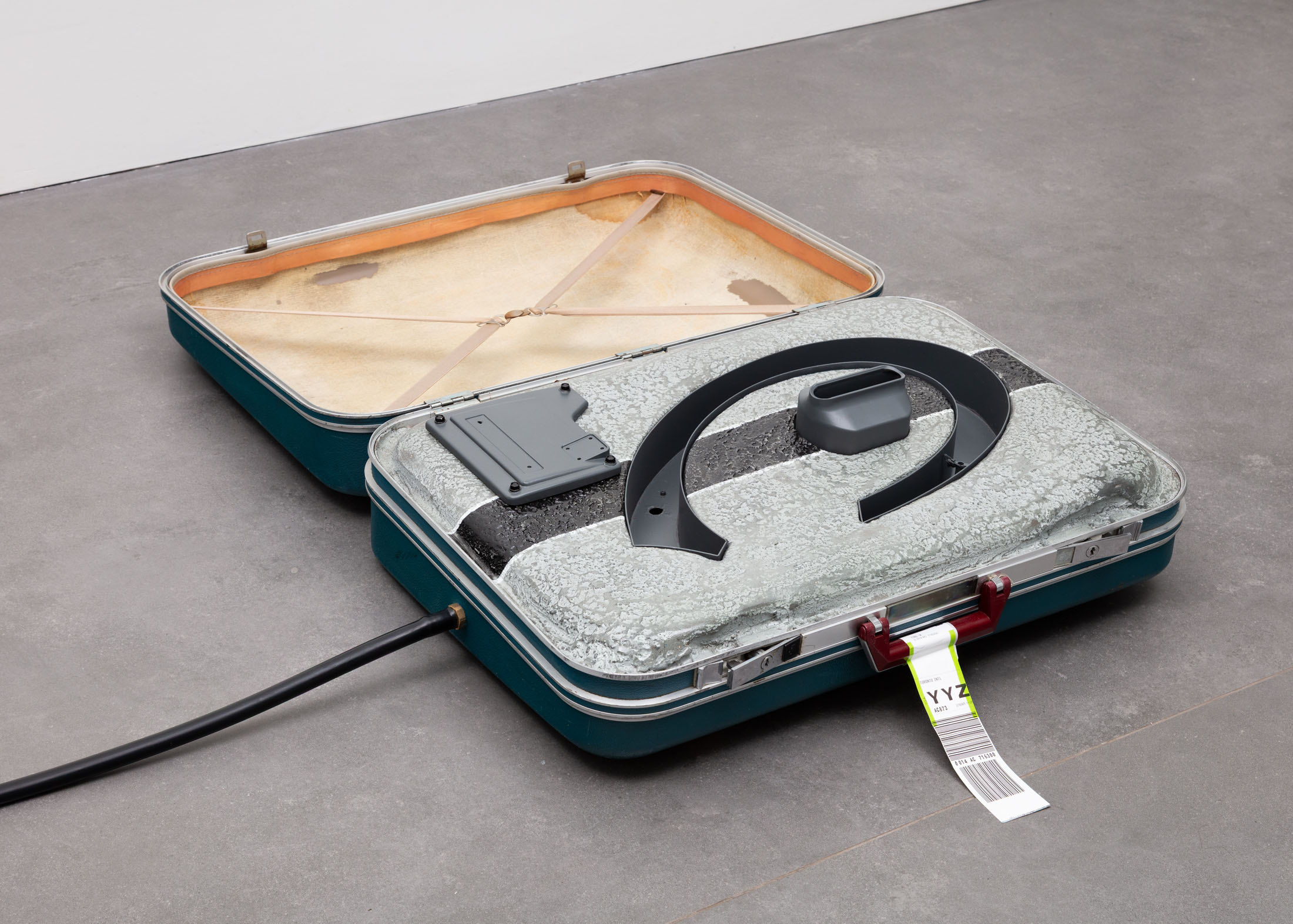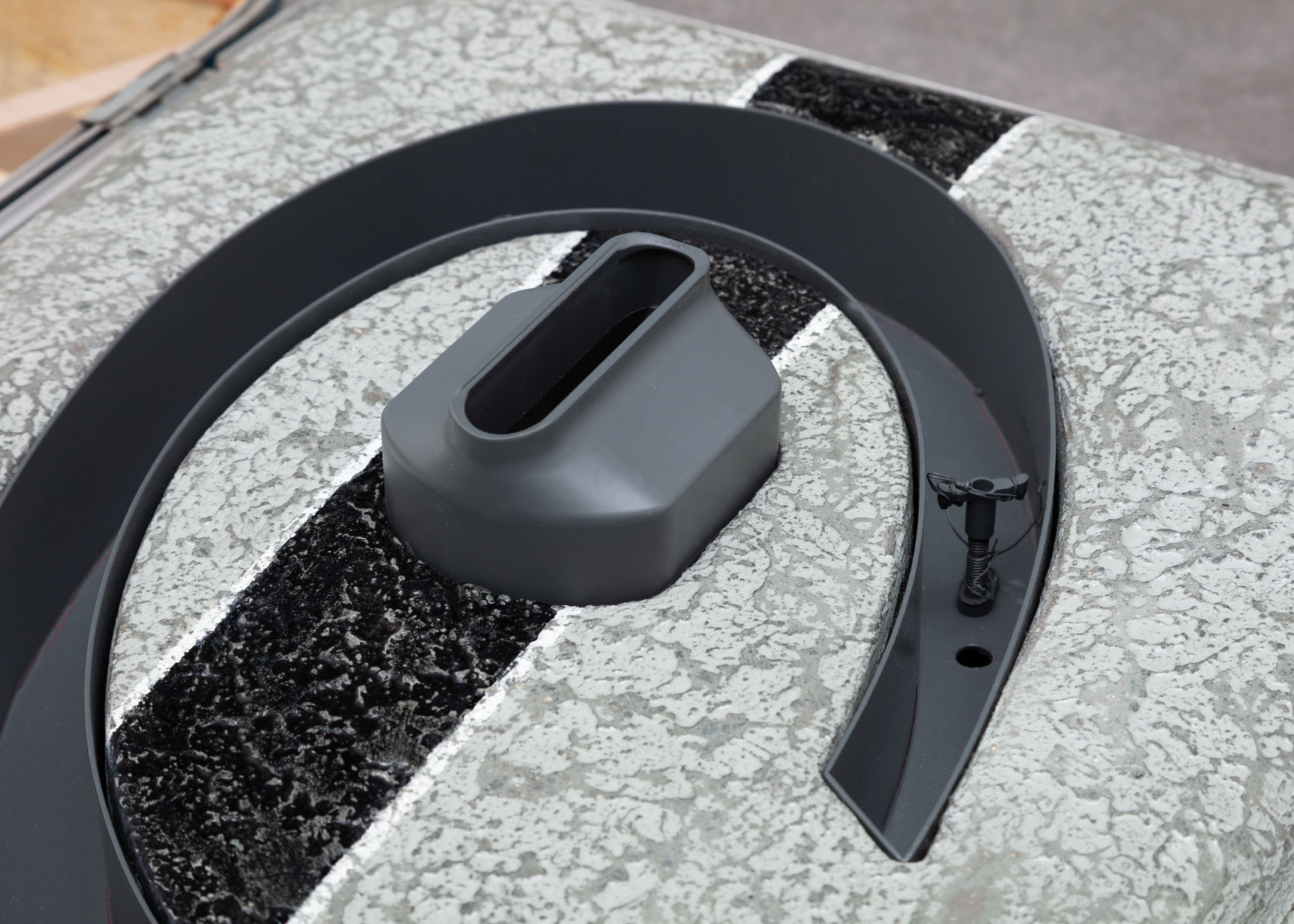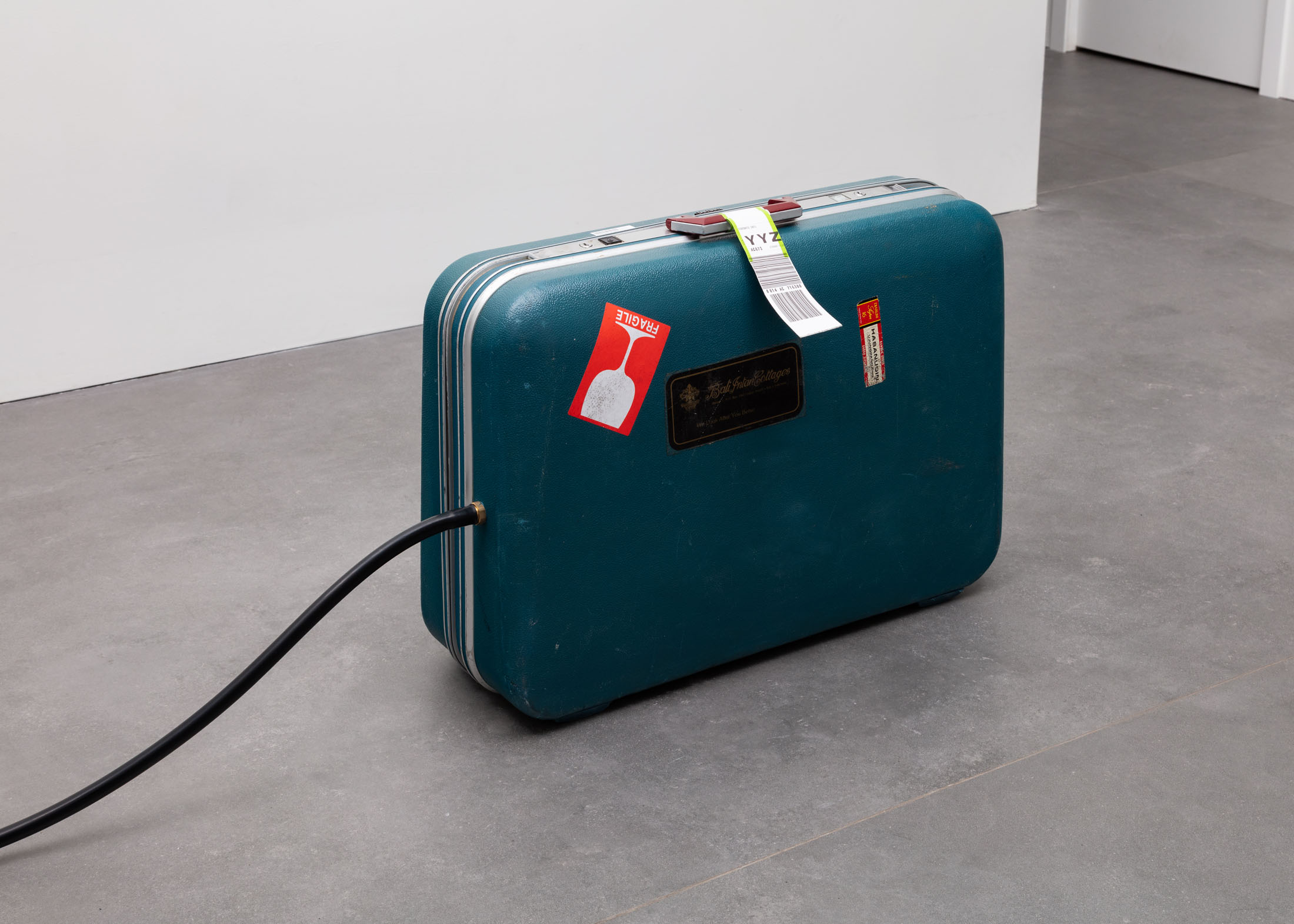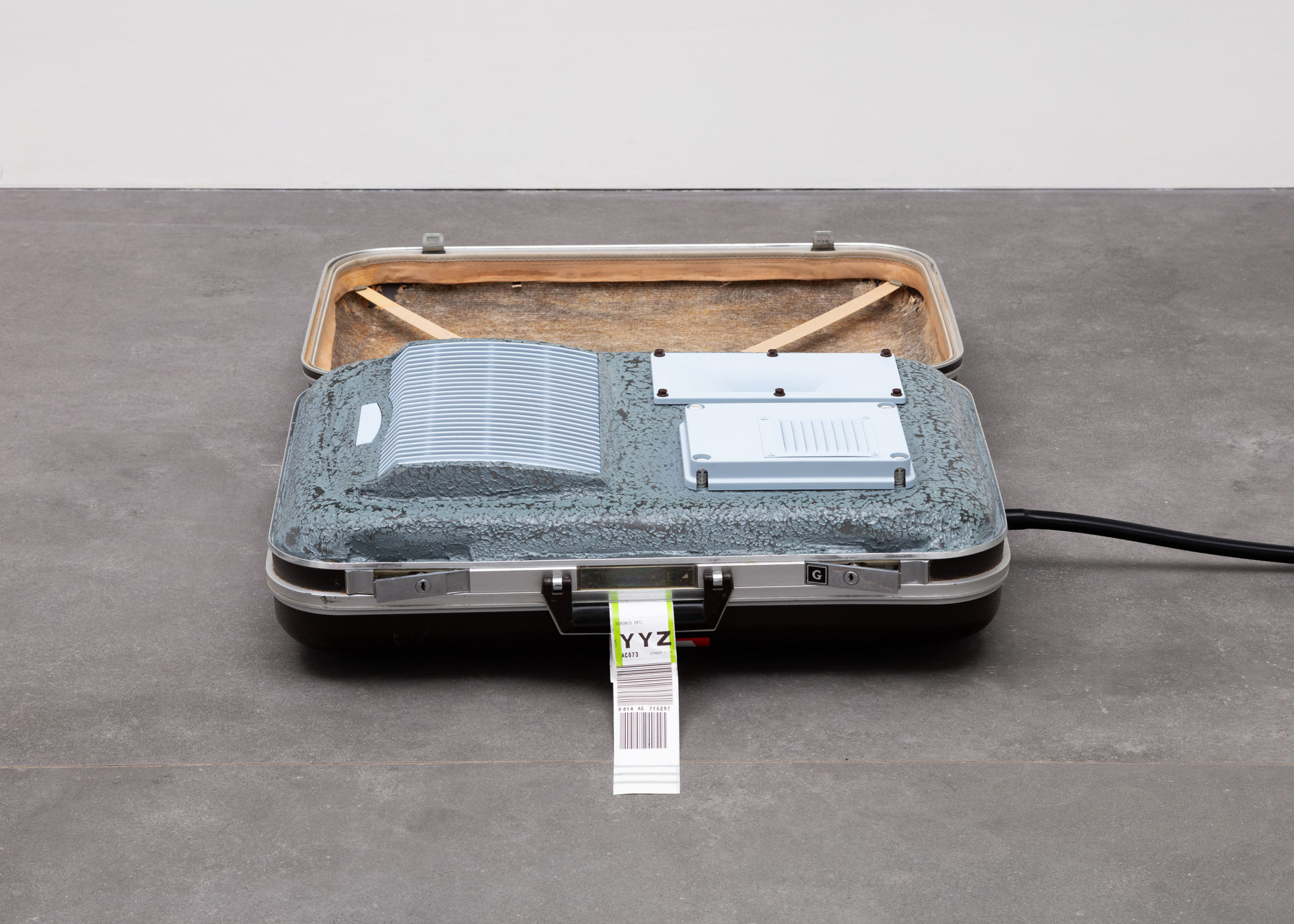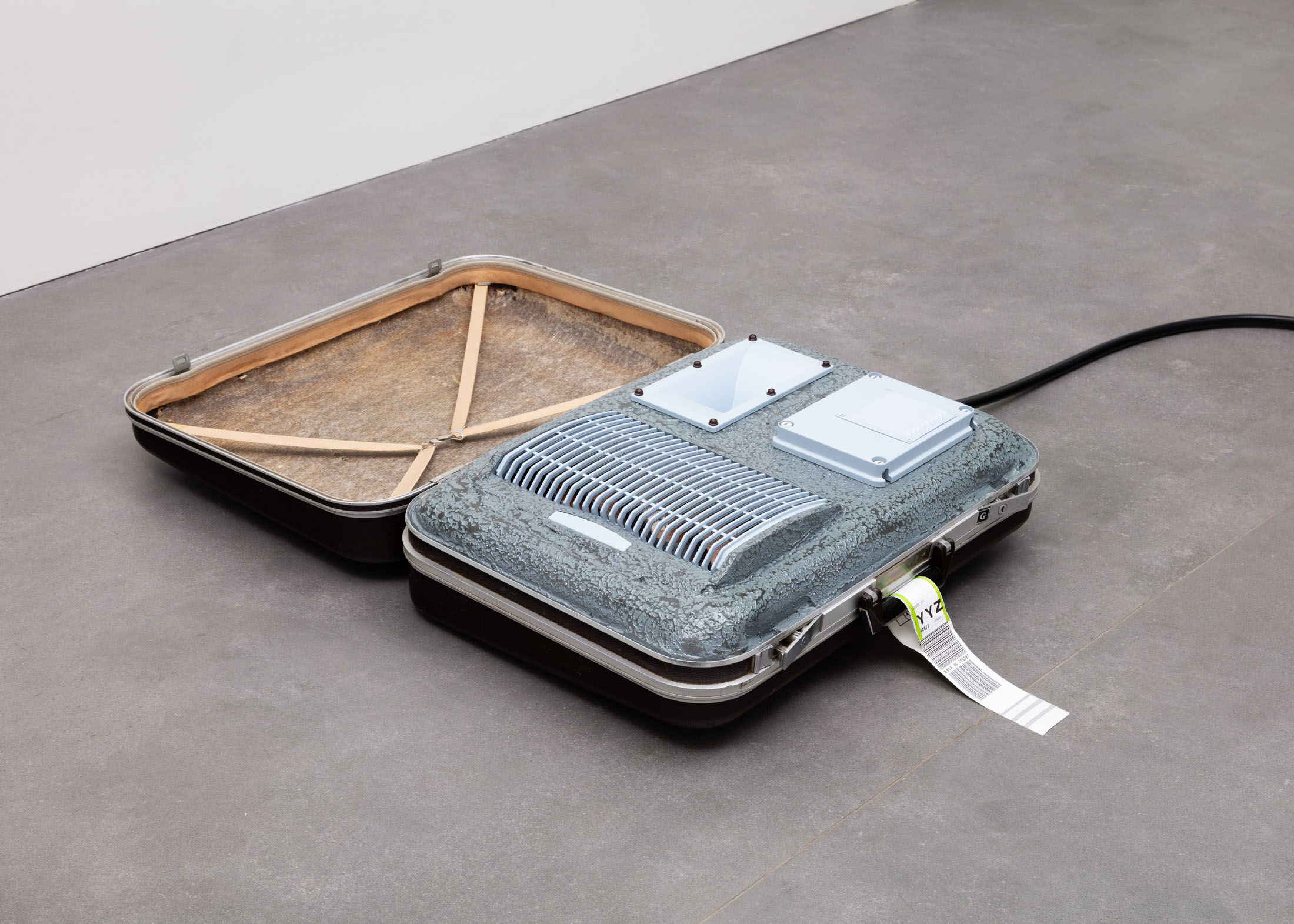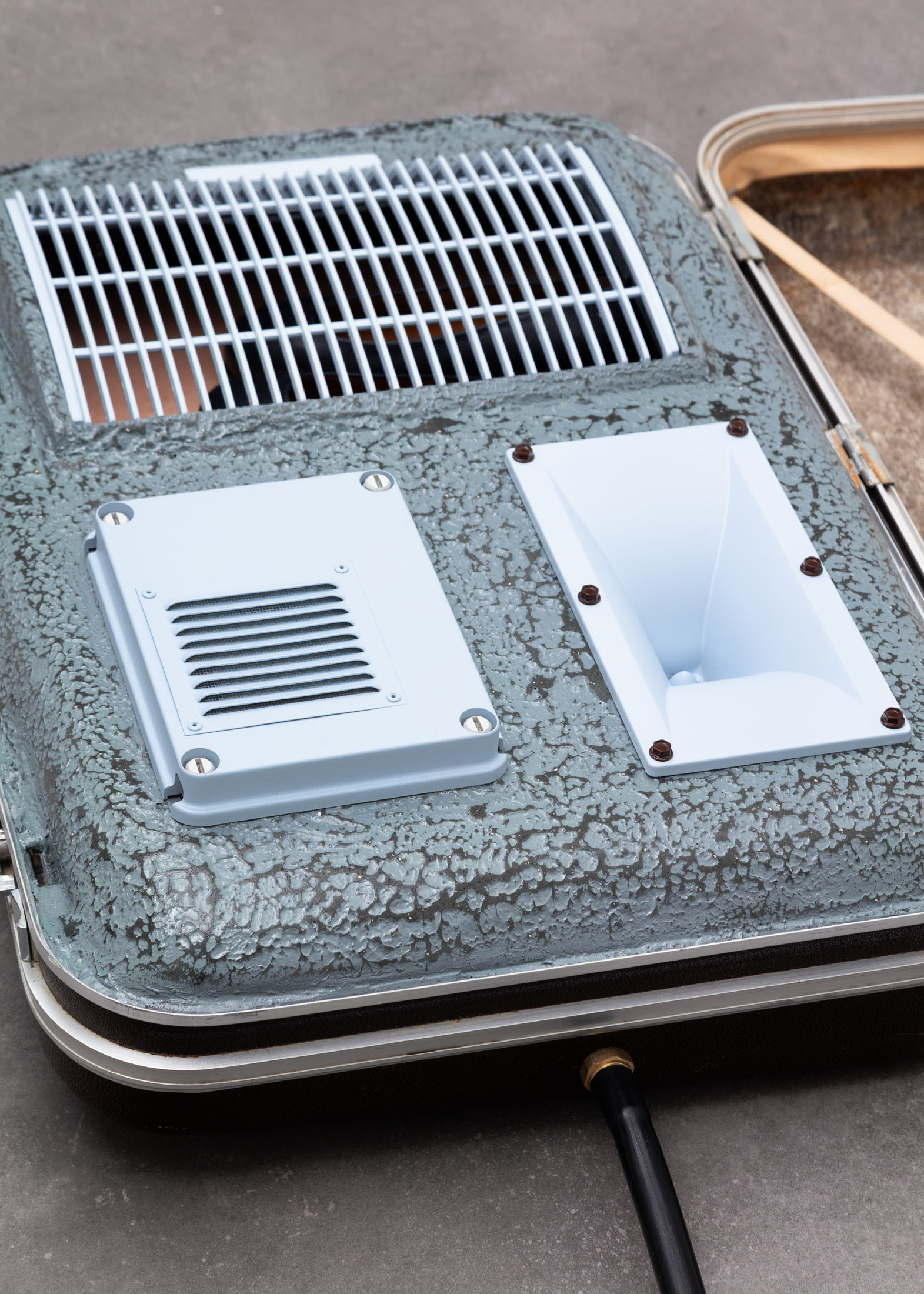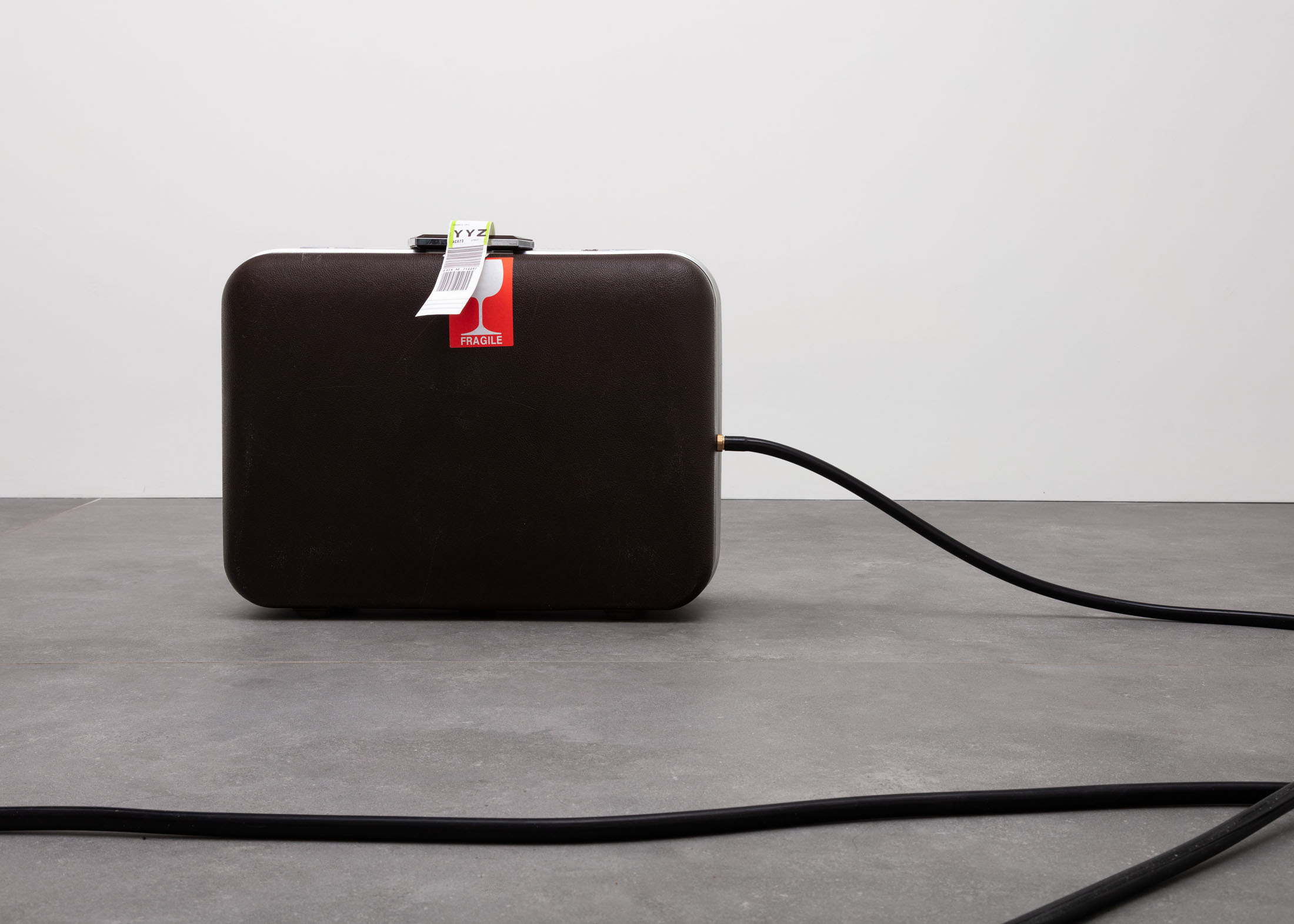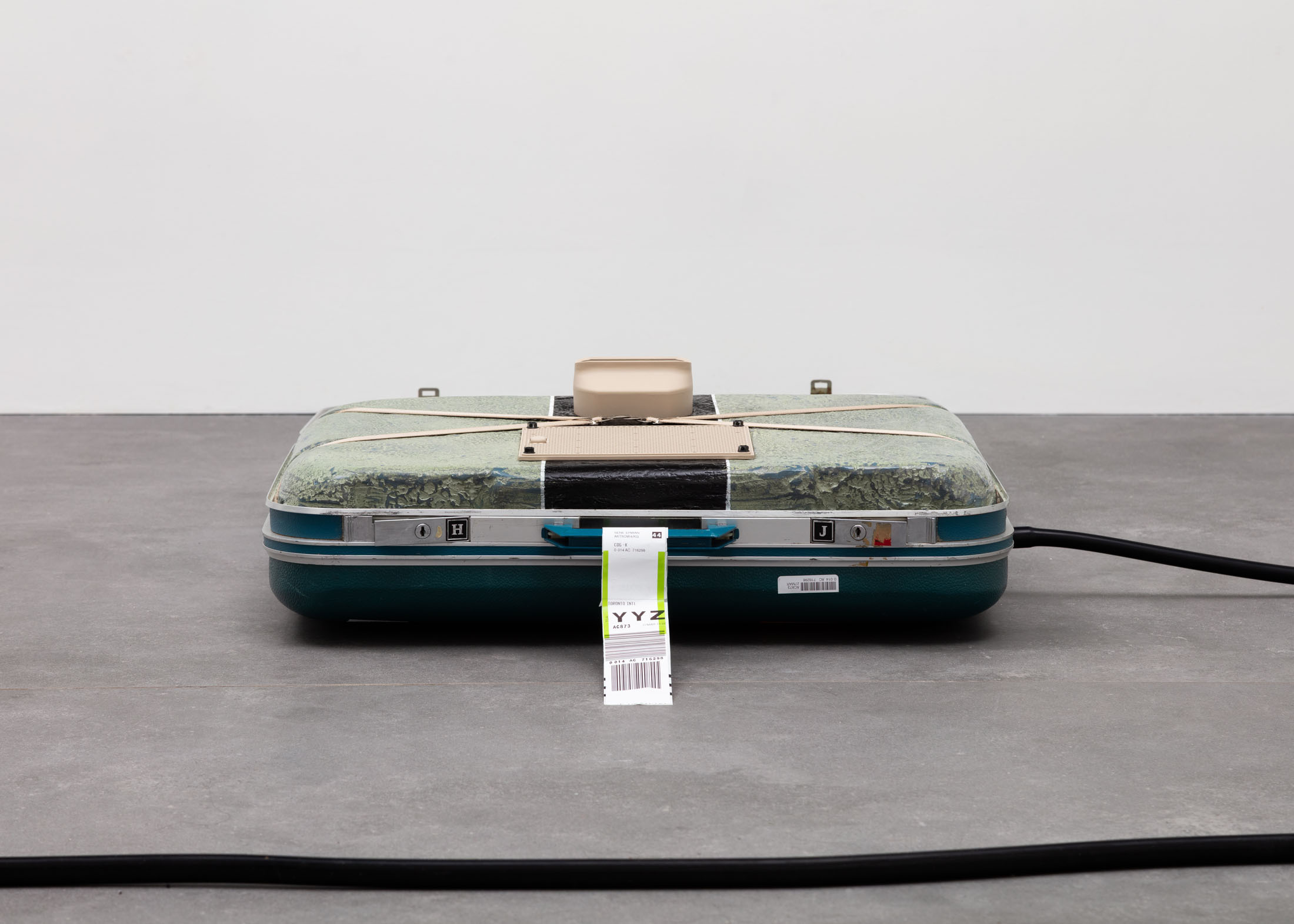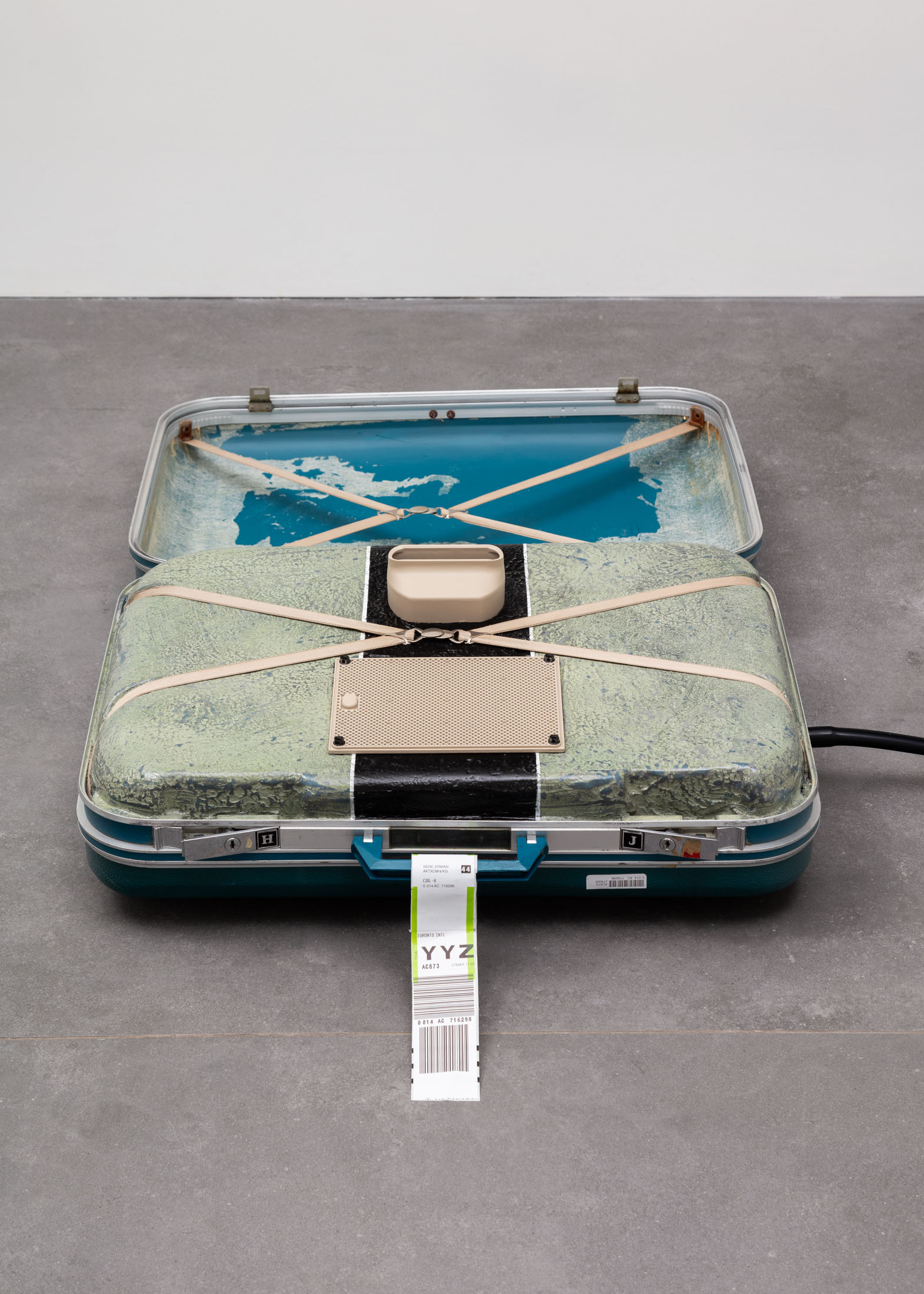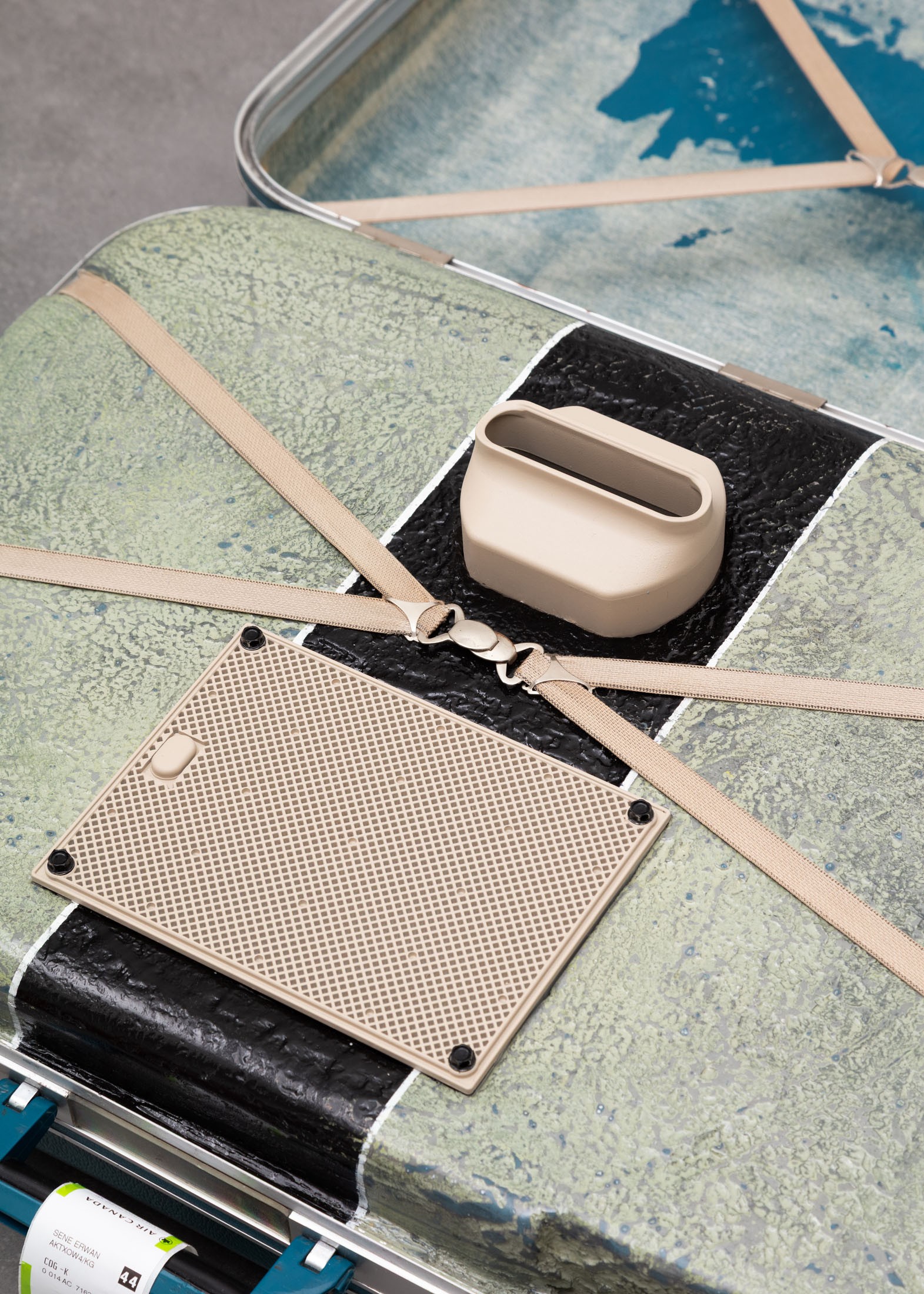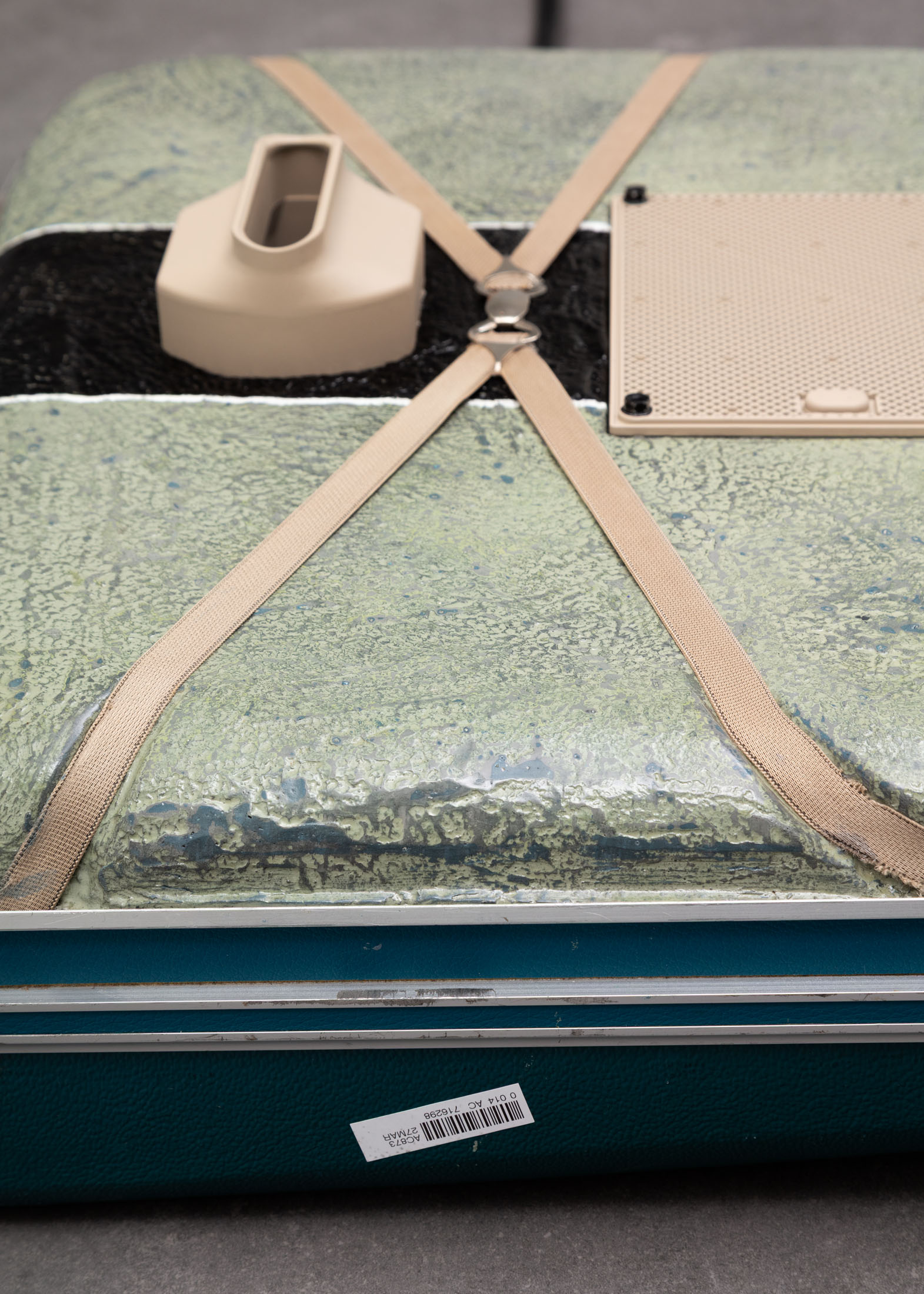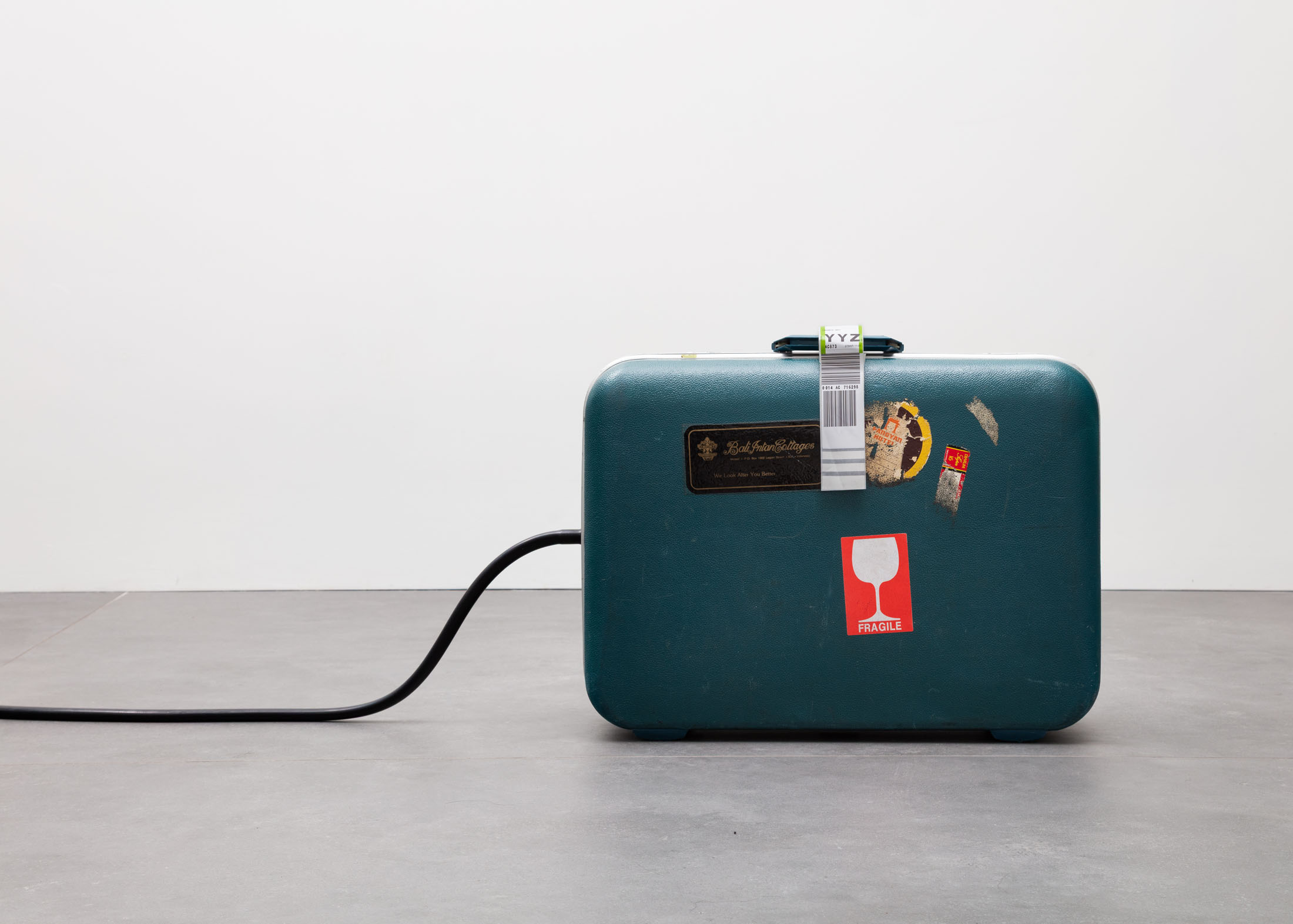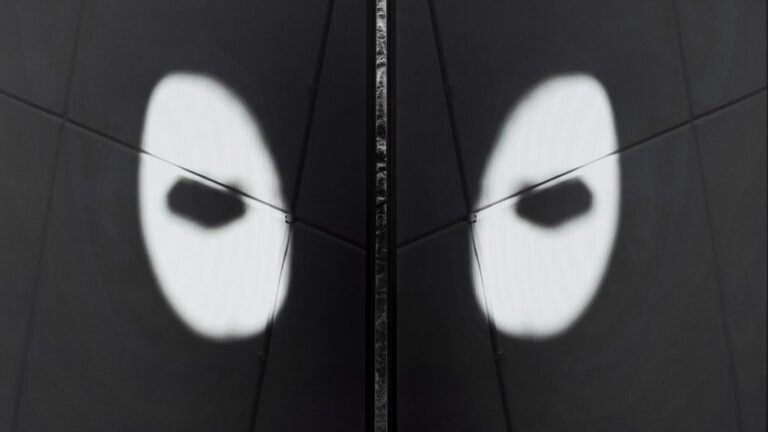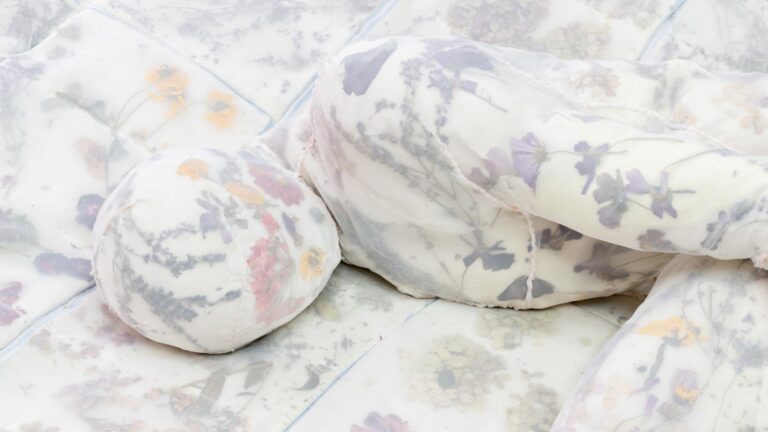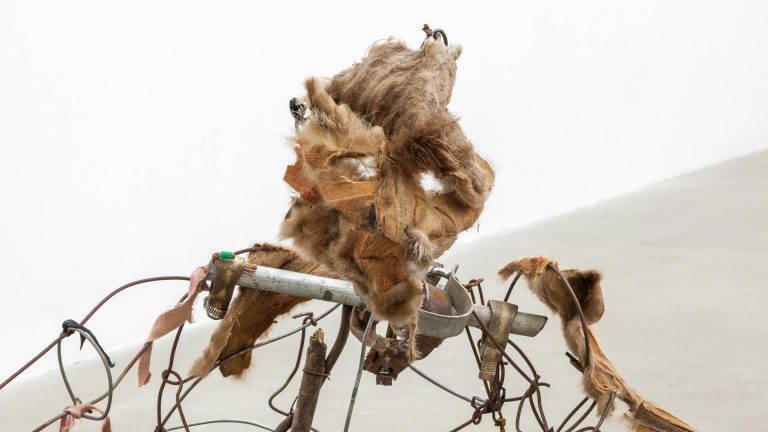
With Checked or four attacks that will never happen, Erwan Sene presents four Delsey suitcases from the 1970s, linked by a network of cables running from one element to the next with the cold logic of infrastructure. Nothing is concealed. The connections remain visible, exposed as form, as if the work’s nervous system refused to withdraw beneath the surface. The suitcase no longer contains; it displays. Not what it holds, but the very condition of its circulation, pushed to the point where visibility itself becomes opaque.
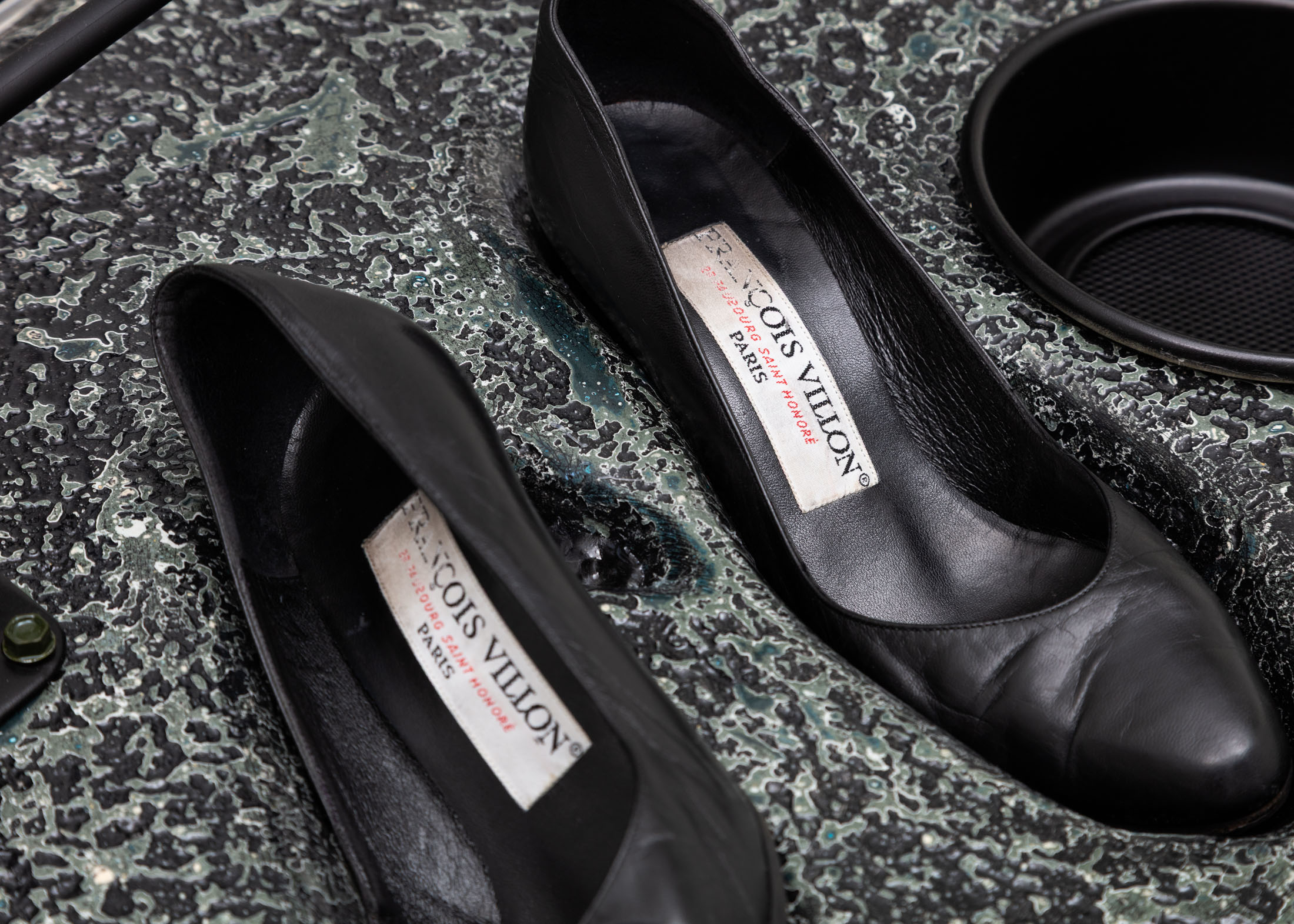
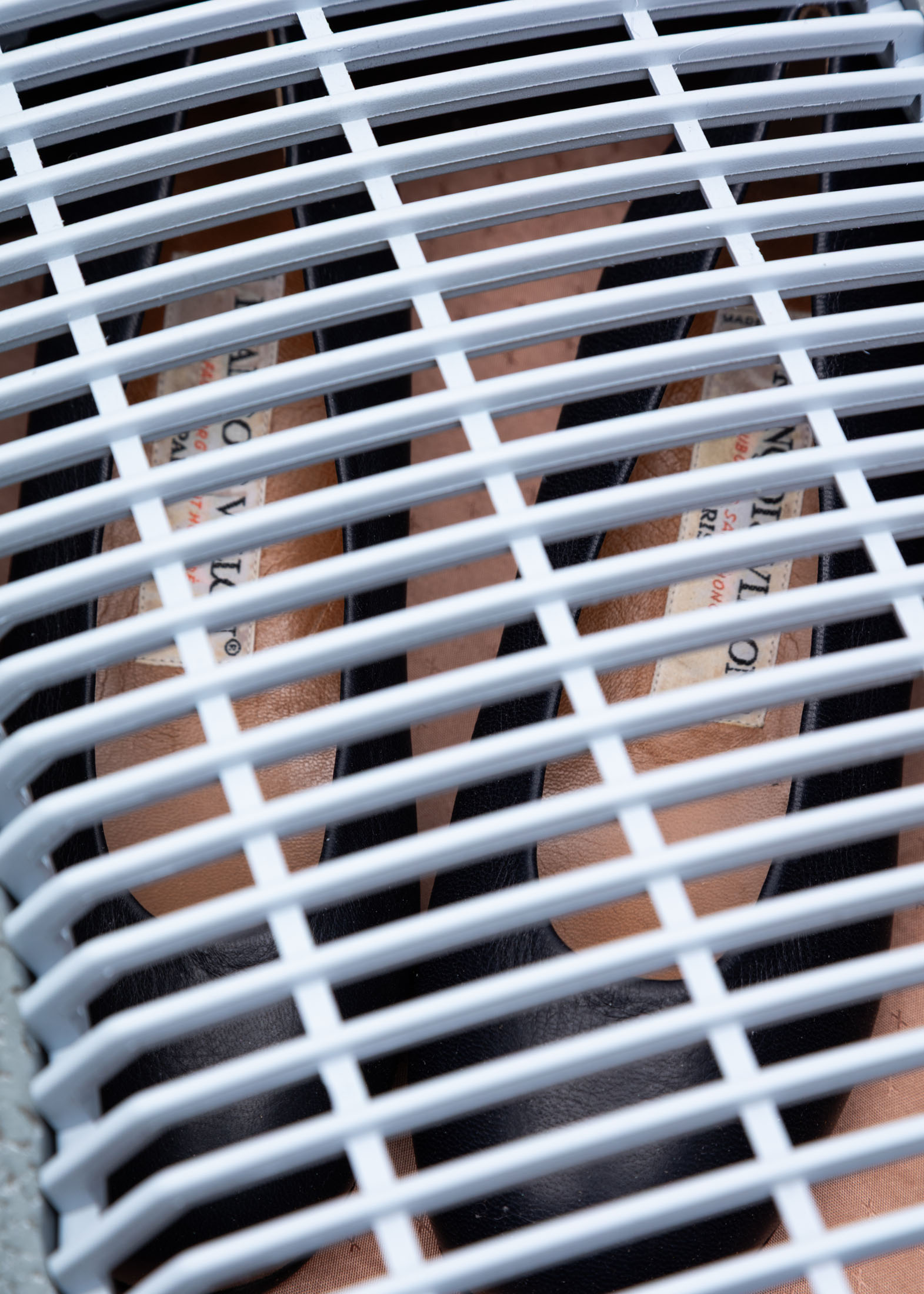
Each piece is an autonomous sculpture. One half is cast in industrial ABS polycarbonate, a material designed to withstand the impacts and ordinary stresses of transport—the commercial promise of indestructibility that only late capitalism could transform into an aesthetic. The other half is excavated, hollowed out, inhabited. Inside are infrasound antennas—devices operating below the threshold of human hearing—and leather high-heeled shoes from the 1960s brand François Villon, understated, bourgeois, unwittingly bearing the name of a poet who invented a coded language so his accomplices could speak to one another without being understood.
The whole is precise, perfectly coherent, and yet without any assignable function. The question is not whether the artifact is real. Rather, it is whether the distinction between the real and its simulacrum still has any operational meaning.
The work is rooted in an aesthetic of gray. Neither clinical white nor dramatic black, but the gray of tarmac, of transit zones, of the infrastructures that organize the world without ever appearing as subjects. Virilio saw in it the color of a permanent state of emergency—not an absence of color but a politics of color, the hue of everything that seeks to go unnoticed in the industrial landscape, of everything that belongs to that intermediate zone between peace and war that modernity has come to call security.
The exhibition exists first and foremost as a legal problem. Before being a work of art, it is a question posed to regulation. What can one carry in a suitcase? What can one make resemble something else without it legally becoming that other thing? International aviation law, and in particular ICAO regulations, distinguishes with surgical precision between what is prohibited, what is restricted, and what is merely suspect. Infrasound antennas do not appear on any list of prohibited items. Neither do bourgeois shoes. ABS polycarbonate is the material used for carryon luggage. The artwork is legal in each of its components. It is their assembly, their networking, their overall arrangement that causes concern. The artwork does not break the law. It reveals the law’s architecture by conforming to it exactly. Ultimately, the system works best when it does not fully understand what it is dealing with. Nothing is prohibited, and everything is conditional.
A structure without transgression is a threat without status. The law deals only with acts and knows nothing of possibilities. The artifact is compliant, and that is why it poses a problem. It intervenes afterward. Conrad understood this in 1907 in The Secret Agent.“The most destabilizing attack is not the one that explodes, but the one that does not quite happen, the one for which one cannot establish with certainty whether it was intentional, accidental, or commissioned by those very people who claim to prevent it.”
The work operates within this interval. Perfect legality, pushed to the point where it becomes indistinguishable from a strategy.
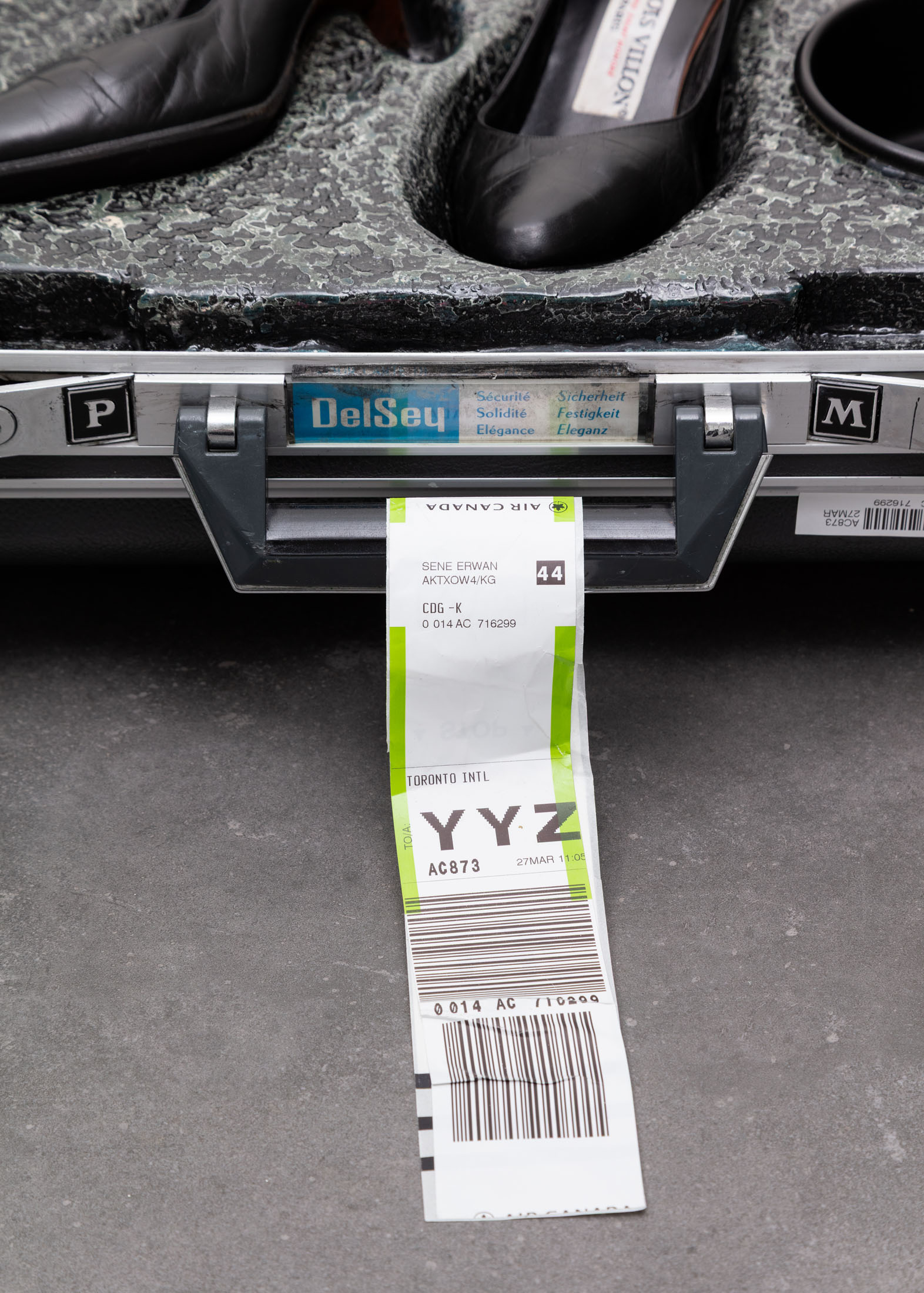
The implied route, CDG–Toronto, is not a geographical anecdote. Charles de Gaulle Airport, as designed by Paul Andreu in 1974, is a mechanism before it is a place, a spatial protocol in which bodies are filtered, slowed down, and redirected according to a regime that McLuhan would have recognized immediately.“Every medium is an extension of the human body that simultaneously numbs the faculty it extends.”The airport extends mobility on a global scale and numbs the body’s awareness of space. The passenger moves, and information precedes them. Under what jurisdiction? Subject to what laws? No one stops. This is precisely what is expected. This disorientation is not a design flaw; rather, it is a condition of operation. The body is already reduced to its value as a means of circulation. The medium, here, is the message. And the message is simple: you are data in transit; there is no longer a subject, only authorized trajectories. Toronto is the city from which McLuhan formulated this diagnosis. CDG is the architecture that confirms it. Between the two, Erwan Sene’s work traces the path that Virilio described as inevitable.
“Civil space as military space temporarily open to circulation, under certain conditions.”What engineers call flow, Virilio calls preventive war. What architects call an airlock, intelligence services call a checkpoint. The difference is a matter of vocabulary, but the mechanism is identical.
In this context, the work engages in dialogue with that of Gregory Green, who crafted technically credible bombs intended for exhibition. The question is simple, and slightly humiliating for the law. At what point does a device that resembles a bomb become a bomb? The legal answer rests on intent. But intent cannot be seen. It does not show up on an X-ray. Philip K. Dick understood this better than lawyers.“In a world where the simulacrum is indistinguishable from the original, the question of authenticity becomes a question of power. Who has the authority to decide what a device actually is?”
The history of espionage is a history of reduction, where the game is to reduce the form until it becomes mundane. The Martini Olive Bug conceals a microphone inside a cocktail olive; the Spy Tech Pen records in the form of a pen; the Anal Toolkit conceals a device within the agent’s own body. The object disappears in its use, and the operation becomes invisible because it is ordinary. This is what Debord called the colonization of everyday life. Not imposing from the outside, but settling into the most familiar forms until they become inseparable from the surveillance they exert. There is always a level of analysis at which the artifact is already interpreted, without anyone knowing by whom.
The box is also a literary form before it is a commercial object.
Sergei Dovlatov, in The Suitcase (1986), makes it the minimal archive of a life reduced to what can be transported: eight items, eight stories, an existence compressed into a standard-sized volume. The container becomes sentimental contraband. What customs cannot seize because they cannot read it, because the value lies not in the artifact but in the context it carries without revealing it. Henry Box Brown solves the problem differently, and more radically. In 1849, he had himself shipped in a wooden crate to escape slavery. The body becomes a package, and freedom comes through transit. This is perhaps the most precise formulation of what McLuhan did not mean to say. Some bodies gain access to mobility only by becoming their own merchandise. Gareth Williams, a GCHQ analyst and undercover agent, was found dead in 2010 inside a red Samsonite suitcase locked from the inside, in his apartment in Pimlico, London. No expert has been able to recreate the scene without outside assistance. The official hypothesis remains undecidable. Conrad would have recognized the situation. In The Secret Agent, again, the accidental death of the innocent is the only real consequence of an operation whose all other effects remain virtual. Williams’s suitcase is no longer a container. It is a conclusion without a premise, and according to the Daily Mirror, it fits in a bathtub. Sad and damp…
The shell, in François Villon’s Le Lais and Le Testament (circa 1456–1461), refers to the church, the shelter, and any deceptive covering. Villon—thief, murderer, poet—simultaneously invented one of the most beautiful lyrical works in the French language and a cryptographic system, the jobelin, a coded slang shared with the Coquillards brotherhood. A criminal organization that used the symbol of the pilgrims of Santiago de Compostela as a cover. Pilgrims in appearance, criminals in reality. The first pretense in the history of France, and perhaps the most elegant. Language becomes a secret shell, and words do not mean what they seem to mean. Meaning is kept in reserve, carried without being declared, delivered only to those who possess the code.
To reiterate, François Villon shoes, a French brand from the 1960s, bear this name without conscious irony. A preppy brand that appropriated a criminal’s name to sell respectable shoes. A criminal elegance that modernity has long since lost. The bourgeoisie steps into the shoes of a thief and believes it is walking on solid ground.
Infrasound antennas extend this logic downward, below the threshold of consciousness. Below 20 hertz, sound is no longer audible but continues to act. It passes through bodies, alters the surrounding space, produces diffuse anxiety, an inexplicable unease. Some researchers have seen in this a hypothesis for phenomena of haunting. Infrasound becomes a technical ghost. Peter Sloterdijk, in Sphären (1998–2004), spoke of a politics of atmospheres.“From the combat gases of World War I to the controlled air conditioning systems of shopping malls, the management of ambient air has become an instrument of power.”Infrasound fits into this genealogy. An invisible, inaudible disturbance that acts on bodies without leaving a trace. The Mosquito, a commercial device emitting ultrasonic waves audible only to those under twenty-five to disperse gatherings of young people, applies the same principle to public space. Control is achieved through frequency: invisible, legal, biologically discriminatory. A sonic weapon disguised as a nuisance. Exclusion becomes a matter of frequency because here, nothing is personal but merely an administration of boredom.
Checked or four attacks that will never happen radicalizes this logic by eliminating the narrative, leaving only the elements. Artifacts, connections, surfaces is an aesthetic of espionage without spies. An operation without agents. Félix Fénéon (1861–1944) understood that the short form was not a reduction but a displacement. He invented portable exhibitions, almost immaterial, ensembles that fit into very little space, that circulate, are transported, and condense. An exhibition like a suitcase. A light form, yet laden with meaning. The same man is accused of terrorism. The same gesture, depending on the context, becomes literature, curation, or a threat. A box-in-a-suitcase ahead of its time.
The Situationist International called this détournement. Seizing an existing structure to turn it against itself. Transforming a functional artifact into a critique of its function. The exhibition proceeds by detournement of infrastructure. It takes the forms of the international transit zone, the suitcase, the cable, the electronic device, and technical language, and assembles them into a system that looks exactly like what it is not. Not an attack, but the configuration of an attack. Not an action, but its possibility kept open, indefinitely, in a legal space that neither Vigipirate nor the ICAO can close because they do not know how to read it.
The work operates at the intersection of three simulacra. That of the suitcase that could contain a bomb. That of the subject, the agent whose intent cannot be proven. That of the apparatus, the surveillance that produces the threat it claims to neutralize, that generates the paranoia justifying its existence, that perpetuates itself by solving problems it has itself created. A security economy that needs insecurity as its raw material.
The text itself is organized like the work it describes. Four pages like four suitcases, linked together by a network of arguments whose logic sheds no light but keeps the flow going. Four standard gray boxes, perfectly functional, perfectly unusable. Nothing sticks out. Perhaps that is what is unsettling. An attack without an explosion. A configuration without an event. An operation without evidence. No one remembers when.
–Pierre-Alexandre Mateos