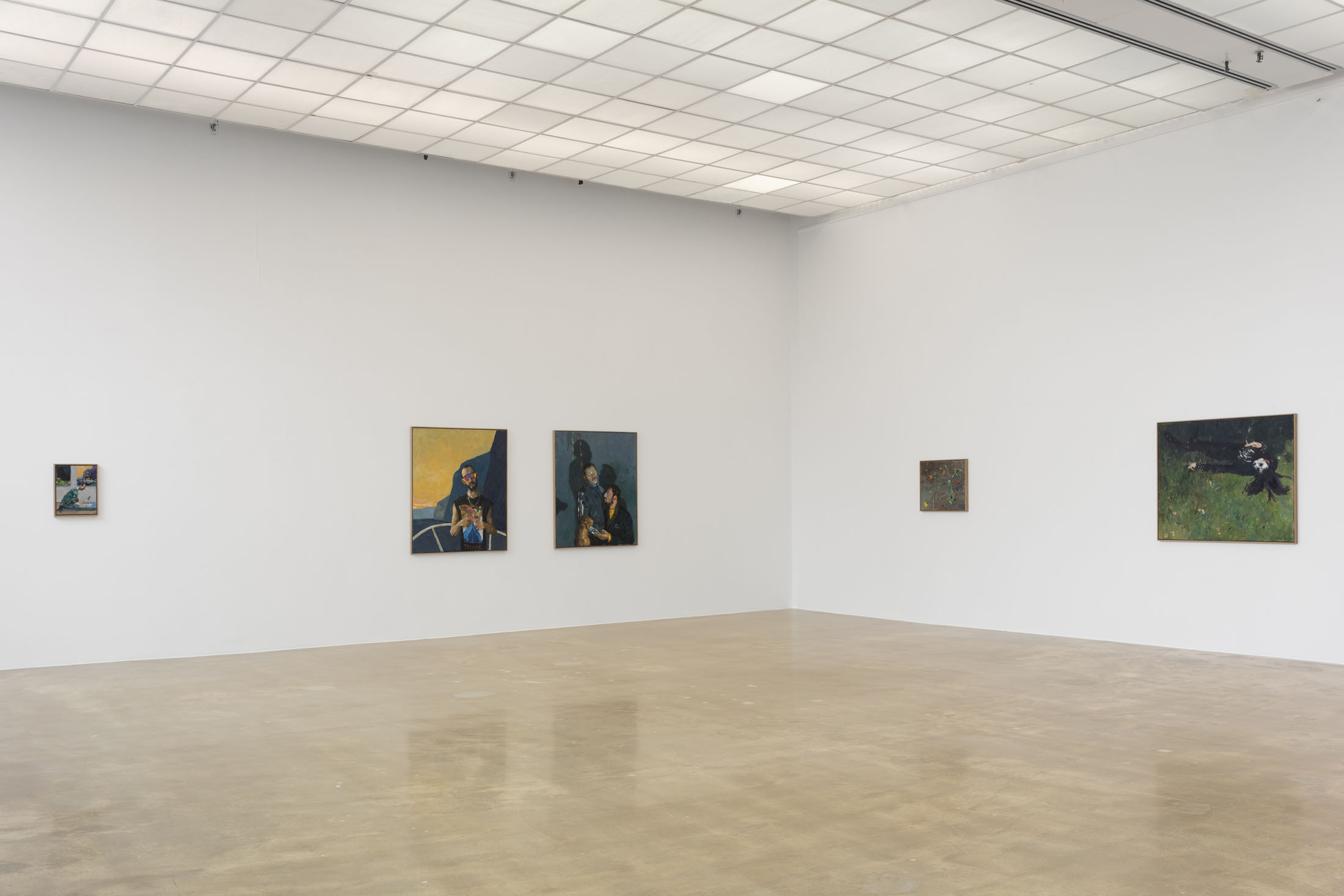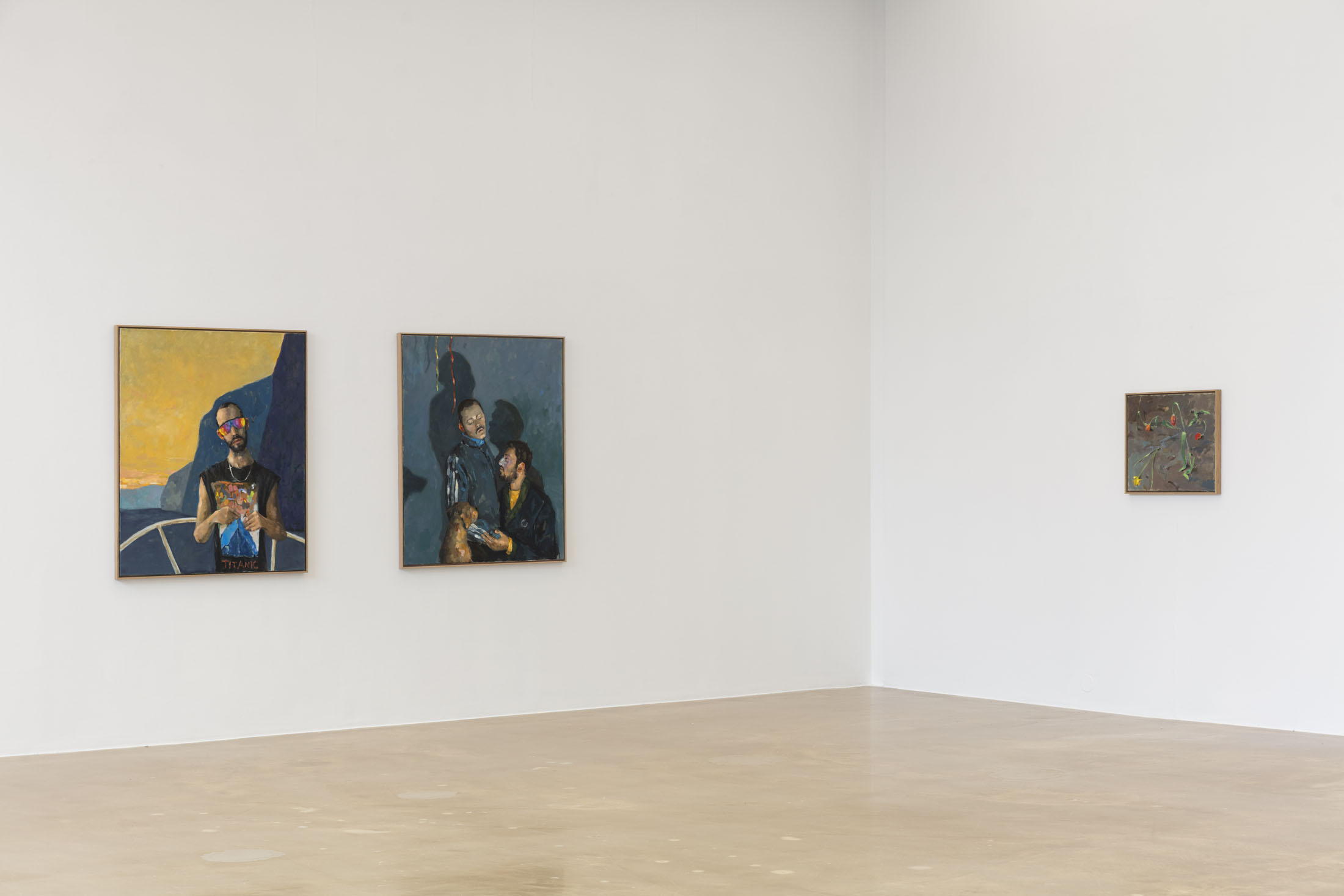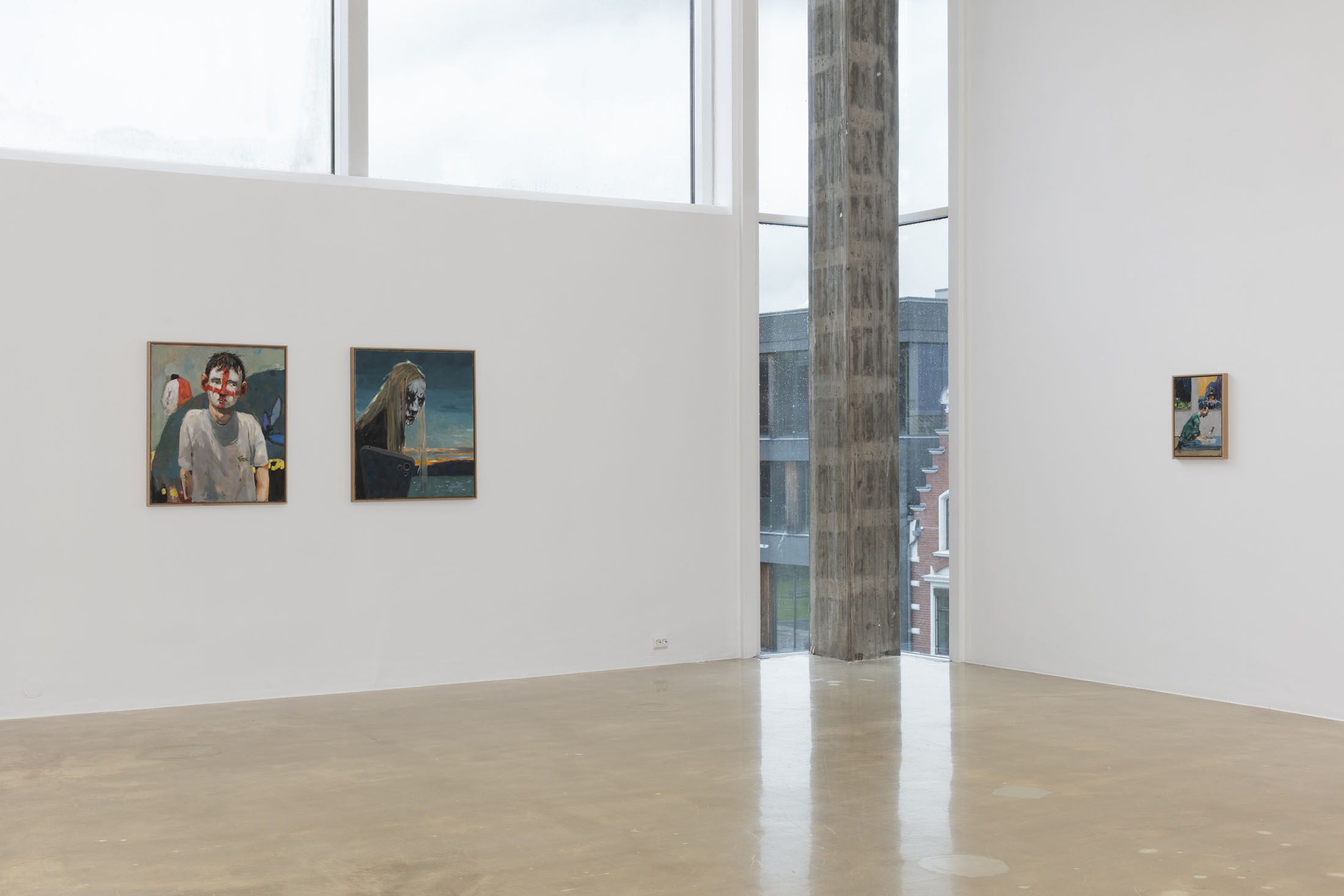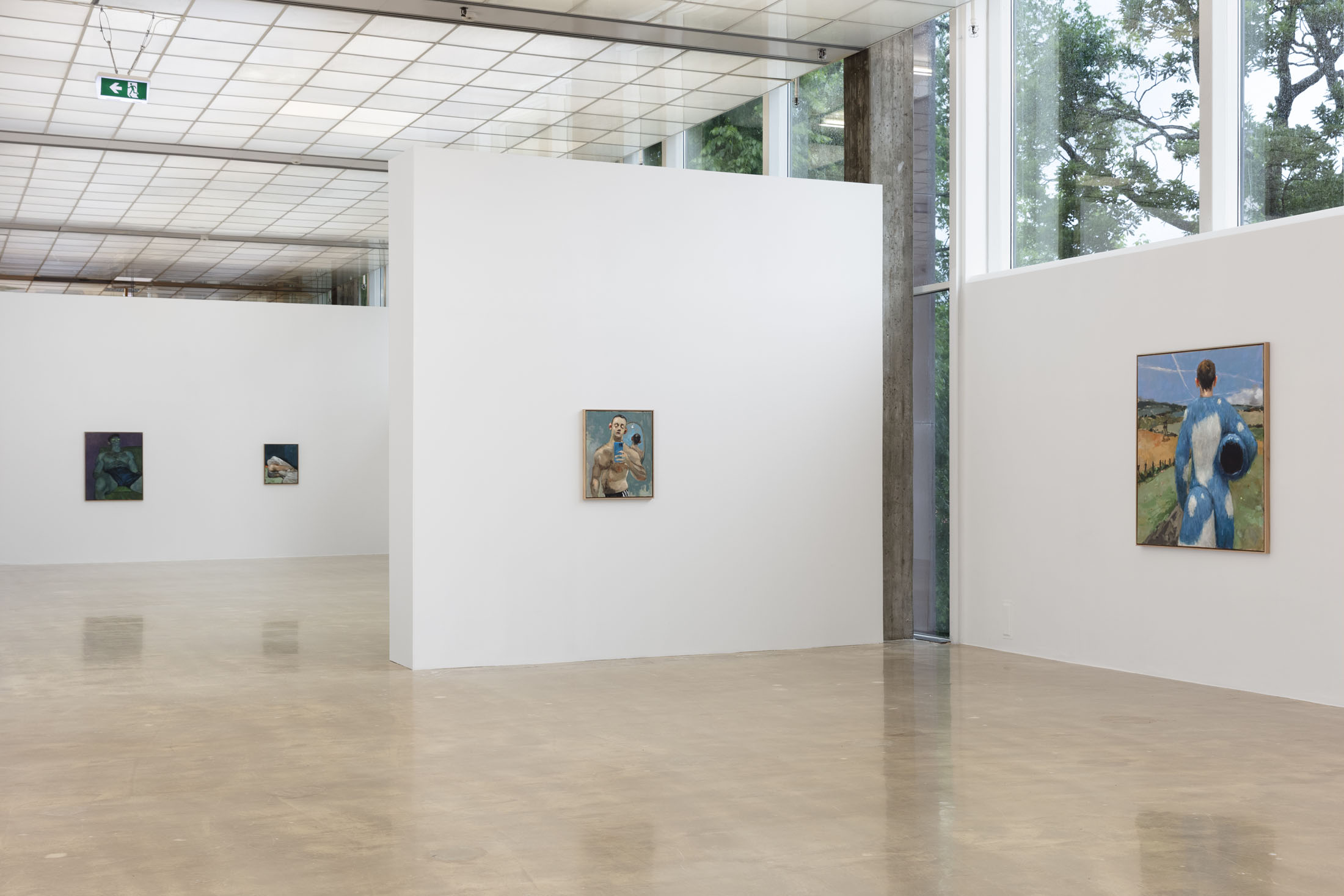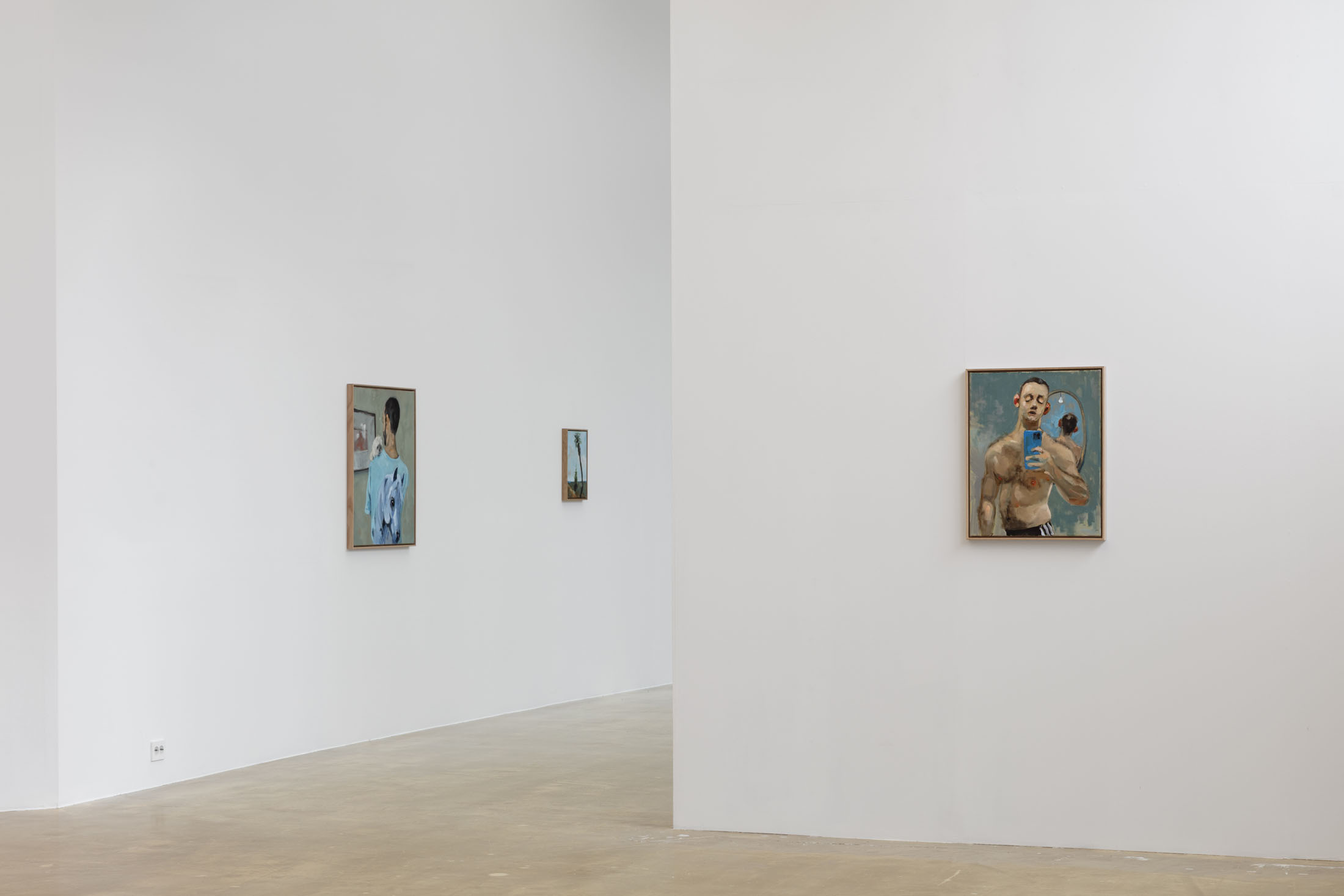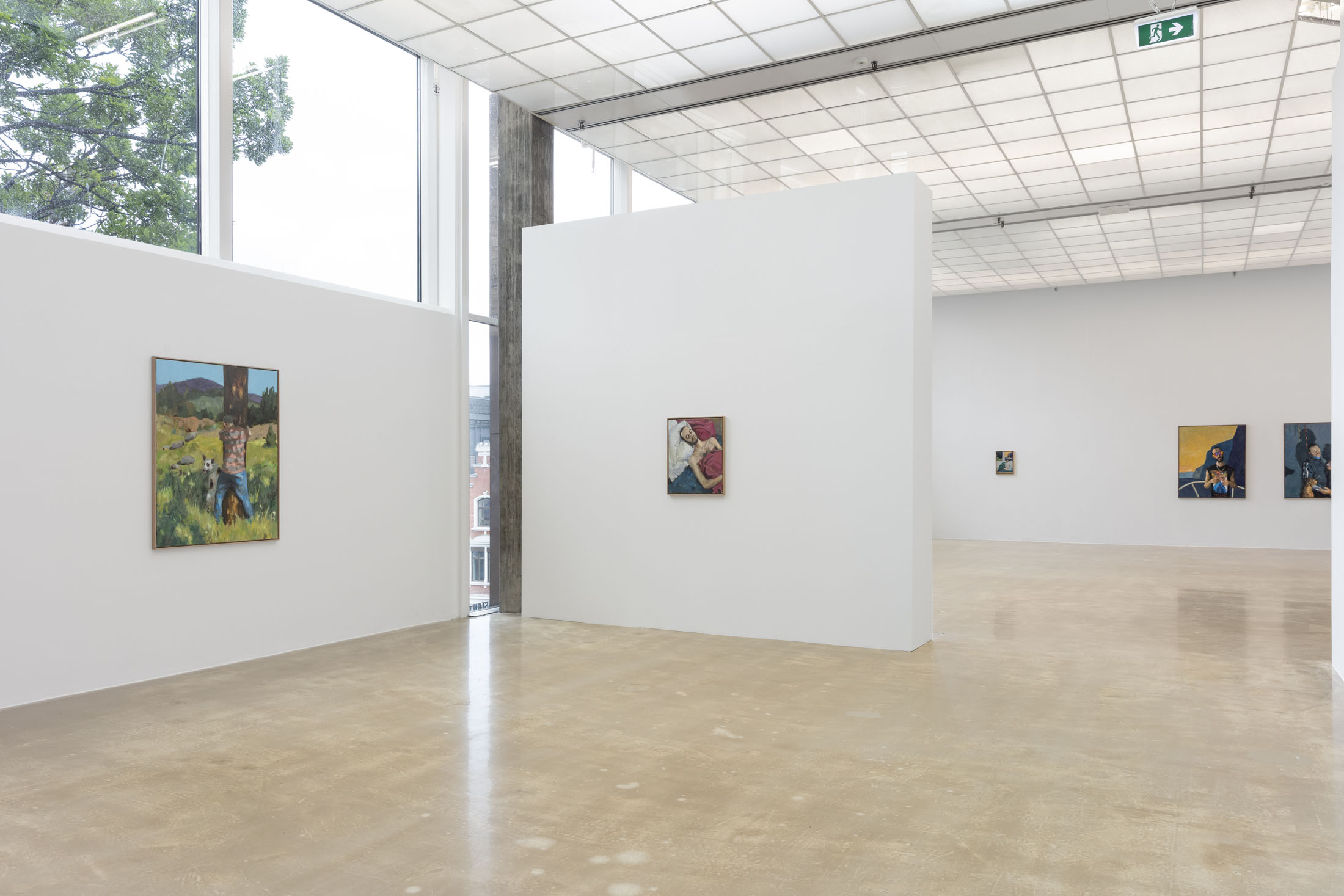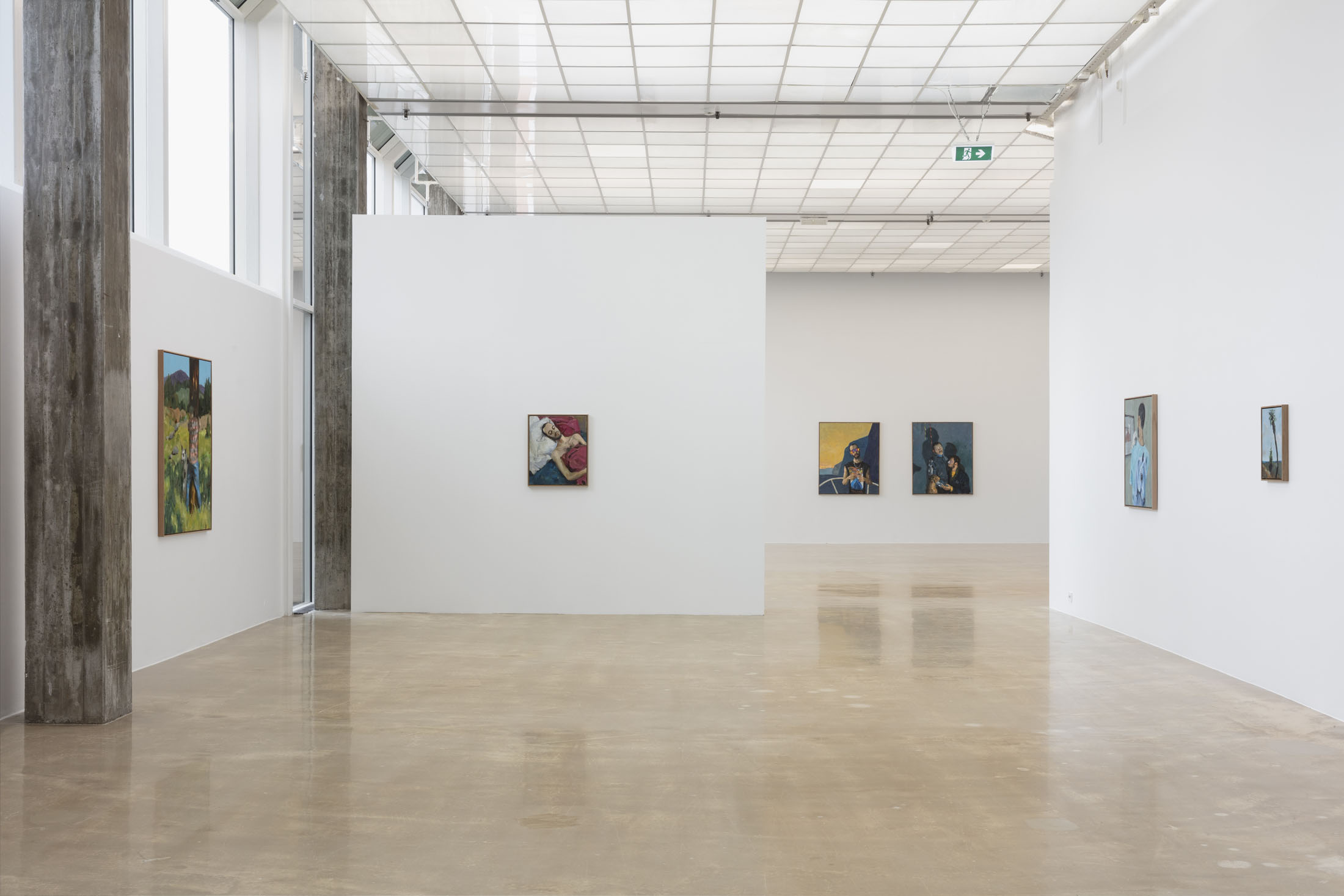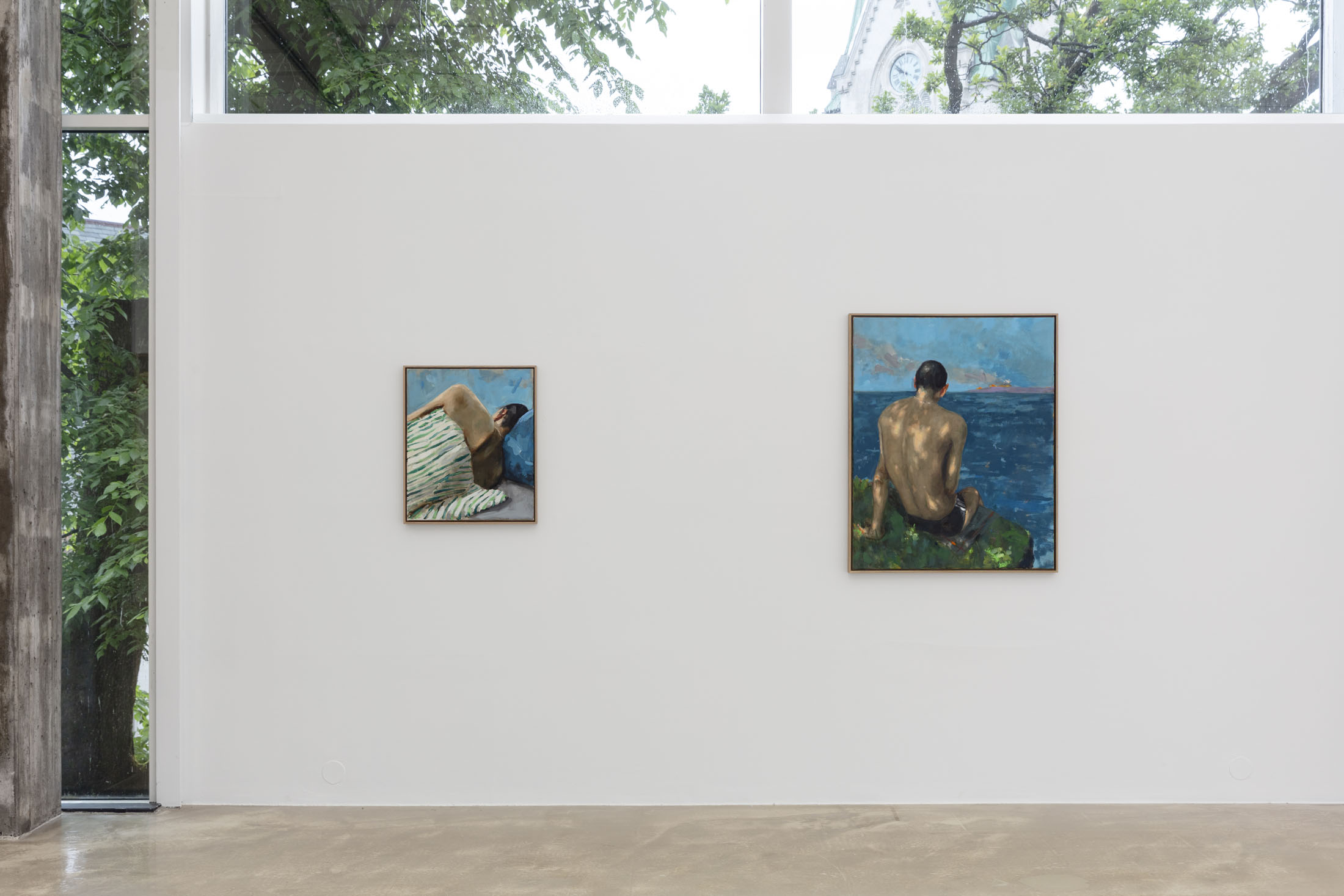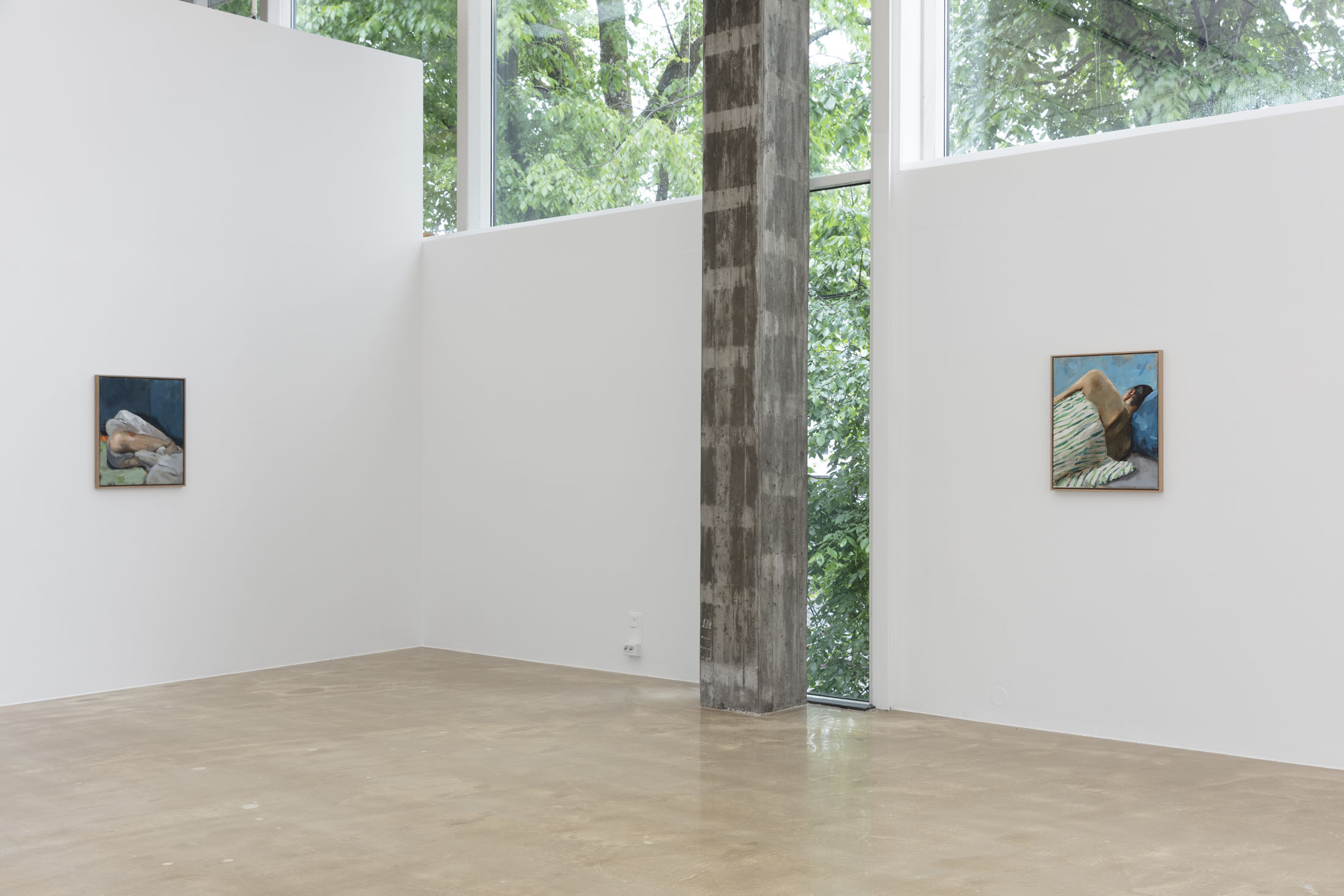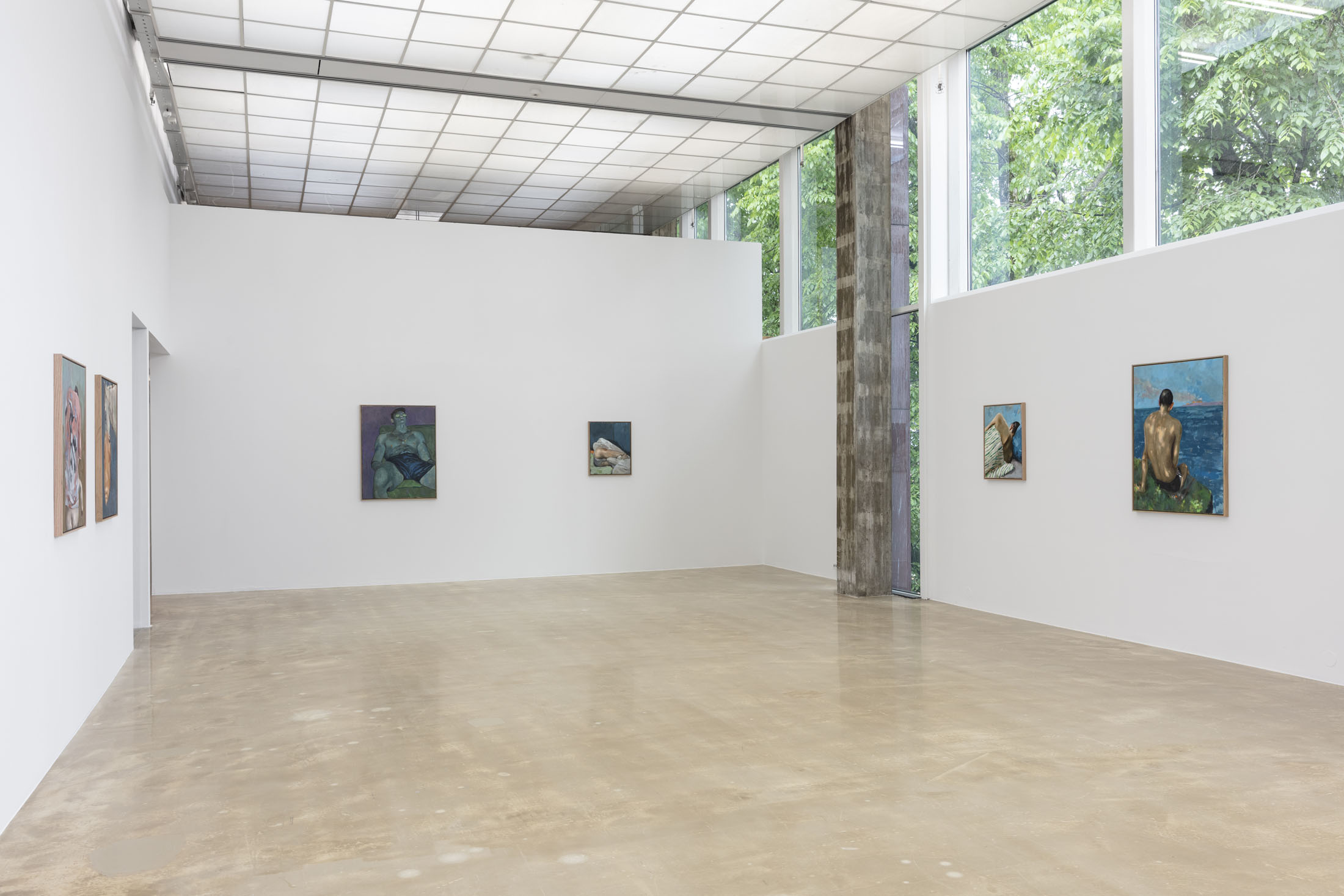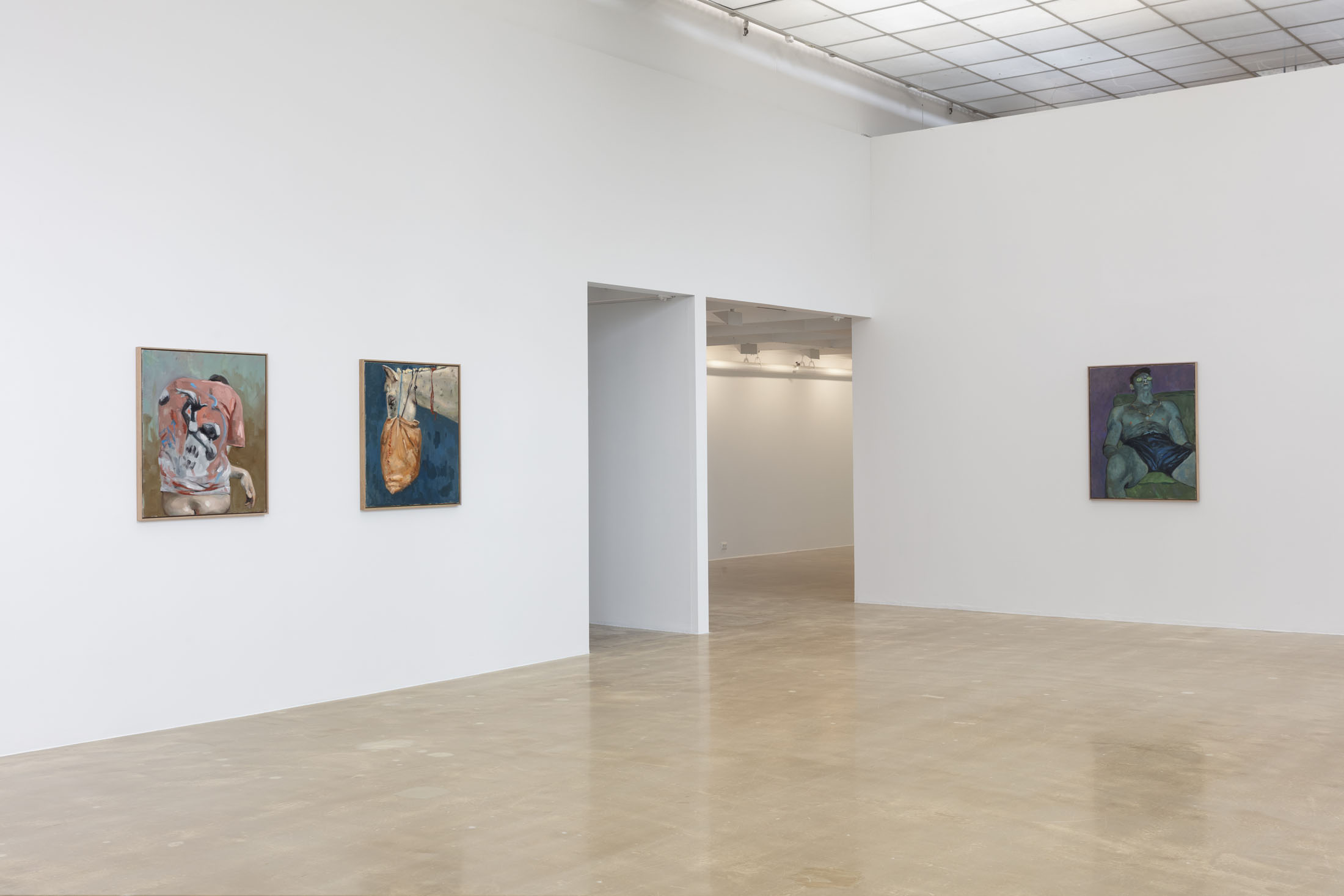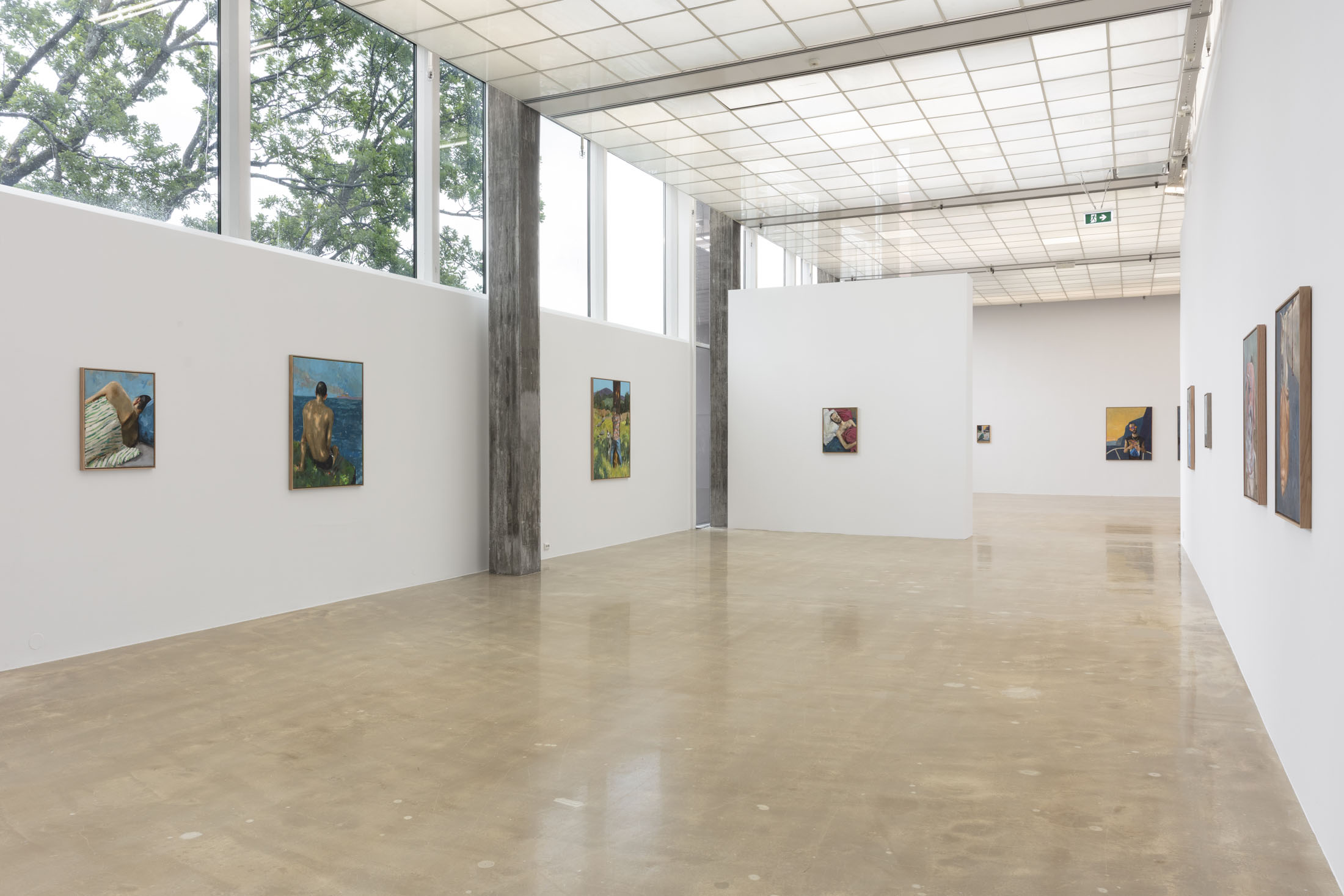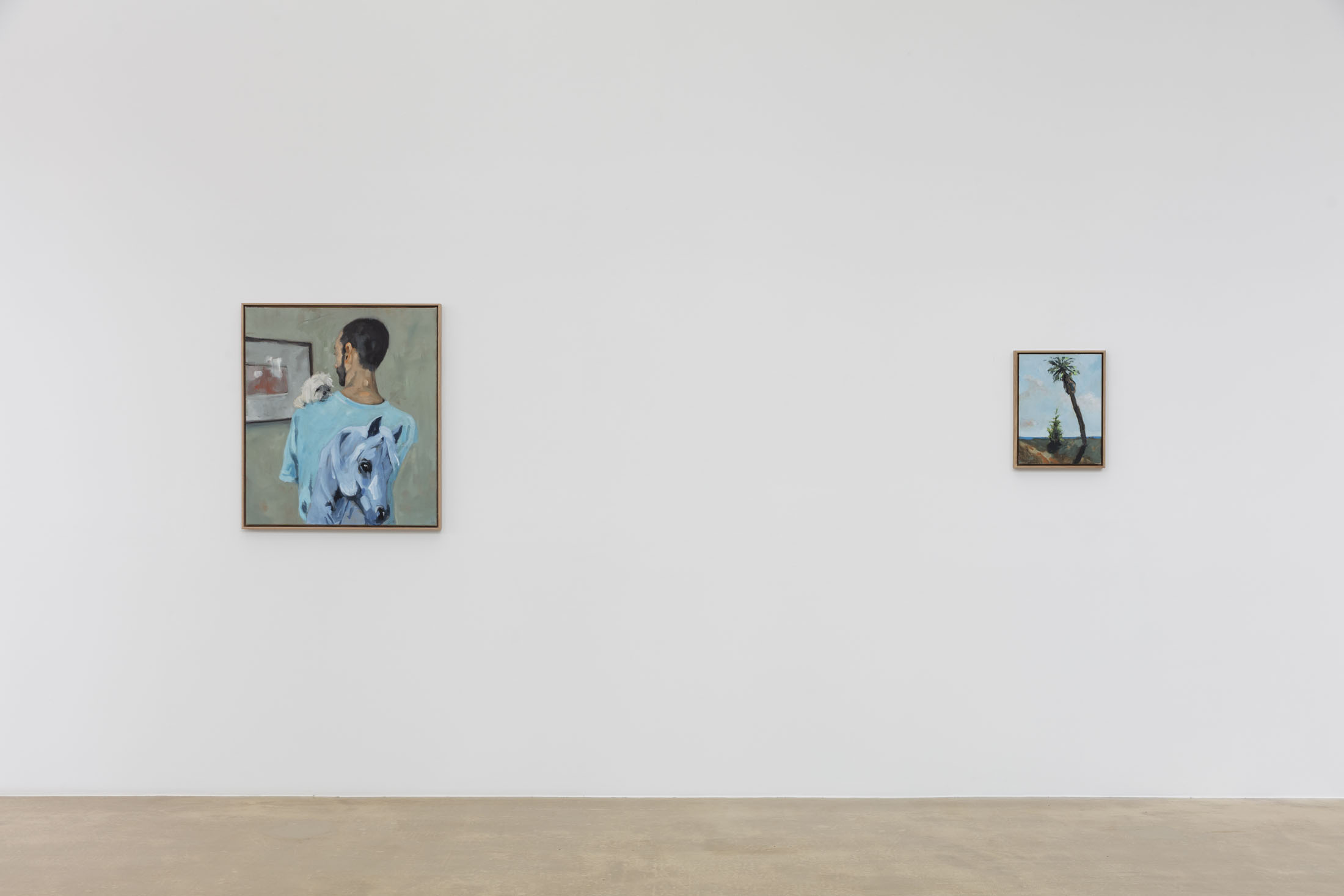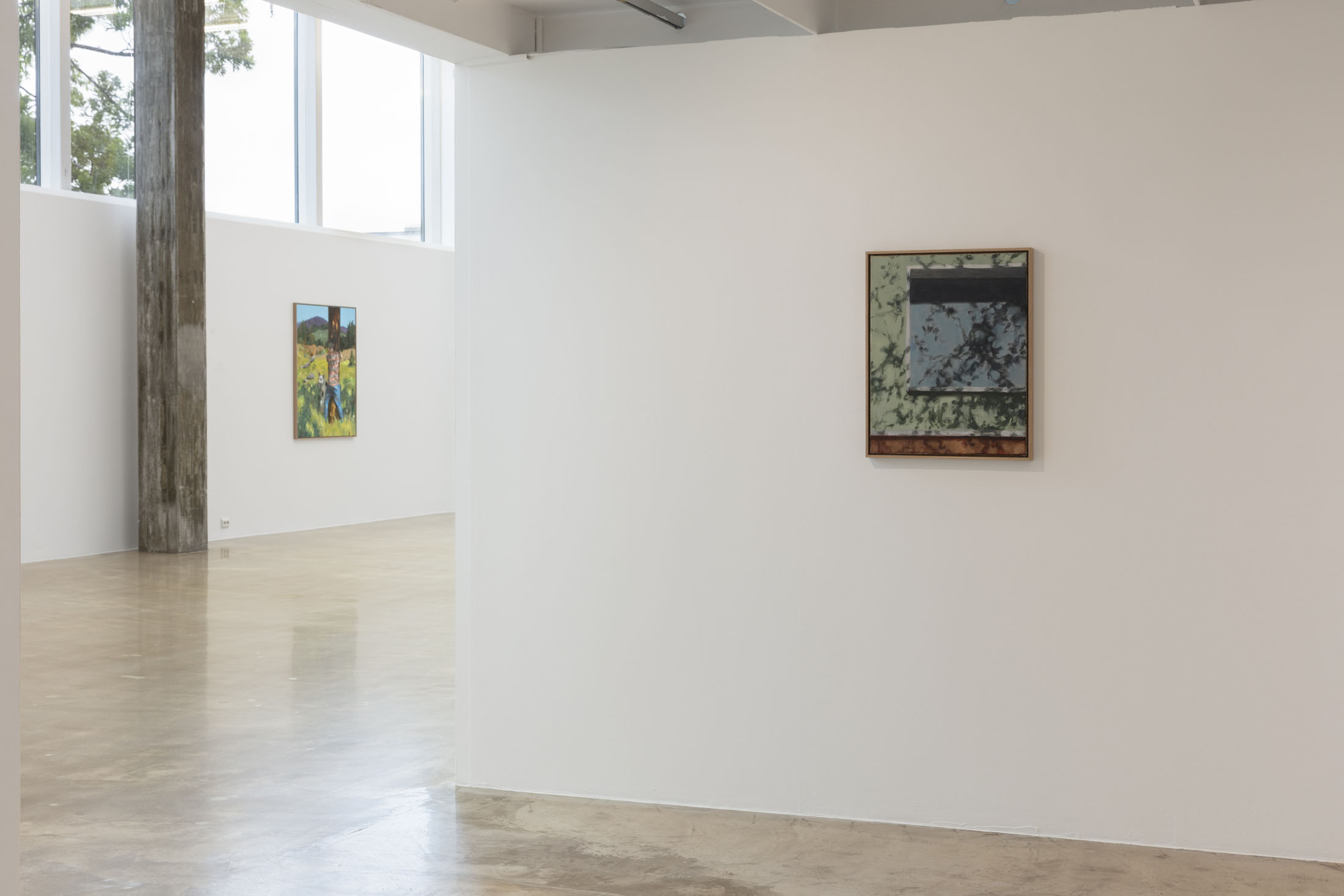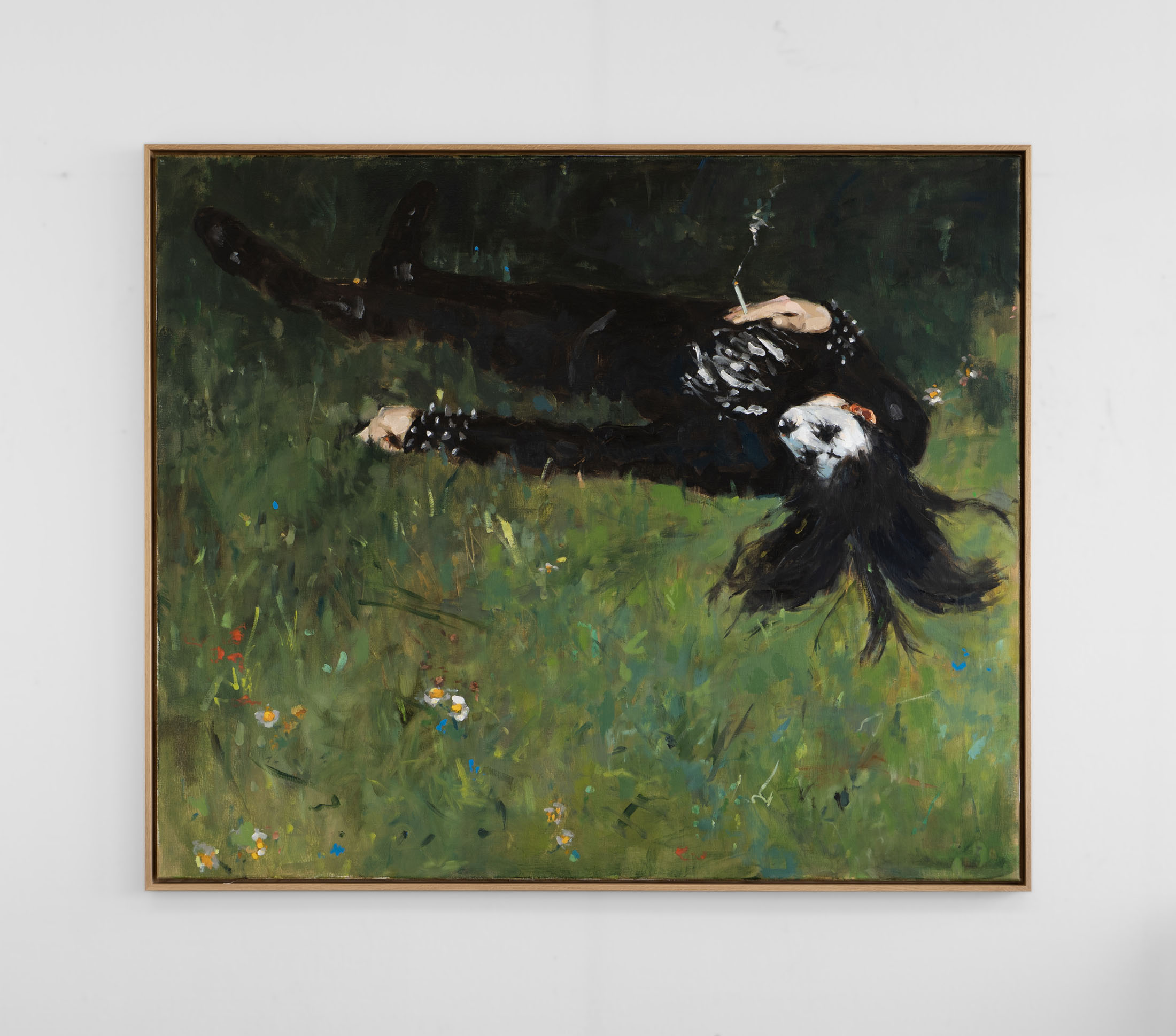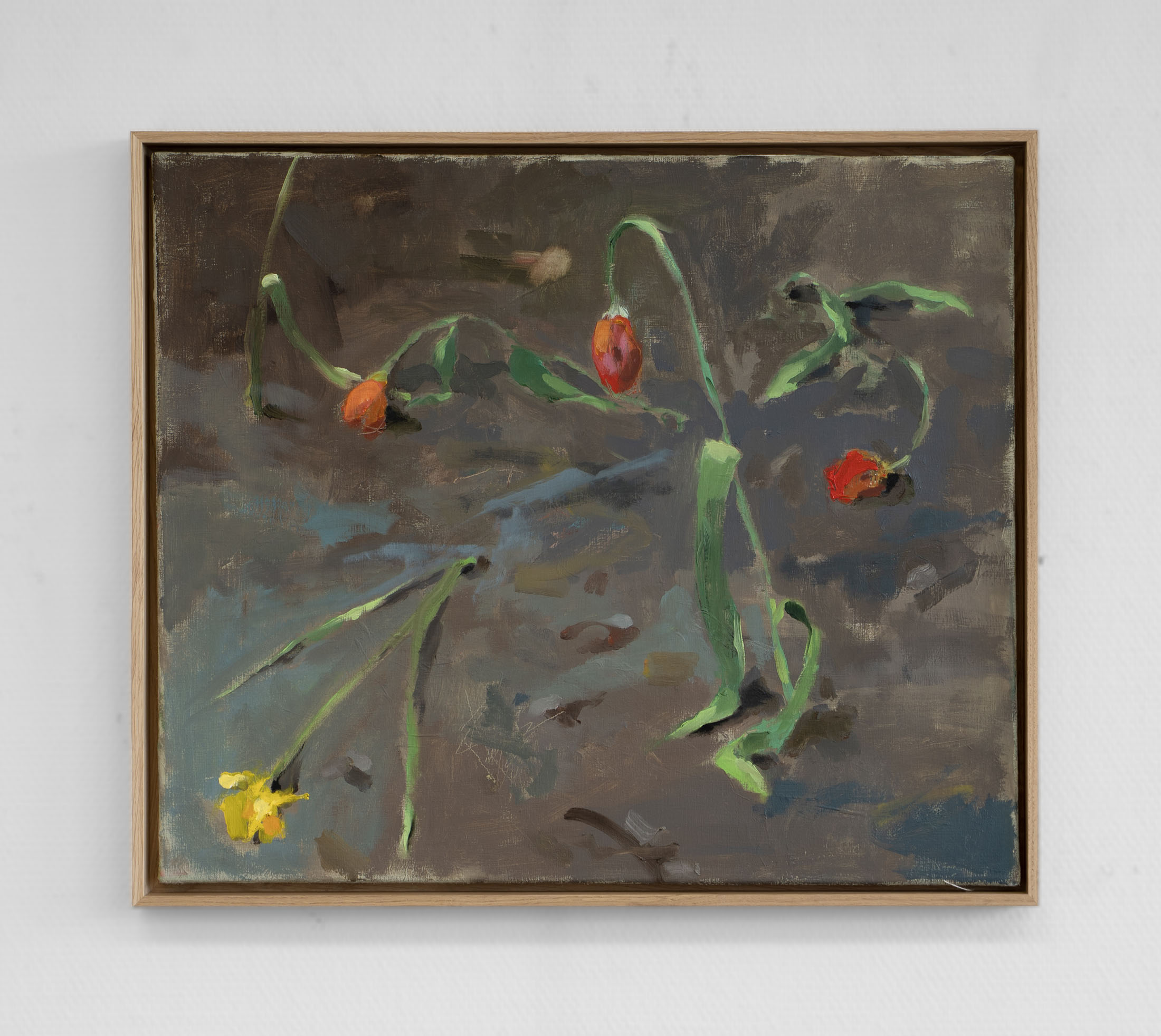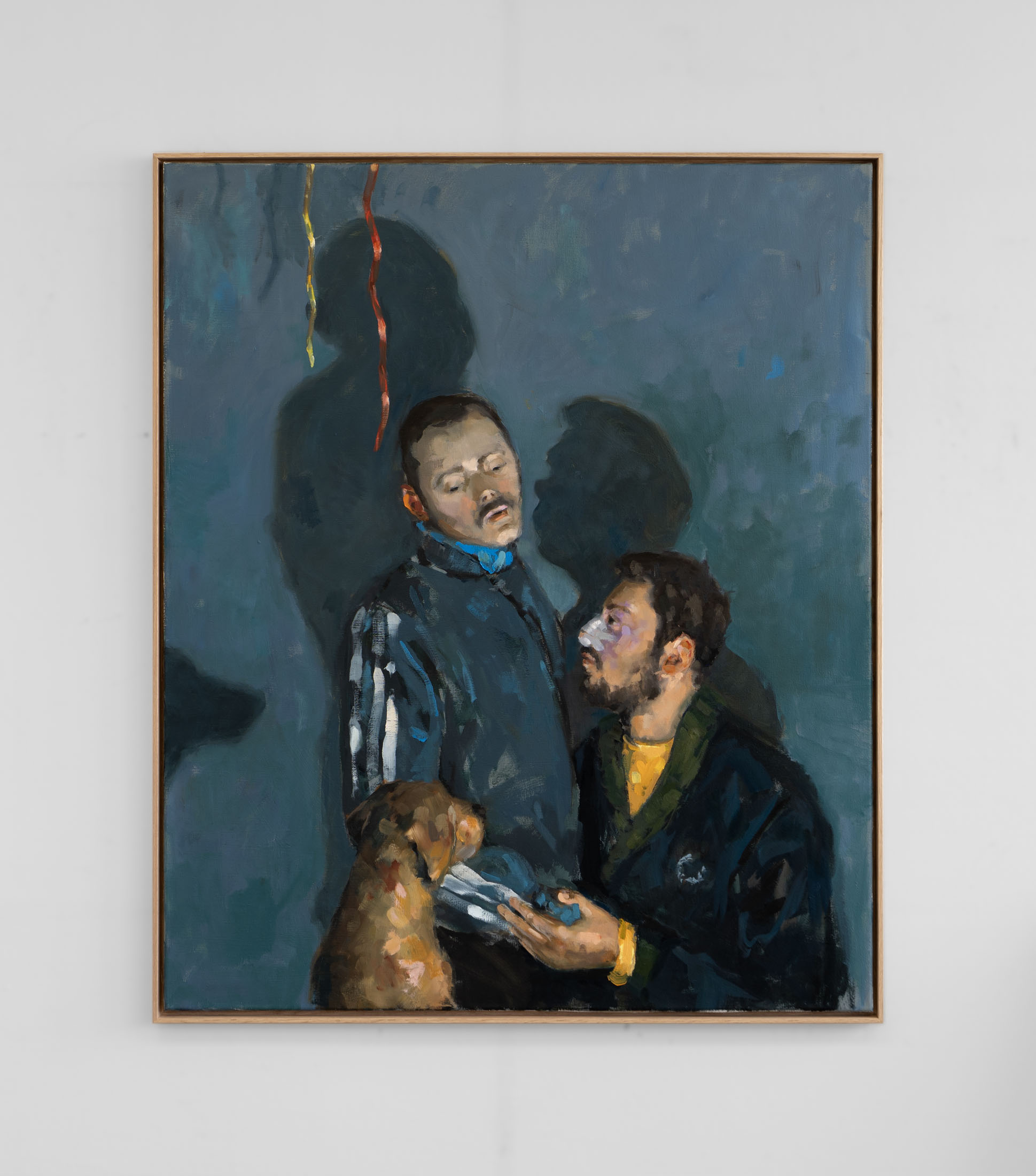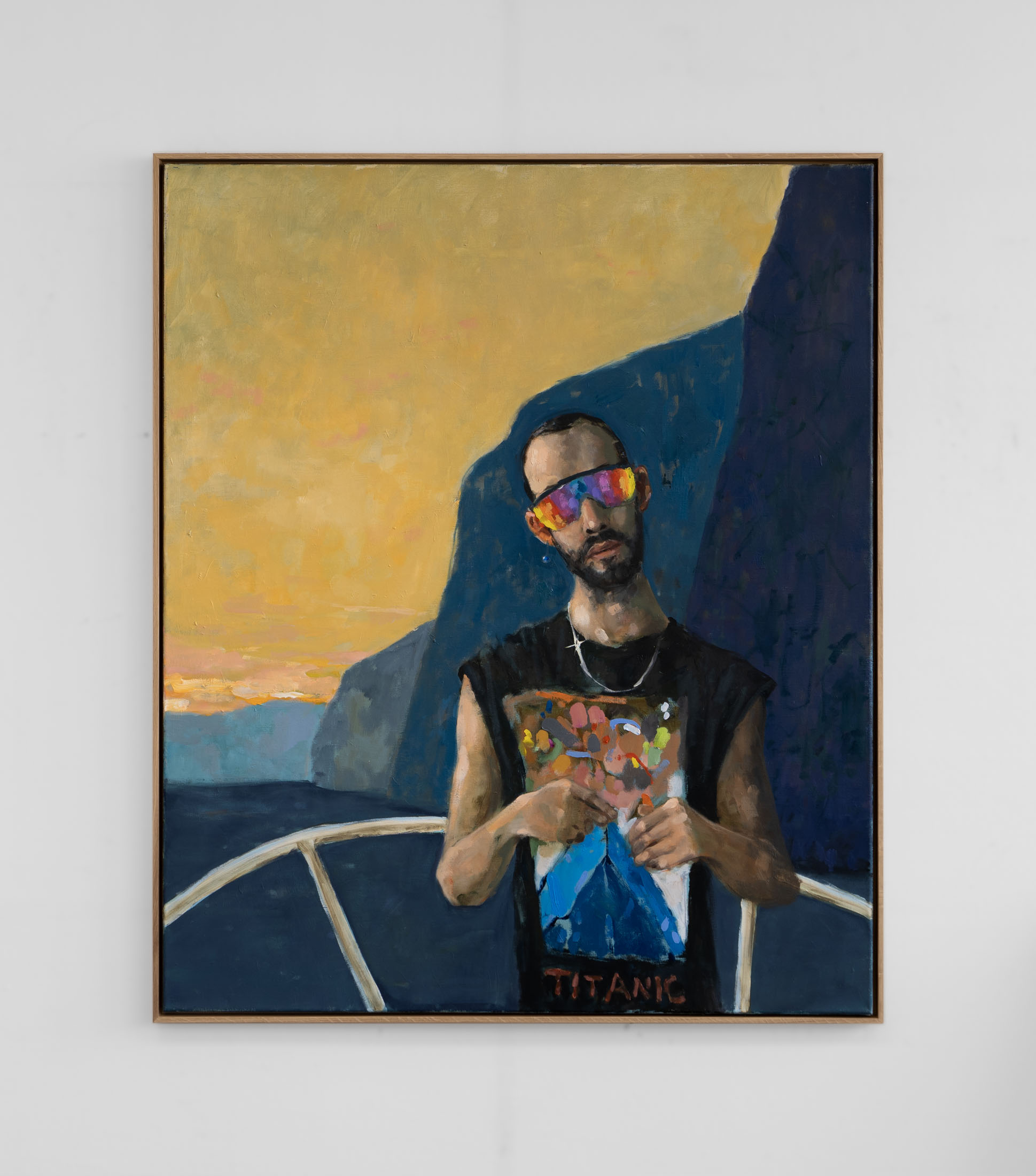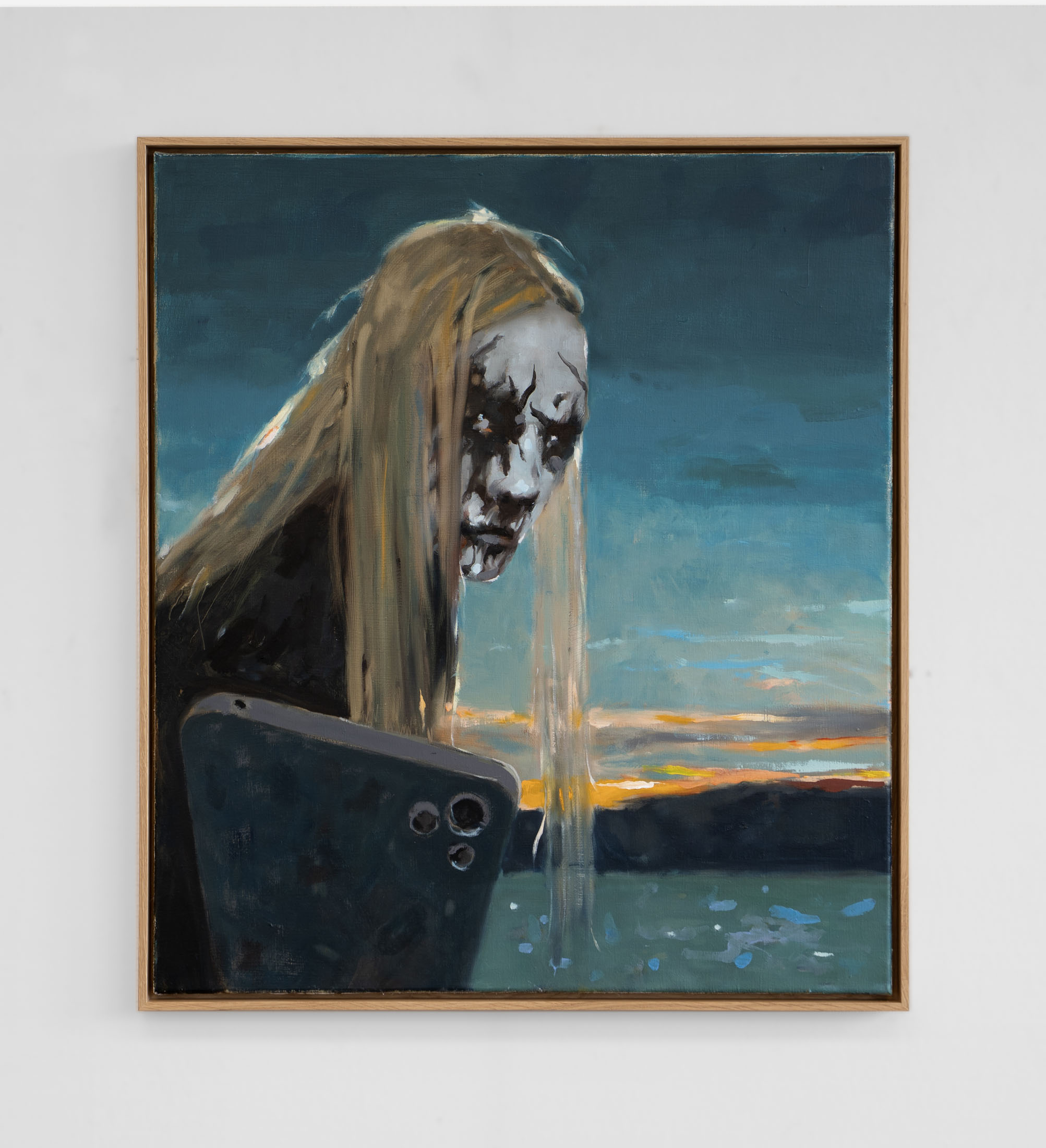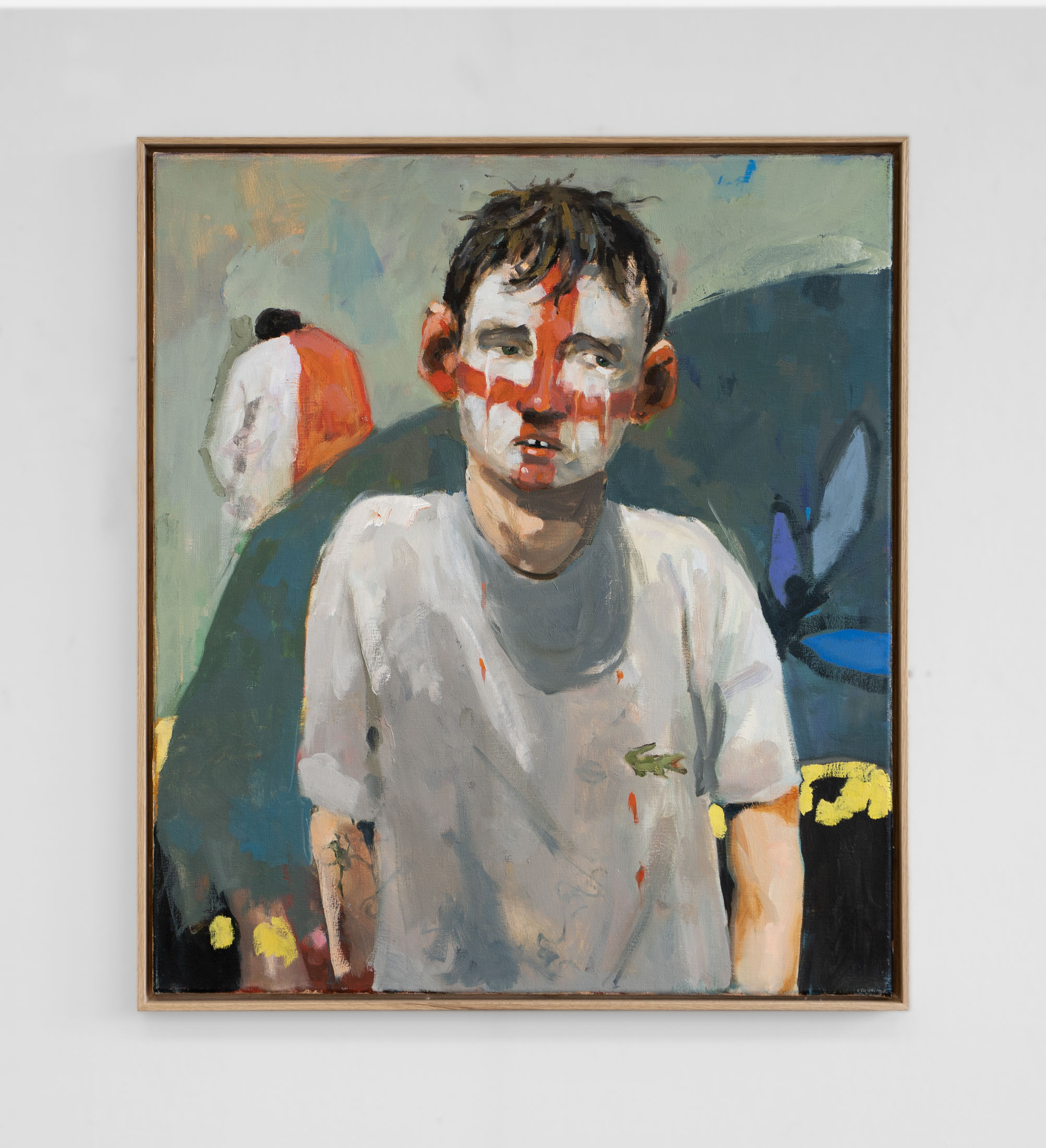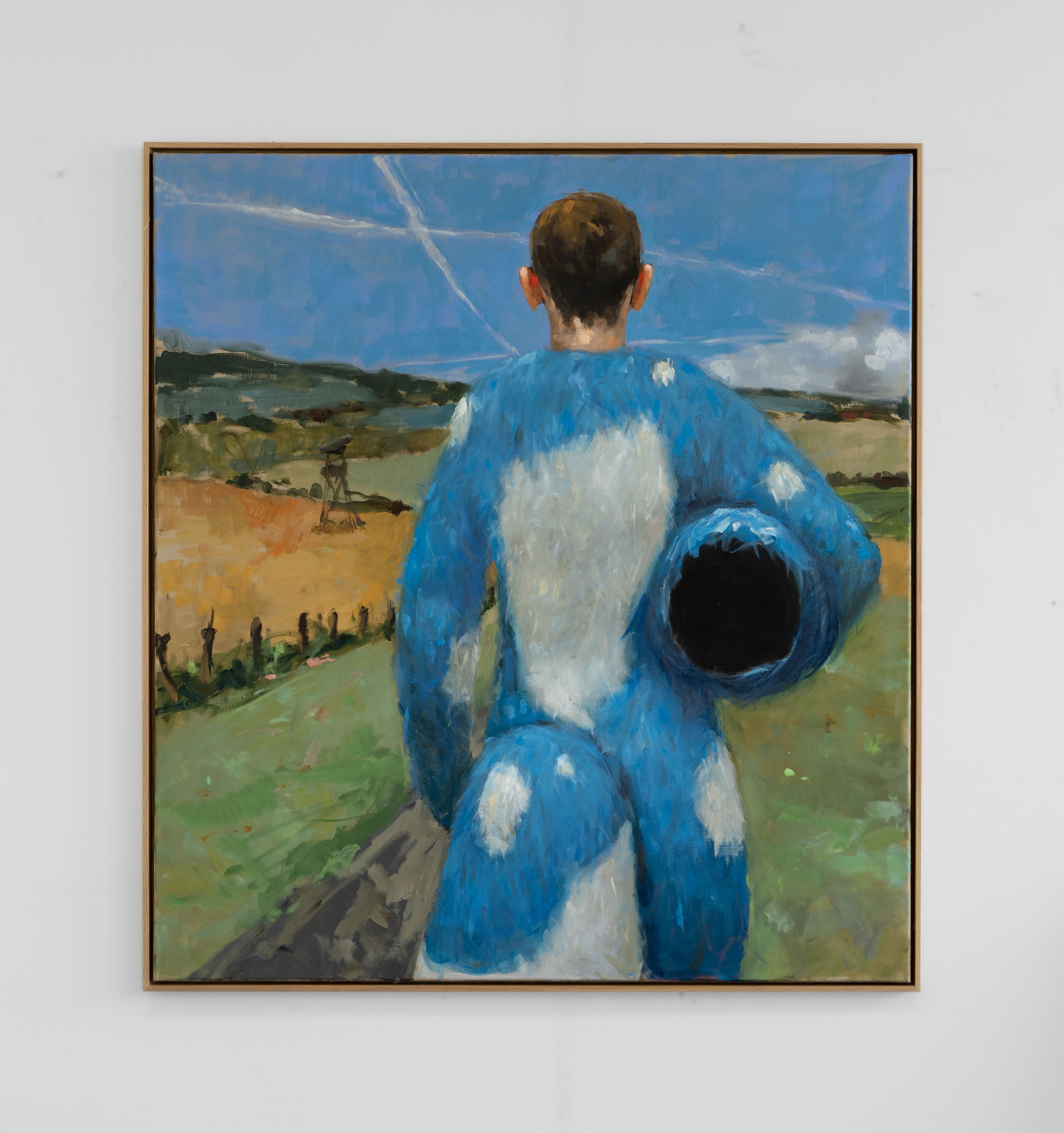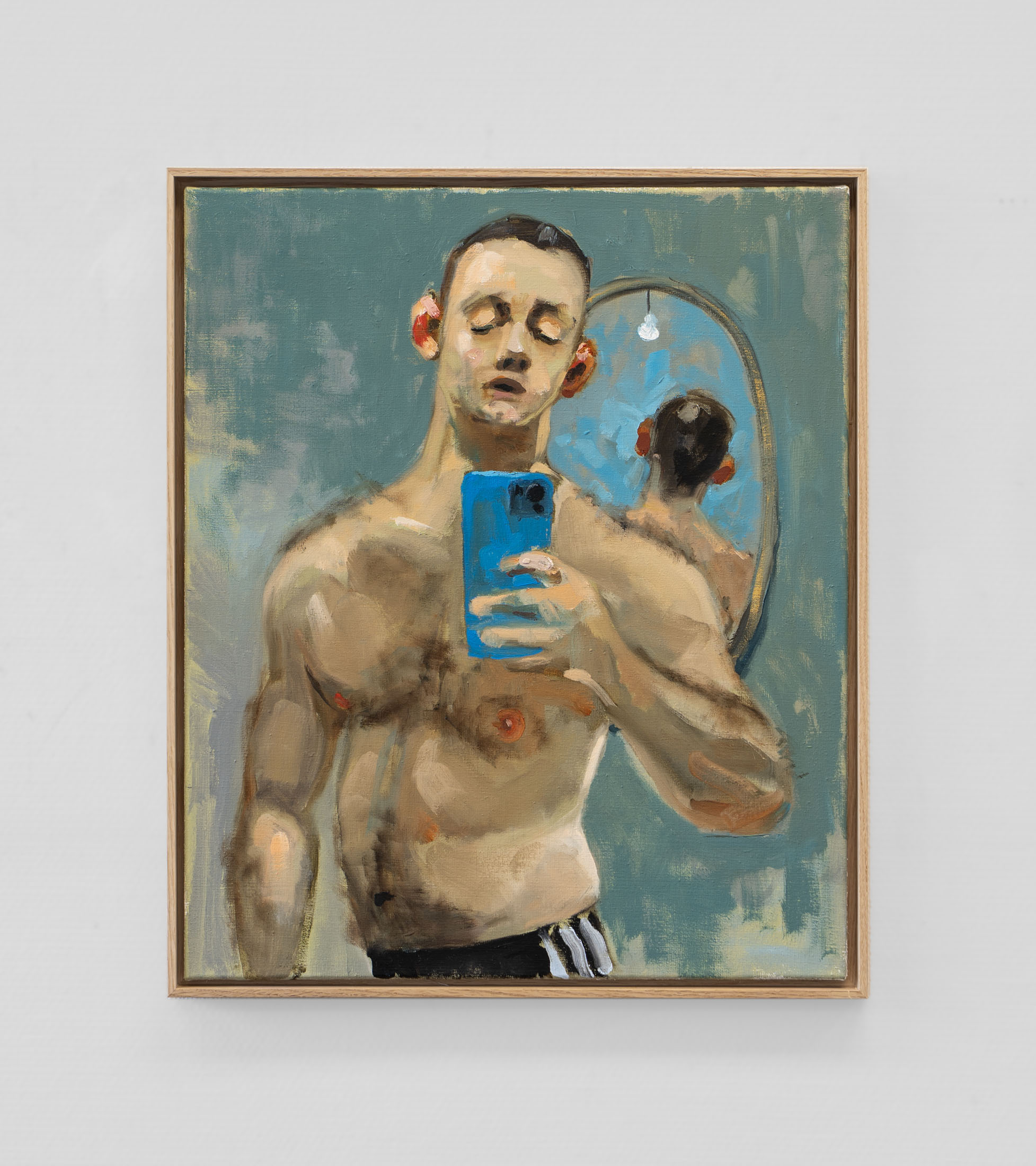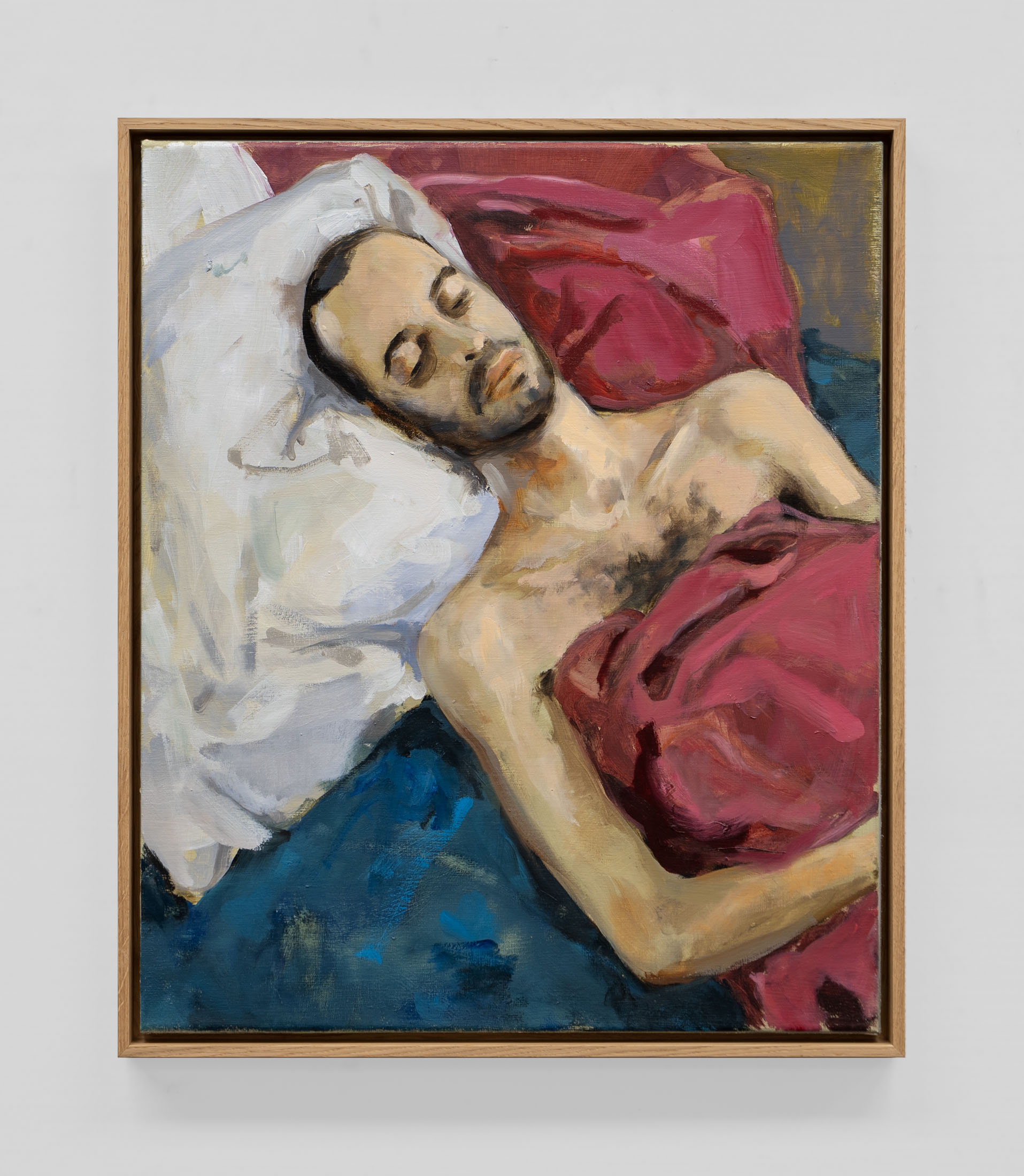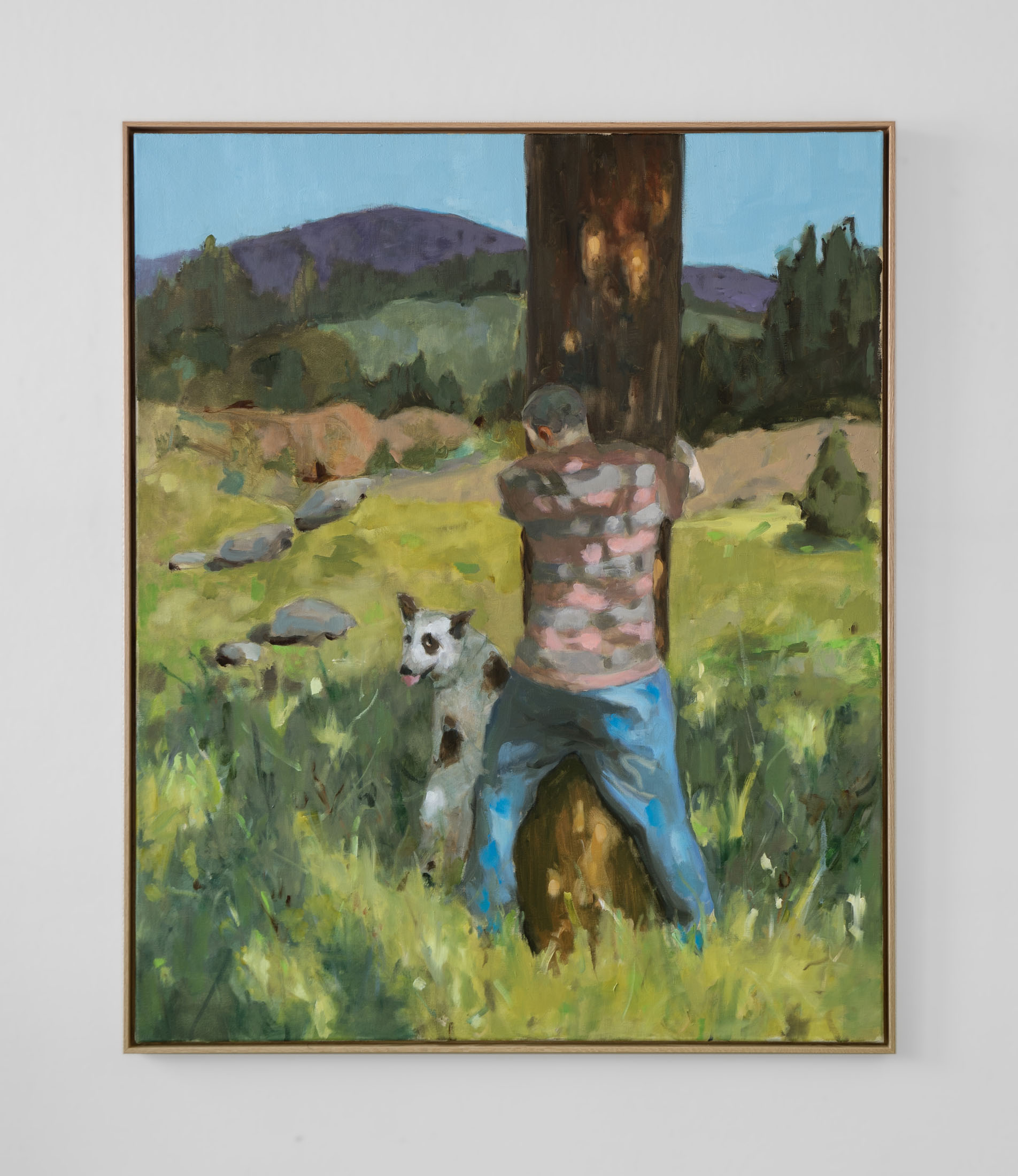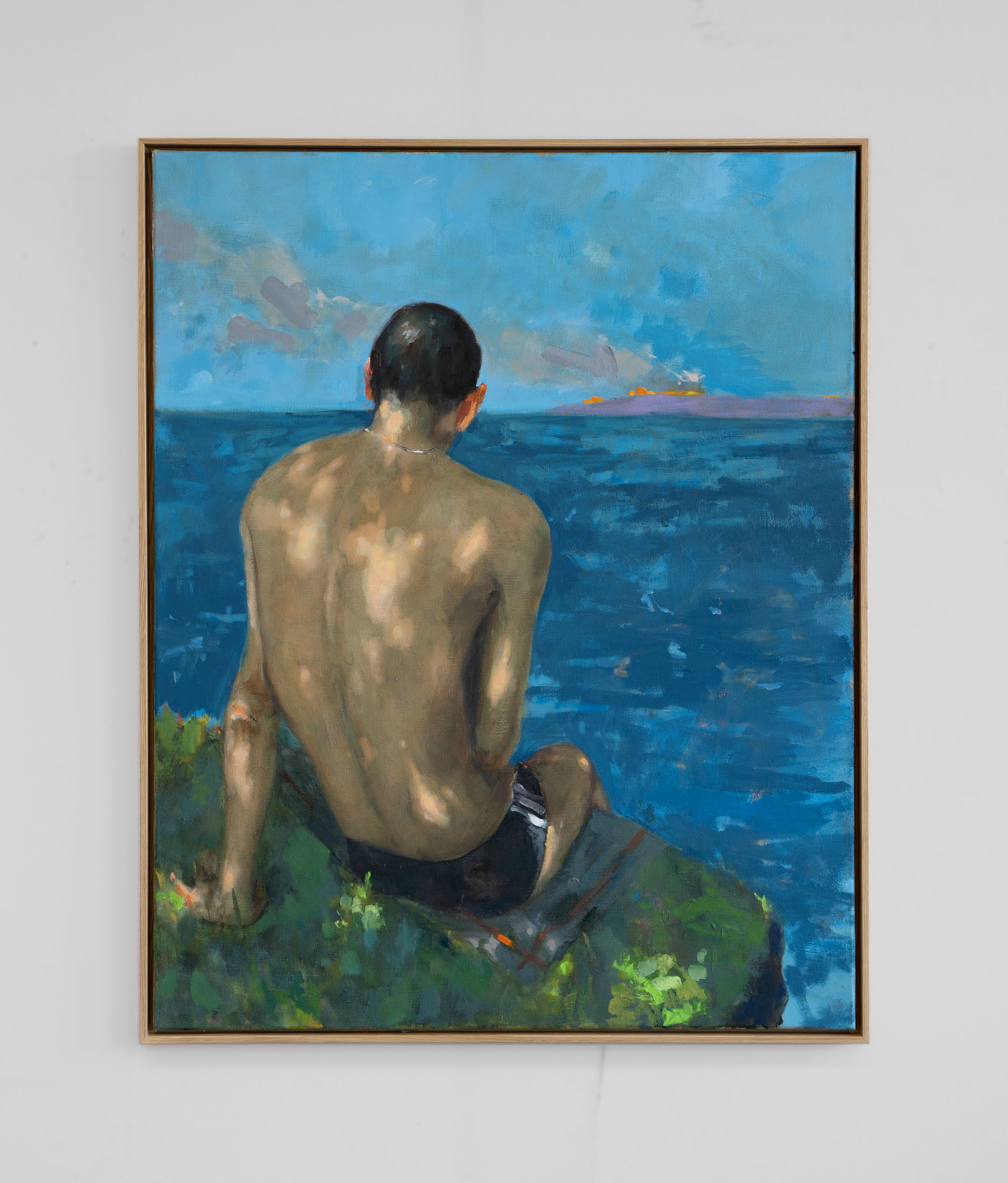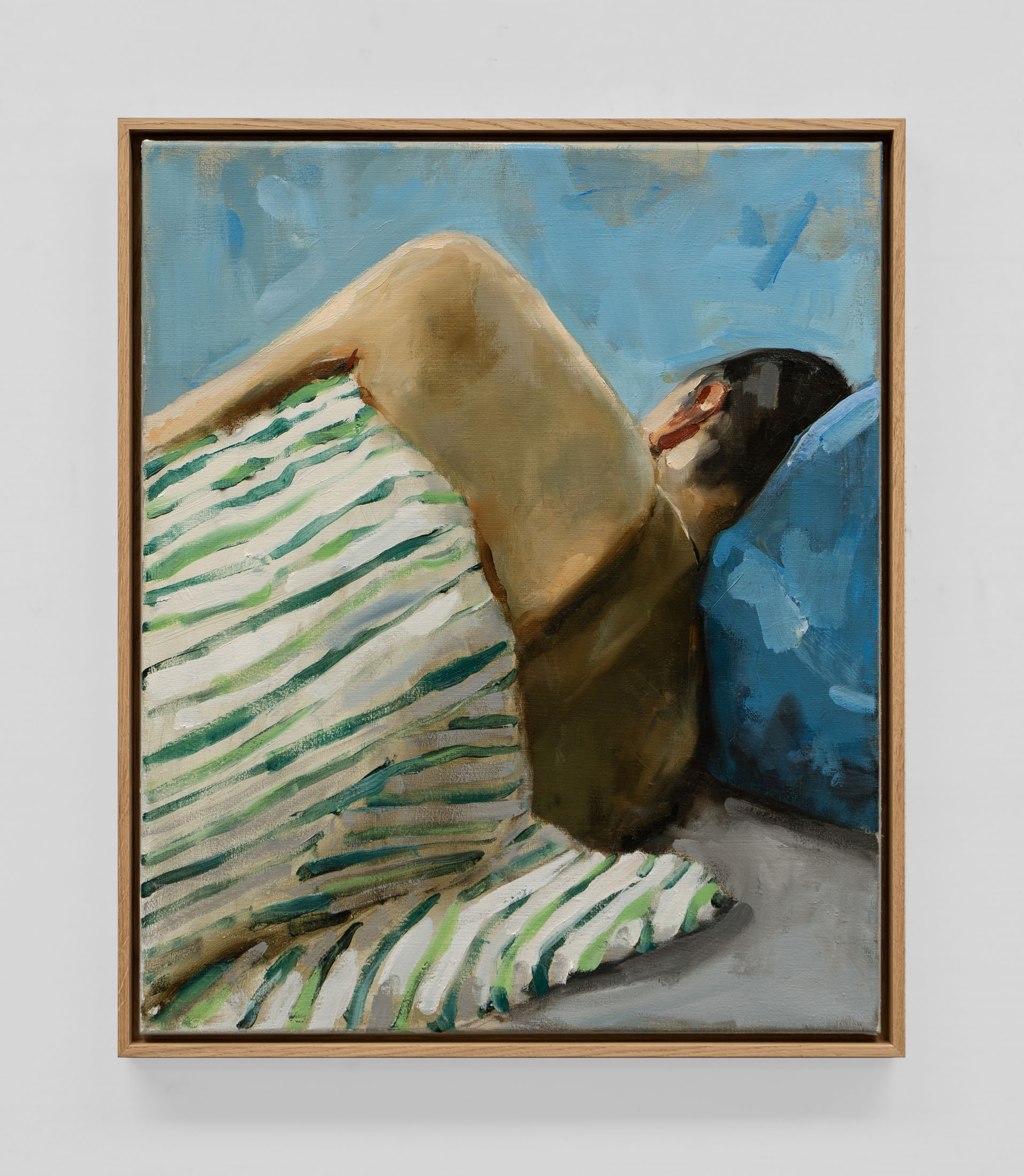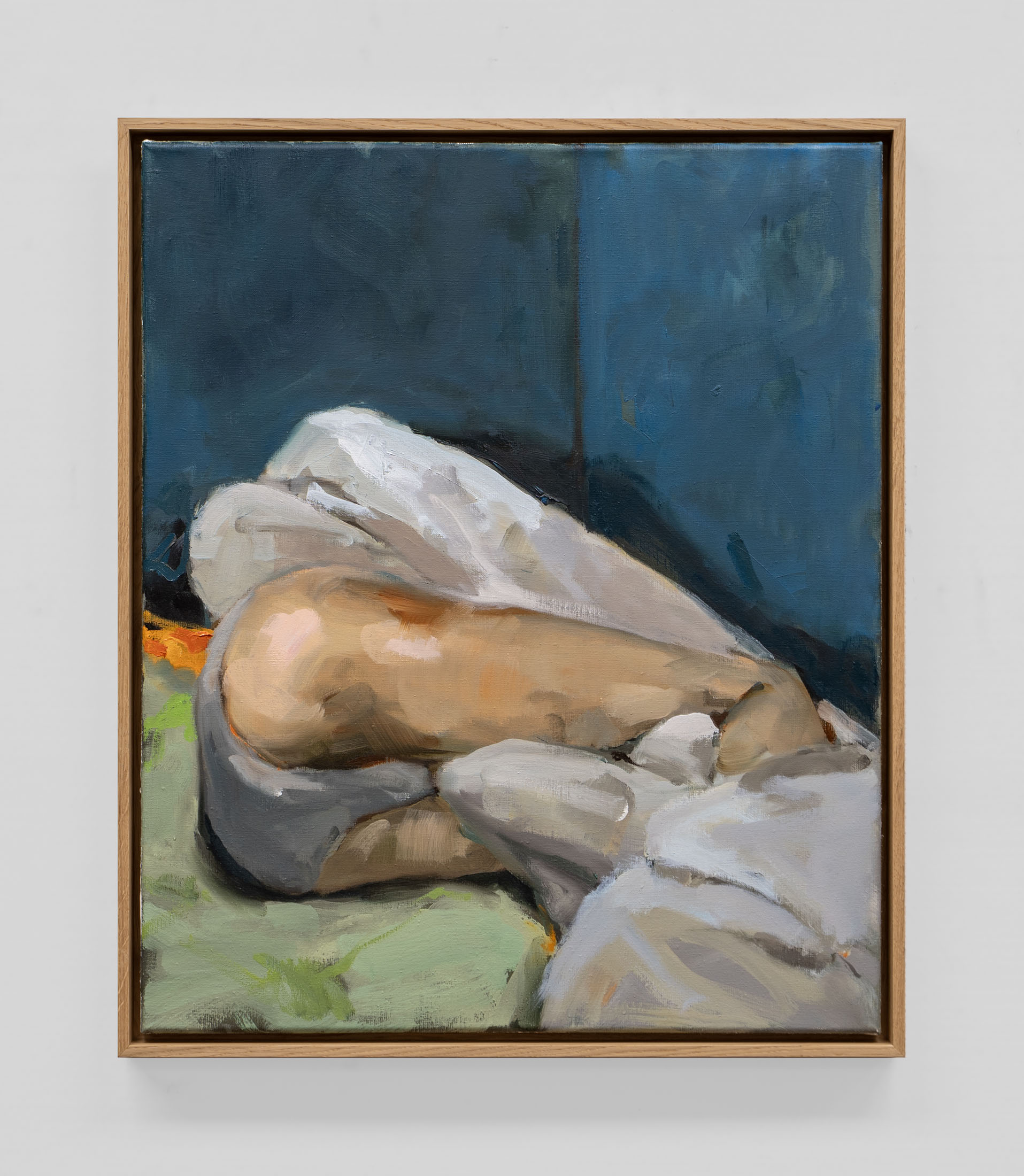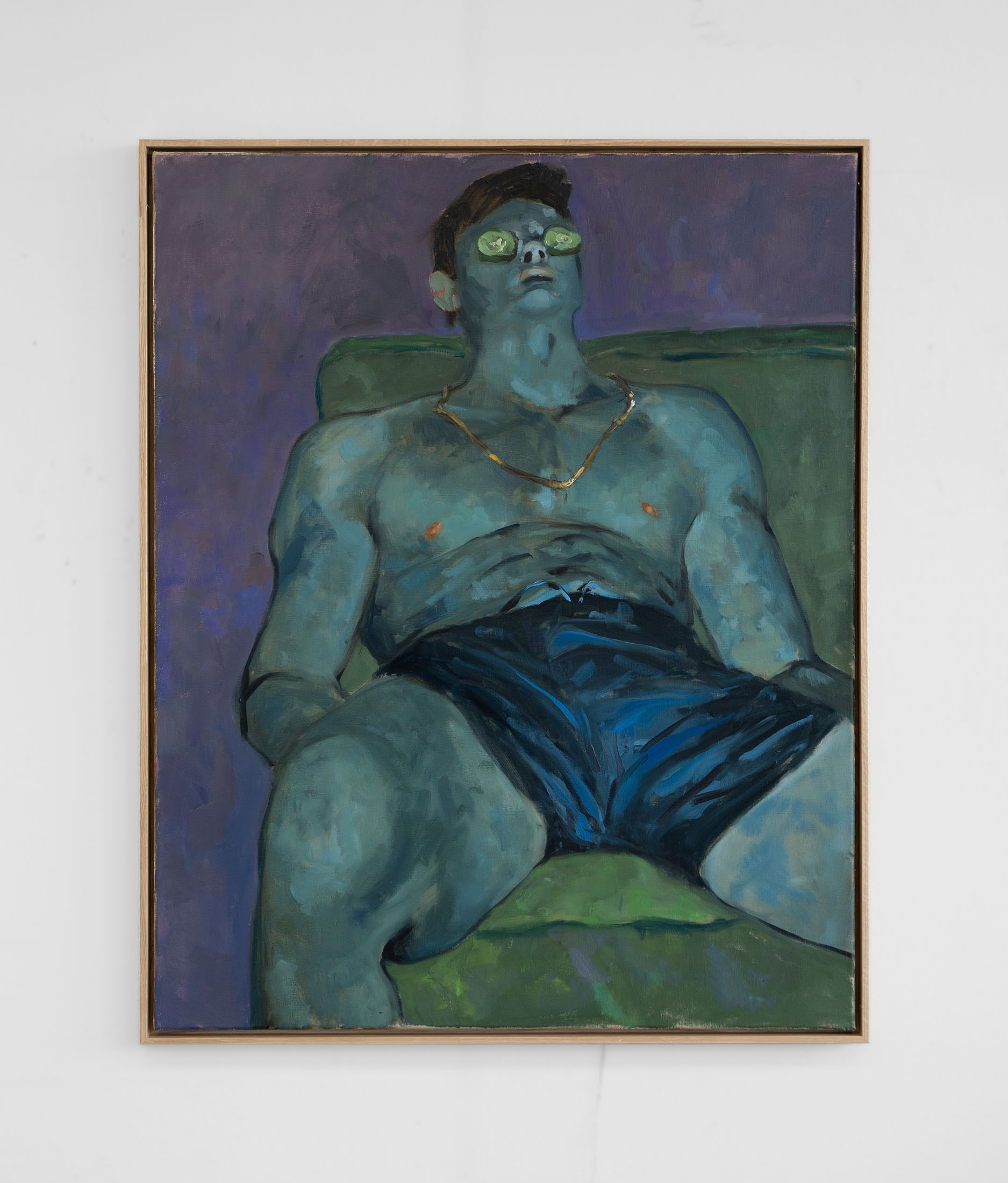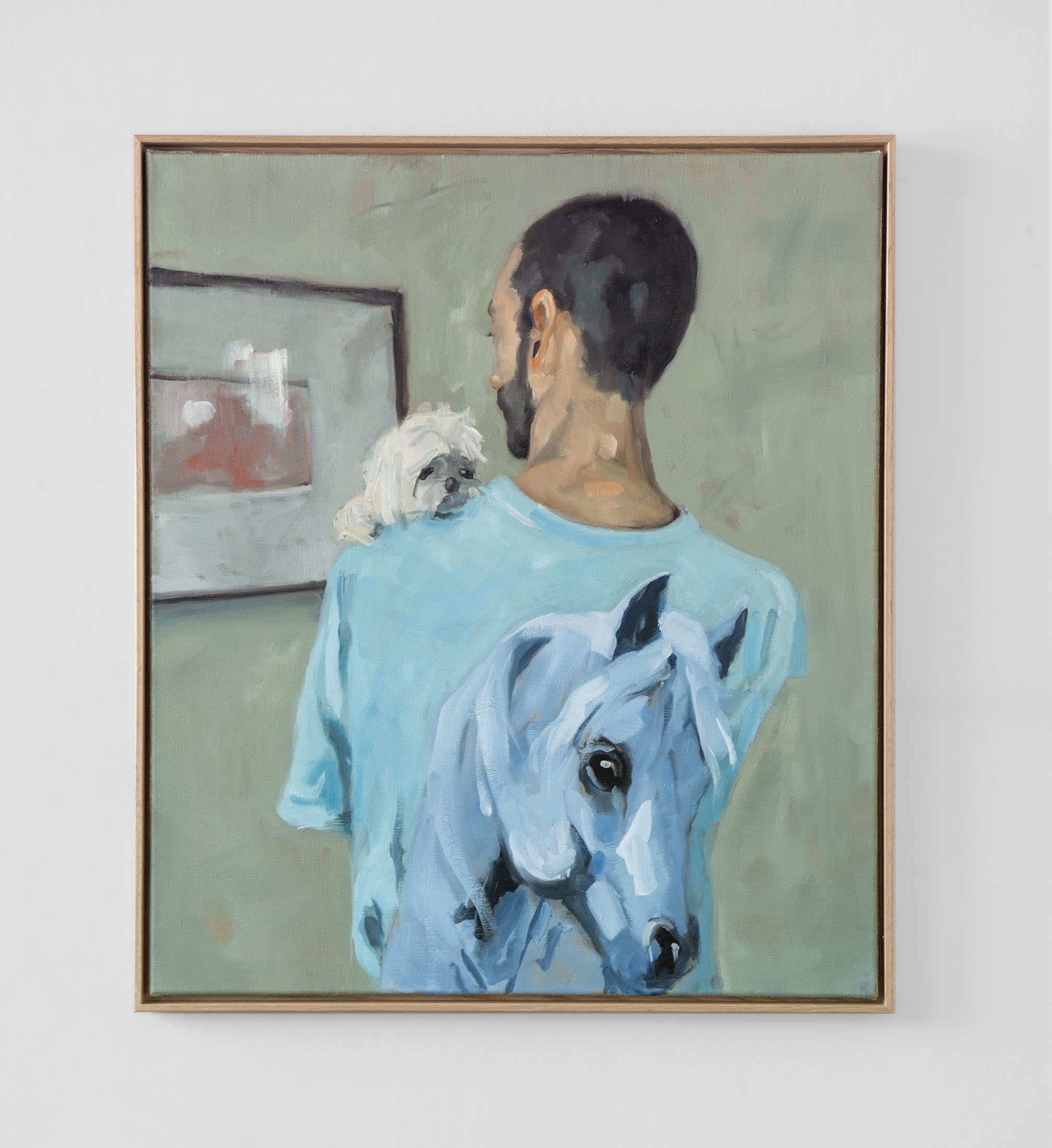
A black metal fan lies on his back in a grassy field. His face is painted fiercely in black and white. But he is in no way threatening. His long black hair spreads out into the flowery meadow. In his hand he limply holds a smoking cigarette. This fan, outfitted with metal spikes and blackened eyes, is strangely vulnerable. Endre Aalrust’s paintings are full of these lonely characters. Although he does not conceive of his work in discrete conceptual projects, certain themes reappear consistently across his paintings: single male figures, sometimes with animals, often turning away from the viewer, or revealing themselves only obliquely. If they face us, their faces are covered with mud masks, painted with makeup, or equipped – one might also say adorned – with a variety of accoutrements: cucumbers to depuff swollen eyes; a WhatsApp filter of dog ears and nose; bright reflective sunglasses; a bandage on a nose bruised from rhinoplasty. These elements distance the figures from us and from their immediate environments, amplifying the sense of loneliness that Aalrust cultivates in his choice of motifs, whether featuring people or not. A lone jonquil flops to the ground in a field of tulips. A single caravan is engulfed by snow – but it sports a satellite dish with a smiley-face, an attenuated means of connecting to the world, or keeping it at bay.
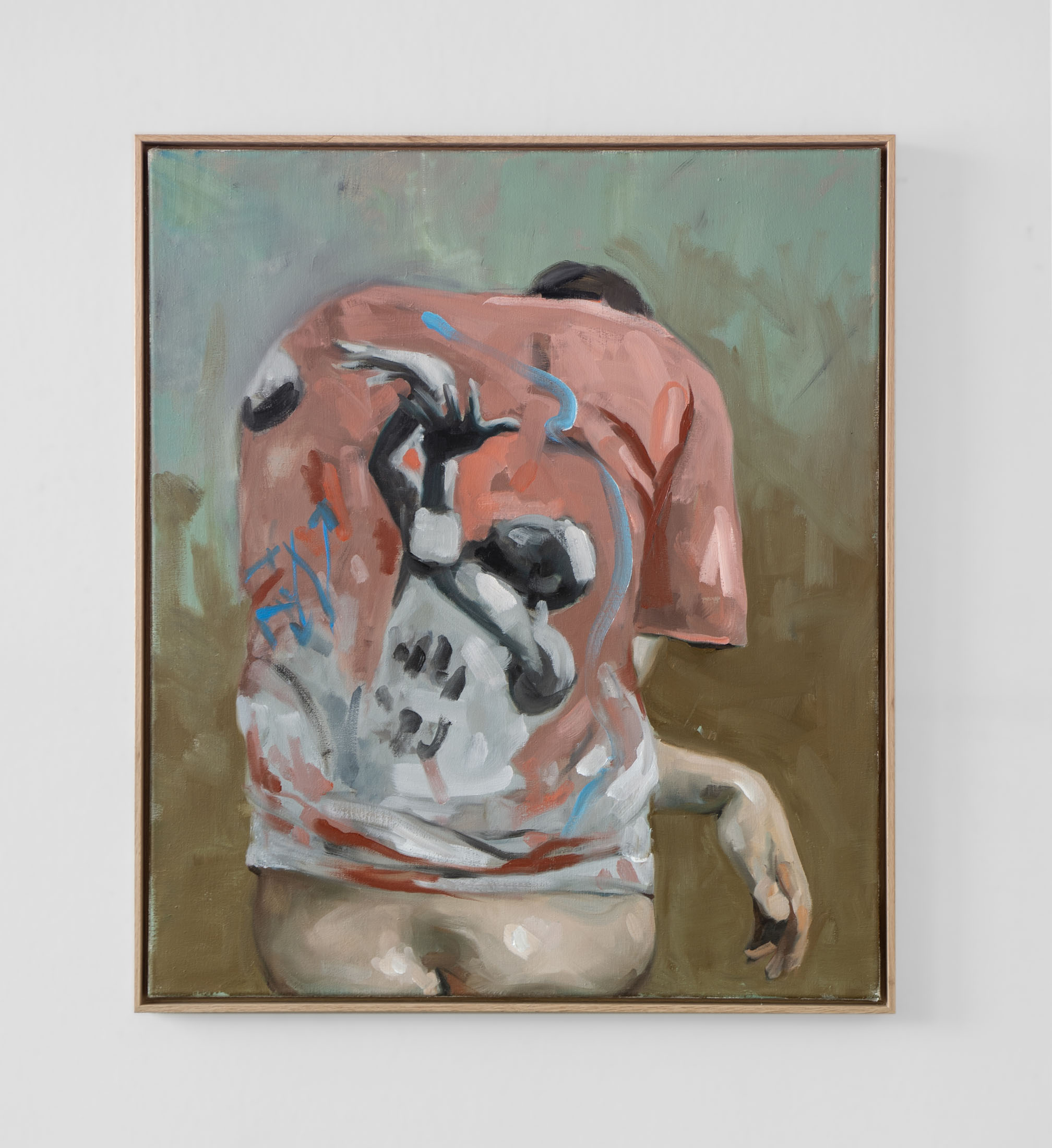
Simultaneously, these distancing elements also multiply surfaces for him to paint, which he does so generously and with gusto. Sunglasses become an additional sunset, the bandaged nose becomes a vehicle for adding violet and pink to the post-op visage. In defacing his protagonists, Aalrust ironically gives them added face-time. In other works, t-shirts similarly become paintings-in-paintings, an extra canvas to play with. The forlorn figure with a limp wrist and a bare bum in On the Edge has no pants, but a basketball fan’s large shirt, featuring Michael Jordan shooting hoops. The latter’s active hands stand in ironic contrast to the figure’s own drooping, passive – implicitly swish – fingers. Balls soaring through hoops.
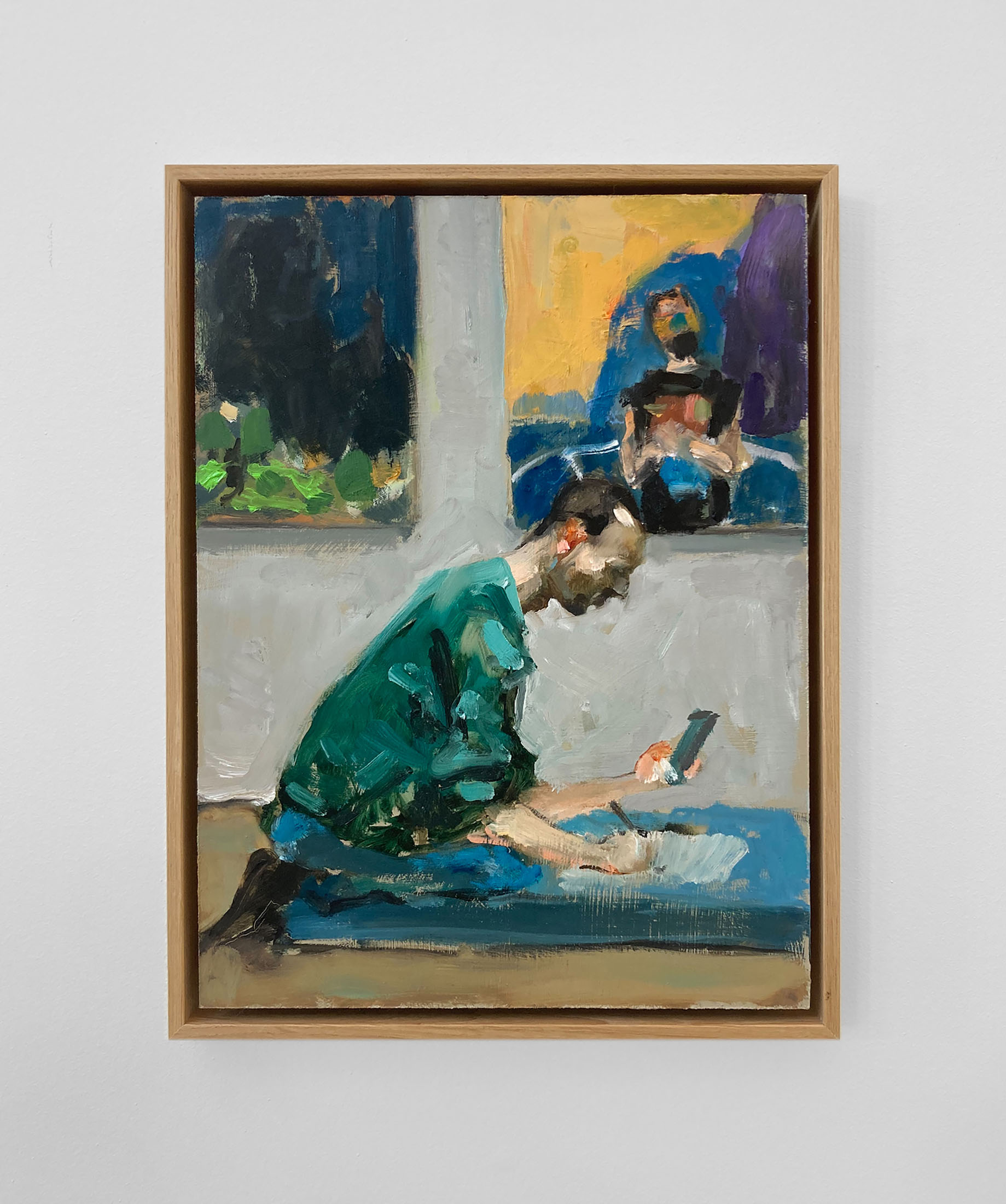
Might the artist be a “lonely fan” as well? He is certainly a fan of painting, evidently, as the proliferation of surfaces, of paintings-in-paintings, suggest. Juxtaposed against his wan and deflated cast of characters is the artist’s evident enjoyment of paint. His soft brushstrokes and deft deployment of colors draw us into the worlds inhabited by the lonely. Texture and pigment swirl around faces that resist our gaze. But if his protagonists want us to steer clear, the artist wants us to come close. In some works, he not only has us look at paintings together with his single men and their dogs but also invites us to check out their tattoos (even more “paintings”), or their reflections in the mirror (while taking a selfie: picture-making in a picture).
This clear enjoyment of the medium somehow ensures that however compromised or frustrated Aalrust’s figures may appear, they are never humiliated. Instead, his painting cultivates sympathy, empathy, and humor as a means of dealing with a contemporary world in meltdown: his figures navigate alienation with a kind of nonchalant ignorance, and the viewer joins in, finding some kind of small joy and even relief in strokes of paint on a surface. We might be a bit bashful about taking pleasure in painting, or in paintings of fey figures painting and preening their faces as a means of hiding from the world by making a spectacle of themselves. „Near, far, wherever you are“ blares the Titanic soundtrack.
Alienation and exclusion become motors for (queer) invention. The artist, who frequently mobilizes jokes and one-liners as vehicles for painting, might be a bit embarrassed as well. But here he has done an about-face, or 180. In Aalrust’s pictures of avoidant or averted glances, painting bursts happily through the proverbial back door.
—Sasha Rossman