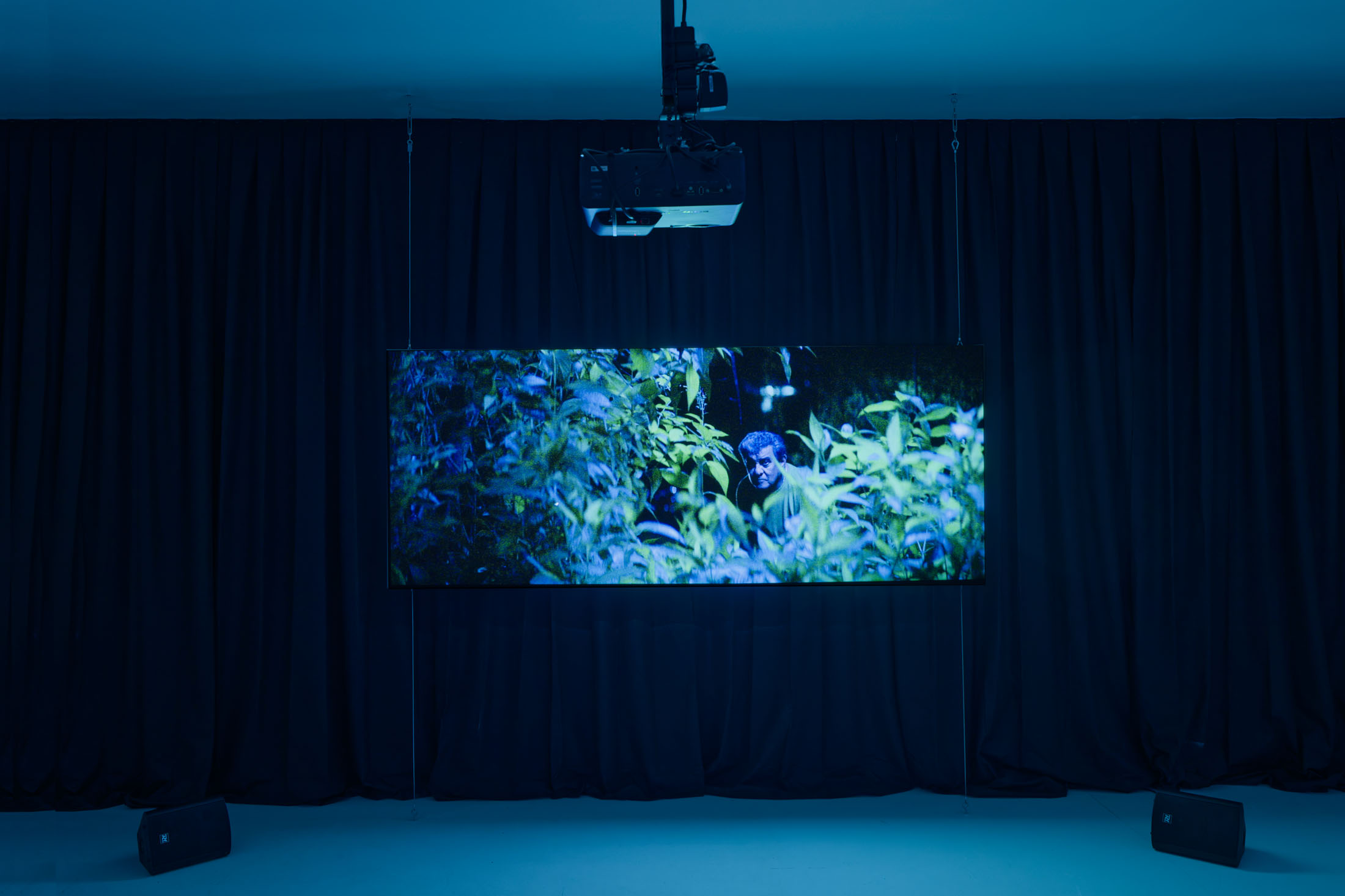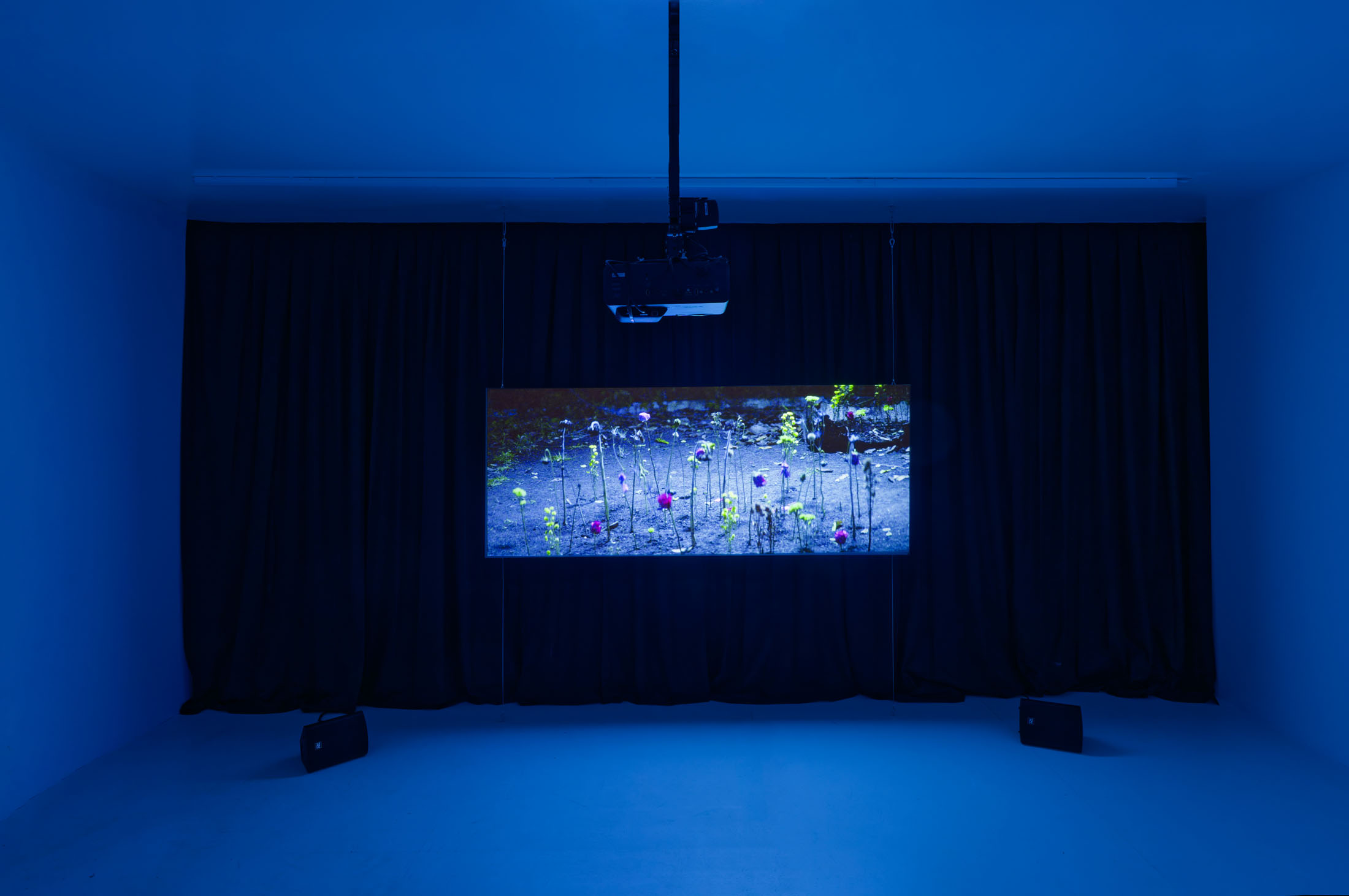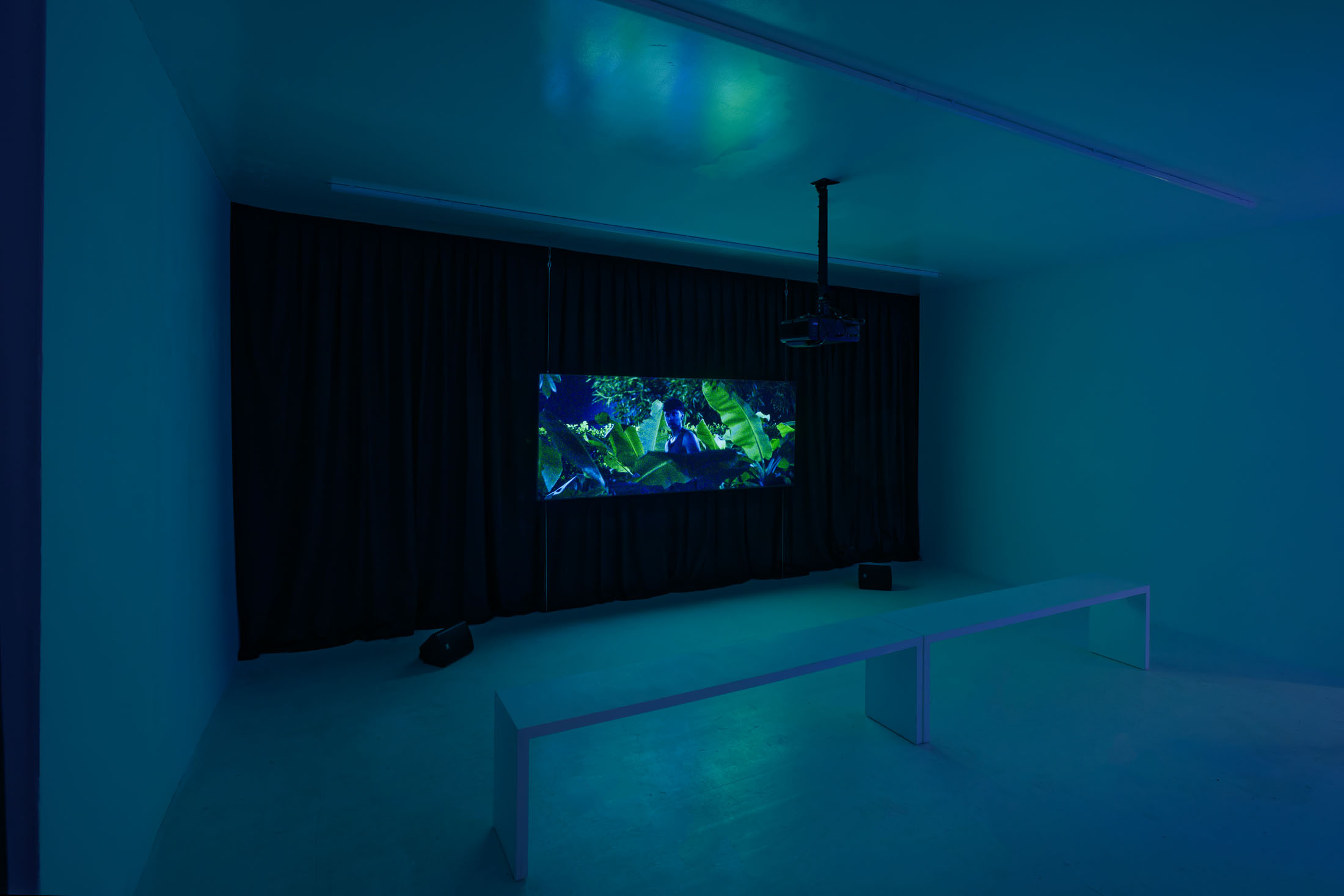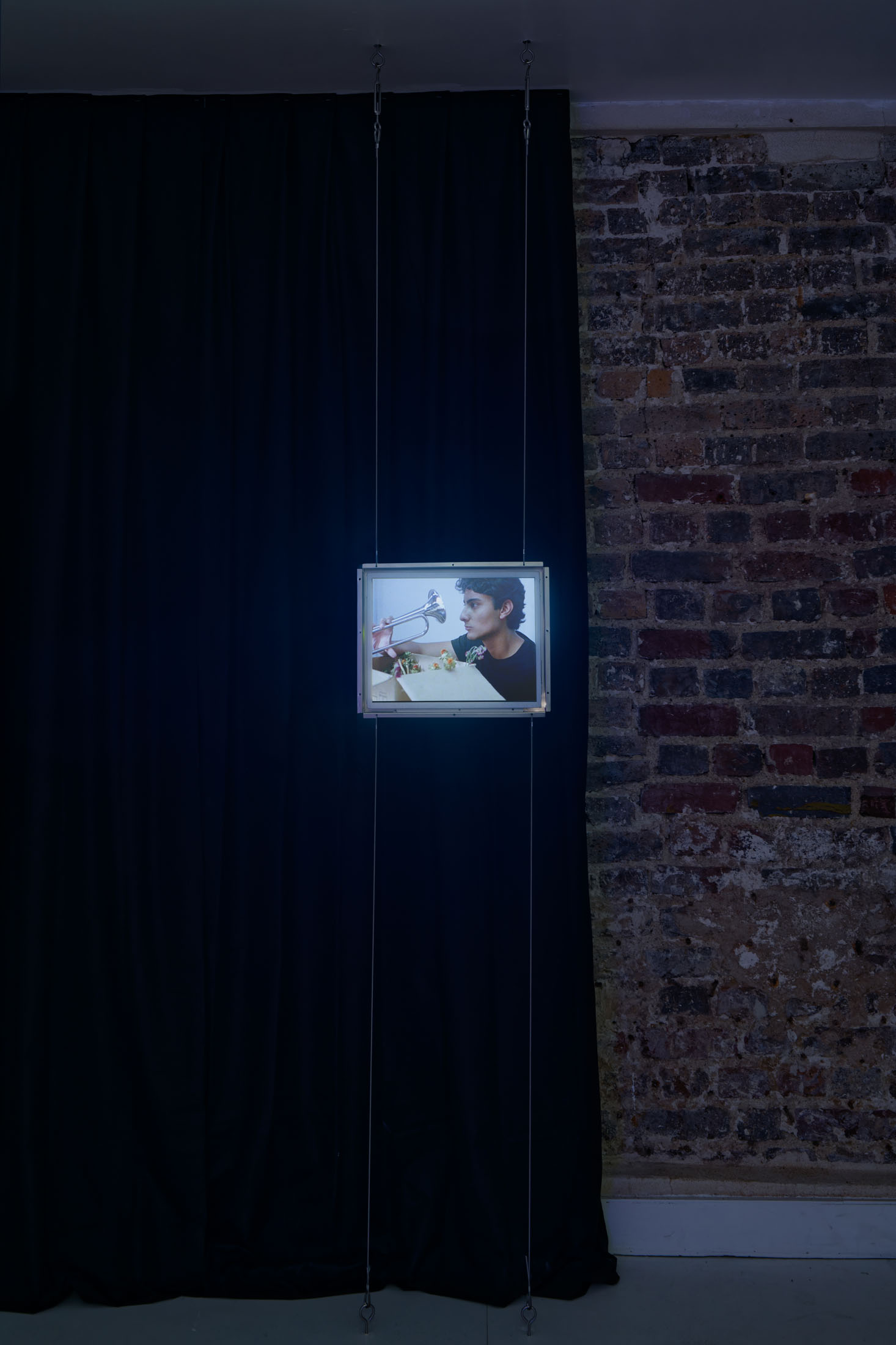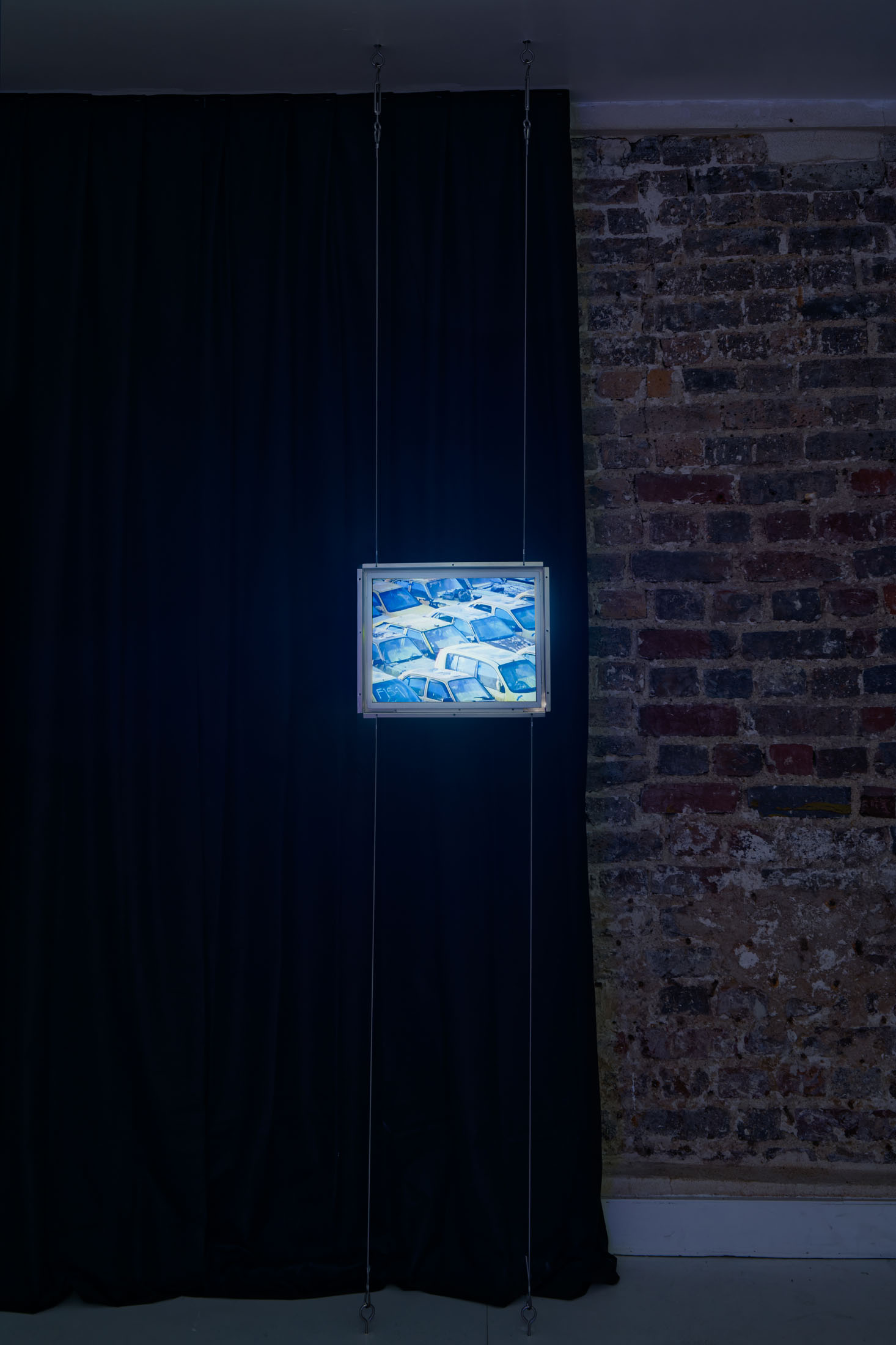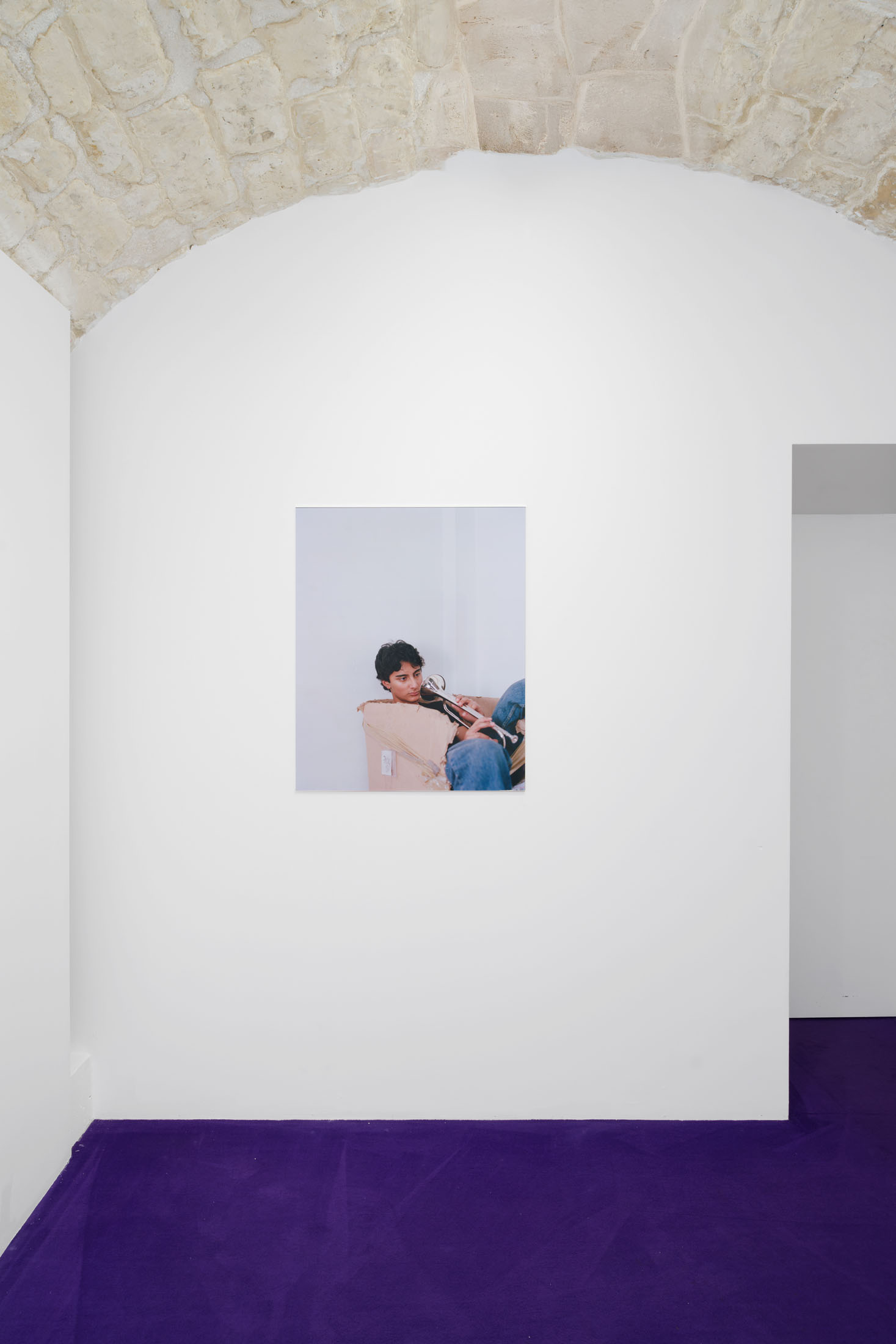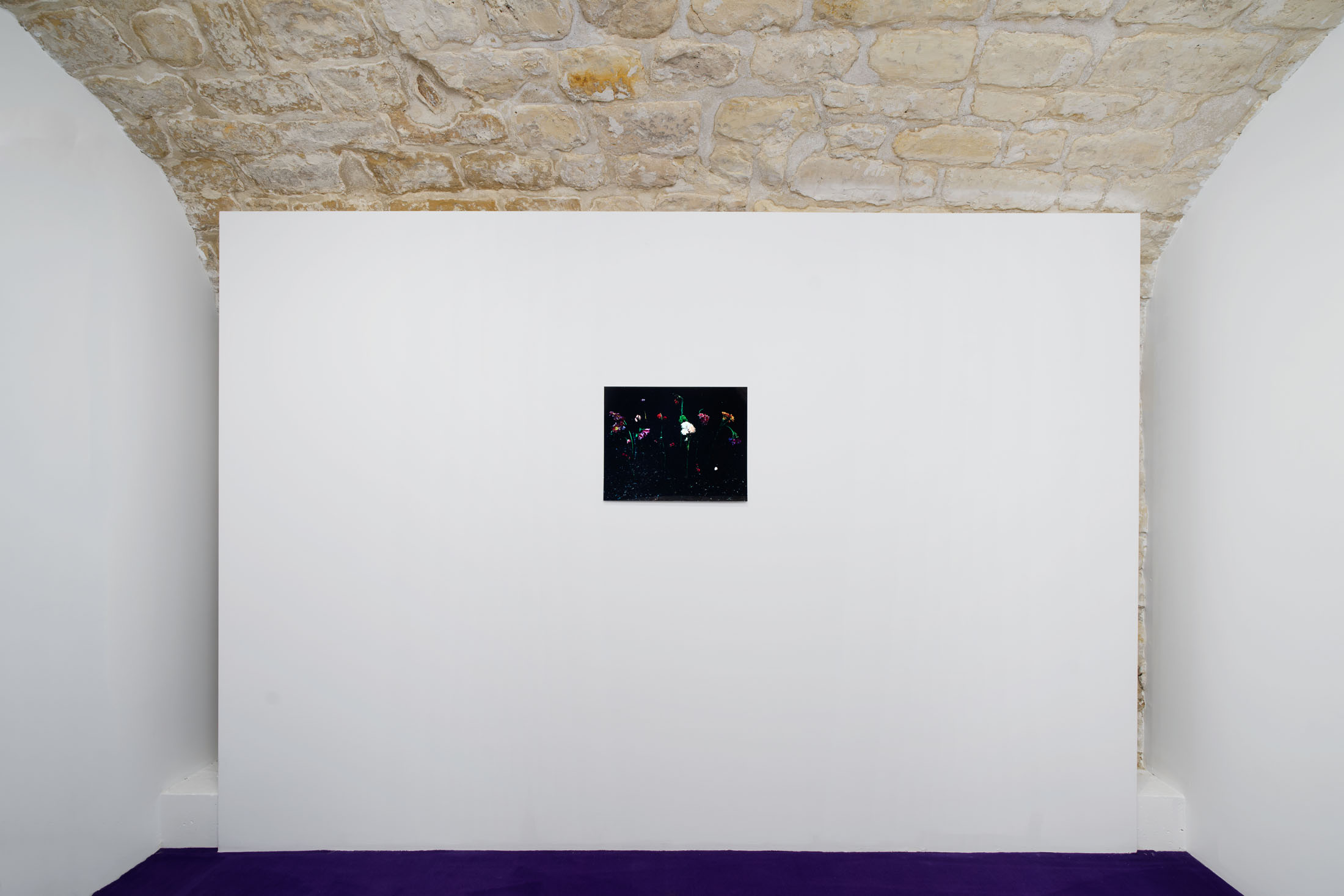
In a saturated blue garden in Tolima, so small it sometimes fails to appear on maps, mirrors and glimmering shards catch the light. Everything turns. A young man and an old man face one another within an almost synthetic landscape. Their movement never advances forward: it coils back onto itself.
Andrés Barón films time-images. In his work, cinema never unfolds linearly; it circles, diverges, folds back upon itself. Characters, objects, landscapes, sounds and voices are caught within an unstable temporal matter where past, present and imagination coexist. This is precisely what Gilles Deleuze described as the crystal-image (image-cristal): an image in which the actual and the virtual become indistinguishable, where one can no longer tell what belongs to memory, immediate perception or mental projection. Like a mineral crystal reflecting light from within, Barón’s films reflect time from their own inner depth.
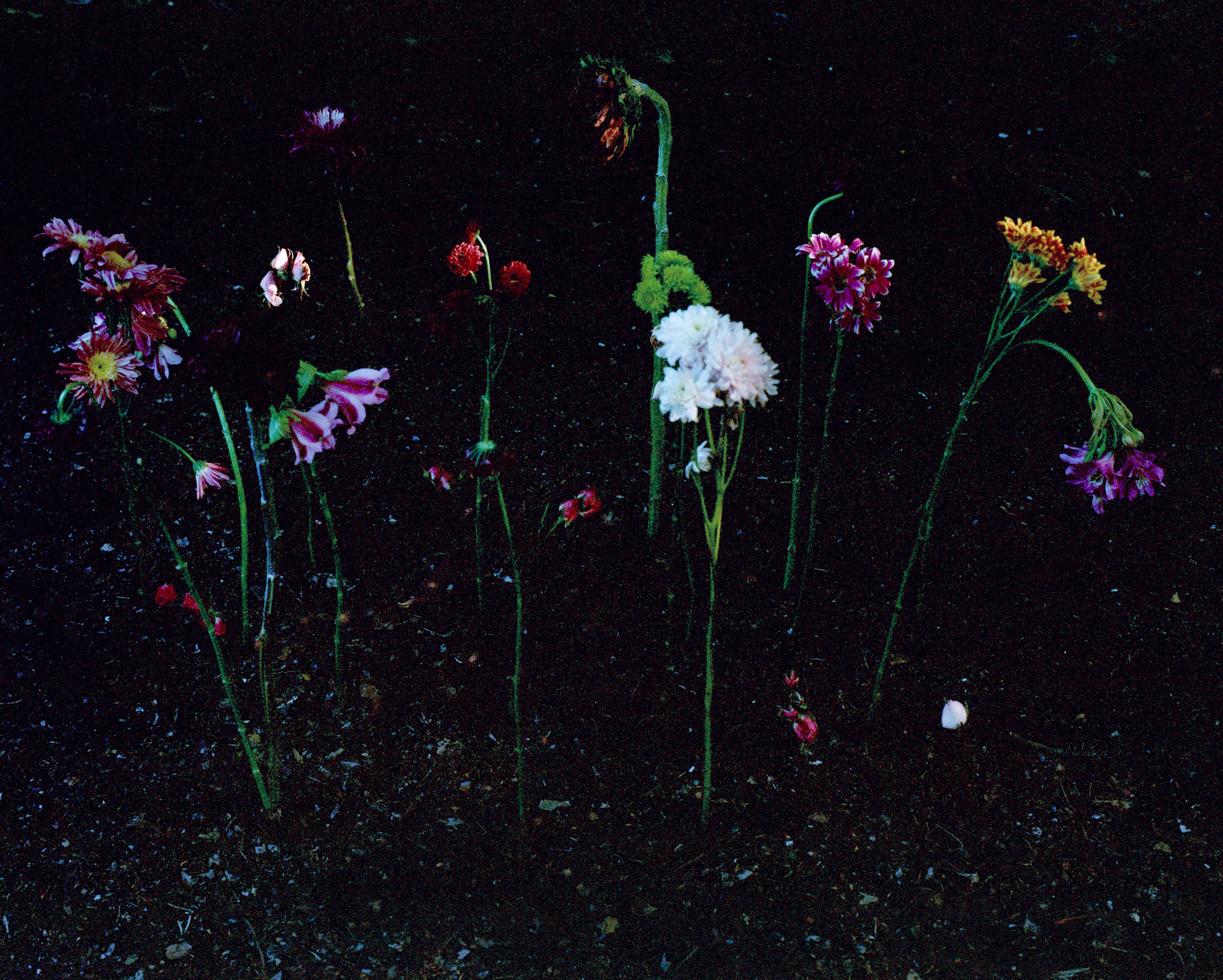
El ruido metálico de la luna does not reconstruct a memory, but rather an inner geography, an unlocatable elsewhere, faithful to the logic of Andrés Barón’s films, which resist all stable forms of identification. The work plunges into a layer of the past where several regions of time coexist: the grandfather’s memory, the recollection of the garden, that of a rural Tolima, and the gaze of the grandson filming, perhaps trying to understand from which level he himself is looking. Here, the camera does not locate; it suspends. Within this suspension, doubled figures emerge: the grandfather and the young man revolve around one another in orbit; they seek each other, elude each other, hunt each other down. Yet they never follow one another chronologically. They appear instead as two points of the present, two simultaneous versions of the same being. The circle they trace within the garden thus becomes a temporal short circuit, a loop in which identity dissolves into doubling, reincarnation, or self-projection. One shoots at his double, triggering a cascade of mirrors and echoes.
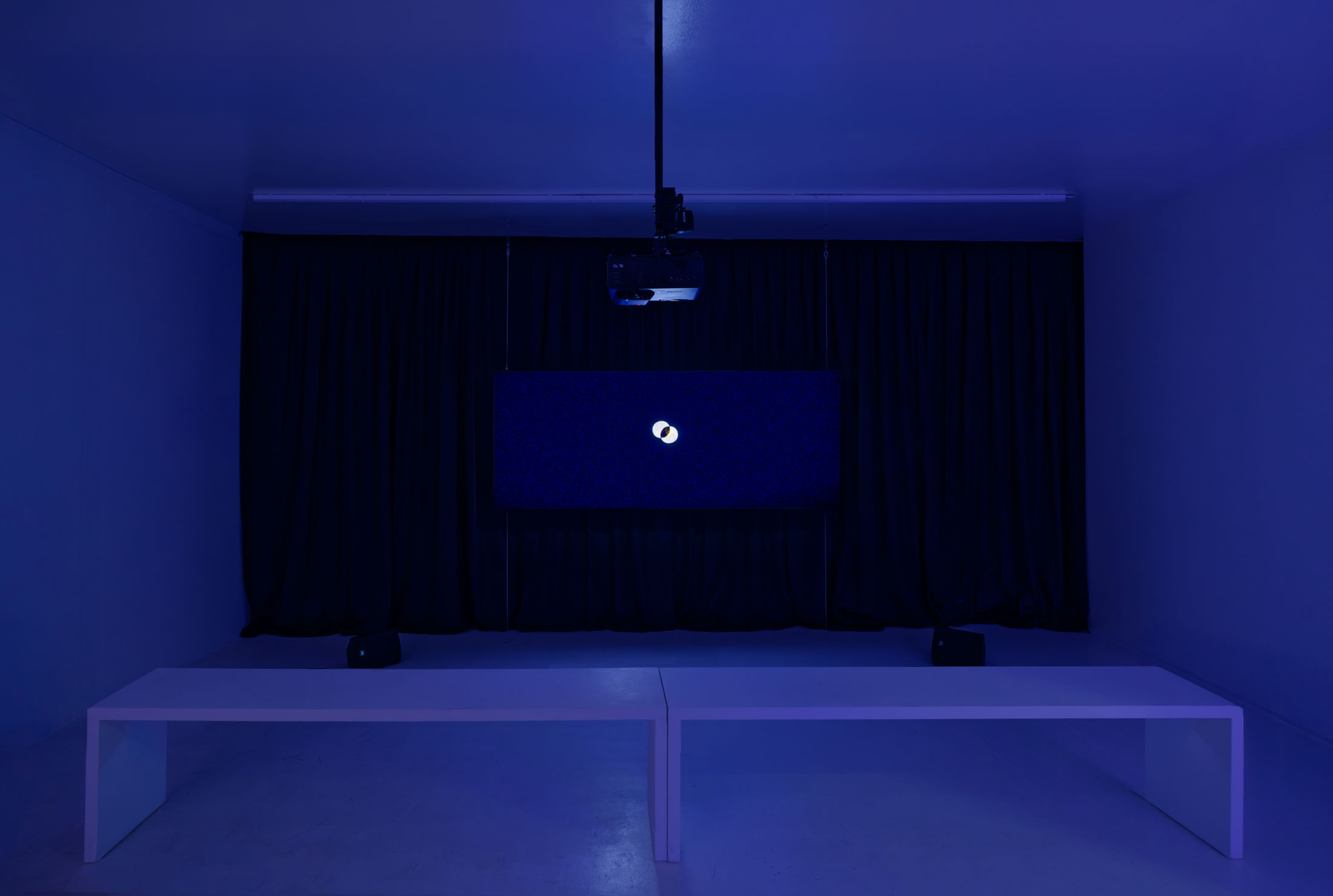
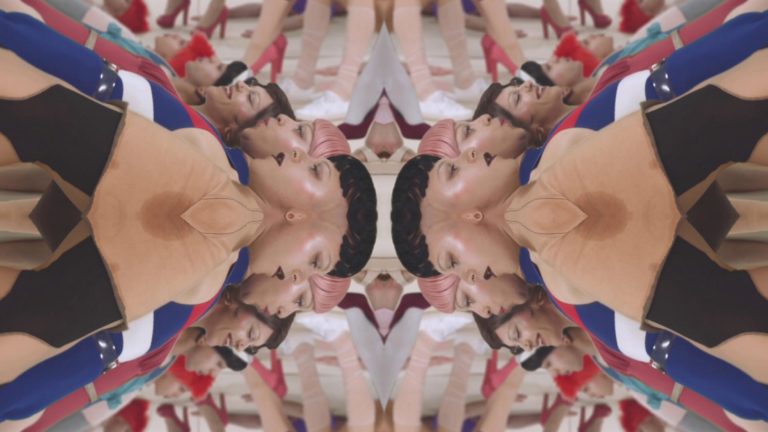
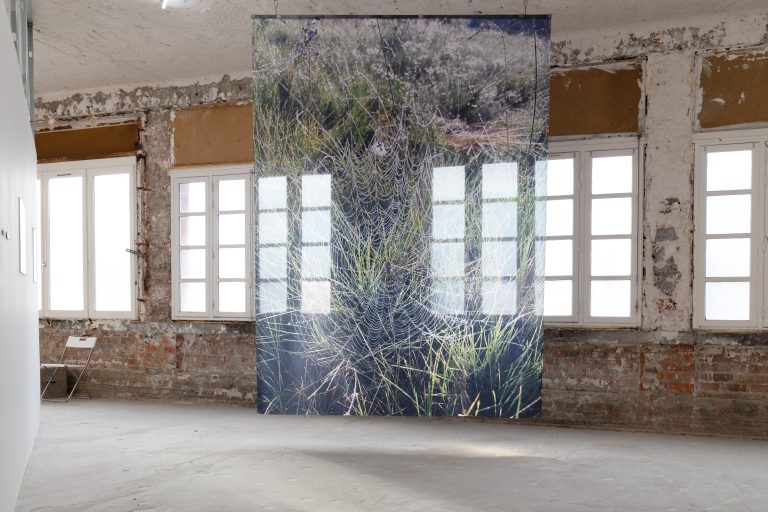
Within this contraction of time, two moons merge, like two incompatible presents gathered within the same sky. Barón’s entire cinematic language operates according to this mirrored structure. The characters are doubles of the artist, but so are the objects: mirrors, screens, reflections, printed or manipulated landscapes become surfaces upon which reality and its projection constantly exchange places. Distinct yet indiscernible, the actual and the virtual endlessly circulate through one another.
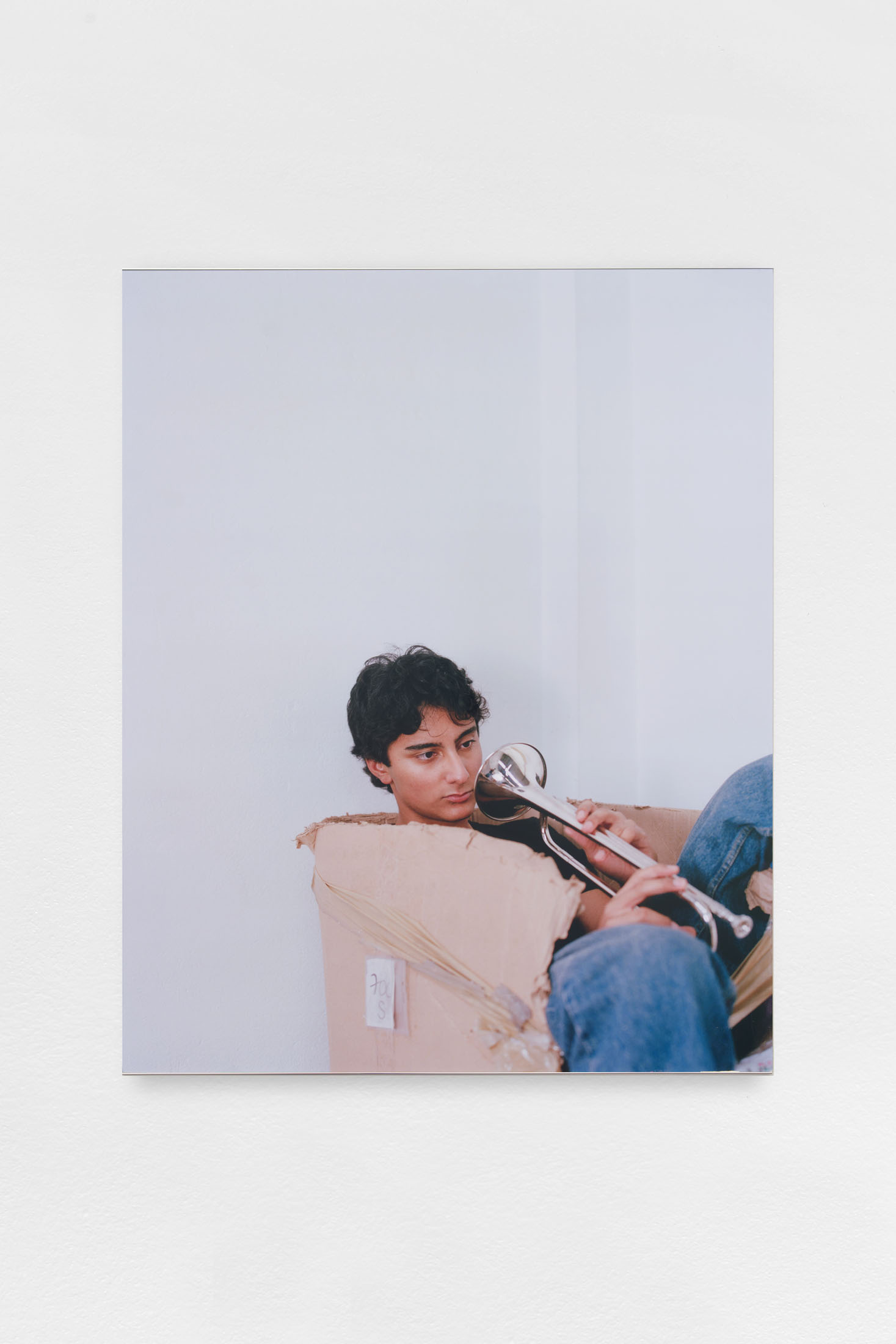
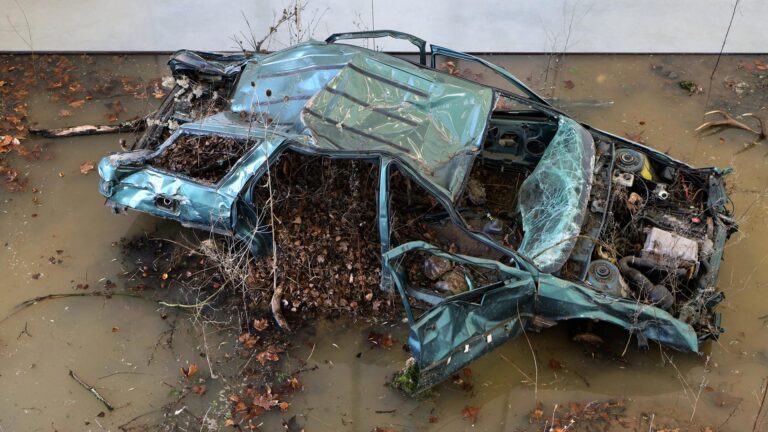
The second film, you, a circle, functions as the virtual image of the first, its mineral extraction. What the blue garden held dissolved within its humid density rises here to the surface in a stripped-down, almost clinical form. A negative space in which only residues remain: gestures, breaths, echoes and reflections. Where the first film belonged to a vast organic circuit, at once vegetal, nocturnal and memorial, the second constructs a tighter system, a mental, mineral and minimal dispositif. An inner world struck by flashes: crystalline images of a decomposing world, fragmented visions of taxi graveyards, apparitions trapped within a corner of the subconscious or inside a cardboard box. Time no longer flows here; it refracts.
The two works communicate underground: certain sounds migrate from one film to another, certain frequencies persist like acoustic ghosts.
Sound constitutes the true architecture of these films. The corneta, a military and funerary instrument that normally produces only a single note, becomes, in Barón’s hands, a distorted and complex sonic material. Serving as sutures between the two films, the grandfather’s breaths merge with the improvisations of trumpeter Toshinori Kondo, while gunshots trigger digitally transformed piano notes. Detonations. One shot per note, one note per shot. Each carries a musical vibration, like a subliminal communication between two dimensions.
Here, perhaps, emerges a crystal-sound: an acoustic situation in which the ear no longer knows whether it is hearing the world itself or what the mind makes of it.
Andrés Barón composes his films as sensitive systems rather than narratives. A song coming to an end, a running dog, a reflection in a mirror, a flickering light: elementary signs capable of opening parallel dimensions.
His films thus appear as portals. Passages between media, between states of time, between memory and dream. The blue garden of Tolima, the Virgin beneath LED lights, air bags containing music, abandoned taxis, exploding mirrors: so many artefacts suspended within a floating temporality. Reality is always in the process of doubling itself. And within this decomposition of the world, something nonetheless persists: a fragile aura, a breath, a vibration that continues to circulate between bodies, images and the dead. What remains once everything has refracted.
—
Text by | Tiffany Dornoy Rezaei